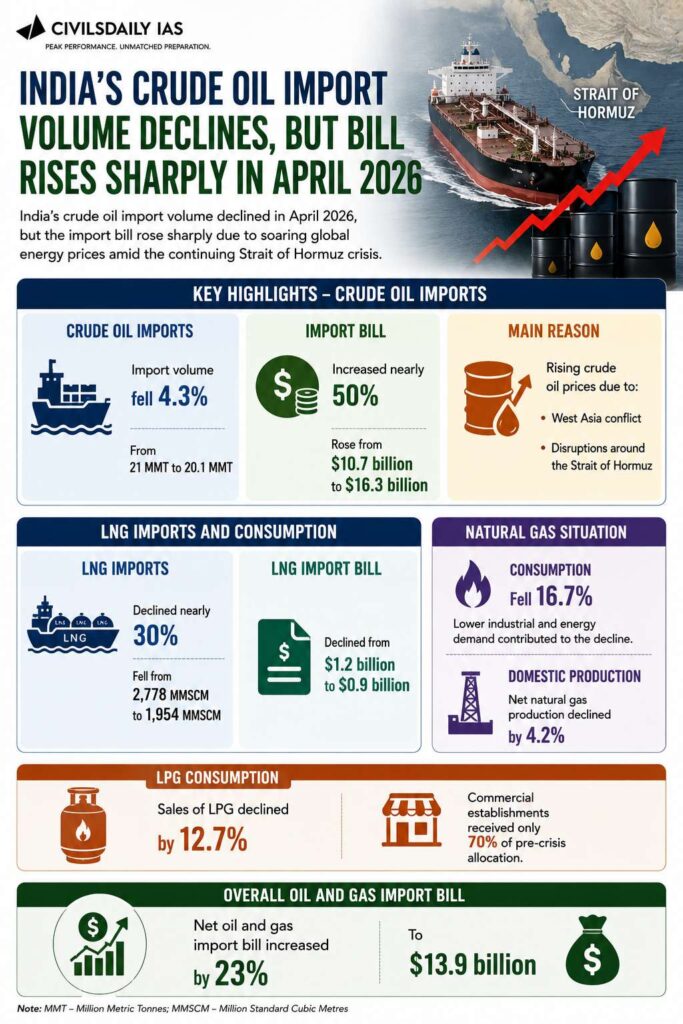
India’s crude oil import volume declined in April 2026, but the import bill rose sharply due to soaring global energy prices amid the continuing Strait of Hormuz crisis.
Key Highlights
Crude Oil Imports
Import volume:
Fell 4.3%
From 21 MMT to 20.1 MMT
Import Bill
Increased nearly 50%
Rose from:
$10.7 billion to $16.3 billion
Main Reason
Rising crude oil prices due to:
West Asia conflict
Disruptions around the Strait of Hormuz
LNG Imports and Consumption
LNG Imports
Declined nearly 30%
Fell from: 2,778 MMSCM to 1,954 MMSCM
LNG Import Bill
Declined from $1.2 billion to $0.9 billion
Natural Gas Situation
Consumption
Fell 16.7%
Lower industrial and energy demand contributed to the decline.
Domestic Production
Net natural gas production declined:
By 4.2%
LPG Consumption
Sales of LPG declined:
By 12.7%
Commercial establishments received only 70% of pre-crisis allocation.
Overall Oil and Gas Import Bill
Net oil and gas import bill increased:
By 23%
To $13.9 billion
About PPAC
Petroleum Planning and Analysis Cell
Attached office of the Ministry of Petroleum and Natural Gas.
Provides data and analysis on India’s petroleum sector.
[2020] The term ‘West Texas Intermediate’, sometimes found in the news, refers to a grade of:
India’s long-term energy security debate has renewed focus on thorium-based nuclear power as the country seeks reliable clean energy to meet its net-zero target by 2070. The issue gains significance because India possesses nearly 21% of global thorium reserves. At the same time, commissioning of the 500 MW Prototype Fast Breeder Reactor (PFBR) at Kalpakkam marks a major step toward operationalising the third stage of India’s nuclear programme.
How Does Thorium Fit into India’s Long-Term Energy Security Strategy?
Thorium Abundance: India possesses nearly 21% of global thorium reserves, largely concentrated in monazite sands of Kerala, Andhra Pradesh, Odisha, and Tamil Nadu.
Energy Security: Reduces dependence on imported uranium and fossil fuels, strengthening strategic autonomy in electricity generation.
Baseload Power: Supports continuous electricity generation unlike intermittent renewable sources such as solar and wind.
Climate Commitments: Facilitates low-carbon electricity generation essential for achieving India’s net-zero target by 2070.
Import Reduction: Limits exposure to volatile global uranium and hydrocarbon markets.
How Does India’s Three-Stage Nuclear Programme Function?
Stage-I (PHWRs): Uses natural uranium in Pressurised Heavy Water Reactors (PHWRs) to generate electricity and produce plutonium.
Stage-II (Fast Breeder Reactors): Uses plutonium in Fast Breeder Reactors (FBRs) to generate more fissile material than consumed.
Stage-III (Thorium Reactors): Converts thorium into Uranium-233 (U-233) for sustained long-term nuclear power generation.
Why Has India Traditionally Relied on a Three-Stage Nuclear Programme?
Limited Uranium Availability: India possesses low reserves of high-grade uranium, constraining large-scale expansion of conventional uranium-based reactors.
Abundant Thorium Reserves: India holds nearly 21% of global thorium reserves, necessitating a long-term strategy to utilise domestic resources.
Energy Security Imperative: Reduces dependence on imported uranium and strengthens strategic autonomy in electricity generation.
Long-Term Fuel Sustainability: Ensures continuity of nuclear fuel supply through breeder technology and fissile material regeneration.
Clean Baseload Requirement: Supports stable, low-carbon electricity generation essential for industrialisation and climate commitments.
Indigenous Nuclear Vision: Reflects Homi Bhabha’s three-stage strategy designed around India’s resource endowment.
Why Is the Prototype Fast Breeder Reactor (PFBR) a Critical Milestone?
A Prototype Fast Breeder Reactor (PFBR) is an advanced nuclear reactor that produces more fissile fuel than it consumes, making it a crucial technology for long-term nuclear energy security. In India’s case, the 500 MW PFBR at Kalpakkam, Tamil Nadu, developed by Bharatiya Nabhikiya Vidyut Nigam Limited, is the first reactor of Stage-II of India’s three-stage nuclear programme.
Technological Breakthrough: Represents India’s transition from experimental capability to near-commercial breeder reactor technology.
Fuel Multiplication: Produces more fissile material than it consumes, ensuring long-term nuclear fuel sustainability.
Thorium Enabler: Creates necessary fissile inventory for Stage-III thorium reactors.
Import Dependence Reduction: Strengthens indigenous nuclear capability and reduces vulnerability to external fuel markets.
Strategic Milestone: Marks a shift from conceptual planning toward practical thorium deployment.
Why is it called a “Fast Breeder Reactor”?
Fast: Uses fast neutrons (without slowing them using a moderator) to sustain nuclear fission.
Breeder: Produces more fissile material than it consumes. It converts non-fissile Uranium-238 into Plutonium-239, which can later be used as nuclear fuel.
How Does India’s PFBR Work?
Fuel Composition: Uses Mixed Oxide (MOX) fuel, comprising plutonium and uranium, to sustain nuclear fission and generate power.
Fast Neutron Technology: Operates using fast neutrons without a moderator, enabling efficient breeding of additional fissile material.
Sodium Cooling System: Uses liquid sodium coolant instead of water, facilitating high-temperature operation and efficient heat transfer.
Electricity Generation: Produces 500 MW of electricity, strengthening India’s clean baseload power capacity.
Fissile Fuel Multiplication: Converts non-fissile Uranium-238 into fissile Plutonium-239, thereby producing more fuel than it consumes.
Thorium Linkage: Generates the plutonium required as a “starter fuel” for Stage-III thorium reactors, since Thorium-232 itself is non-fissile and cannot directly undergo nuclear fission.
Thorium Conversion: Enables the conversion of Thorium-232 into fissile Uranium-233 (U-233), which can sustain nuclear reactions for long-term energy generation.
What Are the Major Technological Challenges in Thorium Utilisation?
Non-Fissile Nature: Thorium itself is not fissile and must first convert into Uranium-233 (U-233).
Fissile Material Requirement: Requires plutonium or enriched uranium to initiate reactions.
The “Ignition” Problem: Natural uranium contains a tiny fraction (0.7%) of Uranium-235, which is fissile (it splits easily and starts a chain reaction naturally). Thorium (232) is fertile, meaning it must sit inside an active reactor, absorb a neutron from a different fissile material (like Enriched Uranium or Plutonium-239), and slowly transform into Uranium-233.
The “Gamma Ray” Shielding Challenge
When Thorium converts to Uranium-233, it always produces a tiny impurity called Uranium-232.
Uranium-232 decays into daughter isotopes that emit incredibly intense, highly penetrating gamma radiation.
Because of this, used thorium fuel cannot be handled or manufactured manually behind standard protective glass. The entire fabrication and reprocessing pipeline must be completely automated using heavy robotics shielded behind massive walls of lead or concrete. This exponentially inflates infrastructure costs.
Delayed Commercialisation: Thorium reactor systems remain technologically complex and commercially underdeveloped.
Because uranium commercialization has a 70-year head start, the global nuclear supply chain is fully optimized for it.
Infrastructure Constraints: Requires specialised reactor systems and long gestation periods.
The commercial viability is further challenged by the fact that thorium requires a closed fuel cycle (reprocessing and reusing spent fuel) to make economic sense. An open, “once-through” cycle where you throw away the thorium after one use loses all its resource advantages.
Can Thorium Strengthen India’s Geopolitical and Strategic Position?
Net-Zero Transition: Supports India’s goal of achieving net-zero emissions by 2070 by providing reliable, low-carbon baseload electricity alongside renewables.
Energy Independence: Reduces external vulnerabilities arising from uranium imports.
Technology Leadership: Positions India among few countries pursuing advanced thorium fuel cycles.
Export Potential: Enables long-term prospects for indigenous reactor technology exports.
Strategic Autonomy: Strengthens sovereign energy choices amid global supply disruptions.
Climate Diplomacy: Supports India’s credibility in global clean-energy negotiations.
Why Does Nuclear Energy Remain Important Despite Renewable Expansion?
Intermittency Challenge: Solar and wind generation fluctuate based on weather conditions.
Reliable Baseload: Nuclear ensures uninterrupted electricity supply for industrial growth.
Grid Stability: Supports integration of renewable energy into national grids.
Large-Scale Decarbonisation: Reduces emissions without compromising industrial energy demand.
Land Efficiency: Requires comparatively less land than renewable alternatives for equivalent power generation.
Conclusion
Thorium offers India a unique opportunity to align energy security, clean growth, and technological self-reliance through its abundant domestic reserves. However, translating this strategic advantage into energy leadership depends on the successful operationalisation of the three-stage nuclear programme, particularly the scaling of Fast Breeder Reactors and thorium-based technologies. As India pursues net-zero emissions by 2070, thorium can emerge as a critical pillar of reliable, indigenous, and low-carbon energy transition.
PYQ Relevance
[UPSC 2018] With growing energy needs should India keep on expanding its nuclear energy programme? Discuss the facts and fears associated with nuclear energy.
Linkage: The PYQ tests understanding of India’s energy security, nuclear expansion, clean energy transition, and associated technological concerns. The article examines how thorium-based nuclear energy and PFBR can support India’s long-term energy needs.
PYQ Relevance[UPSC 2023] The adoption of electric vehicles is rapidly growing worldwide. How do electric vehicles contribute to reducing carbon emissions and what are the key benefits they offer compared to traditional combustion engine vehicles?Linkage: This PYQ tests the EV transition debate, while the article deepens it by examining whether India’s electricity grid can sustain mass EV adoption. UPSC can extend the question from EV benefits to grid readiness, energy security, charging infrastructure, and power-sector reforms.
Mentor’s Comment
India’s EV transition is gaining momentum due to rising crude oil prices and energy-security concerns. However, the bigger challenge is not just EV adoption but whether India’s electricity grid can handle future charging demand. Full electrification may require 900-1,100 TWh of extra electricity, almost like building a second power system.
Why Does India’s EV Transition Require a Fundamental Expansion of Electricity Infrastructure?
Fleet Electrification Burden: India has nearly 420 million registered vehicles. Full electrification across categories could require an additional 900-1,100 TWh of electricity annually, depending on usage intensity and vehicle type.
Partial Transition Impact: Even a 50% EV conversion by 2047 could increase electricity demand by nearly 500 TWh. This is equivalent to almost one-third of India’s present annual power generation.
Second Power System Effect: Electrifying transport effectively requires creating a parallel energy ecosystem comparable to building a new power system. This is unlike gradual infrastructure upgrades witnessed historically.
Freight Electrification Challenge: Heavy transport imposes disproportionate electricity demand due to high energy intensity. This makes freight, not scooters, the central grid concern.
Long-Term Infrastructure Lag: India’s existing electricity infrastructure took nearly seven decades to evolve, whereas EV-led demand growth may materialise within two decades.
Why Is the Political Visibility of Two-Wheeler Electrification Misleading?
Dominant EV Narrative: Public discourse largely associates EV transition with scooters and commuter vehicles due to their high visibility and government incentives.
Limited Grid Burden: India has around 309 million electric two-wheelers potential, yet complete conversion would add only 55-75 TWh annually, constituting less than 7% of projected EV electricity demand.
Consumption Characteristics: A two-wheeler typically travels 5,000-7,000 km annually, consuming approximately 0.035 kWh/km. This results in relatively low aggregate electricity demand.
Political Optics: Subsidies and adoption campaigns focus on visible commuter mobility while underemphasising grid-intensive sectors such as freight transport.
Structural Misdiagnosis: Overemphasis on scooters risks obscuring the actual infrastructure bottleneck, powering commercial logistics networks.
How Does Freight Electrification Create the Real Electricity Challenge?
Heavy Goods Vehicle (HGV) Demand: India has approximately 6.26 million HGVs, each consuming 1.2-1.5 kWh per kilometre over nearly 60,000 km annually.
Electricity Requirement: Electrifying HGVs alone could require nearly 450-565 TWh annually, exceeding several times the electricity consumed by the entire two-wheeler fleet.
Medium Goods Vehicles (MGVs): Nearly one million MGVs would also significantly increase electricity requirements despite lower intensity.
Passenger Car Comparison: A single heavy goods vehicle generates emissions equivalent to roughly 25 passenger vehicles, magnifying decarbonisation benefits but increasing grid stress.
Freight-Centric Transition: “Electrifying roads” effectively means electrifying India’s logistics ecosystem rather than only personal mobility.
Why Does EV Charging Create a Grid Stability Problem Beyond Annual Electricity Demand?
Peak Demand Challenge: Power systems respond not only to annual consumption but also to instantaneous electricity demand, especially during evening hours.
Simultaneous Charging Risk: If millions of EVs charge during evenings, electricity loads may rise by several hundred gigawatts, threatening supply stability.
Distribution Network Constraints: High-tension depot connections for commercial fleets already face delays, revealing infrastructural bottlenecks.
Financial Weakness of DISCOMs: Distribution companies remain burdened by accumulated losses, limiting their capacity to invest in required upgrades.
Price Volatility Risk: Unmanaged charging could trigger supply disruptions and tariff spikes, affecting all electricity consumers rather than only EV owners.
What Demand-Side Solutions Can Reduce EV-Induced Grid Stress?
Workplace Charging: Charging at offices shifts electricity demand away from residential peak periods.
Battery Storage Hubs: Dedicated storage systems enable smoother electricity balancing during demand surges.
Battery Swapping Networks: Fleet vehicles can replace depleted batteries instead of charging simultaneously.
EV Tariff Innovations: Several states have introduced EV-specific tariff frameworks, though no uniform national standard exists.
Smart Charging Capability: Chargers must respond dynamically to grid signals to optimise charging schedules.
Retrofitting Challenge: Conventional chargers installed today without smart capability may require expensive retrofitting later.
What Kind of Energy Mix Does India’s EV Grid Actually Need?
Solar and Wind Energy: Renewable power offers lowest marginal cost and rapid deployment, but intermittency limits reliability due to 25-30% capacity factors.
Storage Dependency: Renewable-heavy systems require battery storage or complementary generation to address non-solar hours.
Nuclear Energy: Provides high-capacity-factor, weather-independent baseload power, though constrained by high costs and long gestation.
Pumped Hydro: Ensures balancing capacity for variable renewable energy during demand fluctuations.
Natural Gas: Supports short-duration peak electricity demand during transition periods.
Diversified Energy Portfolio: Grid resilience requires a balanced mix rather than excessive reliance on a single source.
Coal Expansion Concern: EVs powered primarily through coal merely replace oil-import dependence with coal-import dependence, especially from Australia and Indonesia, while reducing climate gains.
Micro Modular Reactors (MMRs): May support highway corridors and urban logistics hubs by supplying localised baseload electricity.
Why Does Battery Waste Pose a Long-Term Sustainability Challenge?
End-of-Life Battery Surge: Hundreds of millions of EV batteries may eventually reach disposal stage.
Recycling Infrastructure Deficit: India lacks battery recycling systems at required commercial scale.
Waste Transition Risk: Failure to establish recycling systems could transform an energy transition into a waste-management crisis.
Circular Economy Need: Recovery of lithium, nickel, cobalt, and rare materials becomes essential for long-term supply security.
What Institutional and Policy Reforms Are Necessary for EV-Grid Readiness?
Demand Projection Planning: Draft National Electricity Policy must integrate EV demand scenarios of 30%, 50%, and 100% electrification by 2047.
Smart Charging Mandate: New charging infrastructure must include grid-responsive technology at equipment level.
Freight Corridor Mapping:Golden Quadrilateral and Dedicated Freight Corridors require electricity planning before electric trucks scale commercially.
Inter-Ministerial Coordination: Coordination between transport, power, finance, and distribution agencies ensures systemic preparedness.
DISCOM Strengthening: Reform of Revamped Distribution Sector Scheme (RDSS) should include EV-readiness benchmarks.
Last-Mile Delivery Electrification: Financial viability of EV logistics depends upon stronger distribution networks.
Conclusion
India’s EV transition cannot succeed through subsidies and vehicle sales alone. A sustainable shift to electric mobility requires grid readiness, smart charging systems, stronger DISCOMs, storage capacity, and freight-focused infrastructure planning. Without matching energy infrastructure, India risks replacing oil dependence with electricity stress rather than achieving true energy security and decarbonisation.
India’s rising energy import dependence and recurring global fuel disruptions have renewed policy focus on strengthening domestic energy security through indigenous energy sources. Simultaneously, the push for compressed biogas (CBG), waste-to-energy systems, and biomass utilisation under initiatives such as Sustainable Alternative Towards Affordable Transportation (SATAT) and the National Bioenergy Programme has brought decentralised bioenergy systems into the centre of India’s clean energy transition.
What are decentralised bioenergy systems?
They are localized energy-generation systems that convert biological waste (biomass and organic waste) into usable energy near the place where the waste is produced, instead of relying on large, centralized power plants. In simple terms, these systems turn local waste into local energy.
Key Features
Decentralised: Energy is produced at the village, town, farm, dairy cluster, factory, or municipal level rather than a distant central plant.
Bioenergy-based: Uses organic materials such as crop residue, cattle dung, sewage sludge, food waste, municipal organic waste, and agro-waste.
Waste-to-Energy Model: Converts waste into biogas, electricity, heat, compressed biogas (CBG), syngas, ethanol, methanol, or biochar.
Why are decentralised bioenergy systems emerging as a strategic pillar of India’s energy security?
Import Dependence: India imports more than 85% of its crude oil requirement and nearly 50% of its natural gas, exposing the economy to geopolitical disruptions and volatile fuel prices.
Domestic Resource Utilisation: Converts locally available agricultural residue, food waste, sewage sludge, and municipal organic waste into productive energy assets.
Energy Resilience: Reduces vulnerability arising from centralized fuel supply chains and external energy shocks.
Distributed Energy Generation: Enables localized production and consumption of energy, reducing transmission losses and transportation costs.
Circular Economy Transition: Shifts waste management from disposal-centric systems toward resource recovery and economic reuse.
How does India’s biomass surplus create a major untapped energy opportunity?
Biomass refers to organic material derived from plants, animals, or biodegradable waste that can be used to produce energy.
Biomass Availability: India generates nearly 750 million tonnes of agricultural biomass annually.
Surplus Potential: Around 230 million metric tonnes remain surplus and underutilised, especially crop residue and agro-waste.
Import Substitution: Efficient utilisation of surplus biomass can potentially replace nearly one-third of India’s fossil fuel imports.
Municipal organic waste: Food waste, vegetable waste, biodegradable garbage;
Industrial organic waste: Waste from food-processing industries;
Sewage sludge: Organic matter from wastewater treatment plants.
How does thermal gasification convert dry biomass into usable energy?
Thermal gasification is a high-temperature process that converts dry biomass into an energy-rich gas (called syngas) by heating it with limited oxygen.
Feedstock Suitability: Processes dry biomass such as crop residue, husk, woody waste, and solid organic materials.
Thermochemical Conversion: Uses drying, pyrolysis, oxidation, and reduction at nearly 800°C-1000°C to convert biomass into energy-rich gas.
Fuel Diversification: Enables production of renewable methane, methanol, ethanol, and hydrogen.
Industrial Application: Supports decentralized electricity generation and industrial thermal applications.
Biochar Generation: Produces biochar, which improves soil quality and facilitates long-term carbon sequestration.
Example: Agricultural residue and woody biomass can be converted into syngas for localized industrial and power-generation use.
Why is anaerobic digestion critical for India’s wet waste management challenge?
Anaerobic digestion is a biological process in which microorganisms break down wet organic waste in the absence of oxygen to produce biogas and organic fertilizer
Financial Hesitation: Capital-intensive systems discourage private investment without policy certainty.
Why is bioenergy not a single-technology solution?
Technology Diversity: Requires different technological pathways based on waste type and energy objective.
Multi-product Capability: Enables production of biogas, compressed biogas (CBG), hydrogen, syngas, renewable methane, ethanol, and methanol.
Sectoral Flexibility: Supports transport, industry, agriculture, waste management, and local electricity generation.
Example: The SATAT scheme demonstrates conversion of biomass into compressed biogas (CBG) as a renewable alternative to natural gas.
What are the key Government initiatives?
SATAT (Sustainable Alternative Towards Affordable Transportation): Strengthens compressed biogas production from agricultural and organic waste.
National Bioenergy Programme: Supports biomass, biogas, and waste-to-energy deployment.
GOBAR-Dhan Scheme: Facilitates village-level waste-to-wealth models through organic waste management.
National Policy on Biofuels, 2018: Supports ethanol blending and advanced biofuel ecosystems.
Waste-to-Energy Programme: Encourages scientific municipal waste utilization.
Conclusion
India’s energy transition cannot rely solely on large-scale renewable expansion and imported fuels. Decentralised bioenergy systems offer a practical pathway to strengthen domestic energy security by converting agricultural residue, sewage sludge, food waste, and municipal organic waste into reliable energy. A well-integrated bioenergy ecosystem can simultaneously advance energy resilience, waste management, rural livelihoods, and climate goals. This will help in making waste a strategic national resource rather than an environmental burden.
PYQ Relevance
[UPSC 2018] Access to affordable, reliable, sustainable and modern energy is the sine qua non to achieve Sustainable Development Goals (SDGs). Comment on the progress made in India in this regard.
Linkage: This PYQ is directly relevant because the article focuses on sustainable, decentralized, and affordable energy systems as instruments of energy security. The present issue expands the renewable-energy debate beyond solar and wind toward waste-to-energy, biomass utilisation, circular economy, and domestic fuel resilience.
India’s renewable energy capacity has expanded rapidly, with renewables contributing more than half of India’s installed power capacity for the first time. However, this growth has exposed a major challenge: energy storage. As renewable energy use increases, inadequate storage systems are creating concerns over grid stability and reliable electricity supply. The issue has become more important as India aims to achieve 500 GW renewable energy capacity by 2030, but storage infrastructure remains insufficient.
How does inadequate storage undermine India’s renewable energy transition?
Intermittency Problem: Solar generation ceases after sunset, while wind output fluctuates according to weather conditions. This creates instability in electricity availability.
Demand-Supply Mismatch: Electricity demand often peaks during evening hours, whereas solar generation remains concentrated during daytime, creating temporal imbalance.
Grid Stability Risks: Large-scale renewable integration without storage increases frequency fluctuations and voltage instability, affecting grid reliability.
Renewable Curtailment: Surplus renewable electricity often remains unused during periods of excess generation due to inadequate storage infrastructure.
Thermal Dependence: Limited storage necessitates continued dependence on thermal power plants for balancing electricity demand.
Why has energy storage become central to India’s power transition?
Renewable Expansion: Renewable energy now accounts for more than half of India’s installed power capacity, indicating a structural shift in the energy mix.
2030 Energy Target: India aims to achieve 500 GW of renewable energy capacity by 2030, making storage essential for effective grid integration.
Peak Demand Management: Storage systems release electricity during high-demand periods, reducing shortages and supply disruptions.
Energy Security: Domestic storage capacity reduces dependence on imported fossil fuels and strengthens energy resilience.
What are the major energy storage technologies available to India?
Pumped Hydro Storage (PHS)
Operating Mechanism: Stores electricity by pumping water to an elevated reservoir during surplus generation and releasing it through turbines during peak demand.
Established Technology: Represents the most mature and widely deployed large-scale storage technology globally.
Installed Capacity: India currently possesses nearly 7.2 GW of pumped hydro storage capacity.
Future Expansion: The Central Electricity Authority (CEA) projects nearly 94 GW of PHS capacity by 2035-36.
Key Advantage: Ensures long-duration storage and utility-scale grid balancing.
Battery Energy Storage Systems (BESS)
Technology Base: Primarily relies on Lithium-Ion Phosphate (LFP) batteries, recognised for declining costs, higher efficiency and longer life cycles.
Operating Mechanism: Stores electricity during surplus renewable generation and discharges power when output declines.
Current Capacity: India currently possesses nearly 0.27 GW battery storage capacity.
Projected Requirement: Battery storage requirement is projected to reach nearly 80 GW by 2035-36.
Auction Momentum: Around 10,658.94 MW / 28,739.32 MWh of BESS capacity remains under implementation.
Concentrated Solar Thermal Storage: Uses mirrors to concentrate sunlight and heat molten salts, enabling electricity generation during non-solar hours.
Compressed-Air Energy Storage: Stores compressed air underground during excess generation and releases it to produce electricity during peak demand.
Flywheel Energy Storage: Stores rotational kinetic energy and supports short-duration grid frequency regulation.
Gravity Energy Storage: Converts gravitational potential energy into electricity by lifting and lowering heavy masses.
Why is India falling short in energy storage deployment?
Slow Deployment Pace: Storage installation has not kept pace with rapid renewable capacity expansion.
Import Dependence: India imports nearly 75-80% of lithium-ion cells, creating supply-chain vulnerability.
High Cost Structure: Battery systems account for nearly 90% of total storage project costs, affecting affordability.
Policy Gaps: Long-term resource adequacy planning for storage remains insufficient.
Critical Mineral Dependence: Dependence on imported lithium, cobalt and rare earth minerals exposes India to geopolitical risks.
How prepared is India institutionally for large-scale renewable integration?
CEA Planning: The National Electricity Plan (NEP) projects a requirement of nearly 47 GW / 188 GWh battery storage and 94 GW / 676 GWh pumped hydro capacity by 2035-36.
What are the policy alternatives for strengthening India’s storage ecosystem?
Domestic Manufacturing: Strengthens battery ecosystems through PLI incentives and domestic mineral processing.
Critical Mineral Strategy: Ensures secure overseas access to lithium, cobalt and nickel reserves.
Market Mechanisms: Facilitates storage viability through time-of-day pricing and ancillary service markets.
Hybrid Renewable Projects: Integrates solar, wind and storage for round-the-clock electricity supply.
Research and Innovation: Supports emerging technologies such as sodium-ion and solid-state batteries.
Regulatory Reforms: Ensures long-term procurement frameworks and storage deployment certainty.
Conclusion
India’s renewable energy transition now depends not only on increasing generation capacity but also on strengthening energy storage systems. Rapid expansion of solar and wind power without adequate storage can undermine grid stability and energy reliability. Expanding battery storage, pumped hydro capacity and domestic manufacturing, along with regulatory support, will be critical to ensuring a stable, secure and sustainable clean energy transition.
Government Policies and Schemes Supporting Energy Storage in India National Framework for Promoting Energy Storage Systems (2023): It provides the overall policy framework for integrating energy storage into generation, transmission and distribution systems. It recognises storage as a key enabler of renewable energy integration. PLI Scheme for Advanced Chemistry Cell (ACC) Battery Storage (2021): Supports domestic battery manufacturing through a ₹18,100 crore Production Linked Incentive (PLI) programme. Targets establishment of 50 GWh ACC battery manufacturing capacity to reduce import dependence on lithium-ion batteries. Viability Gap Funding (VGF) Scheme for Battery Energy Storage Systems (BESS): Provides financial support to make battery storage commercially viable and accelerate grid-scale deployment of BESS projects. Operational guidelines were issued in 2024. Tariff-Based Competitive Bidding (TBCB) Guidelines for BESS (2022): Enables transparent procurement of storage capacity by power distribution companies and improves investor confidence. Energy Storage Obligation (ESO): Mandates power utilities to integrate a minimum share of energy storage alongside renewable procurement to ensure grid reliability and peak balancing. Green Energy Corridor Programme: Expands transmission infrastructure to facilitate integration of renewable energy and storage systems into the national grid. ISTS Charges Waiver for Renewable + Storage Projects: Waives inter-state transmission charges for co-located renewable energy and storage projects, improving project viability.
PYQ Relevance
[UPSC 2022] Do you think India will meet 50 percent of its energy needs from renewable energy by 2030? Justify your answer. How will the shift of subsidies from fossil fuels to renewables help achieve the above objective? Explain
Linkage: The PYQ tests understanding of India’s renewable energy transition, structural bottlenecks and policy support required for achieving energy targets. The article expands the debate beyond renewable generation to issues of grid stability, intermittency and reliable power supply.
The sudden spike in global crude oil prices due to the intensifying West Asia crisis has reintroduced a familiar vulnerability in India’s macroeconomic landscape. Brent crude crossing the psychological threshold of $100 per barrel again raises concerns over inflation, trade deficits, fiscal stress, and slowing growth. The impact is already becoming visible domestically, with petrol and diesel prices witnessing an upward revision in India.
Why has the recent rise in crude oil prices become a major concern for India?
West Asia Crisis: Escalation of geopolitical tensions in West Asia has pushed crude prices upward and revived fears of supply disruptions.
Psychological Threshold: Crude oil prices crossed the $100 per barrel mark again after years of relative moderation, triggering concerns over inflation and fiscal stress.
High Import Dependence: India imports nearly 85% of its crude oil requirement, making the economy highly vulnerable to external price shocks.
Historical Vulnerability: India’s periods of macroeconomic stress, especially inflation and widening external imbalances, have often coincided with sustained crude price surges.
How have crude oil prices historically influenced India’s macroeconomic performance?
Growth Linkage:India witnessed stronger growth during phases of lower crude prices. Between 2014-16, crude declined sharply, creating fiscal and inflationary space.
High-Price Impact: During 2006-08, when oil prices remained elevated, India faced higher inflationary pressures and macroeconomic vulnerabilities.
Data Trend: Indian Express data shows crude prices moved from $113.5/barrel (2011-12) to nearly $46.2/barrel (2015-16), easing inflationary pressures.
Growth Effect: Higher crude prices reduce disposable income and increase production costs, thereby moderating economic growth.
Recent Stability: Since 2014, global crude prices largely remained below $100/barrel, allowing India to manage inflation and growth more effectively.
How do higher crude oil prices transmit inflation across the economy?
Fuel Inflation: Petrol and diesel prices rise directly when crude prices increase.
Cost-Push Inflation: Transportation costs increase, raising prices of food items, manufactured goods, logistics, and services.
Wholesale Inflation: Higher energy input costs increase Wholesale Price Index (WPI) inflation.
Consumer Inflation: Fuel inflation eventually transmits into Consumer Price Index (CPI) inflation through higher daily consumption costs.
Historical Evidence: During periods of elevated crude prices, inflation consistently remained higher than periods of low oil prices.
Policy Concern: Persistent inflation complicates the task of the Reserve Bank of India (RBI) in maintaining its inflation target of 4% (+/-2%).
Relevant Data
2011-12: Crude oil basket at $113.5/barrel; wholesale inflation at 8.95%.
2015-16: Crude oil basket declined to $46.2/barrel; wholesale inflation turned negative at -3.65%.
2022–23: Crude oil at $93.4/barrel; wholesale inflation rose to 9.41%.
How do rising crude prices affect India’s trade balance and exchange rate?
Double Challenge: India faces the simultaneous challenge of controlling inflation while sustaining economic growth.
Conclusion
The present crude oil surge represents more than a temporary price increase; it is a structural stress test for India’s macroeconomic stability. Inflation management, fiscal prudence, exchange-rate stability, and growth sustainability will depend on how long elevated crude prices persist. India’s long-term resilience lies in accelerating energy diversification while reducing structural dependence on imported fossil fuels.
PYQ Relevance
[UPSC 2018] How would the recent phenomena of protectionism and currency manipulations in world trade affect macroeconomic stability of India?
Linkage: The PYQ tests understanding of how external global shocks affect India’s macroeconomic stability. A rise in crude oil prices widens India’s trade deficit, current account deficit, imported inflation, and exchange-rate pressures. Similar to protectionism or currency shocks, oil-price volatility represents an external economic vulnerability.
As of mid-2026, India is actively advancing its strategy to repurpose retiring coal-fired power plants into nuclear power stations.A high-level workshop hosted by the Central Electricity Authority (CEA) confirmed the identification of 3-4 sites for conversion to host nuclear units. This strategy is part of a larger plan to identify up to 10 retired thermal sites for conversion to help achieve 100 GWe of nuclear capacity by 2047. This represents a massive shift from 8.8 GWe to 100 GWe.
How does repurposing thermal power sites strengthen India’s nuclear expansion strategy?
Existing Land Availability: Facilitates faster project execution through pre-acquired industrial land. This reduces delays arising from land acquisition disputes. The evaluation framework prescribed a minimum land requirement of 340 hectares for nuclear facilities.
Water Infrastructure: Ensures access to cooling water infrastructure already available at thermal stations. Water availability emerged as a key criterion during site selection.
Grid Connectivity: Supports rapid integration into electricity transmission networks due to pre-existing evacuation infrastructure at thermal sites.
Ageing Coal Fleet: Addresses the challenge of thermal plants exceeding operational life. The panel specifically examined plants older than 40 years or nearing retirement.
Emission Reduction: Facilitates decarbonisation by replacing carbon-intensive coal power with low-emission baseload electricity.
Brownfield Development Model: Reduces costs and procedural bottlenecks compared to entirely new nuclear sites.
Why has nuclear power become central to India’s long-term energy transition?
Net-Zero Commitments: Supports India’s transition toward low-carbon electricity generation while maintaining energy security.
Baseload Electricity: Ensures stable electricity supply unlike intermittent renewable sources such as solar and wind.
Capacity Expansion Imperative: India plans expansion from 8.8 gigawatt-electric (GWe) to 100 GWe by 2047. This reflects a nearly 11-fold increase in nuclear generation capacity.
Growing Energy Demand: Supports rising electricity demand from urbanisation, industrialisation, electric mobility, and digital infrastructure.
Energy Diversification: Reduces overdependence on imported fossil fuels and volatile global energy markets.
What institutional and policy mechanisms are enabling this transition?
SHANTI Act, 2025: Expands private sector participation in nuclear operations and fuel-chain management while maintaining public-sector oversight over sensitive activities.
Inter-Agency Coordination: Strengthens institutional cooperation through involvement of the CEA, Atomic Energy Regulatory Board (AERB), and Nuclear Power Corporation of India Limited (NPCIL).
Site Selection Committee: Facilitates scientific evaluation through a subcommittee of the Standing Site Selection Committee, constituted in January 2025.
Retrofitting Strategy: Supports reuse of retiring infrastructure rather than relying exclusively on greenfield nuclear projects.
Why are exclusion-zone norms emerging as a major obstacle?
An exclusion zone is a mandatory safety bubble around a nuclear plant where human habitation is legally prohibited to protect the public in an emergency. However, repurposing old coal plants into nuclear hubs is difficult because local communities have already built homes right up to these existing industrial borders.
Mandatory Exclusion Radius: Requires a minimum 1-km exclusion zone around reactor sites where habitation and economic activity remain prohibited.
Settlement Constraints: Creates implementation barriers as some shortlisted thermal sites have existing settlements nearby.
Population Challenge: One shortlisted site reportedly has 15-20 families living within the mandatory exclusion area, affecting project feasibility.
Conditional Viability: One project becomes feasible only if exclusion requirements reduce from 1 km to 700 metres.
Site Identification Constraint: Restricts availability of suitable inland nuclear locations despite existing industrial infrastructure.
Policy Proposal: Government is considering reducing exclusion-zone requirements for future nuclear plants.
Can Small Modular Reactors (SMRs) address India’s site constraints?
Small Modular Reactors (SMRs) are advanced, compact nuclear fission reactors that generate up to 300 MWe of electricity per unit, which is roughly one-third the output of a traditional large-scale nuclear plant. They are specifically designed to be built efficiently in factories and transported by truck, train, or ship to a designated site for quick assembly.
Compact Design: Requires smaller land parcels and lower cooling-water requirements.
Flexibility: Facilitates deployment at constrained industrial sites unsuitable for large conventional reactors.
Repurposing Potential: Strengthens prospects for converting old thermal power infrastructure into clean energy hubs.
Scalability: Supports phased capacity addition rather than large upfront investment.
Policy Relevance: Government assessments indicate some shortlisted thermal sites may eventually suit Small Modular Reactors (SMRs) better than conventional reactors.
What are the broader concerns associated with nuclear expansion in India?
While the transition to nuclear energy offers a clear path toward zero-carbon baseload power; scaling up capacity to 100 GWe introduces complex regional and systemic vulnerabilities. These concerns cross environmental, financial, regulatory, and public domains.
Environmental and Operational Constraints:
Nuclear reactors require continuous, massive volumes of water for cooling. Deploying reactors at inland, retired coal plant sites risks acute water conflicts with local agriculture and urban centers, especially during peak summer droughts.
Long-Term Waste Disposal: India’s expanding nuclear footprint will significantly increase the volume of high-level radioactive waste.
robustness of emergency evacuation protocols in highly populated surrounding areas
Economic and Regulatory Hurdles:
High Capital Cost: Involves long gestation periods and substantial upfront investments.
Regulatory Delays: Slows implementation due to multi-layered environmental and safety clearances.
Social and Public Friction:
Deep-Rooted Public Resistance: Historical projects like Kudankulam and Jaitapur have faced years of intense local protests over forced displacement, loss of farming land, and perceived health risks.
Exclusion-Zone Displacement: Forcing a 1-km or even a reduced 700-meter safety boundary inside established industrial brownfields means the government must legally evict existing families and ban surrounding economic activities.
Conclusion
Repurposing old thermal power plants for nuclear generation reflects a strategic convergence of energy transition, industrial asset reuse, and long-term electricity security. The initiative can accelerate nuclear expansion through brownfield infrastructure advantages. However, exclusion-zone regulations, water constraints, and regulatory bottlenecks remain critical implementation challenges. The success of this model may shape India’s ability to reconcile decarbonisation with rising energy demand.
PYQ Relevance
[UPSC 2017] Give an account of the growth and development of nuclear science and technology in India. What is the advantage of fast breeder reactor programme in India?
Linkage: The PYQ tests understanding of India’s nuclear energy ecosystem, indigenous nuclear programme, reactor technology, and long-term energy strategy. Evolving nuclear strategies such as repurposing retired thermal plants will help in India’s planned expansion of nuclear power from 8.8 GWe to 100 GWe by 2047
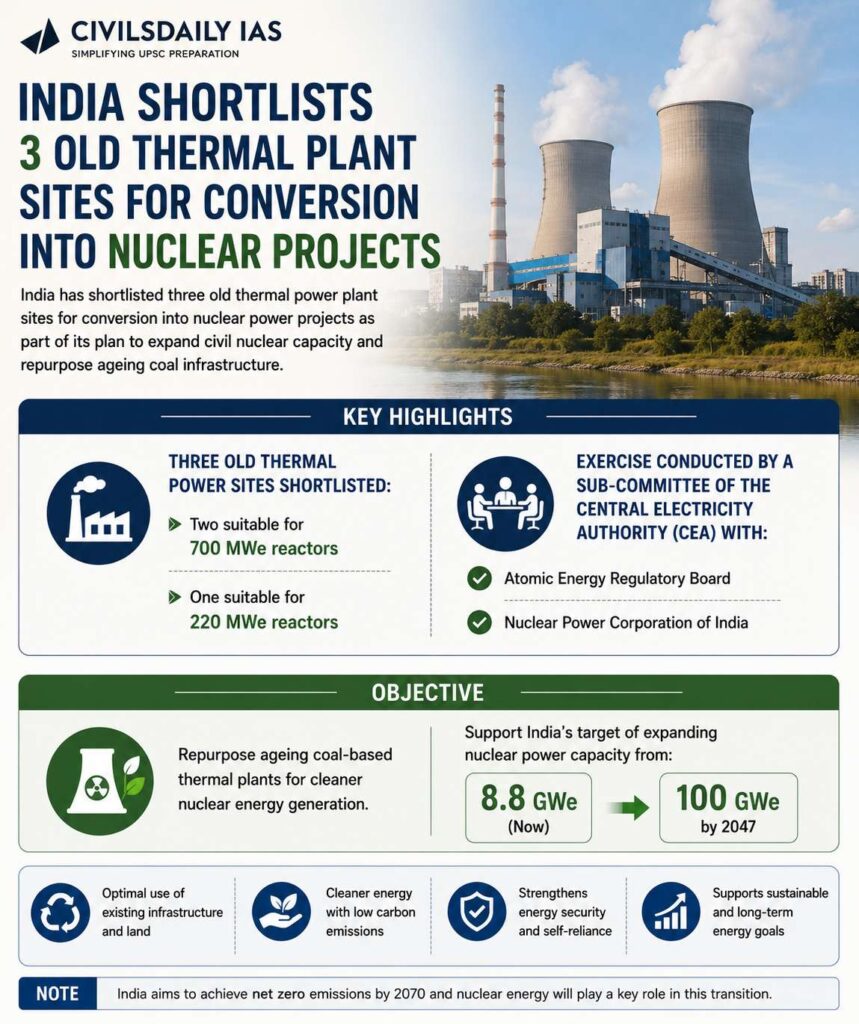
India has shortlisted three old thermal power plant sites for conversion into nuclear power projects as part of its plan to expand civil nuclear capacity and repurpose ageing coal infrastructure.
Key Highlights
Three old thermal power sites shortlisted:
Two suitable for 700 MWe reactors
One suitable for 220 MWe reactors
Exercise conducted by a sub-committee of the Central Electricity Authority (CEA) with:
Atomic Energy Regulatory Board
Nuclear Power Corporation of India
Objective
Repurpose ageing coal-based thermal plants for cleaner nuclear energy generation.
Support India’s target of expanding nuclear power capacity from:
8.8 GWe to 100 GWe by 2047.
Why Old Thermal Sites?
Advantages include:
Existing land and water availability
Existing transmission and infrastructure
Reduction in emissions from old coal plants
Support for clean energy transition
SHANTI Act, 2025
Opened parts of the nuclear sector to private participation.
Allowed private role in operations and fuel management.
Site Selection Criteria
Water availability
Land availability
Seismic safety
Population density
Meteorological conditions
Sites in Seismic Zone V or near active faults were excluded.
What is Exclusion Zone?
Mandatory safety zone around nuclear reactors where habitation and economic activity are restricted.
Current Norms: Around 1 km radius for nuclear plants.
Proposed Changes
700 MWe reactors: reduce from 1 km to 700 m
220 MWe reactors: reduce to 500 m
Proposal has received in-principle approval from:
AERB
Department of Atomic Energy (DAE)
Small Modular Reactors (SMRs)
Officials noted that repurposed thermal sites may be more suitable for:
Small Modular Reactors (SMRs)
Smaller nuclear projects
[2013] Which one among the following industries is the maximum consumer of water in India? (a) Engineering (b) Paper and pulp (c) Textiles (d) Thermal power
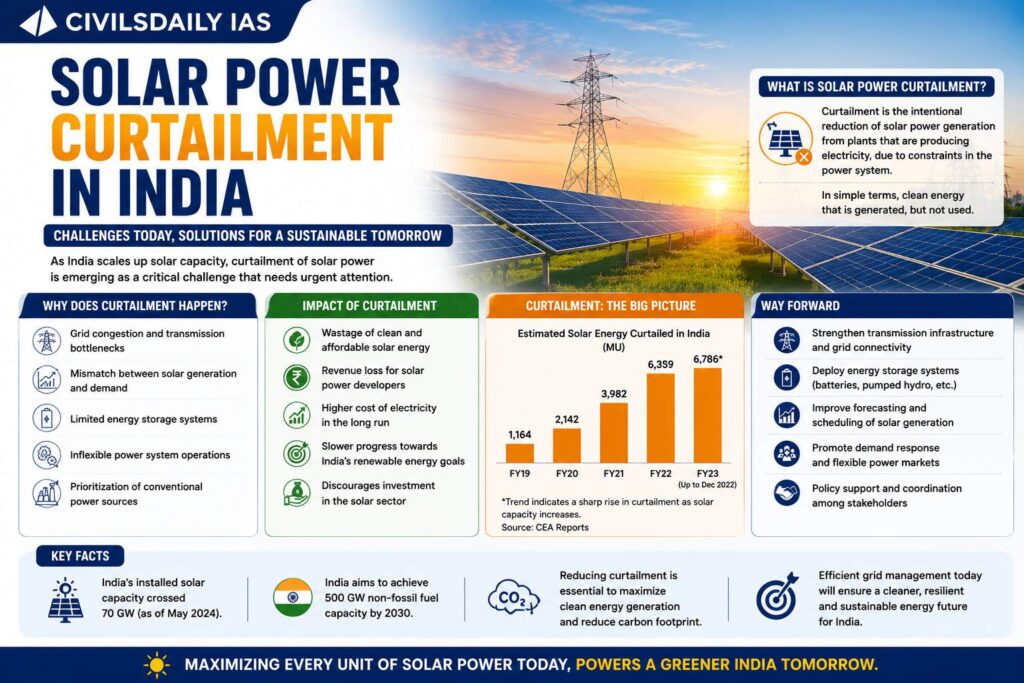
India witnessed record electricity demand in April 2026, yet large amounts of solar power had to be curtailed due to grid stress, transmission bottlenecks, and surplus daytime generation.
What is Solar Curtailment?
Solar curtailment refers to the reduction of electricity generation from solar plants by grid operators to maintain grid stability and prevent overload.
Even though renewable energy has “must-run” status in India, it can still be reduced under emergency or technical conditions.
Record Curtailment
April 2026 solar curtailment:
693.81 GWh
January to March 2026 combined:
399.34 GWh
This means April alone recorded around 74% higher curtailment than the previous three months combined.
Main Reasons Behind Curtailment
Grid Stability Concerns: Rapid increase in solar generation during daytime created excess electricity supply. The grid struggled to absorb this sudden surge.
Transmission Constraints: Major solar-producing States like Rajasthan and Gujarat Faced:
Transformer overloading
Transmission congestion
Heavy underdrawal of electricity
Demand-Supply Timing Mismatch
Daytime: Electricity prices crashed to nearly ₹1.5/unit
Night-time: Solar unavailable. Prices rose close to ₹10/unit ceiling
This highlights the need for energy storage systems.
What is Emergency TRAS (Tertiary Reserves Ancillary Services)?
It is a mechanism used by the power grid operator to maintain stability during emergency situations.
Under Emergency TRAS:
Renewable energy plants are instructed to reduce generation temporarily.
They receive financial compensation for the lost generation.
[2025] Consider the following statements about ‘PM Surya Ghar Muft Bijli Yojana’: I. It targets installation of one crore solar rooftop panels in the residential sector. II. The Ministry of New and Renewable Energy aims to impart training on installation, operation, maintenance and repairs of solar rooftop systems at grassroot levels. III. It aims to create more than three lakhs skilled manpower through fresh skilling, and upskilling, under scheme component of capacity building. Which of the statements given above are correct? [A] I and II only [B] I and III only [C] II and III only [D] I, II and III
The Union Cabinet approved two new semiconductor units in Gujarat (totaling 12 projects under Phase-I) under the India Semiconductor Mission (ISM) to boost domestic manufacturing. These include India’s first commercial Gallium Nitride (GaN)-based display facility by Crystal Matrix Limited and an OSAT unit by Suchi Semicon.
Why Is India’s Semiconductor Push Considered a Strategic Turning Point?
Strategic Autonomy: Reduces dependence on imported semiconductors used in telecom, defence, automobiles, AI systems, and consumer electronics.
Supply Chain Security: Strengthens resilience after global chip shortages disrupted automobile, electronics, and industrial production during the COVID-19 period.
Geopolitical Relevance: Positions India as an alternative manufacturing destination amid US-China technological decoupling and “China+1” diversification.
Economic Value Addition: Expands domestic value addition in electronics manufacturing, which has remained heavily import-dependent despite growth in assembly operations.
Technology Sovereignty: Facilitates indigenous capability in advanced manufacturing sectors such as AI chips, display drivers, sensors, power electronics, and compound semiconductors.
Employment Generation: Supports high-skilled jobs in fabrication, packaging, design, testing, materials, and semiconductor equipment manufacturing.
Industrial Ecosystem Expansion: Strengthens downstream sectors including smartphones, EVs, telecom equipment, defence electronics, medical devices, and industrial automation.
What Is the India Semiconductor Mission (ISM)?
Institutional Framework
India Semiconductor Mission (ISM): Functions under the Ministry of Electronics and Information Technology (MeitY) as the nodal agency for semiconductor and display ecosystem development.
Financial Support: Provides fiscal incentives for semiconductor fabs, display fabs, Assembly, Testing, Marking, and Packaging (ATMP)/Outsourced Semiconductor Assembly and Test (OSAT) facilities, compound semiconductors, and design-linked incentives.
Display Manufacturing: Expands domestic production of display drivers and display-related semiconductor components.
Design Ecosystem: Supports fabless semiconductor startups and chip design innovation.
Supply Chain Development: Encourages ecosystem creation in chemicals, gases, substrates, machinery, and clean-room technologies.
Which Semiconductor Projects Have Been Approved Under Phase-I?
Sl.No.
Project Name
Details
1.
Tata Electronics Semiconductor Fab, Gujarat
Investment: Involves approximately ₹91,000 crore investment.Technology Node: Targets 28-nanometre chip manufacturing capacity.Production Scale: Plans production of nearly 50,000 wafers across 28-nanometre to 110-nanometre technologies.Strategic Importance: Establishes India’s first commercial-grade chip foundry.Commercial Timeline: Expected commencement of commercial chip production from February next year.
Tata Electronics Semiconductor Assembly Unit, Assam
Investment: Involves nearly ₹27,000 crore investment.Production Focus: Manufactures around 48 million chips daily for electronics, automotive, and telecom sectors.Regional Importance: Expands high-technology manufacturing to Northeast India.
HCL-Foxconn Semiconductor Unit, Uttar Pradesh
Investment: Includes nearly ₹3,700 crore investment.Production Capacity: Plans production of approximately 20,000 wafers per month.Technology Application: Focuses on display driver chips used in smartphones, laptops, vehicles, and industrial systems.Operational Timeline: Expected to begin operations by March 2026.
Kaynes Semiconductor Unit, Gujarat
Investment: Involves approximately ₹3,300 crore investment.Technology Focus: Produces chips for industrial applications.Production Capacity: Targets nearly 60 lakh chips per day.
Technology Focus: Establishes India’s first advanced 3D chip packaging unit.Strategic Importance: Enhances advanced semiconductor packaging capability using indigenous technologies.
Advaned System Package Technologies (ASPT), Andhra Pradesh
Technology Partnership: Collaborates with South Korea’s APACK Co. Ltd.Production Focus: Manufactures advanced semiconductor packaging products.
Continental Device India (CDIL), Punjab
Technology Focus: Manufactures discrete semiconductors including power electronics components.Industrial Importance: Supports EVs, renewable energy systems, and industrial electronics.
Crystal Matrix Laboratories, Gujarat
Investment: Involves approximately ₹3,068 crore.Production Focus: Manufactures semiconductor substrates and materials
Why Is Semiconductor Manufacturing Critical for India’s Economy?
Electronics Manufacturing Expansion
Import Reduction: India imports a major share of semiconductor requirements despite becoming a major electronics assembly hub.
Domestic Value Addition: Semiconductor manufacturing increases local value addition beyond assembly operations.
Export Competitiveness: Strengthens India’s role in global electronics exports.
Strategic and National Security Importance
Defence Electronics: Supports indigenous missile systems, radars, drones, communication systems, and surveillance infrastructure.
Critical Infrastructure: Ensures supply security for telecom networks, power grids, and digital infrastructure.
Cyber Security: Reduces vulnerabilities associated with excessive import dependence.
Emerging Technology Integration
Artificial Intelligence: Supports AI accelerators, edge computing, and data-centre infrastructure.
Electric Vehicles: Enables production of power semiconductors and automotive chips.
5G and Telecom: Strengthens telecom equipment manufacturing ecosystem.
Renewable Energy: Supports solar inverters, battery management systems, and smart-grid technologies.
What Structural Challenges Continue to Constrain India’s Semiconductor Ambitions?
Capital Intensity
High Investment Requirement: Semiconductor fabs require investments running into billions of dollars with long gestation periods.
Skill Ecosystem: Develops semiconductor-focused engineering and vocational programmes.
Global Talent Partnerships: Facilitates collaboration with international semiconductor experts.
International Partnerships
Technology Collaboration: Expands strategic partnerships with trusted semiconductor economies.
Supply Chain Integration: Integrates India into resilient global semiconductor networks.
Conclusion
India’s semiconductor mission marks a transition from assembly-led electronics manufacturing to strategic technology production. Phase-I approvals indicate movement toward an integrated semiconductor ecosystem spanning fabrication, packaging, display technologies, and materials. Long-term success will depend on ecosystem depth, skilled workforce creation, infrastructure reliability, technological partnerships, and sustained policy support.
PYQ Relevance
[UPSC 2017] Account for the failure of the manufacturing sector in achieving the goal of labour-intensive exports rather than capital-intensive exports. Suggest measures for more labour-intensive rather than capital-intensive exports
Linkage: The semiconductor mission reflects India’s attempt to strengthen high-technology manufacturing and reduce import dependence under industrial policy reforms. The topic links with challenges in manufacturing competitiveness, technology ecosystems, skilled labour, global value chains, and Make in India-led industrial growth.