💥Join UPSC 2027,2028 Mentorship (July Batch) + XFactor Notes & Microthemes PDF

GS Paper: GS3-13.Infrastructure: Energy, Ports, Roads, Airports, Railways etc:

  • Why Manufacturing Growth Has Not Led to Broad Employment

    Why in the News?

    Union Budget 2026 reinforces the existing manufacturing strategy, especially through Production Linked Incentive schemes and customs duty rationalisation. However, analysts note that manufacturing growth has not translated into large scale job creation.

    Core Issue: Growth Without Jobs

    1. Stagnant Share in GDP

    • Manufacturing share remains 14 to 17 percent for decades.
    • Successful industrialisers in East Asia reached 25 to 30 percent before stabilising.
    • Indicates incomplete structural transformation.

    2. Jobs Growth Disconnect

    • Organised manufacturing employs about 1.96 crore workers.
    • Only about 57 lakh jobs added in the last decade.
    • Total manufacturing employment around 5.44 crore, with two thirds in informal units.

    Note: Organised factories are productive but create few jobs. Unorganised units absorb labour but remain low productivity and low wage.

    3. Capital Intensive Expansion

    • Firms rely on automation and capital deepening.
    • Output rises faster than employment.
    • Job elasticity of growth remains low.

    4. Skills Mismatch

    • Firms struggle to find job ready workers.
    • Weak firm level training and apprenticeship ecosystem.
    • Skill programmes poorly linked to industry demand.

    5. MSME Constraints

    • MSMEs contribute 35 percent of manufacturing output and about half of exports.
    • Credit expansion improves liquidity but not productivity.
    • Weak technology adoption, poor supply chain integration, limited scaling.
    [2020] With reference to the Indian economy after the 1991 economic liberalization, consider the following statements: 

    1. Worker productivity (Rupee per worker at 2004-05 prices) increased in urban areas while it decreased in rural areas. 

    2. The percentage share of rural areas in the workforce steadily increased. 

    3. In rural areas, the growth in non-farm economy increased. 

    4. The growth rate in rural employment decreased. 

    Which of the statements given above is/are correct? 

    (a) 1 and 2 only (b) 3 and 4 only (c) 3 only (d) 1, 2 and 4 only

  • DISCOMs and the road ahead

    Why in the News?

    India’s power distribution companies (DISCOMs) have recorded a decisive turnaround after years of mounting losses. India has 72 DISCOMs (44 State-owned, 16 private, 12 power departments). The sector earlier was subjected to AT&C losses and a persistent ACS-ARR gap. Now it has reported a positive Profit After Tax (PAT) of ₹2,701 crore in FY 2024-25, compared to a loss of ₹67,962 crore in 2013-14. AT&C losses declined from 22.62% to 15.04%, and the Average Cost of Supply-Average Revenue Realised Gap (ACS-ARR) gap narrowed from 78 paise to 6 paise per unit,  marking a sharp contrast to earlier years of financial distress. However, the improvement is uneven, with several utilities still reliant on tariff subsidies and State government support, underscoring the scale and complexity of the reform challenge.

    What Was the Historical Problem with DISCOMs?

    1. Rising Aggregate Technical & Commercial Losses (AT&C) Losses: Aggregated Technical and Commercial losses widened significantly over the years.
    2. Widening ACS-ARR Gap: Gap increased from ₹0.78 per unit (2020-21) before reducing to ₹0.06 per unit.
    3. Escalating Debt: Outstanding debt rose from ₹5.5 lakh crore to ₹6.47 lakh crore; subsequently increased to ₹7.26 lakh crore.
    4. Non-Cost Reflective Tariffs: Tariffs did not cover actual supply cost.
    5. Delayed State Subsidies: Payment delays worsened liquidity stress.
    6. Section 59 Violation: Law required 3% profit or zero loss; utilities continued losses.
    7. Legacy Dues: Outstanding legacy dues reached ₹1,39,947 crore by March 2023.

    What Explains the Recent Turnaround?

    1. Positive PAT: ₹2,701 crore profit in FY 2024-25.
    2. AT&C Reduction: Declined from 22.62% to 15.04%.
    3. ACS-ARR Improvement: Reduced from 78 paise to 6 paise per unit.
    4. Revamped Distribution Sector Scheme (RDSS) Implementation: Ensures operational efficiency and financial sustainability.
    5. Electricity Rules Amendments: Strengthened accountability.
    6. Late Payment Surcharge (LPS) Rules: Enables structured EMI-based clearance (39 EMIs).
    7. Debt Clearance: Legacy dues reduced to ₹4,927 crore; DISCOMs now paying current dues on time.

    Is the Improvement Uniform Across States?

    1. State Sector Variation: Tamil Nadu received ₹15,772 crore tariff subsidy and ₹16,107 crore loss takeover; recorded ₹2,073 crore profit.
    2. Persistent Loss Example: TANGEDCO reported ₹14,034 crore loss in PFC’s 14th Integrated Rating Exercise.
    3. Gujarat Example: Improved performance with ₹92 crore profit; ₹11,625 crore subsidy and ₹2,540 crore loss takeover.
    4. Risk of Reversal: Revenue surplus may be transient due to future employee pay revisions.

    What Structural Concerns Persist?

    1. Dependence on Subsidies: Turnaround largely driven by tariff subsidies and State loss takeover.
    2. Cross-Subsidisation: Agricultural and domestic segments distort cost structure.
    3. Unmetered Power Supply: Especially in Tamil Nadu; impedes accurate consumption data.
    4. Feeder Segregation Gaps: Ongoing in Rajasthan, Andhra Pradesh, Gujarat, Karnataka, Maharashtra; incomplete elsewhere.
    5. Agricultural Power Burden: Political reluctance to rationalize free power.

    What Is the Way Forward?

    1. Feeder Segregation: Ensures accurate agricultural consumption measurement.
    2. Metering Reform: Enables real cost accounting.
    3. Solar Pump Promotion: Reduces power procurement costs.
    4. Financial Discipline: Sustains gains under RDSS framework.
    5. Political Will: Resists universal free electricity policies.
    6. Public-Spirited Bureaucracy: Ensures transformation into viable entities.

    Conclusion

    The power distribution sector demonstrates measurable operational improvement. However, sustainability depends on structural tariff reforms, subsidy rationalisation, metering expansion, and political commitment to financial discipline. Without these, the risk of reverting to revenue deficit remains significant.

    Keywords and their definitions:

    1. AT&C Losses (Aggregate Technical & Commercial Losses): Total losses incurred by DISCOMs due to technical losses (transmission & distribution inefficiencies) and commercial losses (theft, faulty metering, billing inefficiency).
    2. ACS-ARR Gap (Average Cost of Supply-Average Revenue Realised Gap): Difference between the average cost incurred to supply electricity and the average revenue actually realised per unit.
    3. Reflective Tariffs (Cost-Reflective Tariffs): Electricity tariffs that reflect the actual cost of supply, including power purchase, transmission, distribution, and operational expenses.
    4. Section 59, Electricity Act, 2003: Mandates that distribution licensees must maintain financial discipline, ensuring revenues are adequate to cover operational costs and leave a reasonable surplus. Objective:
      1. Prevent chronic losses
      2. Promote commercial viability
      3. Enforce tariff rationalisation
    5. Electricity (Amendment) Rules, 2022: Significance:
      1. Mandated timely payment of subsidies by State governments
      2. Prevented DISCOMs from carrying subsidy burden indefinitely
      3. Linked power supply obligation with subsidy payment
    6. Late Payment Surcharge (LPS) Rules, 2022
      1. Structured repayment of legacy dues
      2. Prevented cascading debt in power sector
    7. Revamped Distribution Sector Scheme
      1. Launched by: Ministry of Power
      2. Outlay: ₹3.03 lakh crore; Objective:
        1. Reduce AT&C losses to 12-15%
        2. Eliminate ACS-ARR gap
        3. Smart metering & infrastructure upgradation
      3. Nature: Reform-linked, results-based funding mechanism.
    8. Cross-Subsidisation: Practice of charging higher tariffs to industrial/commercial consumers to subsidise agricultural and domestic consumers.
    9. Feeder Segregation: Separation of agricultural and non-agricultural electricity feeders.

    PYQ Relevance

    [UPSC 2022] Do you think India will meet 50 percent of its energy needs from renewable energy by 2030? Justify. How will the shift of subsidies from fossil fuels to renewables help achieve the objective?

    Linkage: It falls under GS-III (Infrastructure: Energy, Subsidies, Sustainable Development) and tests understanding of renewable transition, fiscal prioritisation, and energy economics. The DISCOM article highlights issues directly impacted by shifting subsidies from fossil fuels to renewables to improve distribution sector sustainability.

  • India gives 20 year tax holiday to foreign firms using local data centres 

    Why in the News?

    In Union Budget 2026–27, Finance Minister Nirmala Sitharaman announced a 20 year tax holiday till 2047 for foreign companies that provide global cloud services using data centres located in India, to boost India’s position as a global data and digital services hub.

    What is the Announcement?

    • Foreign companies offering cloud and digital services globally
    • Using data centres physically located in India
    • Will not be taxed on global income arising from such services
    • Tax holiday applicable till the year 2047

    Key Benefits

    • Provides long term tax clarity and stability
    • Encourages hyperscalers to locate data storage and processing in India
    • Boosts employment, energy infrastructure and allied services
    • Strengthens India’s role in cloud computing, AI and digital trade

    Investments in Focus

    • Google plans 15 billion dollar investment in AI data centres in Andhra Pradesh
    • Microsoft and Amazon have invested billions in Indian data centres
    • Indian conglomerates like Reliance Industries and Adani Group are also major players

    Government View

    • IT Minister Ashwini Vaishnaw stated that data centres will become a major strength for India in providing digital services to the world
    [2018] With reference to India’s decision to levy an equalization tax of 6% on online advertisement services offered by non-resident entities, which of the following statements is/are correct? 1. It is introduced as a part of the Income Tax Act

    2. Non-resident entities that offer advertisement services in India can claim a tax credit in their home country under the “Double Taxation Avoidance Agreements”

    Select the correct answer using the code given below: 

    (a) 1 only (b) 2 only (c) Both 1 and 2 (d) Neither 1 nor 2

  • What’s ailing India’s battery scheme for EVs

    Why in the News?

    The ₹18,100 crore PLI Scheme for Advanced Chemistry Cell (ACC) Battery Storage, launched to create 50 GWh of domestic battery manufacturing capacity by 2025, has achieved only 1.4 GWh of installed capacity even after multiple bidding rounds. Despite awarding 20 GWh of capacity and disbursing commitments to three beneficiaries, no incentive funds have been released due to missed milestones. The scheme has attracted only 25.58% of the targeted investment, far below expectations. This represents a sharp contrast with the scheme’s original promise of rapidly catalysing India’s EV battery ecosystem and exposes structural weaknesses in mineral supply, technology readiness, and industrial execution.

    What are Advanced Chemistry Cells (ACCs)?

    1. Energy storage systems: Enable storage of electrical energy and conversion back to electricity as required.
    2. Lithium-ion dominance: Represent the most widely used battery chemistry globally, particularly in EVs and electronics.
    3. Technology-agnostic design: Allows multiple chemistries, including lithium manganese cobalt, lithium iron phosphate, and sodium-ion batteries.

    What was the intent behind the ACC PLI scheme?

    1. Manufacturing ecosystem creation: Seeks establishment of large-scale domestic battery manufacturing capacity.
    2. Import substitution: Reduces reliance on Chinese battery imports and supply chains.
    3. Strategic value chain integration: Requires complementary policies for mineral refining and component manufacturing.

    How was the scheme designed to function?

    1. Capacity-linked incentives: Rewards firms based on committed and operational manufacturing capacity.
    2. Minimum scale requirement: Mandates at least 5 GWh per participant to ensure economies of scale.
    3. Investment threshold: Requires ₹225 crore per GWh of committed capacity.
    4. Performance-linked payouts: Allows incentives up to ₹2,000 per kWh sold.
    5. Domestic Value Addition (DVA): Mandates 25% DVA within two years and 60% by the fifth year.

    Who were selected as beneficiaries under the scheme?

    1. Ola Electric: Awarded 20 GWh capacity initially; operationalised only 1.4 GWh by October 2025.
    2. Reliance New Energy: Allocated 5 GWh in the first round and an additional 10 GWh in the second round.
    3. Rajesh Exports: Allocated 5 GWh capacity.

    What has been the actual performance so far?

    1. Capacity shortfall: Only 1.4 GWh operational against a target of 50 GWh by 2025.
    2. Investment gap: Scheme generated only ₹1,118 crore, compared to an expected ₹4,360 crore.
    3. Zero disbursement: No incentive payouts released despite elapsed timelines.
    4. Concentration risk: Entire operational capacity limited to a single beneficiary.

    Why has the ACC PLI scheme underperformed?

    1. Unrealistic gestation period: Two-year commissioning timeline unsuitable for complex battery manufacturing plants.
    2. Mineral processing gaps: India lacks domestic facilities for lithium, nickel, and cobalt refining.
    3. Subsidy-centric design: Emphasises financial incentives without adequate ecosystem readiness.
    4. Execution capability mismatch: New entrants lack manufacturing experience compared to established global players.
    5. Supply chain dependence: Continued reliance on China for raw materials, equipment, and technical approvals.
    6. Regulatory delays: Slow clearance of Chinese technical specialists and technology transfer processes.
    7. Skilled labour deficit: Insufficient trained workforce for precision battery cell manufacturing.

    What does the article recommend going forward?

    1. Faster regulatory approvals: Accelerates visas and clearances for foreign technical expertise.
    2. Penalty relaxation: Extends commissioning deadlines by at least one year to reflect ground realities.
    3. Value chain deepening: Requires targeted schemes for mineral refining and component manufacturing.
    4. Technology and R&D focus: Prioritises domestic innovation over assembly-led expansion.
    5. Human capital development: Builds specialised skill pipelines for battery manufacturing.

    Conclusion

    The ACC PLI scheme reveals that fiscal incentives alone cannot substitute for ecosystem readiness. Manufacturing scale, mineral security, skilled labour, and technological capability must evolve simultaneously. Without structural correction, India’s battery ambitions risk remaining aspirational rather than transformative.

    PYQ Relevance

    [UPSC 2023] The adoption of electric vehicles is rapidly growing worldwide. How do electric vehicles contribute to reducing carbon emissions and what are the key benefits they offer compared to traditional combustion engine vehicles?

    Linkage: Electric vehicles reduce carbon emissions only when supported by clean electricity and efficient energy storage; weak domestic battery manufacturing limits these climate gains. Without strong domestic battery manufacturing, EV adoption may remain limited to vehicle sales rather than real decarbonisation.

  • Thorium based nuclear power key to securing energy independence

    Why in the News?

    Thorium-based nuclear power is gaining attention again as India expands its Pressurized Heavy-Water Reactor (PHWRs) using imported uranium, which allows faster production of fissile material needed for thorium use. Earlier, limited domestic uranium kept reactor capacity low and delayed the thorium programme. With a target of 100 GWe nuclear capacity, largely through PHWRs, India can now produce enough U-233, making thorium reactors practically feasible. This reflects a clear shift from long-term planning to real implementation, strengthening energy independence.

    Pressurised Heavy Water Reactor (PHWR)

    1. It is a nuclear reactor type that uses unenriched, natural uranium as fuel and heavy water as both coolant and moderator. 
    2. Characterized by a horizontal “Calandria” vessel, PHWRs operate under pressure to prevent boiling, offering high neutron economy and low proliferation risk. 

    How Does India’s Three-Stage Nuclear Programme Enable Thorium Use?

    1. Three-stage framework: Structures India’s nuclear strategy around uranium, plutonium, and thorium to overcome resource asymmetry.
    2. Stage One (PHWRs): Uses natural uranium to generate electricity and produce plutonium as a by-product.
    3. Stage Two (Fast Breeder Reactors): Utilises plutonium to generate power and multiply fissile material.
    4. Stage Three (Thorium reactors): Converts thorium into U-233, enabling long-term clean energy production.
    5. Strategic outcome: Ensures sustained energy security using domestically abundant thorium reserves.

    Why Is Scaling Up PHWR Capacity Critical for Thorium Transition?

    1. Irradiation capacity: Enables production of U-233 by irradiating thorium in sufficient quantities.
    2. Earlier constraint: Limited domestic uranium restricted reactor scale when the programme was conceptualised.
    3. Current shift: Access to international uranium markets removes fuel bottlenecks.
    4. Capacity expansion: Nuclear roadmap targets 100 GWe, with PHWRs forming the backbone.
    5. Transition acceleration: Large-scale PHWR deployment shortens the timeline for thorium-based power.

    What Role Do Advanced PHWR Designs Play in Energy Independence?

    1. Technological evolution: Enables use of thorium in PHWRs through advanced fuel cycles.
    2. Fuel innovation: Facilitates blending of thorium with HALEU (High-Assay Low-Enriched Uranium).
    3. Efficiency gains: Improves fissile breeding and fuel utilisation.
    4. Strategic benefit: Reduces reliance on fast breeder reactors alone for thorium transition.
    5. System-wide impact: Enhances safety, economic viability, and fuel security.

    How Feasible Is Rapid PHWR Capacity Expansion in India?

    1. Scale requirement: Achieving 50-75 GWe requires addition of approximately 3 GWe annually.
    2. Infrastructure implication: Construction of five to eight reactors per year.
    3. Capital intensity: Demands significant financial mobilisation for reactors, fuel cycle, and back-end facilities.
    4. Institutional expansion: Requires entry of multiple public and private players beyond existing structures.
    5. Implementation role: Positions NPCIL as technology provider, capacity builder, and programme integrator.

    What Is the Case for Imported Light-Water Reactor (LWR)-Based Nuclear Projects?

    1. Complementarity: Supplements indigenous PHWR capacity during rapid scale-up.
    2. Fuel efficiency: Higher energy output per unit of enriched fuel.
    3. Economic condition: Viability depends on cost competitiveness and fuel cycle consistency.
    4. Strategic balance: Does not replace indigenous systems but supports capacity growth.
    5. Policy approach: Prioritises futuristic technologies while leveraging imported reactors pragmatically.

    How Does Fuel Cost Comparison Strengthen the PHWR Case?

    1. LWR fuel demand: A 1,000 MWe LWR requires ~25 tonnes of enriched fuel annually at 80% PLF.
    2. Cost implication: At $1.76 million per tonne, fuel costs translate to ~₹350 crore/year (±₹80 crore).
    3. PHWR advantage: Requires lower enriched uranium input due to higher efficiency in mined uranium use.
    4. Hybrid fuel strategy: Using small amounts of enriched uranium with thorium in PHWRs reduces overall cost.
    5. Outcome: Positions PHWRs as economically superior for clean power expansion.

    Conclusion

    India’s nuclear energy pathway is entering a decisive phase where scale, fuel flexibility, and technological maturity converge. Expansion of PHWR capacity using imported uranium removes historical constraints on thorium utilisation, enabling faster production of U-233 and improving the feasibility of thorium-based reactors. Combined with advanced fuel designs and selective use of imported LWRs, this strategy strengthens India’s long-term energy independence while ensuring cost efficiency and system resilience.

    PYQ Relevance

    [UPSC 2018] With growing energy needs should India keep on expanding its nuclear energy programme? Discuss the facts and fears associated with nuclear energy?

    Linkage: This question tests understanding of India’s long-term energy security choices amid rising power demand and clean energy transition. The article shows how scaling up PHWRs and advancing the thorium fuel cycle addresses energy security.

  • [28th January 2026] The Hindu OpED: Manufacturing woes: Capital support alone will not add to battery cell manufacturing capacity

    PYQ Relevance

    [UPSC 2017] Account for the failure of the manufacturing sector in achieving the goal of labor-intensive exports. Suggest measures for more labor-intensive rather than capital-intensive exports. 

    Linkage: This PYQ directly aligns with GS III (Industrial Policy, Manufacturing, Employment) by examining why India’s manufacturing remains capital-intensive despite policy support like PLI. 

    Mentor’s Comment

    This article is critical for GS Paper III (Energy, Infrastructure, Industrial Policy). It highlights structural limits of India’s PLI-driven manufacturing strategy, especially for technology-intensive green sectors, and questions the assumption that fiscal incentives alone can deliver strategic self-reliance.

    What Is the Strategic Objective Behind Non-Fossil PLI Schemes?

    1. Energy Transition Target: Supports installation of 500 GW non-fossil capacity by 2030.
    2. Industrial Deepening: Enables domestic manufacturing of solar and battery components.
    3. Import Substitution: Reduces reliance on imported green technologies.
    4. Global Integration: Positions India as a supplier in global clean-energy value chains.

    How Have PLI Schemes Performed Across the Value Chain?

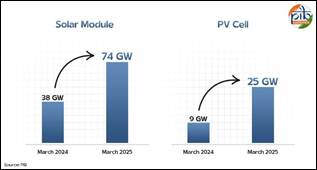
    1. Downstream Assembly: Achieved 56% of target in solar module assembly by mid-2025.
    2. Upstream Manufacturing: Remains a bottleneck in both solar and batteries.
    3. Value Chain Imbalance: Assembly expanded faster than material and component production.

    Why Are Upstream Solar Manufacturing Segments Lagging?

    1. Polysilicon Manufacturing: Achieved only 14% of the target capacity.
    2. Wafer Manufacturing: Reached merely 10% of the planned capacity.
    3. Capital Intensity: Requires high upfront investment with long gestation.
    4. Technology Dependence: Relies on specialised global expertise and equipment.

    What Explains the Failure in Battery Cell Manufacturing?

    1. Target Capacity: 50 GWh of domestic battery cell production.
    2. Fiscal Outlay: ₹18,000 crore under PLI.
    3. Actual Commissioning: Only 1.4 GWh (2.8%) by late 2025.
    4. Domestic Value Addition Rules: Mandate 25% within two years and 60% within five years.
    5. Gigafactory Complexity: Requires advanced infrastructure and long-term R&D ecosystems.

    How Do Policy Design Constraints Affect Outcomes?

    1. Capital-Only Incentives: Assume finance can substitute for expertise.
    2. Skill Deficits: Ignore the need for decades of workforce training.
    3. Technology Transfer Limits: International transfers are capital-intensive and slow.
    4. Penalty Structure: Firms face steep fines for missing deadlines despite structural hurdles.

    What Role Do External Dependencies Play?

    1. Imported Raw Materials: Persistent reliance on foreign inputs.
    2. Specialised Expertise: Dependence on foreign technical experts.
    3. Visa Restrictions: Non-issuance of visas to Chinese technicians delayed factory setup.
    4. Supply Chain Risk: Increases vulnerability in strategic energy sectors.

    Why Has the Telecom PLI Succeeded While Green PLIs Struggle?

    1. Lower Technology Entry Barriers: Telecom manufacturing required fewer foundational innovations.
    2. Established Ecosystems: Global supply chains were already mature.
    3. Faster Market Realisation: Sales-linked incentives translated quickly into output.
    4. Green Tech Contrast: Solar and batteries require upstream industrial ecosystems, not just assembly.

    What Rethinking Does the Article Suggest for PLI Design?

    1. Expertise-Based Selection: Prioritises technical capability over net worth.
    2. Capital Risk-Sharing: Considers additional capital subsidies for upstream segments.
    3. Longer Timelines: Aligns targets with technology development cycles.
    4. Ecosystem Approach: Integrates R&D, skills, and industrial infrastructure.

    Conclusion

    Capital support alone cannot manufacture technological capability. India’s clean-energy ambitions require patient industrial policy, focused on skills, research, and ecosystem creation. Without recalibrating PLI design to reflect the realities of high-technology manufacturing, the gap between targets and outcomes is likely to persist.

  • Wings India 2026: Asia’s Largest Civil Aviation Event

    Why in the News?

    India’s rapidly expanding civil aviation sector will be showcased at Wings India 2026, Asia’s largest civil aviation event, scheduled from 28 to 31 January 2026 at Begumpet Airport, Hyderabad.

    About Wings India 2026

    • Asia’s largest civil aviation event
    • Organised as a global platform for Connectivity, Manufacturing, Services, Innovation and Sustainability
    • Inaugurated by Rammohan Naidu Kinjarapu, Union Minister of Civil Aviation

    Theme
    “Indian Aviation: Paving the Future from Design to Deployment, Manufacturing to Maintenance, Inclusivity to Innovation and Safety to Sustainability”

    India’s Aviation Growth Story

    • India among the fastest growing aviation markets globally
    • Passenger traffic has grown multi fold in the last decade
    • Record aircraft orders place India among the largest future aircraft markets
    • Rapid expansion of airport infrastructure Greenfield airports, Modernised terminals and Regional connectivity under UDAN

    Prelims Pointers

    • Wings India is a civil aviation industry event, not a treaty or summit
    • Held at Begumpet Airport, Hyderabad
    • Focus areas include MRO, SAF, drones and advanced air mobility
    • Reflects India’s transition from aviation growth to aviation leadership
    [2024] Consider the following airports: 

    1. Donyi Polo Airport 

    2. Kushinagar International Airport 

    3. Vijayawada International Airport 

    In the recent past, which of the above have been constructed as Greenfield projects? 

    (a) 1 and 2 only (b) 2 and 3 only (c) 1 and 3 only (d) 1, 2 and 3

  • Prime Minister at India Energy Week 2026

    Why in the News?

    Prime Minister Narendra Modi addressed the inauguration of India Energy Week 2026 via video conferencing, highlighting India’s growing role in the global energy sector, major investment opportunities.

    India Energy Week 2026

    • Representatives from nearly 125 countries participated
    • Emerged as a global platform for energy dialogue and action
    • Focus on energy security, sustainability, and global partnerships
    • Venue: Goa

    Key Highlights from the Prime Minister’s Address

    India’s Energy Potential

    • India is the world’s fastest growing major economy
    • Rising domestic energy demand and strong export capacity
    • Among the top five exporters of petroleum products, supplying over 150 countries
    • Large opportunities across the entire energy value chain

    Oil and Gas Exploration Sector

    • India has opened up its exploration sector significantly
    • Linked to Samudra Manthan Mission for deep sea exploration
    • Targets by end of decade
      • 100 billion dollars investment in oil and gas
      • Exploration area expanded to 1 million sq km
    • Over 170 blocks already awarded
    • Andaman and Nicobar Basin emerging as a new hydrocarbon zone
    • Reduction of No Go areas and regulatory reforms undertaken

    Refining and Petrochemicals

    • India ranks second globally in refining capacity
    • Current capacity: around 260 MMT per annum
    • Target: exceed 300 MMT per annum and become number one globally
    • Rising demand for petrochemical products due to population and economic growth

    Liquefied Natural Gas (LNG) Focus

    • Target to meet 15 percent of total energy demand through LNG
    • Investment opportunities across LNG transportation, LNG terminals and Regasification infrastructure
    • Domestic shipbuilding supported by ₹70,000 crore shipbuilding programme
    • Expansion of National gas pipeline network and City gas distribution systems

    Energy Reforms and Vision

    • India moving from energy security to energy independence
    • Focus on Transparent, Investor friendly and Reform driven ecosystem
    • Estimated 500 billion dollars investment opportunity in India’s energy sector
    [2019] Consider the following statements: 

    1. Petroleum and Natural Gas Regulatory Board (PNGRB) is the first regulatory body set up by the Government of India

    2. One of the tasks of PNGRB is to ensure competitive markets for gas

    3. Appeals against the decisions of PNGRB go before the Appellate Tribunals for Electricity. Which of the statements given above are correct? 

    (a) 1 and 2 only (b) 2 and 3 only (c) 1 and 3 only (d) Neither 1 nor 2

  • Equity Infusion into SIDBI

    Why in the News?

    The Union Cabinet has approved an equity infusion of INR 5,000 crore into Small Industries Development Bank of India to strengthen MSME credit flow and institutional capital.

    Key Decision

    • Approved by the Union Cabinet, chaired by Narendra Modi
    • Capital support to be provided by the Department of Financial Services
    • Objective: Boost MSME lending, improve capital adequacy, and enable low cost funding

    Equity Infusion Details

    • Mode: Equity infusion in three tranches
      • INR 3,000 crore in FY 2025–26 at book value of INR 568.65 per share (as on March 31, 2025)
      • INR 1,000 crore in FY 2026–27
      • INR 1,000 crore in FY 2027–28
    • Later tranches to be infused at book value as on March 31 of the preceding financial year

    Why Capital Infusion is Needed?

    • Expansion of directed credit
    • Growth in digital collateral free lending
    • Increase in venture debt financing for startups
    • These segments raise risk weighted assets, requiring stronger capital buffers
    • Helps maintain credit rating and comply with regulatory norms

    About SIDBI

    • Established in 1990
    • Apex financial institution for MSME financing in India
    • Functions include:
      • Direct lending to MSMEs
      • Refinance to banks and NBFCs
      • Support to startups and innovation driven enterprises

    Prelims Pointers

    • SIDBI is not a commercial bank, but a development financial institution
    • Equity infusion helps meet Basel based capital requirements
    • Focus areas include MSMEs, startups, and digital lending
    • Nodal oversight lies with the Department of Financial Services
    [2023] Consider the following statements with reference to India: 

    1. According to the ‘Micro, Small and Medium Enterprises Development (MSMED) Act, 2006’, the ‘medium enterprises’ are those with investments in plant and machinery between Rs. 15 crore and Rs. 25 crore

    2. All bank loans to the Micro, Small and Medium Enterprises qualify under the priority sector. 

    Which of the statements given above is/are correct? 

    (a) 1 only (b) 2 only (c) Both 1 and 2 (d) Neither 1 nor 2

  • DAE’s nuclear pivot: Light water push to tap global markets, retain heavy water edge

    Why in the News

    India’s nuclear establishment is prioritising Light Water Reactors (LWRs) for global market integration while retaining Pressurised Heavy Water Reactors (PHWRs) as a domestic and strategic strength. This marks a significant departure from India’s earlier inward-looking PHWR-centric approach. The shift is urgent as Light Water Reactors account for over 85% of global nuclear capacity. India seeks export competitiveness as emerging economies like the UAE, Bangladesh, Saudi Arabia, and Turkey expand nuclear power.

    What is a Light Water Reactor?

    1. A Light Water Reactor (LWR) is a nuclear reactor that uses ordinary water (H₂O) as both the coolant and neutron moderator.
    2. Fuel type: Operates on low-enriched uranium fuel.

    What is a Pressurised Heavy Water Reactor?

    1. Definition: A Pressurised Heavy Water Reactor (PHWR) is a nuclear reactor that uses heavy water (D₂O) as both the coolant and neutron moderator.
    2. Fuel type: Operates on natural uranium, avoiding the need for enrichment.

    Why do Light Water Reactors dominate the global nuclear market?

    1. Global share: LWRs constitute over 85% of installed civil nuclear reactor capacity worldwide.
    2. Design simplicity: Uses normal water as coolant and moderator, reducing engineering complexity.
    3. Cost structure: Lower construction costs due to economies of scale and standardised designs.
    4. Operational efficiency: Higher thermal efficiency compared to heavy water reactors.
    5. Fuel ecosystem: Reliance on enriched uranium, readily accessible in Western markets.

    Why has India relied on PHWRs despite global LWR dominance?

    1. Fuel flexibility: PHWRs operate on natural uranium, reducing enrichment dependence.
    2. Resource alignment: Matches India’s limited uranium and abundant thorium reserves.
    3. Indigenous capability: Strong domestic expertise in design, manufacturing, and operation.
    4. Strategic autonomy: Minimises external fuel supply vulnerabilities.
    5. Limitation: Reduced export competitiveness in markets structured around LWR ecosystems.

    Why is the current LWR push a strategic departure for India?

    1. Export integration: Enables Indian firms to enter the global nuclear supply chain.
    2. Private participation: Supported by legal reforms opening nuclear power to non-state actors.
    3. Project acceleration: DAE fast-tracking the 900 MWe indigenous LWR design, initiated in 2015.
    4. Negotiating leverage: Enhances bargaining capacity with foreign vendors on imports and technology.
    5. Market realism: Aligns reactor strategy with international demand patterns.

    What challenges have exposed the limits of LWR-led imports?

    1. Cost escalation: Higher capital costs translate into elevated electricity tariffs.
    2. Domestic displacement: Risk of sidelining indigenous PHWR manufacturing capacity.
    3. Case study: Jaitapur: Project delays due to tariff concerns, liability issues, and Areva’s financial instability.
    4. Market absorption: Indian electricity markets struggle to absorb high-cost nuclear power.

    How are PHWRs repositioned in India’s nuclear future?

    1. Fuel innovation: PHWRs using thorium and low-enriched uranium lower scale-up constraints.
    2. Export differentiation: Positions PHWRs as a niche solution for resource-constrained economies.
    3. Manufacturing depth: Builds on India’s experience from 220 MWe to 700 MWe PHWR units.
    4. Growth alignment: Supports nuclear expansion without overreliance on imported enrichment services.

    What role do SMRs play in India’s nuclear ambitions?

    1. Capacity range: 30-300 MWe Small Modular Reactors (SMRs).
    2. Cost efficiency: Enables modular, scalable deployment.
    3. Export potential: Enhances attractiveness for emerging economies.
    4. Strategic competition: China pursuing SMR leadership as a Global South diplomatic tool, similar to EV sector disruption.

    Conclusion

    India’s nuclear pivot reflects strategic pragmatism rather than abandonment of legacy strengths. The dual-track approach, global LWR integration combined with PHWR-based differentiation, balances export ambition, energy security, and industrial capability. Success depends on managing costs, protecting indigenous capacity, and converting legislative reform into manufacturing scale.

    PYQ Relevance

    [UPSC 2018] With growing energy needs should India keep on expanding its nuclear energy programme? Discuss the facts and fears associated with nuclear energy?

    Linkage: The question links directly to India’s energy security and clean baseload power needs, where nuclear energy complements renewables. The current debate on LWR expansion, PHWR indigenisation, high costs, and safety concerns reflects the balance between the facts and fears of nuclear power.