💥Join UPSC 2027,2028 Mentorship (August Batch) + XFactor Notes & Microthemes PDF

GS Paper: Social Empowerment

  • [pib] Stand Up India Scheme

    The Ministry of Finance has informed that more than 81% of account holders are Women under Stand Up India Scheme.

    Try this PYQ from CSP 2016:

    Q.With reference to ‘stand up India scheme’, which of the following statement is/are correct?

    1. Its purpose is to promote entrepreneurship among SC/ST and women entrepreneurs.
    2. It provides for refinance through SIDBI.

    Select the correct answer using the code given below.

    (a) 1 only

    (b) 2 only

    (c) Both 1 and 2

    (d) Neither 1 nor 2

    Stand-Up India Scheme

    • Stand Up India Scheme was launched on 5 April 2016 to promote entrepreneurship at the grass-root level of economic empowerment and job creation.
    • This scheme seeks to leverage the institutional credit structure to reach out to the underserved sector of people such as SCs, STs and Women Entrepreneurs.
    • The objective of this scheme is to facilitate bank loans between Rs.10 lakh and Rs.1 crore to at least one SC or ST borrower and at least one woman borrower per bank branch for setting up a Greenfield enterprise.
    • The offices of SIDBI and NABARD shall be designated Stand-Up Connect Centres (SUCC)
    • It is similar to but distinct from Startup India.

    Back2Basics: Start-Up India Scheme

    • Startup India Scheme is an initiative of the Indian government, the primary objective of which is the promotion of startups, generation of employment, and wealth creation.
    • It was launched on the 16th of January, 2016.
    • A startup defined as an entity that is headquartered in India, which was opened less than 10 years ago and has an annual turnover of fewer than ₹100 crores (US$14 million).
    • The action plan for this initiative is based on the following three pillars:
    1. Simplification and Handholding
    2. Funding Support and Incentives
    3. Industry-Academia Partnership and Incubation
    • An additional area of focus is to discard restrictive States Government policies within this domain, such as License Raj, Land Permissions, Foreign Investment Proposals, and Environmental Clearances.
    • It was organized by The Department for promotion of industry and internal trade (DPI&IT).
  • [pib] Sugamya Bharat App

    Union Minister for Social justice and Empowerment has launched the “Sugamya Bharat App”.

    Sugamya Bharat App

    • The Sugamya Bharat App is a simple to use Mobile App with an easy registration process, requiring only 3 mandatory fields, namely, Name, Mobile number and Email-id.
    • Registered users can raise issues related to accessibility being faced.
    • The App is made accessible for ease of use for persons with disabilities also with features such as font size adjustment, color contrasting option, text to speech, and having an integrated screen reader in Hindi and English.
    • It is available in 10 regional languages, namely, Hindi, English, Marathi, Tamil, Odiya, Kannada, Telugu, Gujarati, Punjabi, and Malayalam.
    • The App also has the provision of easy photo uploads with a geotagging option of the premise where accessibility intervention is required.

    Its features

    • The app, a Crowdsourcing Mobile Application is a means for sensitizing and enhancing accessibility in the 3 pillars of the Accessible India Campaign i.e. built environment, transportation sector and ICT ecosystem in India.
    • The app provides for five main features, 4 of which are directly related to enhancing accessibility, while the fifth is a special feature meant only for Divyangjan for COVID related issues.

    The accessibility-related features are:

    • Registration of complaints of inaccessibility across the 3 broad pillars of the Sugamya Bharat Abhiyaan;
    • Positive feedback of examples and best practices worth emulating being shared by people as jan-bhagidhari;
    • Departmental updates and guidelines and circulars related to accessibility.

    Back2Basics: Sugamya Bharat Abhiyan

    • Accessible India Campaign or Sugamya Bharat Abhiyan is a program that is set to be launched to serve the differently-able community of the country.
    • The flagship program has been launched on 3 December 2015, the International Day of People with Disabilities.
    • The program comes with an index to measure the design of disabled-friendly buildings and human resource policies.
    • The initiative also in line with Article 9 of the (UN Convention on the Rights of Persons with Disabilities) which India is a signatory since 2007.
    • The scheme also comes under the Persons with Disabilities Act, 1995 for equal Opportunities and protection of rights which provides non-discrimination in Transport to Persons with Disabilities.
  • NHRC advisory on Sex Work

    The National Human Rights Commission (NHRC) recognised sex workers as informal workers in their advisory on “Human Rights of Women in the context of COVID 19”.

    Try this question for mains:

    Q.Recognizing sex workers as informal workers is a myopic and moralistic objection of human rights activism. Discuss.

    What is the NHRC advisory?

    • The NHRC in an effort to secure the rights of all excluded and marginalised women included sex workers as informal workers in their advisory on ‘Women at Work’.
    • The advisory asked officials to recognise sex workers as informal workers and register them so they are able to avail the benefits of a worker.
    • The Ministries have been asked to issue temporary documents so that the sex workers like all other informal workers, can access all welfare measures and health services.

    Why is the advisory important?

    • The advisory included sex workers among groups that they were considered as part of vulnerable and marginal sections of society thereby consider them as citizens who are deserving of the protection of human rights.
    • To do this, NHRC had sought expert advice, and both the government and constitutional bodies had stood by the protection of the human rights and dignity of sex workers.
    • For many, it is a welcome move and an important milestone in achieving constitutional rights for sex workers.

    Legality check of such work

    • The Immoral Traffic (Prevention) Act — lays down that the institution of prostitution is illegal.
    • Sex is either a consensual engagement between two adults or it is rape.
    • Commercial sex, if engaged through any institutional process is illegal and liable for prosecution. Hence the Government of India never recognised sex work.

    Criticisms of this advisory

    • The feminists who wish to end sex slavery are critical of this NHRC’s move.
    • There has not been a single instance where a woman has voluntarily gone into prostitution.
    • Therefore they have regarded this as an absolute failure to not provide viable options to women to engage in productive work.

    Back2Basics: National Human Rights Commission (NHRC)

    • The NHRC is a statutory public body constituted on 12 October 1993 under the Protection of Human Rights Ordinance of 28 September 1993.
    • It was given a statutory basis by the Protection of Human Rights Act, 1993 (PHRA).
    • This act defines Human Rights as “Rights Relating To Life, liberty, equality and dignity of the individual guaranteed by the Constitution or embodied in the International Covenants and enforceable by courts in India.

    Functions

    • Proactively or reactively inquire into violations of human rights by the government of India or negligence of such violation by a public servant
    • Protection of human rights and recommend measures for their effective implementation

    Composition

    The NHRC consists of The Chairman and Four members (excluding the ex-officio members)

    • A Chairperson, who has been a Chief Justice of India or a Judge of the Supreme Court
    • One member who is, or has been, a Judge of the Supreme Court of India, or, One member who is, or has been, the Chief Justice of a High Court
    • Three Members, out of which at least one shall be a woman to be appointed from amongst persons having knowledge of, or practical experience in, matters relating to human rights
    • In addition, the Chairpersons of National Commissions serve as ex officio members.
  • Why emergency response units are needed to ensure safety of sanitation workers

    • The Maharashtra government has directed all civic bodies in the state to set up Emergency Response Sanitation Units (ERSUs) to ensure safeguards for sanitation workers who clean manholes and sewers.
    • This move is in response to the multiple cases which were reported of workers dying from suffocation or inhalation of hazardous gases.

    PEMSR ACT, 2013

    • The Prohibition of Employment as Manual Scavengers and their Rehabilitation (PEMSR) Act came into force in 2013.
    • The law prohibits employing manual scavengers, manual cleaning of sewers and septic tanks without protective equipment and construction of insanitary latrines.
    • Those violating the law and getting sewers and septic tanks cleaned without protective equipment can face imprisonment of up to two years or a fine of up to Rs 2 lakh, or both.
    • Repeat offenders will face imprisonment of up to five years or a fine of up to Rs 5 lakh, or both.

    The Supreme Court judgment

    • While hearing a case on manual scavenging in 2014, the Supreme Court had stated, “If the practice of manual scavenging has to be brought to an end, and also to prevent future generations from the inhuman practice… rehabilitation of manual scavengers will need to include steps to avoid sewer deaths.”
    • The court had said that making a sanitation worker enter sewer lines without safety gear should be a crime even in emergency situations.
    • In such instances, if a sanitation worker died due to the unsafe conditions, a compensation of Rs 10 lakh has to be given to the family of the deceased, stated the court.
    • The court had also directed authorities to identify the family members of sanitation workers who died while cleaning manholes and septic tanks since 1993, and give a compensation of Rs 10 lakh to them.

    Directives by National Commission for Scheduled Castes

    • To ensure effective implementation of the law banning manual scavenging, the commission issued various directives.
    • It said workers have to be fully equipped with safety apparatus and oxygen masks in case they have to clean sewers manually.
    • A first information report has to be lodged against officials or contractors responsible for sending a worker to clean sewers manually, without proper gear.
    • The commission also made it mandatory for all municipal corporations to get an insurance policy of Rs 10 lakh per worker, as per the Supreme Court’s directions.
    • The employers, in this case the civic bodies, will have to pay the policy premium.

    Emergency Response Sanitation Unit (ERSU)

    • In its directive on the setting up of ERSUs, the state government said the municipal commissioner of the civic body concerned will be the Responsible Sanitation Authority (RSA).
    • The ERSU should be headed by a senior civic officer and other civic officers should be on the ERSU advisory board to decide the standard operating procedure (SoP) for workers who enter manholes for cleaning purposes.
    • The civic body will also have to set up a dedicated toll-free number for the ERSU. The unit will impart training to sanitation workers.
    • Only workers trained and certified by an ERSU will be able to clean sewers, but the priority will be on using machines to get such work done.
    • In case a worker dies while cleaning a sewer, the civic body will have to hold an inquiry and register a police complaint.

    Workshop on creating awareness on the issue

    • All civic bodies have been asked to hold workshops to raise awareness on this issue in their respective jurisdictions.
    • The workshops are going to focus on latest technology for cleaning sewers and septic tanks, and the final objective is to find a way to clean septic tanks or manholes with machines.
    • The workshops will have sessions on laws pertaining to sanitation workers, the establishment of ERSUs and their roles, presentations on the latest equipment, machines and protective gear.
    • Sanitation workers, NGOs, social organisations, housing society members and government officials have to participate in the workshops.
  • Karnataka Anti-superstition Law

    A controversial anti-superstition law in Karnataka was formally notified by the current government.

    Provisions of the earlier drafts

    • The law, which was initially drafted as the Karnataka Anti Superstition Bill, 2013, was a pet project of former CM Siddaramaiah.
    • The model Bill held human dignity as its central tenet and sought eradication of irrational practices found in different communities.
    • The first draft made practices like inflicting self-wounds and conversion through bribery illegal.
    • Some of the proposals opposed by religious leaders and political parties in the early draft were the ban on practices such as the carrying of priests in palanquins, worshipping the feet of religious leaders.
    • It sought to ban Made Snana practised in the Dakshina Kannada region where Dalits roll over the remains of food consumed by upper castes.

    The current version

    • A Bill with sizable consensus across the political spectrum finally evolved in 2017. A total of 16 practices have been banned under the law.
    • The practice of Vaastu, astrology, pradakshina or circumabulation of holy places, yatras, parikramas performed at religious places were kept out of the purview of the law.
    • Made Snana was banned under the law with respect to having Dalits roll over leftover food.
    • The practice has now been modified to be voluntary and not involving leftover food.
    • Practices such as barring menstruating women from entering houses of worship and their homes, coercing people to take part in fire-walks, and beating up people by declaring them evil, are among the irrational practices that have been banned under the 2017 law.

    Penalties

    • The law stipulates “imprisonment for a term which shall not be less than one year but which may extend to seven years and with fine which shall not be less than five thousand rupees but which may extend to fifty thousand rupees”, as punishment for violations.
    • The law is to implemented by the state police with the appointment of vigilance officers under the law at police stations.
  • Explained: Why are there more men than women in the field of STEM?

    Across the world, there are more men who are active in science, technology, engineering and medicine (STEM) than women. Of the 866 Nobel winners so far, only 53 have gone to women.

    Sociology behind the gender-divide

    • Research shows that when men and women apply for jobs — be in the labour market, or in places where high level qualifications are demanded, men candidates engage in self-promotion, and are boastful while equally qualified women are more ‘modest’ and ‘undersell’ themselves.
    • Even in groups and situations where men and women are present as colleagues, the views of women are either ignored or listened to less seriously than those of men.
    • As a result, women tend to underestimate their ability relative to men, especially in public settings, and negotiate less successfully.

    Why this imbalance?

    The authors suggest three socio-psychological reasons, namely:

    1. masculine culture
    2. lack of sufficient early exposure to computers, physics and related areas compared to boys in early childhood and
    3. gender gap in self-efficacy

    Stereotypes and role models

    I] Masculine culture

    • The masculine culture is due to stereotyping that men are fitter for certain jobs and skills than women, and that women are more ‘delicate’, ‘tender’ and thus unfit for ‘hard’ jobs.
    • In addition, there are not enough female role models whom women may admire and follow.

    II] Lack of exposure

    • The lack of exposure in early childhood to certain fields and the supposed stereotyping of computer field practitioners as ‘nerds’ with social awkwardness would seem to have played a role from women shying away into other fields.

    III] Gender gap in self-efficacy

    • The ‘gender gap in self-efficacy’ appears to have arisen as a result of the above two, and leads to a worry in girls’ and women’s minds as to ‘whether I am really only fit for certain ‘soft’ fields and jobs or a feeling of diffidence.
    • This is clearly a reflection and product of masculine culture.
    • But then, even when we turn to life sciences, where both men and women compete for positions and career advancements in universities and research labs, this gender disparity is glaring.

    India is no better

    • The men rule roosts here too in India. India has been a patrilineal society with the notion that women need not take on jobs, and that this notion has only recently been revised.
    • Women form only 10-15% of STEM researchers and faculty members in the IITs, CSIR, AIIMS and PGIs.
    • In private R & D labs, there are very few women scientists.
  • Global Social Mobility Report 2020


    The Global Social Mobility Report was recently released at the ongoing World Economic Forum at Davos, Switzerland.

    Global Social Mobility Report

    • The World Economic Forum organizes the well-known annual gathering of the world’s most influential business and political decision-makers at Davos.
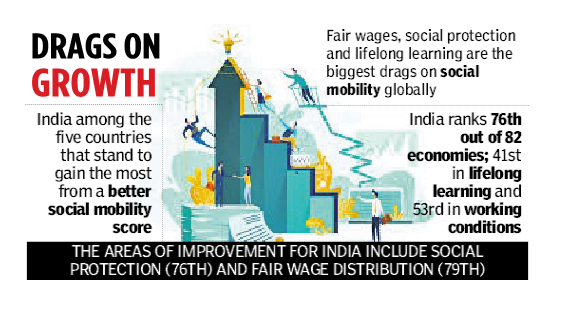
    • It has come out with its first-ever Global Social Mobility Report, which has ranked India a lowly 72 out of the 82 countries profiled.
    • According to the report, the Nordic economies such as Denmark and Finland top the social mobility rankings while countries like India, Pakistan, Bangladesh and South Africa languish at the bottom (see Table 1).

    Table 1: WEF’s Global Social Mobility Rankings

    Country Rank (out of 82)
    Denmark 1
    Germany 11
    United Kingdom 21
    United States 27
    Russia 39
    China 45
    Saudi Arabia 52
    Brazil 60
    India 76
    Pakistan 79


    What is the context for this report?

    • Notwithstanding fast global growth, inequalities have been growing across the world.
    • The rise of inequality has not only created massive social unrest but also adversely affected the global consensus on the kind of economic policies that countries follow.
    • A good example of this is the rise of trade protectionism across the world over the past few years.
    • Be it US or the UK several countries have started looking inwards in the hope that greater trade protectionism will help allay the fears and apprehensions of domestic workers.

    What is Social Mobility?

    • Typically, inequalities are measured in income terms. And this measure has been found inadequate.
    • As the report states, “many situations exist where, despite high levels of absolute income mobility, relative social mobility remains low.
    • For example, in economies such as China and India, economic growth can lift entire populations upward in terms of absolute income, but an individual’s status in society relative to others remains the same”.
    • The report states: “The notion of relative social mobility is more closely related to the social and economic status of an individual relative to their parents. I
    • n a country with a society with perfect relative mobility, a child born in a low-income family would have as much chance to earn a high income as a child born to parents who earn a high income”.

    Thus, the concept of social mobility is much broader than just looking at income inequality. It encompasses several concerns such as:

    • Intragenerational mobility: The ability for an individual to move between socio-economic classes within their own lifetime.
    • Intergenerational mobility: The ability for a family group to move up or down the socio-economic ladder across the span of one or more generations.
    • Absolute income mobility: The ability for an individual to earn, in real terms, as much as or more than their parents at the same age.
    • Absolute educational mobility: The ability for an individual to attain higher education levels than their parents.
    • Relative income mobility: How much of an individual’s income is determined by their parents’ income.
    • Relative educational mobility: How much of an individual’s educational attainment is determined by their parents’ educational attainment.

    Why does social mobility matter?

    • How far an individual can move up in the society determines a lot whether one is closer to the income “floor” (or poor) or “ceiling” (or rich).
    • Social mobility levels, then, can help us understand both the speed – that is, how long it takes for individuals at the bottom of the scale to catch up with those at the top – and the intensity – that is, how many steps it takes for an individual to move up the ladder in a given period – of social mobility.
    • Research also shows that countries with high levels of relative social mobility—such as Finland, Norway or Denmark— exhibit lower levels of income inequality.
    • Conversely, countries with low relative social mobility—such as India, South Africa or Brazil—also exhibit high levels of economic inequality.
    • That’s why it matters for countries like India to increase social mobility.


    As shown in Table 2, it would take a whopping 7 generations for someone born in a low-income family in India to approach mean income level; in Denmark, it would only take 2 generations.


    Table 2: Income Mobility across Generations

    Country Number of generations required by a poor family member to achieve mean income level
    Denmark 2
    United States/ United Kingdom 5
    Germany/ France 6
    India/China 7
    Brazil/South Africa 9


    So, how is social mobility calculated?

    The WEF’s Global Social Mobility Index assesses the 82 economies on “10 pillars” spread across the following five key dimensions of social mobility:

    1. Health;
    2. Education (access, quality and equity, lifelong learning);
    3. Technology;
    4. Work (opportunities, wages, conditions);
    5. Protection and Institutions (social protection and inclusive institutions).

    How did India perform on each of the 10 pillars of social mobility?

    India’s overall ranking is a poor 76 out of the 82 countries considered. Thus it should not come as any surprise that India ranks lowly in individual parameters as well.

    Table 3 below provides the detailed breakup.

    Table 3: Where India ranks on the 10 Pillars of Social Mobility

    Parameter Rank (out of 82 countries)
    Health 73
    Access to Education 66
    Quality and Equity in Education 77
    Lifelong learning 41
    Access to Technology 73
    Work Opportunities 75
    Fair Wage Distribution 79
    Working Conditions 53
    Social Protection 76
    Inclusive Institutions 67


    Back2Basics

    World Economic Forum (WEF)

    • The WEF based in Cologny-Geneva, Switzerland, is an NGO founded in 1971.
    • The WEF’s mission is cited as “committed to improving the state of the world by engaging business, political, academic, and other leaders of society to shape global, regional, and industry agendas”.
    • It is a membership-based organization, and membership is made up of the world’s largest corporations.
    • The WEF hosts an annual meeting at the end of January in Davos, a mountain resort in Graubünden, in the eastern Alps region of Switzerland.

    Various reports published by WEF:

    [Tikdam: Most (Not all) reports titled with ‘Global’ are released by WEF.]

    1. Global Competitiveness Report
    2. Global Information Technology Report
    3. Global Gender Gap Report
    4. Global Travel and Tourism Report
    5. Global Enabling Trade Report etc.