Attitude refers to a person’s predisposition to think, feel and act in a particular way. In the words of Lou Holtz,
“Ability is what you’re capable of doing. Motivation determines what you do. Attitude determines how well you do it.”
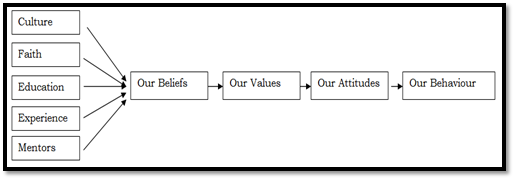
Importance of Attitude in the Development of Humans
Knowledge Function- Attitudes help humans organize and simplify complex information. Eg- positive attitude toward “Digital Governance” make it easier to implement new tech-tools.
Ego-Defensive Function- Protects self-esteem and emotional stability. Eg- Coping with failure without losing confidence.
Value-Expressive Function- Attitudes allow humans to express their central values.
Instrumental function – Guides behaviour to achieve rewards and avoid punishment.
Adaptive (utilitarian) function – Helps individuals adjust to social and professional environments
Attitude acts as a “behavioral compass,” ensuring consistency in beliefs and actions, leading to a sense of “Wholeness.”
Decision-making function – Influences judgement and choices.
Ways to build a suitable attitude for a public servant
Internalising constitutional and ethical values. Eg- Ethics training at LBSNAA.
Sensitivity Training through village immersion programs for breaking the “Elite Bubble.”
Practicing Self-reflection for recognising biases and emotional triggers. Eg- reflective journaling.
Developing Emotional intelligence through mindfulness and counselling sessions for managing stress and conflict constructively.
Role modelling. Eg- “Technocratic Optimism” of E. Sreedharan for a solution-oriented attitude
Learning responsibility through transparency. Eg- Social audits and RTI processes.
Continuous learning for updating knowledge and perspectives. Eg- Mid-career training.
Adversity Simulation – Creating high-pressure scenarios in a controlled environment to build resilience. Eg- “crisis-room” simulation during training
Peer-to-Peer De-biasing- Group sessions to identify and dismantle hidden prejudices and develop objectivity. Eg- Using Implicit Association Tests (IAT)
Feedback Loops- Direct citizen interaction to develop compassion and leadership. Eg- Jan Sunwais
Historical Analysis of Failures to build Proactiveness. Eg- Analyzing the Bhopal Gas Tragedy to foster an attitude of “Precautionary Vigilance” rather than “Post-facto Compliance.”
These can help in shifting from a “Command and Control” mindset to “Collaborate and Care” attitude among public servants