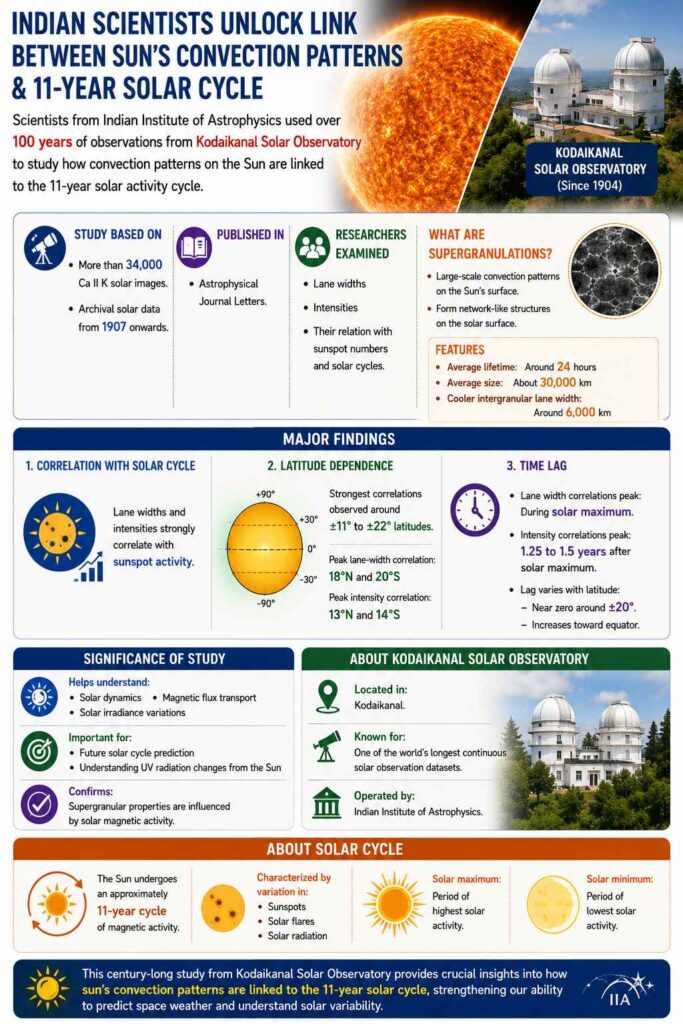
Why in News?
Scientists from Indian Institute of Astrophysics used over 100 years of observations from Kodaikanal Solar Observatory to study how convection patterns on the Sun are linked to the 11-year solar activity cycle.
Key Highlights
- Study based on: More than 34,000 Ca II K solar images.
- Published in: Astrophysical Journal Letters.
- Researchers examined:
- Lane widths
- Intensities
- Their relation with sunspot numbers and solar cycles.
Note: The 34,000 Ca II K solar images mean a historic, 100-year-old archive of solar photographs from India’s Kodaikanal Solar Observatory that scientists recently digitized and used to solve mysteries about the Sun’s 11-year magnetic cycle.
What are Supergranulations?
- Large-scale convection patterns on the Sun’s surface.
- Form network-like structures on the solar surface.
Features
- Average lifetime: Around 24 hours.
- Average size: About 30,000 km.
- Cooler intergranular lane width: Around 6,000 km.
Note: An intergranular lane is the darker, cooler region found between bright granules (bright cellular structures visible on the Sun’s surface) on the Sun’s surface.
Major Findings
Correlation with Solar Cycle
- Lane widths and intensities strongly correlate with Sunspot activity.
Latitude Dependence
- Strongest correlations observed around ±11° to ±22° latitudes.
- Peak lane-width correlation 18°N and 20°S.
- Peak intensity correlation 13°N and 14°S.
Time Lag
- Lane width correlations peak:
- During solar maximum.
- Intensity correlations peak:
- 1.25 to 1.5 years after solar maximum.
- Lag varies with latitude:
- Near zero around ±20°.
- Increases toward equator.
Significance of Study
- Helps understand:
- Solar dynamics
- Magnetic flux transport
- Solar irradiance variations.
- Important for:
- Future solar cycle prediction.
- Understanding UV radiation changes from the Sun.
- Confirms:
- Supergranular properties are influenced by solar magnetic activity.
About Kodaikanal Solar Observatory
- Located in: Kodaikanal.
- Known for: One of the world’s longest continuous solar observation datasets.
- Operated by: Indian Institute of Astrophysics.
About Solar Cycle
- The Sun undergoes an approximately: 11-year cycle of magnetic activity.
- Characterized by variation in:
- Sunspots
- Solar flares
- Solar radiation.
- Solar maximum: Period of highest solar activity.
- Solar minimum: Period of lowest solar activity.
[2022] If a major solar storm (solar flare) reaches the Earth, which of the following are the possible effects on the Earth?:
1. GPS and navigation systems could fail.
2. Tsunamis could occur at equatorial regions.
3. Power grids could be damaged.
4. Intense auroras could occur over much of the Earth.
5. Forest fires could take place over much of the planet.
6. Orbits of the satellites could be disturbed
7. Shortwave radio communication of the aircraft flying over polar regions could be interrupted.
Select the correct answer using the code given below;
[A] 1, 2, 4 and 5 only
[B] 2, 3, 5, 6 and 7 only
[C] 1, 3, 4, 6 and 7 only
[D] 1, 2, 3, 4, 5, 6 and
