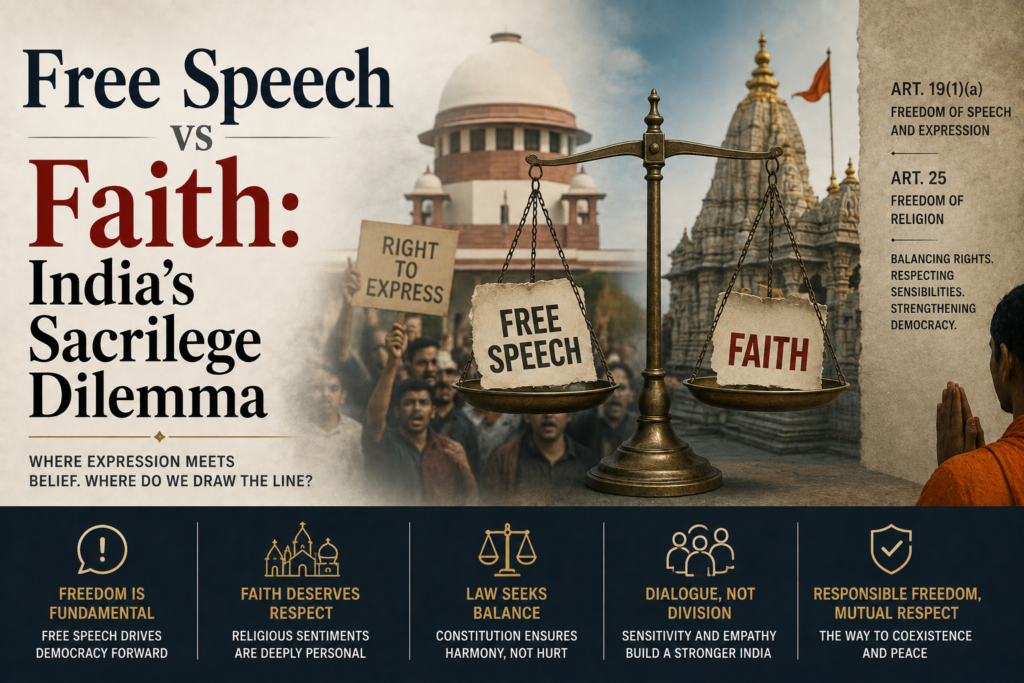
Why in the News
Punjab’s Governor assented in April 2026 to the Jaagat Jot Sri Guru Granth Sahib Satkar (Amendment) Act, which provides punishment up to life imprisonment for sacrilege. The Act also covers words, signs, visible representations and electronic means, raising debate over the boundary between sacrilege and blasphemy.
What is the Act?
- Applies to wilful and deliberate desecration of the Guru Granth Sahib.
- Covers physical acts such as damage, defacement, burning, tearing and theft of Saroop.
- Also covers certain spoken/written words, signs, visual representations and electronic acts.
- Emerged against the backdrop of the 2015 Bargari and Burj Jawahar Singh Wala incidents.
Key Legal Provisions
Bharatiya Nyaya Sanhita, 2023 (BNS)
- Replaced the Indian Penal Code, 1860 from July 2024.
- Section 298: Offences involving injury/defilement of places of worship.
- Section 299: Deliberate and malicious acts intended to outrage religious feelings, including through electronic means.
- Section 299 carries forward the substance of former Section 295A, IPC.
Constitutional Provisions
- Article 19(1)(a): Freedom of speech and expression.
- Article 19(2): Permits reasonable restrictions, including for public order.
- Article 25: Freedom of conscience and religion, subject to public order, morality and health.
- Article 14: Equality before law.
- Article 51A(e): Promotes harmony and common brotherhood.
- Article 51A(h): Promotes scientific temper, inquiry and reform.
- Secularism: Part of the basic structure of the Constitution.
Sacrilege vs Blasphemy
- Sacrilege: Physical or conduct-based desecration of something sacred.
- Blasphemy: Expressive acts showing contempt or irreverence towards religious beliefs.
- Concern: Punjab’s law potentially merges the two by treating certain expressive acts as sacrilege.
Historical Background of Section 295A
- Rangila Rasul pamphlet triggered controversy in Lahore in 1924.
- Section 295A IPC was enacted in 1927 to criminalise deliberate and malicious acts intended to outrage religious feelings.
- The Supreme Court upheld its constitutionality in Ramji Lal Modi v. State of Uttar Pradesh (1957) under the Article 19(2) public order exception.
Key Concerns
- Chilling effect on speech, scholarship and satire.
- Subjective interpretation of religious hurt.
- Potential misuse by organised complainants.
- Risk of vigilante violence despite criminalisation.
- Digital communication expands the potential reach of the offence.
- Different States may prescribe different levels of punishment.
