Why in News?
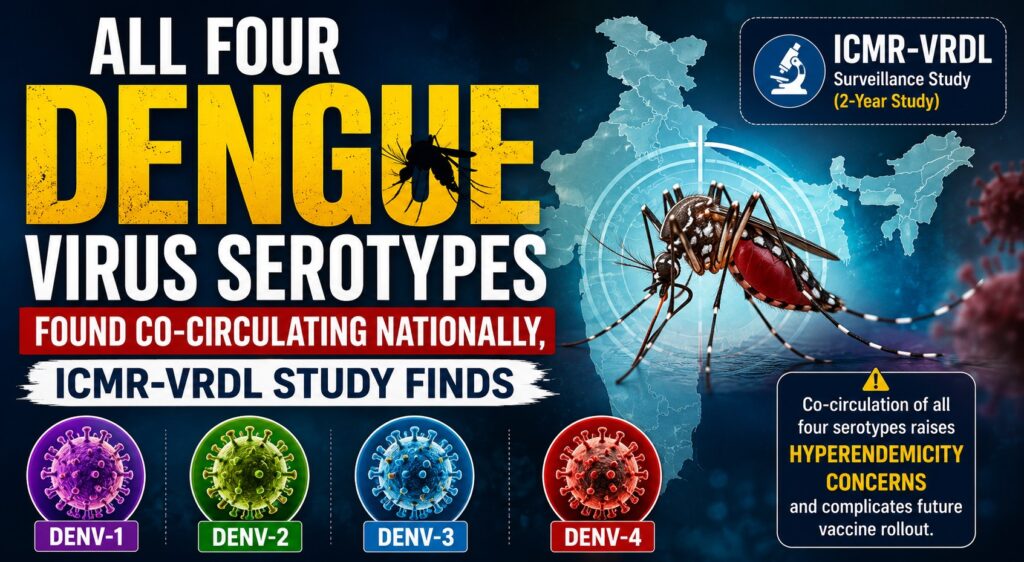
A two year Indian Council of Medical Research-Virus Research and Diagnostic Laboratory (ICMR-VRDL) surveillance study finds all four dengue virus serotypes co-circulating nationally, raising hyperendemicity concerns and complicating future vaccine rollout.
Key Highlights
- Study duration: Conducted over two years through nationwide surveillance.
- Conducting body: ICMR-Virus Research and Diagnostic Laboratory (VRDL) Network.
- Key concern: Simultaneous circulation of all serotypes indicates hyperendemicity, increasing the risk of severe dengue and complicating vaccine strategies.
- Note: A serotype is a distinct subgroup or variation of a microorganism (such as a bacterium or virus) classified by the specific antigens found on its surface
What is Dengue?
- Dengue is a viral disease caused by the dengue virus (DENV).
- It is transmitted by the female Aedes aegypti mosquito (also Aedes albopictus).
- The virus has four distinct serotypes: DENV-1, DENV-2, DENV-3 and DENV-4.
- Infection with one serotype provides lifelong immunity only against that serotype and temporary protection against the others.
What is Hyperendemicity?
- Hyperendemicity refers to the simultaneous circulation of multiple serotypes of the same pathogen in a region.
- It increases the likelihood of secondary infections, which can lead to severe dengue due to Antibody-Dependent Enhancement (ADE).
About the ICMR-VRDL Network
- Established by the Indian Council of Medical Research (ICMR).
- Functions as a nationwide network for diagnosis, surveillance and research on viral diseases.
- Supports early detection and monitoring of emerging and re-emerging viral infections.
[2017] Consider the following statements:
1. In tropical regions, Zika virus disease is transmitted by the same mosquito that transmits dengue.
2. Sexual transmission of Zika virus disease is possible.
Which of the statements given above is/are correct?
[A] 1 only
[B] 2 only
[C] Both 1 and 2
[D] Neither 1 nor 2
