Why in News?
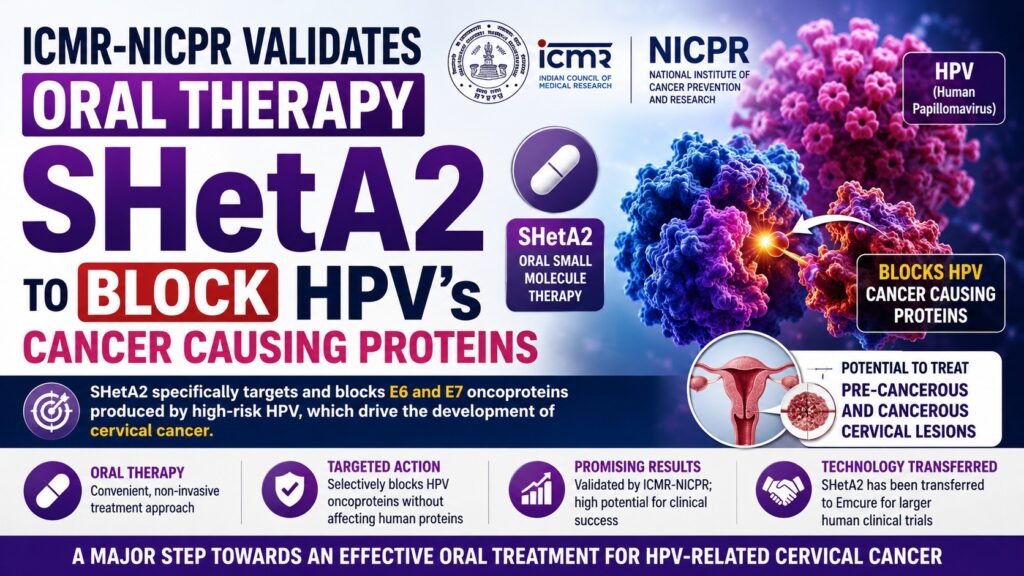
The Indian Council of Medical Research-National Institute of Cancer Prevention and Research (ICMR-NICPR) has validated an oral small molecule therapy, SHetA2, that blocks Human Papillomavirus (HPV)’s cancer causing proteins, potentially treating pre-cancerous and cancerous cervical lesions. The molecule has been transferred to Emcure for larger human trials.
Key Highlights
- Therapy: SHetA2, an oral small molecule drug.
- Mechanism: Blocks HPV oncoproteins (E6 and E7), which drive cervical cancer development.
- Target: Designed to treat pre-cancerous (CIN) and cancerous cervical lesions.
- Validating body: ICMR-National Institute of Cancer Prevention and Research (ICMR-NICPR).
- Next stage: Technology transferred to Emcure for advanced human clinical trials.
- Significance: Represents a potential non-surgical, oral treatment for HPV-related cervical disease.
What is Human Papillomavirus (HPV)?
- HPV is a common DNA virus that infects the skin and mucous membranes.
- It is transmitted mainly through sexual contact.
- Persistent infection with high-risk HPV types, especially HPV-16 and HPV-18, is the leading cause of cervical cancer.
- HPV is also associated with cancers of the anus, vulva, vagina, penis and oropharynx.
How Does SHetA2 Work?
- Inhibits the activity of HPV’s E6 and E7 oncoproteins.
- Restores the function of tumour suppressor proteins (p53 and Rb), allowing abnormal cells to undergo programmed cell death (apoptosis).
- May help prevent progression from pre-cancerous lesions to invasive cervical cancer.
Significance
- Offers a non-invasive oral treatment option for HPV-related cervical lesions.
- May reduce the need for surgical procedures in early-stage disease.
- Supports India’s efforts to reduce the burden of cervical cancer, one of the most common cancers among women.
- Demonstrates the growing role of indigenous biomedical research and public-private collaboration.
Government Initiatives
- National Programme for Prevention and Control of Non-Communicable Diseases (NP-NCD) includes cervical cancer screening.
- Introduction of Cervavac, India’s indigenous HPV vaccine, to expand cervical cancer prevention.
- Promotion of HPV vaccination, screening and early diagnosis under national health programmes.
[2021] Consider the following statements:
1. Adenoviruses have single-stranded DNA genomes whereas retroviruses have double-stranded DNA genomes.
2. Common cold is sometime caused by an adenovirus whereas AIDS is caused by a retrovirus.
Which of the statements given above is/are correct?
[A] 1 only
[B] 2 only
[C] Both 1 and 2
[D] Neither 1 nor 2
