Why in the News?
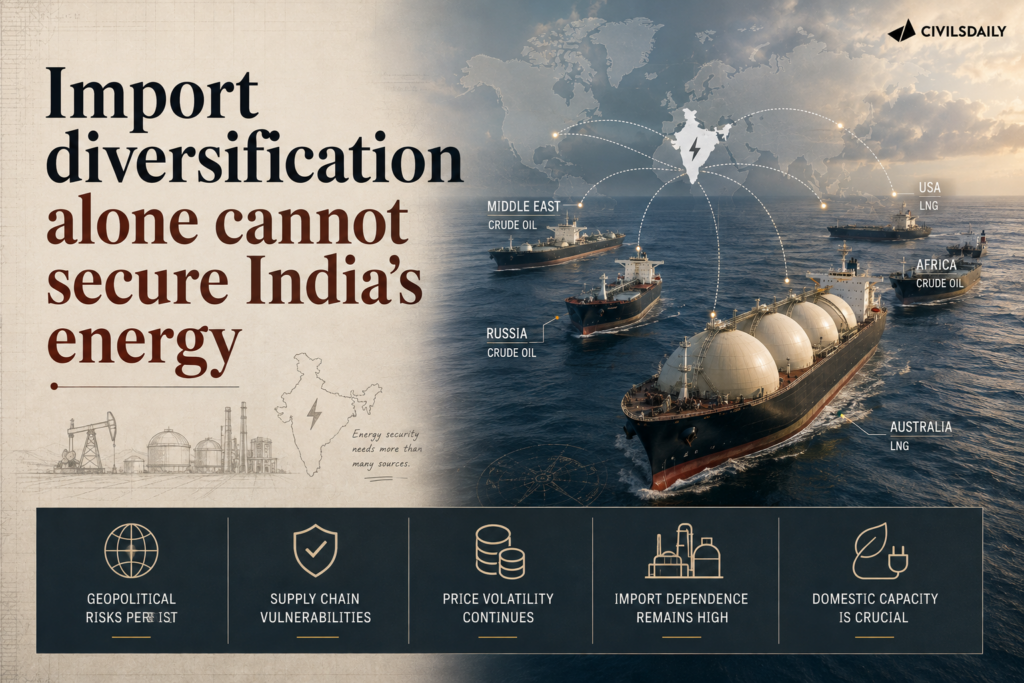
Diversifying import sources cannot by itself secure India’s energy supply while crude and gas still transit a few chokepoints. The tension is between the visible fix of new suppliers and the hidden vulnerability of the routes those supplies travel.
What is the energy security problem being described?
- Route dependence: India’s crude and Liquefied Petroleum Gas (LPG) flows still pass through a handful of maritime chokepoints.
- Supplier shift alone: Adding new source countries does not remove the risk if the shipping route stays the same.
Which chokepoints concentrate the risk?
- Strait of Hormuz: The Gulf’s primary oil export chokepoint, exposed to conflict escalation.
- Bab el-Mandeb: The Red Sea gateway threatened by Houthi attacks on shipping.
How does external policy compound the exposure?
- US tariff pressure: Trade measures constrain India’s room to optimise import decisions.
- Conflict spillover: West Asia instability raises both price and insurance costs.
What structural response does the argument imply?
- Strategic reserves: Deeper petroleum reserves buffer supply shocks.
- Domestic transition: Faster renewable and storage build out reduces import dependence over time.
Conclusion
The central idea is that supplier diversification treats the symptom, not the structural route risk. Real energy security needs resilience against chokepoint disruption, not just a longer supplier list.
PYQ Relevance
[UPSC 2017] The question of India’s Energy Security constitutes the most important part of India’s economic progress. Analyze India’s energy policy cooperation with West Asian Countries.
Linkage: The PYQ examines India’s energy security through its dependence on West Asian energy supplies and strategic partnerships. The article highlights how chokepoint dependence and regional instability can undermine India’s energy security despite diversification of suppliers.
