| PYQ Relevance [UPSC 2019] ‘What introduces friction into the ties between India and the United States is that Washington is still unable to find for India a position in its global strategy, which would satisfy India’s National self-esteem and ambitions’ Explain with suitable examples. Linkage: The PYQ examines the structural frictions in India-US ties arising from differences in strategic priorities and expectations. The article shows how the relationship is shifting from strategic convergence to reciprocal, transactional cooperation, reinforcing the PYQ’s concern over divergent expectations. |
Mentor’s Comment
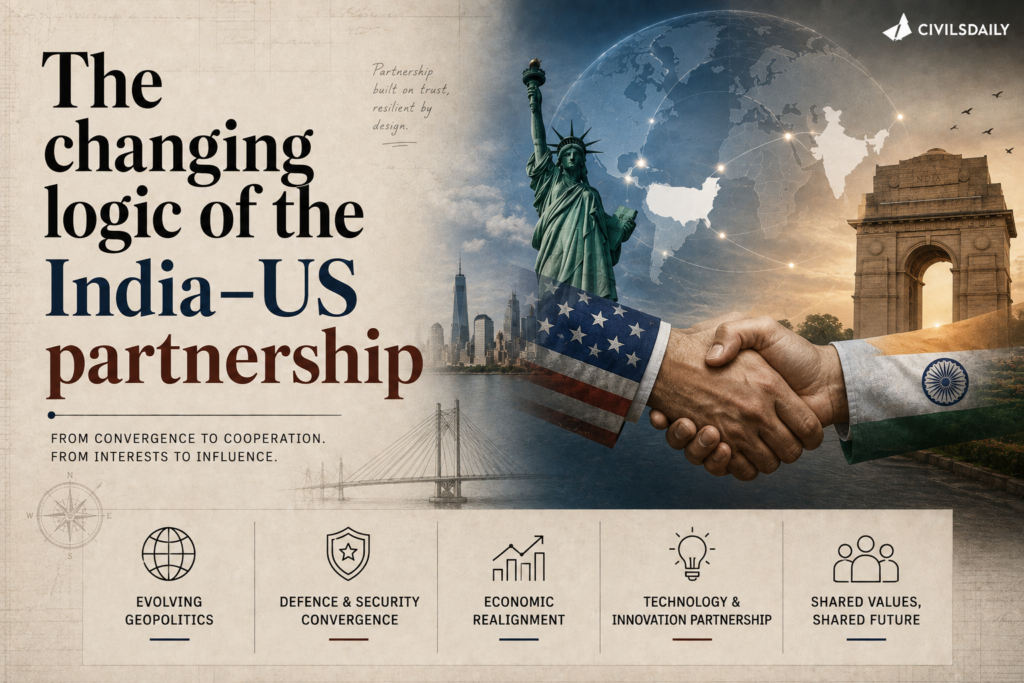
An analysis argues the India-US partnership now runs on ‘flexible realism’ rather than shared containment of China. The first decade of the India-U.S. partnership was propelled by shared concern over China’s rise, not by identical values. As Washington moves toward interest-based alliance building, India’s strategic relevance will depend less on China’s trajectory and more on India’s own economic, technological, and military weight. This is a test of how convincingly India can operationalise strategic autonomy through multi-alignment.
What is the shift in the partnership’s logic?
- From convergence to reciprocity: The relationship is moving from a China driven strategic alignment to a value for value calculus.
- Tariff signal: Trump tariffs on Indian goods illustrate that shared interests no longer guarantee concessions.
Why does the tariff dispute signal a deeper shift in American foreign policy, not merely a trade rift?
- Not an isolated trade dispute: The tariffs accompany demands for greater burden-sharing, tighter technology restrictions, and a more reciprocal approach to partnerships, indicating a policy pattern rather than a standalone measure.
- Flexible realism defined: This approach places national interest at the centre of foreign policy and treats trade, technology, industrial policy, and security as integrated instruments of statecraft.
- Departure from the post-Cold War order: Partnerships are judged by the tangible strategic and economic value they deliver, not by shared values or historical goodwill.
- Not a retreat from engagement: The approach recalibrates how the U.S. pursues its interests rather than signalling disengagement from global affairs.
What strategic logic sustained the India-U.S. partnership over the past decade, and why can this convergence no longer be assumed?
- China as the organising driver: India’s growing strategic importance to the U.S. followed directly from China’s emergence as Washington’s principal strategic competitor.
- Convergence visible across domains: Defence cooperation, the Quad, technology partnerships, and supply-chain resilience all expanded on the back of this shared concern.
- Values were a backdrop, not the driver: Democratic values provided a favourable political context, but strategic convergence on China was the actual engine of cooperation.
- Assumption no longer holds: India can no longer assume that intensifying U.S.-China competition will automatically enhance its own strategic relevance.
- New basis of assessment: Washington will increasingly judge partners, including India, by reciprocal economic benefit, technological capability, and strategic contribution.
How is the basis of the India-U.S. partnership shifting from convergence to complementarity?
- First phase defined: The initial phase of the relationship rested on strategic convergence driven by China’s rise.
- Second phase defined: The next phase depends on strategic complementarity, with each side contributing capabilities that reinforce the other.
- Substantive domains: Defence cooperation, critical technologies, resilient supply chains, and advanced manufacturing will matter for their own economic and strategic value, not only as tools to manage China.
- Net strategic effect: This evolution could make the partnership more balanced and resilient rather than weaker.
- Reframing India’s relevance: A more capable India becomes a more valuable partner for the U.S. and is also better placed to pursue its own strategic interests independently.
Why is the shift happening now?
- Domestic priorities: Washington is prioritising reciprocal trade gains over grand strategy.
- Multipolar drift: A more contested global order weakens automatic alignment.
What is India’s central challenge in this new phase of the relationship?
- Relevance must be self-generated: India’s strategic relevance must increasingly flow from its own economic dynamism, technological capability, defence preparedness, and diplomatic influence.
- From remaining relevant to becoming indispensable: The task is not just to stay useful in Washington’s calculus but to build the capabilities that make India an indispensable partner.
- Convergence still matters, but is insufficient alone: Shared concern over China will remain important but can no longer be the sole basis for sustaining momentum.
- Dual payoff: Building these capabilities would strengthen the India-U.S. partnership and reinforce India’s own strategic autonomy at the same time.
How should India respond?
- Strategic autonomy: Preserve independent decision making rather than lock into one camp.
- Multi alignment: Deepen ties across the European Union, Japan, and the Global South.
- Strategic complementarity: Offer the US areas where Indian and American interests genuinely reinforce each other.
Conclusion
The tariffs mark a transition in American statecraft from strategic convergence to reciprocity-based partnership, and the India-U.S. relationship must transition correspondingly from a China-driven first phase to a capability-driven second phase. Strategic convergence around China will persist but can no longer be assumed sufficient on its own. India’s task is to build the economic, technological, and defence capabilities that make it an indispensable partner in its own right, using strategic autonomy and multi-alignment to convert this recalibration into greater agency rather than vulnerability.
