Why in the News
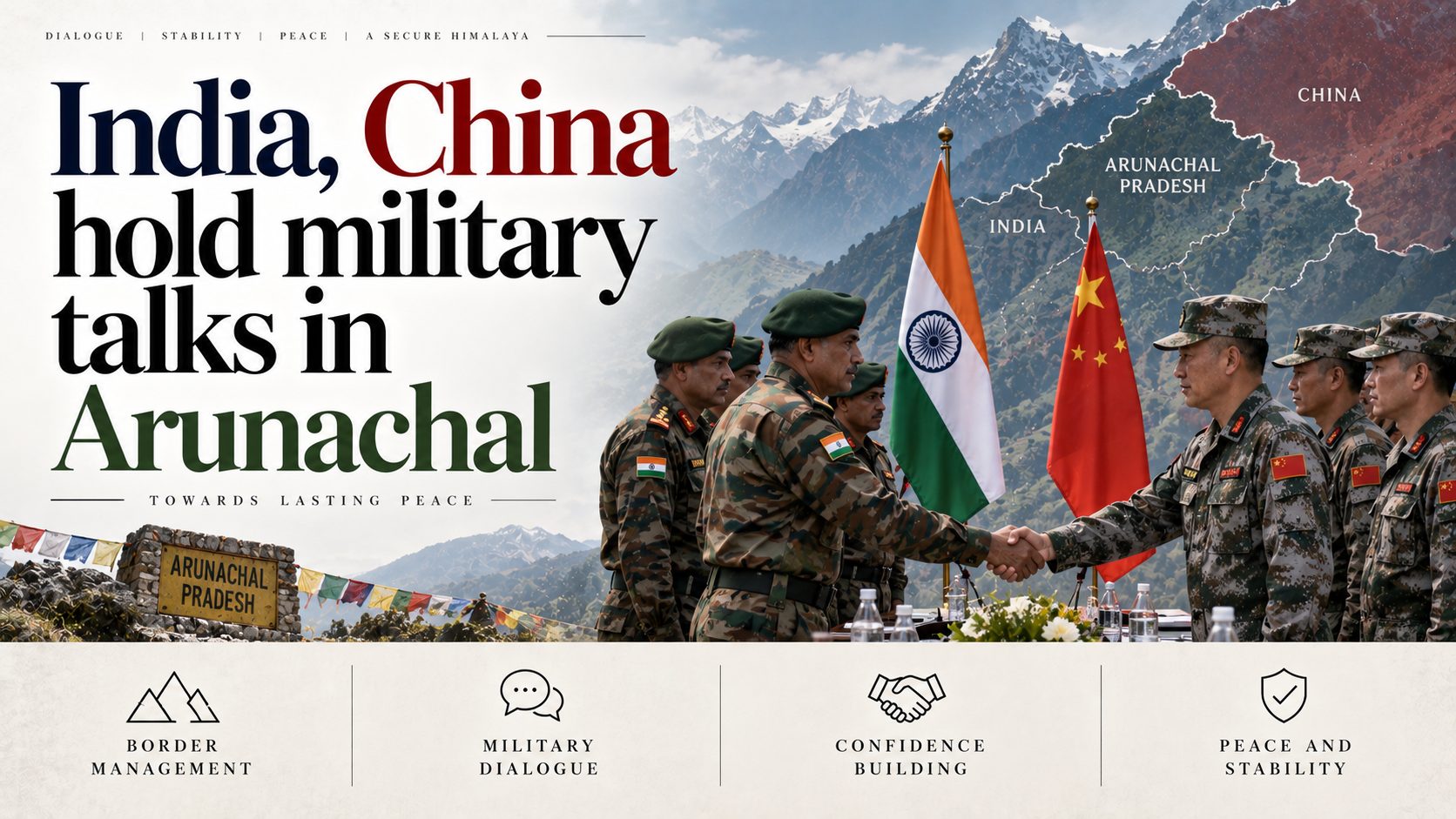
The Indian and Chinese Armies have held their first Corps Commander-level meeting in the Eastern Sector, at the Vacha-Damai Border Personnel Meeting Point in Arunachal Pradesh.
What is a Border Personnel Meeting Point?
- A designated meeting place on the Line of Actual Control: Border Personnel Meeting Points are fixed locations along the Line of Actual Control (LAC) where troops and local commanders of the two armies meet face to face on agreed dates.
- The lowest rung of the border management architecture: They handle local incidents, transgressions and ceremonial exchanges, sitting below the diplomatic and Special Representatives channels that handle the boundary question itself.
- Five existed before this round: Chushul and Daulat Beg Oldi in Ladakh, Nathu La in Sikkim, and Bum La and Kibithu in Arunachal Pradesh.
What is new about this meeting?
- The first at this level in the Eastern Sector: Corps Commander-level meetings between the two armies have largely been held at the Chushul-Moldo Border Meeting Point in eastern Ladakh, particularly after the Galwan Valley clashes.
- A mechanism built for one sector applied to another: Until now the Corps Commander-level channel had primarily been used to address military issues and tensions along the western sector in Ladakh.
- The delegation was joint rather than purely Army: The Commander of 3 Corps led a 12-member delegation that included an Inspector-General of the Indo-Tibetan Border Police (ITBP), the force that mans the border posts along the LAC.
- The formation that owns the ground led it: 3 Corps, headquartered at Rangapahar in Nagaland, is responsible for operational areas along the LAC in Arunachal Pradesh, alongside the Tezpur-based 4 Corps.
What friction prompted the meeting?
- Reported activity in a specific pocket: Chinese activity and alleged incursions have continued in the Taksing area of Upper Subansiri district despite two high-level engagements since July.
- Conflicting claims and a build-up along the line: The meeting takes place against conflicting territorial claims and a military build-up along the LAC, which is the standing condition the local mechanism exists to manage.
- Operational readiness reviewed at the same time: The Army Chief recently visited the headquarters of 3 Corps, where formation commanders briefed him on operational readiness and on measures being taken to strengthen combat capabilities.
How has the border dialogue architecture been built up this year?
- The diplomatic tier met first: The two countries held the 36th meeting of the Working Mechanism for Consultation and Coordination on India-China Border Affairs on 6 August.
- The political tier followed three weeks later: The 25th round of talks between the Special Representatives on the Boundary Question was held in Beijing on 26 August. India was represented by the National Security Adviser, and the Chinese delegation was led by the Director of the Office of the Central Commission for Foreign Affairs.
- Two new meeting points and new hotlines were agreed: The eight-point outcome document provided for two additional Border Personnel Meeting Points and new hotlines to strengthen communication and confidence-building along the frontier.
- The new points cover the sectors that lacked them: One of the newly proposed points will be in the Eastern Sector under the operational responsibility of 3 Corps, and the other in the Central Sector. Joshimath is not among the newly identified points.
Challenges to the border personnel meeting mechanism
- Local commanders have no agreed line to refer to: The LAC has never been jointly delineated on maps, so a meeting on a transgression begins with each side asserting a different alignment. Eg. The two countries exchanged maps of the middle sector around 2001 and the process stalled before the western and eastern sectors were taken up.
The Fix: Resume the map exchange sector by sector, beginning with the pockets where transgressions recur, so a local meeting has a common reference document. - Infrastructure asymmetry sets the terms of any local talk: China’s road, rail and airfield network across the plateau allows a faster build-up than Indian logistics in the eastern frontier permit. Eg. The Lhasa-Nyingchi railway, opened in 2021, runs close to the eastern frontier.
The Fix: Complete the Arunachal Frontier Highway and the all-weather tunnel network on the Indian side, so force posture does not depend on seasonal road access. - Facts on the ground change between meetings: Dual-use border villages and permanent construction alter the position a subsequent meeting is negotiating over. Eg. China has built clusters of border villages opposite the Arunachal Pradesh frontier.
The Fix: Accelerate delivery under the Vibrant Villages Programme, so the Indian side of the frontier retains a resident population that anchors the claim. - The mechanism has no calendar of its own: Meetings convene when one side requests them, so the channel is least available during the periods of tension it exists for. Eg. The extension to the Eastern Sector required a decision at the Special Representatives level rather than a local one.
The Fix: Fix a mandatory minimum frequency for meetings at each point and a defined response window for a request raised outside it.
Conclusion
The dialogue architecture along the frontier has moved from a single-sector crisis channel to one that covers the eastern and central stretches as well. Whether that widening amounts to more than an additional venue depends on whether the two newly agreed meeting points and hotlines become operational, and how quickly a reported transgression is taken up through them. The immediate milestone is the BRICS Summit that India hosts in New Delhi from 11 to 13 September, which the Chinese President is expected to attend.
Back2Basics
- Working Mechanism for Consultation and Coordination on India-China Border Affairs: A diplomatic-level institutional channel established in 2012 to manage peace and tranquility along the border between the two countries.
- Composition: It is led by joint-secretary-level officials of India’s Ministry of External Affairs and China’s Ministry of Foreign Affairs, with representatives of the defence establishments of both sides.
- Mandate: It coordinates on incidents along the LAC and prepares the ground for talks at the Special Representatives level, and it holds no authority to settle the boundary itself.
[2024, GS3, 15 marks] India has a long and troubled border with China and Pakistan fraught with contentious issues. Examine the conflicting issues and security challenges along the border. Also give out the development being undertaken in these areas under the Border Area Development Programme (BADP) and Border Infrastructure and Management (BIM) Scheme.”
