Why in the News:
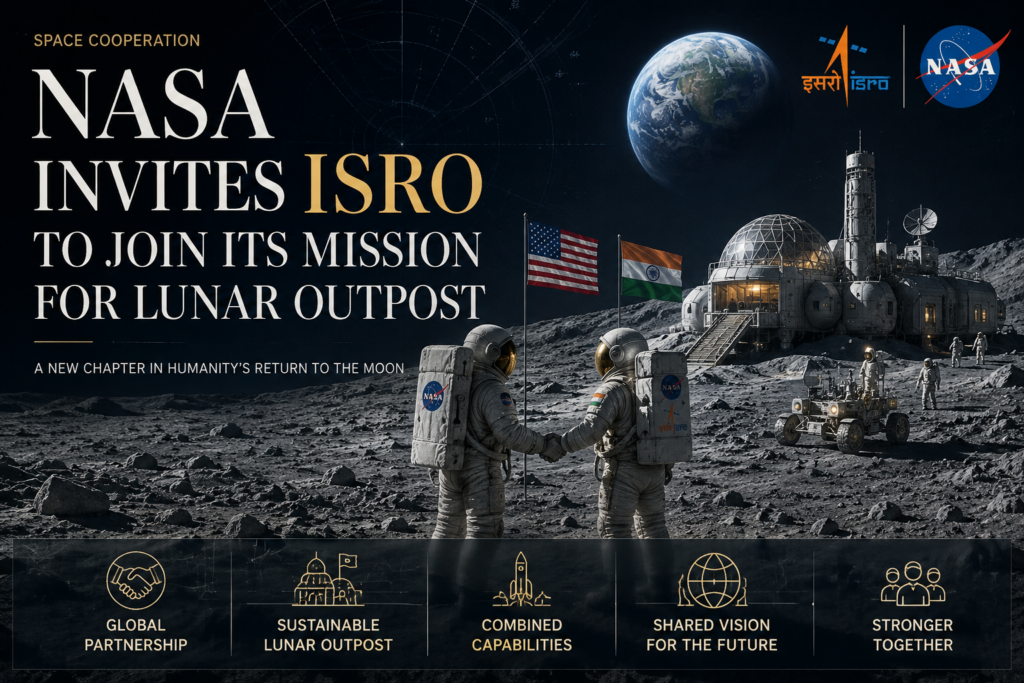
The National Aeronautics and Space Administration (NASA) has invited the Indian Space Research Organisation (ISRO) to join its Moon Base programme, the effort to return humans to the Moon and set up a permanent settlement near the lunar South Pole. The invitation was extended at the ninth meeting of the India and United States Civil Space Joint Working Group, deepening a partnership that already spans the Artemis Accords and a joint radar satellite.
What was announced and what is the Moon Base programme?
- The invitation: NASA invited ISRO to join its Moon Base programme, building on the two countries’ partnership under the Artemis Accords.
- The venue: The offer was made at the ninth meeting of the India and United States Civil Space Joint Working Group, held in Bengaluru on 5 and 6 August.
- The programme: The Moon Base programme aims to establish humanity’s first outpost on another celestial body, near the South Pole of the Moon.
- Wider setting: The meeting advanced civil and commercial space cooperation under a strategic technology initiative aligned with the February 2025 Joint Leaders’ Statement.
What are the Artemis Accords?
- Definition: The Artemis Accords are a United States led set of non binding principles to govern the peaceful civil exploration and use of outer space, including the Moon.
- India’s role: India signed the Accords in 2023 as the 27th country, and a total of 70 countries are now part of them.
- Relevance: The Moon Base invitation and agreed open scientific data sharing are being pursued under this framework.
What deepening ties does the invitation reflect?
- NISAR mission: The two agencies last year launched the NASA and ISRO Synthetic Aperture Radar (NISAR) mission, a dual frequency radar satellite and a first of its kind joint venture.
- Human spaceflight: An Indian astronaut flew to the International Space Station in 2025 through an Axiom mission, a result of a strategic framework for human spaceflight cooperation.
- Data cooperation: Both sides agreed to advance open scientific data sharing and discussed joint missions to the Moon and beyond.
- Outer space governance: They reaffirmed commitment to United Nations guidelines on the long term sustainability of outer space activities.
What are India’s own lunar and human spaceflight programmes?
- Gaganyaan: ISRO is pursuing its human spaceflight programme to send Indian astronauts to low Earth orbit.
- Moon landing target: India has stated plans to achieve a human landing on the Moon by 2040.
- Chandrayaan legacy: India’s earlier lunar missions established its capability, including a South Pole region landing.
- Complementary strengths: NISAR’s success is seen as a base for more complex joint missions, including the lunar base and human spaceflight.
Back2Basics: NISAR Mission
- Full form: NASA and ISRO Synthetic Aperture Radar mission.
- Nature: A joint Earth observation satellite using dual frequency radar, a first of its kind.
- Purpose: Monitors changes in land surface, ice sheets, ecosystems and natural hazards.
- Significance: Regarded as a landmark joint venture that could enable more complex India and United States space missions.
Government Initiatives / Programmes in Indian Space
- Gaganyaan: India’s human spaceflight programme to send astronauts to low Earth orbit.
- Chandrayaan Programme: Series of lunar missions advancing India’s Moon exploration.
- IN-SPACe: Regulator and promoter enabling private sector participation in space.
- Indian Space Policy 2023: Framework opening the sector to non governmental entities.
Key Facts about India and Global Space Cooperation
- Artemis signatory: India was the 27th country to sign the Artemis Accords in 2023, now numbering 70 countries.
- Working group: The invitation came at the ninth India and United States Civil Space Joint Working Group in Bengaluru.
- Moon landing goal: India targets a human landing on the Moon by 2040.
- South Pole focus: The Moon Base aims for humanity’s first outpost near the lunar South Pole.
“[2016] Consider the following statements: The Mangalyaan launched by ISRO
1. is also called the Mars Orbiter Mission
2. made India the second country to have a spacecraft orbit the Mars after USA
3. made India the only country to be successful in making its spacecraft orbit the Mars in its very first attempt
Which of the statements given above is/are correct?
(a) 1 only
(b) 2 and 3 only
(c) 1 and 3 only
(d) 1, 2 and 3
