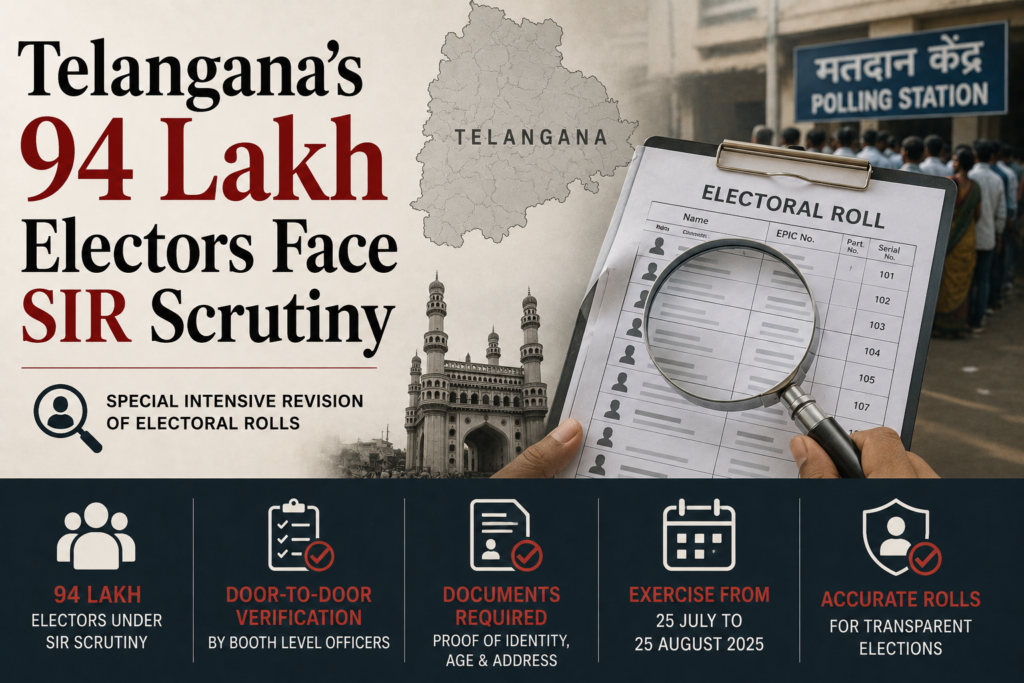
Why in the News
The Telangana Chief Electoral Officer’s office records that only 78.3 percent of enumeration forms in the ongoing Special Intensive Revision (SIR) of electoral rolls have been digitised, with the remaining 21.7 percent classified as uncollectable. Together with nearly 20 lakh technically inconsistent or unmapped entries, close to 94 lakh electors now face scrutiny, exposing a conflict between the Election Commission’s duty to purify the roll and the elector’s burden of proving continued existence at a particular address.
What is the Special Intensive Revision (SIR) of electoral rolls?
- Nature of the exercise: SIR is a house to house re-verification of the entire electoral roll ordered by the Election Commission of India, distinct from the routine annual summary revision that only adds and deletes at the margin.
- Core method: Every existing elector is served an enumeration form and must return it with supporting particulars, so continued enrolment depends on a fresh positive response rather than on the presumption of an existing entry.
- Statutory anchor: The revision is conducted under the Representation of the People Act, 1950, read with the Registration of Electors Rules, 1960, which govern preparation and revision of rolls.
- Output of the exercise: The Commission publishes a draft roll, invites claims and objections, disposes of them, and then publishes the final roll that governs the next election.
- Stated purpose: The exercise removes deceased, shifted, duplicate and ineligible entries and is intended to produce a roll free of multiple enrolment across constituencies.
What is a Booth Level Officer (BLO)?
- Who they are: A Booth Level Officer is a local government functionary, usually a schoolteacher, anganwadi worker or panchayat employee, appointed by the Electoral Registration Officer for one polling station area.
- Core duty: The BLO conducts door to door verification, distributes and collects enumeration forms and reports additions, deletions and corrections for that booth.
What is a Booth Level Agent (BLA)?
- Who they are: A Booth Level Agent is a party appointed representative attached to a polling station, authorised to submit claims and objections in bulk on behalf of a recognised political party.
- Function in a revision: The BLA is the party’s only institutional means of tracking who is being added to or removed from the roll while the revision is still under way.
What is the claims and objections phase?
- What it is: After the draft roll is published, any person may file a claim for inclusion or correction, and any elector may file an objection to another person’s entry, within a notified window.
- Why it matters here: An elector whose form is missing, uncollected or found to contain discrepancies must use this window to restore the entry, which shifts the burden of proof onto the individual.
What is the current status of the right to vote in India?
- Who holds the right: Every citizen of India not less than 18 years of age on the qualifying date, ordinarily resident in a constituency and not otherwise disqualified, is entitled to be registered as an elector.
- Nature of the right: The right to vote is a statutory right conferred by the Representation of the People Act, 1950 and 1951, not a fundamental right, though the Supreme Court has treated the act of voting as an expression of choice touching Article 19(1)(a).
- Age threshold: The voting age was lowered from 21 to 18 years by the Sixty first Constitutional Amendment Act, 1988.
- Bar on discrimination: No person may be excluded from a roll on grounds only of religion, race, caste or sex, and separate electorates stand abolished.
- Grounds of disqualification: Non citizenship, unsoundness of mind declared by a competent court, and corrupt practices or electoral offences under the Representation of the People Act, 1951 disqualify a person from registration.
- Practical precondition: Enrolment requires ordinary residence in the constituency, which is the exact test that a migration heavy electorate such as Telangana’s strains.
Which constitutional provisions govern electoral rolls and the franchise?
- Article 324: Vests superintendence, direction and control of the preparation of the electoral rolls and the conduct of all elections to Parliament, State legislatures, the office of President and the office of Vice President in the Election Commission of India.
- Article 325: Provides for a single general electoral roll for every territorial constituency and bars exclusion on grounds only of religion, race, caste or sex.
- Article 326: Establishes adult suffrage as the basis of elections to the Lok Sabha and State Legislative Assemblies, with non residence, unsoundness of mind, crime, corrupt practice or illegal practice as the only permitted disqualifications.
- Article 327: Empowers Parliament to make law on all matters relating to elections, including the preparation of electoral rolls.
- Article 328: Empowers a State legislature to legislate on election matters for that State where Parliament has not occupied the field.
- Article 329: Bars courts from questioning the delimitation of constituencies and confines challenges to an election to an election petition filed under law.
What does the Telangana revision’s own arithmetic show?
- Total electorate: The Chief Electoral Officer’s office records a total electorate of 3,38,26,448 in Telangana.
- Forms digitised: 2,64,86,214 enumeration forms have been digitised, a completion rate of 78.3 percent.
- Forms uncollectable: The remaining 21.7 percent stand classified as uncollectable, the category at the centre of the dispute.
- Additional problem entries: Nearly 20 lakh entries have been identified as technically inconsistent or unmapped, which is separate from the uncollectable set.
- Aggregate exposure: The two categories together account for nearly 94 lakh electors who may face scrutiny during the revision.
- Political reading of the figure: The State’s Chief Minister has warned party colleagues that a potential reduction of 21 percent in voter numbers would carry serious consequences.
What exactly does the uncollectable category contain?
- Deceased: 9,22,230 electors are recorded as deceased.
- Absent or untraceable: 11,25,546 electors are marked absent or untraceable.
- Permanently shifted: 45,18,961 electors are listed as permanently shifted, the single largest component of the set.
- Enrolled elsewhere: 6,70,203 electors are shown as enrolled elsewhere.
- Other categories: 1,02,294 electors fall under residual other categories.
Why has the uncollectable count risen so far?
- Verification substituted, not performed: Overburdened Booth Level Officers allegedly skipped mandatory door to door verification in several areas and worked instead from centralised collection points.
- Consequence of that substitution: Persons who could not travel to those collection centres were marked unavailable, so an administrative shortcut is recorded as an elector’s absence.
- Geographic concentration: The problem is concentrated in districts around Hyderabad, specifically the erstwhile districts of Ranga Reddy, Medak, Mahabubnagar and Nalgonda, which have seen substantial migration to the capital region.
- The dual voter imbalance: People who moved to Hyderabad retained their votes in their native places, producing low local enrolment across the 28 Assembly segments falling under the Hyderabad, Secunderabad, Chevella and Malkajgiri Lok Sabha constituencies.
- Interstate migration: Migrant workers from Bihar, Chhattisgarh and other States also vote in their home States rather than registering locally, which leaves them unavailable at the Telangana address on record.
- Absence of party level checks: The ruling party did not deploy adequate Booth Level Agents during field verification, so lapses in the revision went unchallenged while opposition parties monitored enrolment patterns closely.
Why does a roll cleaning exercise carry a disenfranchisement risk?
- Both claims are legitimate: A roll carrying deceased and duplicate entries is a genuine integrity problem, and a revision that deletes a living elector is a genuine rights problem, and the same exercise produces both outcomes.
- The burden inverts: Once an entry is classed uncollectable, the elector must affirmatively reclaim it during claims and objections, so the cost of an official’s failure falls on the individual.
- Incidence is not neutral: Deletions concentrate among minorities, low income households and socio economically weaker groups, precisely the electors least able to navigate a documentary appeal.
- Loss extends beyond the vote: Losing an entry can also affect access to welfare linked identity systems and government benefits, since the roll functions as a residence proof in practice.
- Scale defeats remedy: A claims window designed for marginal correction cannot realistically process nearly 94 lakh contested entries within a normal revision calendar.
- Comparative anxiety: The concern is framed against roll controversies in other States where large scale deletions are alleged to have altered electoral outcomes.
What are the major debates surrounding electoral roll revision?
- Purity versus inclusion: One position treats a bloated roll as the primary threat to a fair election, the other treats wrongful deletion as the graver harm, and the Commission has no settled test for choosing between them.
- Ordinary residence versus migration: The ordinary residence requirement of the Representation of the People Act, 1950 assumes a settled population, which sits badly with an economy built on circular and long distance internal migration.
- Burden of proof: Whether the State must prove ineligibility before deletion, or the elector must prove eligibility to retain an entry, remains the central unresolved question of every intensive revision.
- Documentary thresholds: Any documentary requirement beyond the existing roll risks excluding electors who lack birth records, which raises a question of proportionality under Article 14.
- Aadhaar linkage: The voluntary linking of Aadhaar with the elector photo identity card, permitted after 2021, is contested on the ground that a residence and identity database is being used to test citizenship linked entitlement.
- Data and audit gap: No independent audit of deletion accuracy is published, so the actual error rate of any revision is unknown to both parties in the dispute.
- Migrant voting rights: The absence of a working remote voting mechanism means an internal migrant must choose between a vote at origin and residence at destination.
Challenges to the Special Intensive Revision
- Field capacity deficit: A single Booth Level Officer handling more than a thousand electors alongside a regular government job cannot complete genuine door to door verification within a compressed calendar, e.g. Telangana’s revision saw officers operating from centralised collection points instead of visiting households.
- Migration blindness of the roll: The roll’s design assumes a fixed address, so circular migrants appear as absent rather than as electors resident elsewhere, e.g. 45,18,961 Telangana entries classed as permanently shifted with no corresponding transfer of registration.
- Asymmetric political capacity: Parties with dense booth level networks can protect their electors during verification while weaker parties cannot, e.g. Telangana’s ruling party admitted it failed to deploy adequate Booth Level Agents during field verification.
- Documentary exclusion of the poorest: Reclaiming a deleted entry requires paperwork that landless, informal and displaced households frequently lack, e.g. the 46 lakh distinct caste strings thrown up by the 2011 Socio Economic and Caste Census illustrate how weakly self reported records map onto official categories.
- Compressed appeal window: The claims and objections period is calibrated for marginal correction, not for mass restoration, e.g. nearly 94 lakh Telangana entries now require individual disposal inside a single revision cycle.
- Absence of a deletion audit: No independent verification of deletion accuracy is published before the final roll, e.g. neither the 11,25,546 absent or untraceable entries nor the nearly 20 lakh unmapped entries in Telangana have been sample audited.
- Federal friction over process: State governments read a centrally ordered intensive revision as an intrusion into a politically sensitive process, e.g. the Telangana Cabinet was alerted that a 21 percent reduction in voter numbers would carry serious consequences.
Conclusion
The Telangana revision has converted an administrative failure of verification into a question of individual entitlement, because an elector missed at the doorstep is recorded as an elector who does not exist. Nearly 94 lakh entries now stand exposed at the claims and objections phase, and the burden of correcting an officer’s shortcut has passed to the elector. The revision will only be defensible if field verification is genuinely completed and deletions are audited before the final roll is published.
