Why in the News
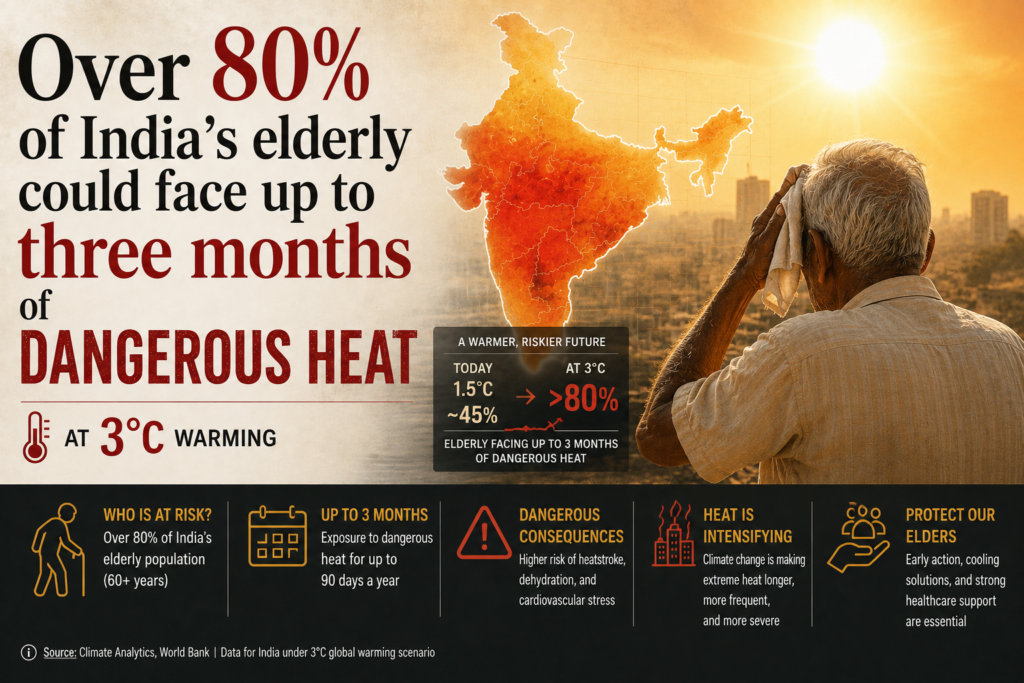
A Lancet Planetary Health study finds that older adults in India, China, Pakistan and Bangladesh could face dangerous heat for up to 3 months at 3°C warming. Using age-specific heat tolerance thresholds shows previous estimates may have underestimated risk by at least two-fold.
Key Concepts
Heat Stress
- Occurs when the body cannot shed enough heat to maintain normal core temperature.
- Depends on temperature + humidity + duration, not temperature alone.
- High humidity reduces sweat evaporation and increases risk.
Wet-Bulb Temperature
- Measures the lowest temperature achievable through evaporative cooling.
- Combines heat and humidity.
- Around 35°C wet-bulb temperature is the theoretical survivability limit for a healthy person at rest, while vulnerable groups face risk at lower levels.
Heat Action Plan
City/State-level system covering:
- Early warnings and colour-coded alerts
- Changes in work/school timings
- Cooling shelters and water
- Hospital preparedness
Study Findings
- Examined 15-39, 40-59 and 60+ age groups.
- Modelled warming from 1°C to 4°C.
- At 3°C warming, over 80% of India’s older population could experience at least 180 hours of intolerable heat annually.
- Delhi and the Indo-Gangetic Plain could see nearly 1,000 hours at 1.5°C warming and over 2,000 hours at 3°C.
- Heat exposure is concentrated mainly between May and September and increasingly extends into nights.
Why Older Adults Are More Vulnerable
- Reduced sweating
- Slower vascular response
- Greater cardiac strain
- Lower heat tolerance
Challenges for India’s Heat Action Plans
- Age-blind thresholds
- Limited attention to night-time heat
- Weak integration of humidity
- Rising cooling and electricity demand
- Under-reporting of heat-related mortality
- Continued occupational exposure
- Limited disaster-response financing for heatwaves
