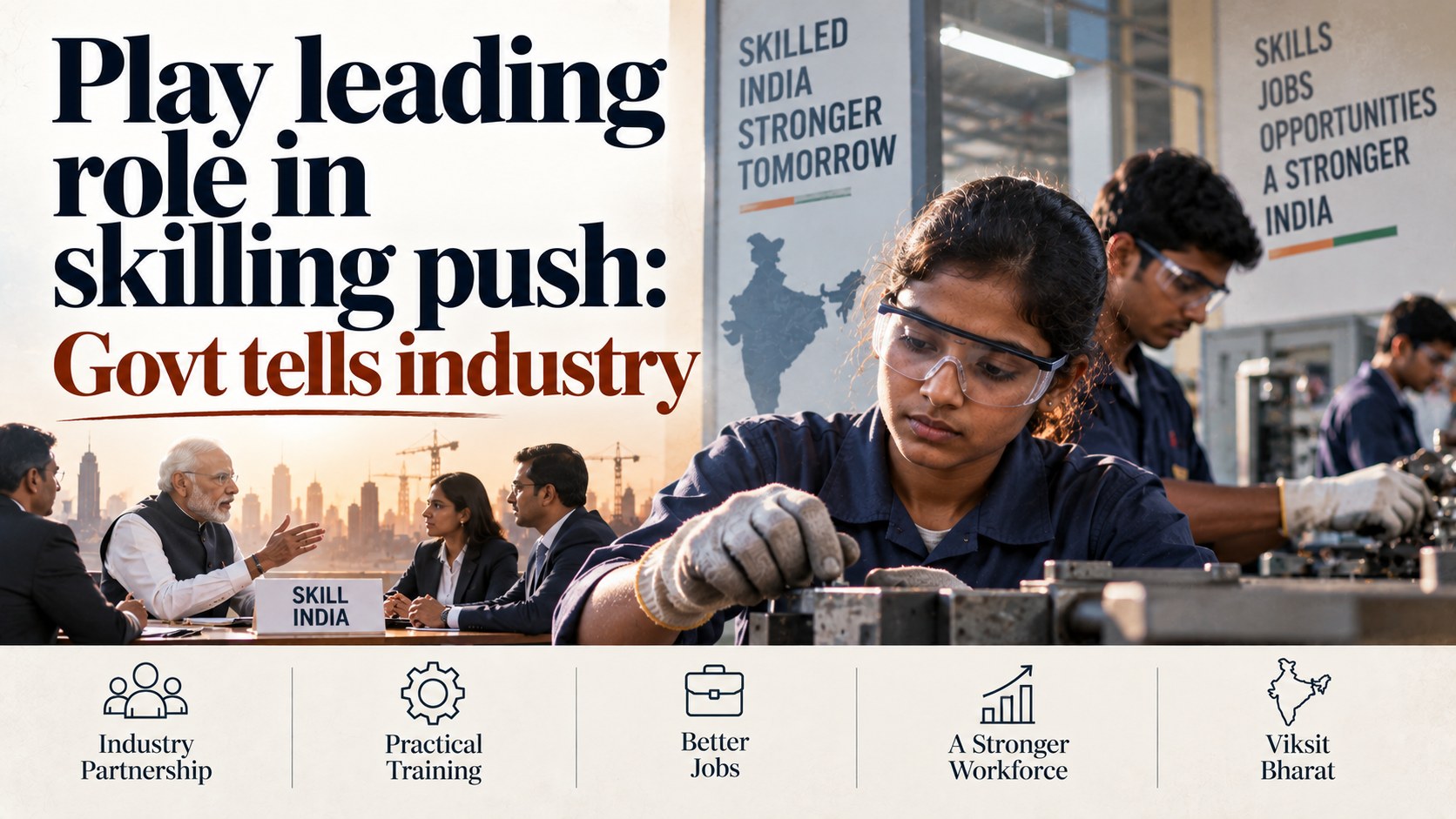
Why in the News
The Ministry of Skill Development and Entrepreneurship has asked industry to take the leading role in the Pradhan Mantri Skilling and Employability Transformation through Upgraded ITIs (PM-SETU) scheme. The scheme’s own design already places industry there. Industry partners take a controlling 51 percent stake in the Section 8 companies (not for profit companies registered under the Companies Act, 2013, which cannot pay dividends to their members) that will manage clusters of Industrial Training Institutes (ITIs). The Centre and the States put up the bulk of the money. Industry’s 17 percent share qualifies as Corporate Social Responsibility (CSR) spending. Control over curriculum, technology and delivery therefore passes to a partner whose own contribution comes out of a statutory obligation rather than commercial risk capital.
What is PM-SETU?
- What it is: A central scheme carrying an outlay of Rs 60,000 crore to upgrade government Industrial Training Institutes.
- What it funds: Upgraded laboratories, new machines and revised trade curricula at the institutes it covers.
- What it is measured on: Employability, since the stated purpose is the quality and relevance of vocational training rather than the number of training seats created.
What does the ownership structure change?
- Industry holds control of the managing entity: Industry partners take a controlling 51 percent stake in the Section 8 companies that will manage ITI clusters.
- The state pays and industry decides: The Centre and the States provide the bulk of the funding, against an industry contribution of 17 percent.
- The industry share is a statutory obligation, not risk capital: That 17 percent is eligible under Corporate Social Responsibility, so the controlling partner can meet it from money the Companies Act, 2013 already requires it to spend.
- What moves into the partner’s hands: Curriculum design, technology adoption and the running of skill development pass to the industry partner.
Why is industry being asked to lead?
- The demand side gets to write the syllabus: Placing curriculum and technology decisions with employers is meant to keep trade training aligned to the machines and processes actually in use.
- The immediate driver is the energy and manufacturing transition: The appeal was addressed to the power and utilities industry, whose workforce requirements are changing as generation and grid technology change.
- A working cluster is being held up as the model: ArcelorMittal’s leadership of the Vizag cluster has been cited as the benchmark for what the arrangement should produce.
- Institute workshops lag the shop floor: ITIs have long trained on equipment that industry has already replaced, which is the specific gap upgraded labs and employer set curricula are meant to close.
Challenges to PM-SETU
- Most trades have no anchor employer: A cluster needs a large firm willing to hold a controlling stake and carry the management burden, which exists in steel or power and not across most trades an ITI teaches. Eg. Plumbing, welding and electrical work are served largely by contractors and micro enterprises, with no single firm able to lead a cluster.
The Fix: Allow a sector skill council or an industry association to hold the controlling stake in trades where no single anchor firm exists. - Corporate Social Responsibility money contracts in a downturn: A partner funding its share from CSR can redirect that spending in a year when its own hiring slows. Eg. The obligation is calculated at two percent of average net profits of the preceding three financial years, so it falls exactly when industrial demand falls.
The Fix: Fix the industry contribution as a multi year commitment inside the cluster agreement, so a cluster’s operating budget does not track one partner’s profits. - Control is granted without an outcome obligation: A controlling stake gives industry decision rights over publicly funded assets with no placement or wage commitment attached to those rights. Eg. The National Apprenticeship Promotion Scheme has repeatedly recorded engagement below its sanctioned targets, since participation carried no binding hiring commitment.
The Fix: Tie renewal of a cluster’s management contract to verified placement and wage outcomes for its trainees. - Clusters will form where industry already is: The model reproduces the existing gap between industrialised and lagging States, because the anchor employer is the precondition. Eg. Institutes in the north eastern States operate with far thinner employer presence than those in Tamil Nadu, Gujarat or Maharashtra.
The Fix: Reserve a share of central funding for clusters in districts with no large anchor employer, with a public sector undertaking as the lead partner. - The trained worker is a poachable asset: A Section 8 company cannot distribute surplus, so a firm’s only return is the workers it hires, and a competitor can hire them instead. Eg. A firm that trains a welder who then joins a rival bears the full cost and gets none of the benefit, which is the standard problem in employer funded training.
The Fix: Publish cluster wise trainee supply data so participating firms recruit from a pool they collectively financed rather than each underwriting a rival’s hiring.
Conclusion
The scheme moves the state from provider of vocational training to financier of it. That works where a large employer wants the workers and is willing to run the institution, and the scheme has not said who takes charge in the trades where neither condition holds. The marker to watch is the first set of cluster agreements, and specifically whether any hiring or wage commitment is attached to the controlling stake.
Back2Basics: Industrial Training Institutes
- What they are: Post school institutions offering trade level vocational training in engineering and non engineering trades, entered after Class 8, 10 or 12 depending on the trade.
- Who runs them: Government institutes are run by State governments alongside a large private sector, with standards set by the Directorate General of Training under the Ministry of Skill Development and Entrepreneurship.
- What a trainee gets: Trainees sit the All India Trade Test and are awarded the National Trade Certificate.
- Where they sit in the system: They form the country’s oldest and largest formal vocational training network, run under the Craftsmen Training Scheme since 1950.
[2023, GS2, 15 marks] Skill development programs have succeed in increasing human resources supply to various sectors. In the context of the statement analyze the linkages between education, skill and employment.
