Source: The Hindu, Page 4 Published: 15 October 2026
Why in the News
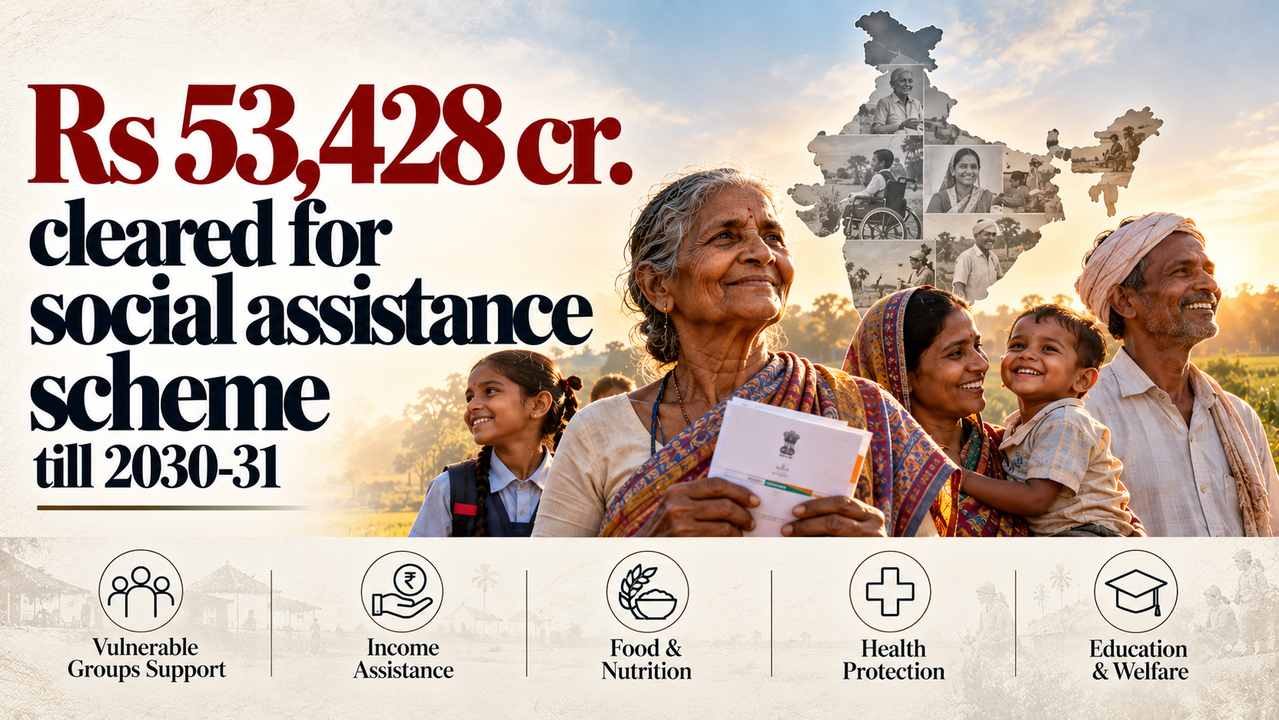
The Centre’s pension scheme for poor elderly people, widows and persons with disabilities has been renamed from the National Social Assistance Programme (NSAP) to the Pradhan Mantri Samajik Sahayata Yojana, with its budget fixed for five years. The Union Cabinet approved Rs 53,428 crore for 2026-27 to 2030-31. Critics argue the scheme is already too small to reach everyone eligible.
What is the NSAP?
- What it is: The NSAP pays small monthly pensions from the Centre to poor elderly people, widows and persons with disabilities. It works like a minimum floor, to which States add their own benefits.
- Why it was introduced: It took effect on 15 August 1995 to set minimum national standards for social assistance across States.
- Constitutional basis: It gives effect to Article 41, a Directive Principle, a constitutional goal courts cannot enforce, asking the State to provide public assistance in old age, sickness and disablement.
- Components: Three pension sub-schemes cover old age, widowhood and disability, alongside a family benefit scheme for households that lose a breadwinner and Annapurna.
- The takeaway: The NSAP is the Centre’s main cash safety net for people who cannot work, so its size decides how many of them are protected.
What has the Cabinet changed?
- Prefix dropped: The “Indira Gandhi” prefix is removed from all three pension sub-schemes.
- Disability pension revised: The Cabinet changed who qualifies for the disability pension (eligibility criteria) and how much it pays (assistance rates). The new figures have not been made public.
- Rest unchanged: Old age and widow pensions and the family benefit scheme continue “in their existing form”.
- Budget locked in: The outlay is fixed for the full five years, so it does not rise on its own with prices or population.
Why do critics call it inadequate?
- Fixed beneficiary cap: The NSAP limits its three pension schemes to 3.09 crore beneficiaries, a number set in advance. Several other welfare schemes instead identify beneficiaries from Socio Economic and Caste Census (SECC) 2011 data.
- Eligibility without entitlement: Azim Premji University’s handbook, “Realising Rights: A Handbook of Welfare in India”, finds the ceiling matches neither administrative capacity nor the number of eligible people. So qualifying for a pension does not guarantee receiving one.
- Static assumption: An Associate Professor at Azim Premji University says the decision assumes the number of beneficiaries will stay the same, ignoring demographic change and inflation.
- Shortfall estimate: If prices rise 5% a year, paying even today’s beneficiaries would cost about Rs 55,698 crore, more than the approved outlay.
Challenges
- Exclusion by quota: Under a fixed cap, an eligible elderly person or widow waits for a vacancy instead of receiving a pension on qualifying.
- Ageing population: The elderly share of India’s population is rising, so a frozen cap covers a shrinking fraction of those in need.
- Eroding value: Central pension amounts are not indexed to inflation, so their real value falls every year.
- Unequal top ups: States add very different amounts, so a pensioner’s income depends on her State of residence.
Way Forward
- Index to prices: The Ministry of Rural Development should link central pension amounts and the outlay to the Consumer Price Index.
- Data based ceiling: Replace the fixed cap with a ceiling drawn from current poverty and population data, revised every year.
- Mid term review: Revisit the five year outlay halfway through against actual demand.
- Publish disability changes: Release the revised disability criteria and rates so applicants know what they can claim.
Conclusion
The renaming leaves the scheme’s central weakness, a fixed beneficiary ceiling, untouched for five more years. Whether the outlay is revisited as prices and the elderly population rise will decide if eligibility turns into an actual pension.
Back2Basics: Socio Economic and Caste Census (SECC) 2011
- What it is: A household survey of economic deprivation and caste, begun in 2011 across rural and urban India.
- Who ran it: The Ministry of Rural Development led the rural survey and the then Ministry of Housing and Urban Poverty Alleviation the urban survey.
- How it is used: Its deprivation criteria identify beneficiaries for schemes such as Pradhan Mantri Awas Yojana Gramin and Ayushman Bharat Pradhan Mantri Jan Arogya Yojana.
PYQ
[2019] Consider the following statements about Particularly Vulnerable Tribal Groups (PVTGs) in India:
1. PVTGs reside in 18 States and one Union Territory.
2. A stagnant or declining population is one of the criteria for determining PVTG status.
3. There are 95 PVTGs officially notified in the country so far.
4. Irular and Konda Reddi tribes are included in the list of PVTGs.
Which of the statements given above are correct?
(a) 1, 2 and 3
(b) 2, 3 and 4
(c) 1, 2 and 4
(d) 1, 3 and 4
ANSWER: (c)
