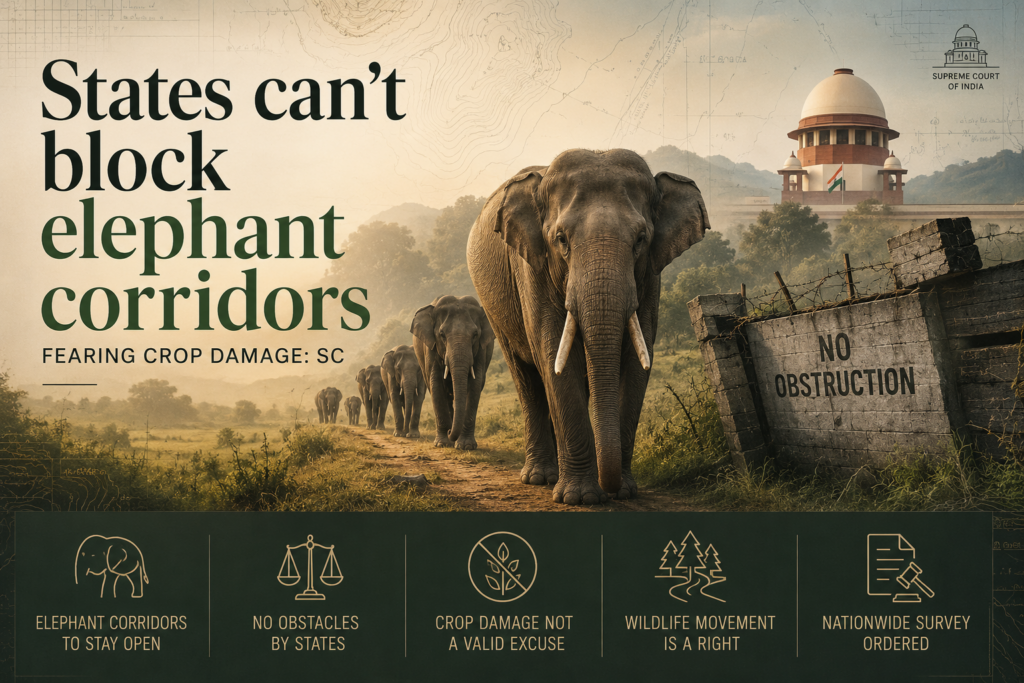
Why in the News
The Supreme Court has directed a fresh nationwide survey of elephant corridors, noting that several corridors remain impeded, blocked or obstructed despite existing guidelines of the Ministry of Environment, Forest and Climate Change (MoEFCC).
The Court held that crop damage cannot justify placing obstacles in elephant movement paths, highlighting the conflict between wildlife conservation and local livelihood concerns.
What is an Elephant Corridor?
- Meaning: A natural or narrow land passage connecting two elephant habitats, enabling movement between them.
- Need: Elephants move over large areas in search of food, water and mineral licks.
- Ecological role: Corridors maintain habitat connectivity and gene flow between elephant populations.
- Legal status: Corridors are identified through ecological and movement studies but are not automatically Protected Areas.
- Land ownership: Many corridors pass through private, revenue, plantation or community land.
- India: 150 elephant corridors have been identified across 15 elephant range States.
What did the Supreme Court Direct?
- Fresh nationwide survey of elephant corridors.
- A comprehensive report on existing corridors and measures taken to prevent their obstruction.
- Identification of corridors that have been blocked, choked or obstructed.
- States cannot justify blocking elephant paths merely because of crop destruction.
- The Court emphasised that elephants are a wide-ranging species and require unobstructed movement.
- The matter will be considered again after six weeks.
Why are Elephant Corridors Important?
- Habitat connectivity: Prevents isolation of elephant populations.
- Gene flow: Allows breeding between different populations.
- Conflict reduction: Functional corridors can prevent elephants from being forced into settlements.
- Climate resilience: Connected habitats allow species to shift their range as environmental conditions change.
- Landscape conservation: Corridors connect forests beyond individual protected areas.
Major Causes of Corridor Blockage
- Resorts and other infrastructure: Restrict access to traditional movement paths.
- Railways and highways: Increase collision and fragmentation risks.
- Plantations and agriculture: Conversion of corridor land narrows movement routes.
- Electric fencing: Illegal or poorly designed fencing can cause electrocution.
- Mining and quarrying: Remove vegetation and fragment habitats.
- Canals and irrigation structures: Create physical barriers, particularly for calves.
- Settlements and encroachment: Increase human presence along traditional routes.
Elephant Conservation in India
- The species and its status: The Asian elephant (Elephas maximus) is listed as Endangered on the IUCN Red List and is India’s National Heritage Animal, declared in 2010.
- India’s share of the global population: India holds the largest wild Asian elephant population, about 29,964 individuals, roughly 60 per cent of the global population as per the 2017 census.
- Population growth under the programme: Wild elephant numbers rose from about 25,000 in 1992 to about 30,000 in 2021 under Project Elephant.
- State distribution: Karnataka holds the highest population, followed by Assam and Kerala.
- Elephant Reserves: India has 33 elephant reserves covering about 80,777 sq km.
- Corridors: 150 corridors have been identified across 15 elephant range States.
- Regional spread of corridors: The East central region holds 52 corridors, or 35 per cent of the total, the North East 48 corridors, or 32 per cent, Southern India 32 corridors, or 21 per cent, and Northern India 18 corridors, or 12 per cent.
- State with the most corridors: West Bengal, with 26 corridors, about 17 per cent of the national total.
- Why the elephant is a keystone species: It disperses seeds over long distances and opens forest canopy and waterholes that other species depend on.
Constitutional Framework Governing Wildlife Protection
- Article 48A: Directs the State to protect and improve the environment and to safeguard the forests and wildlife of the country.
- Article 51A(g): Places a fundamental duty on every citizen to protect and improve the natural environment including forests, lakes, rivers and wildlife, and to have compassion for living creatures.
- Seventh Schedule, Concurrent List Entry 17B: Places protection of wild animals and birds on the Concurrent List after the 42nd Constitutional Amendment, 1976.
- Seventh Schedule, Concurrent List Entry 17A: Places forests on the Concurrent List, which is why State forest departments implement central wildlife law.
- Article 21: Protects life and personal liberty, read to include a right to a clean and healthy environment, the basis for much environmental litigation.
- Article 32 and Article 142: Give the Supreme Court the power to entertain writ petitions and to pass orders necessary for complete justice, the source of continuing mandamus in wildlife matters.
- Article 253: Empowers Parliament to legislate to implement international conventions, the basis for wildlife law giving effect to treaty obligations.
Laws and Rules Governing Elephants and Their Habitat
- Wildlife (Protection) Act, 1972: The primary law for protection of wild animals and plants and for the constitution of protected areas.
- Key protection: The Indian elephant is listed in Schedule I, which carries the highest degree of protection and the strictest penalties.
- 2022 Amendment: Rationalised the schedules, gave effect to CITES obligations in domestic law, and regulated the transfer of captive elephants for religious and other purposes.
- Project Elephant, 1992: A centrally sponsored scheme for protection of elephants, their habitat and corridors, and for management of human elephant conflict.
- Coverage: It extends to 23 States and provides the framework under which elephant reserves are declared.
- Forest (Conservation) Act, 1980, renamed the Van (Sanrakshan Evam Samvardhan) Adhiniyam: Requires prior central approval for diverting forest land, which governs infrastructure passing through corridors on forest land.
- Indian Forest Act, 1927: Provides the categories of reserved and protected forest through which many corridors run.
- Scheduled Tribes and Other Traditional Forest Dwellers (Recognition of Forest Rights) Act, 2006: Recognises community rights in forest areas, including in landscapes that carry elephant movement.
- Environment (Protection) Act, 1986: Provides for eco sensitive zone notifications and environmental clearance conditions applicable to projects near protected areas.
- Biological Diversity Act, 2002: Provides for conservation of biological diversity and equitable sharing of benefits, with biodiversity management committees at the local level.
- Convention on International Trade in Endangered Species of Wild Fauna and Flora: Lists the Asian elephant in Appendix I, barring commercial international trade in the species and its parts.
- Convention on the Conservation of Migratory Species of Wild Animals: Lists the Asian elephant in Appendix I, obliging range States to conserve and restore its habitats.
Back2Basics: Asian Elephant
- Scientific and common name: Elephas maximus, the Asian or Asiatic elephant, of which the Indian elephant is the mainland subspecies.
- IUCN Red List status: Endangered.
- Convention on Migratory Species: Listed in Appendix I.
- Wildlife (Protection) Act, 1972: Listed in Schedule I, the highest protection category.
- Global significance: India holds the largest wild Asian elephant population in the world, about 29,964 individuals, close to 60 per cent of the global total as per the 2017 census.
- Range within India: Highest numbers in Karnataka, followed by Assam and Kerala, across 15 elephant range States.
- Habitat: Tropical moist and dry deciduous forest, grassland, scrub and adjoining agricultural landscapes, with populations in fragmented forests, tea estates and farmland.
- Social structure: Herds are matrilineal, led by an older female, and family units combine into clans and sub populations.
- Communication: Elephants use over 60 distinct calls together with gestures and physical contact, including low frequency rumbles that carry over long distances.
- Behavioural notes: Elephants comfort distressed companions, mourn their dead, cooperate in raising calves and adopt orphaned young, and individual animals show distinct personalities.
- Recorded mortuary behaviour: Research in fragmented forests, tea estates and farmland near the Gorumara Wildlife Division and Buxa Tiger Reserve in West Bengal documented herds carrying calf carcasses and burying them in a legs upright position, then avoiding paths near the burial site.
- Genetic structure: A recent study identified five genetically distinct populations of Asian elephants in India.
- Conservation framework: Project Elephant, 1992, 33 elephant reserves over about 80,777 sq km, and 150 identified corridors.
- Named corridors: Kaniyanpura to Moyar in Karnataka, Chilla to Motichur in Uttarakhand, Thirunelli to Kudarakote in Kerala, the Segur corridor in Tamil Nadu, Kuldiha to Hadgarh in Odisha, Edayarahalli to Doddasampige in Karnataka, and Mudahalli to Talavadi across Tamil Nadu and Karnataka.
- Major threats: Habitat loss and fragmentation, corridor blockage, railway collisions, electrocution, poaching for ivory, and retaliatory killing arising from crop and property damage.
Government Initiatives
- Project Elephant, 1992: The umbrella centrally sponsored scheme for elephant protection, habitat and corridor management, and conflict mitigation across 23 States.
- Elephant Reserves: 33 reserves notified over about 80,777 sq km, providing a landscape unit for management outside the protected area system.
- Gaj Yatra: A national awareness campaign for securing elephant corridors, launched on World Elephant Day.
- Haathi Mere Saathi: A public outreach campaign of the Ministry to build tolerance and awareness in elephant range landscapes.
- Monitoring of Illegal Killing of Elephants: A site based monitoring programme run under the Convention on International Trade in Endangered Species, in which India participates.
- Surakshya portal: A national portal for real time reporting and collection of human elephant conflict data from the field.
- Synchronised elephant population estimation: A periodic all India estimation exercise conducted jointly by range States using common protocols.
- National Wildlife Action Plan 2017 to 2031: The national policy framework for wildlife conservation, including landscape level and corridor conservation.
- Compensatory Afforestation Fund Management and Planning Authority: Funds habitat improvement and conflict mitigation works, including barriers and water sources, in elephant landscapes.
Key Facts about Elephants in India
- World Elephant Day: Observed on 12 August every year.
- National Heritage Animal: The Indian elephant was declared India’s National Heritage Animal in 2010.
- Project Elephant launch: February 1992, by the Ministry of Environment, Forest and Climate Change.
- Largest land mammal in Asia: The Asian elephant is the largest terrestrial mammal on the continent.
- Distinguishing feature: Only some male Asian elephants carry tusks, unlike the African elephant where both sexes commonly do.
- Gestation: About 22 months, the longest of any land mammal, which makes population recovery slow.
- Elephant reserves and corridors: 33 reserves and 150 identified corridors across 15 range States.
- Gaj Yatra launch: Launched on 12 August 2017 as a nationwide corridor awareness campaign.
- Global population share: India holds about 60 per cent of the world’s wild Asian elephants.
“[2022] With reference to Indian laws about wildlife protection, consider the following statements :
1. Wild animals are the sole property of the government.
2. When a wild animal is declared protected, such animal is entitled for equal protection whether it is found in protected areas or outside.
3. Apprehension of a protected wild animal becoming a danger to human life is sufficient ground for its capture or killing.
Which of the statements given above is/are correct ?
(a) 1 and 2
(b) 2 only
(c) 1 and 3
(d) 3 only
