Why in the News
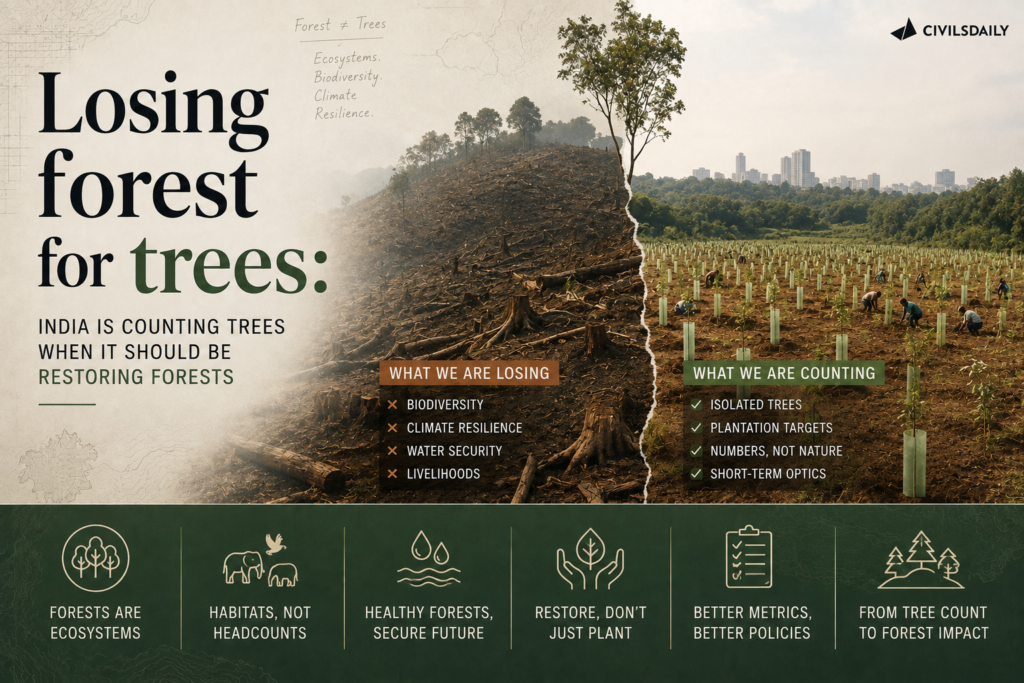
A performance audit by the Comptroller and Auditor General (CAG) of the Green India Mission (GIM) has found that across a decade the Mission improved forest quality over only 0.11 million hectares against a target of 1.4 million hectares, and achieved barely 4 per cent of its forest cover expansion goal. The Mission was designed as ecological restoration, and it has been displaced in practice by a sapling planting drive whose success is measured in trees planted rather than in forest restored. The India State of Forest Report 2023 records a green cover gain of 1,445 sq km, of which only 156 sq km is true forest.
What is the Green India Mission?
- What it is: A national mission of the Ministry of Environment, Forest and Climate Change aimed at protecting, restoring and enhancing India’s forest cover and at responding to climate change through adaptation and mitigation.
- Where it sits: It is one of the eight pillars of the National Action Plan on Climate Change, unveiled in 2008.
- Its climate function: It is the instrument through which India promised the Paris Agreement an additional carbon sink of 2.5 billion to 3 billion tonnes by 2030.
- Its animating idea: The objective is ecological, covering biodiversity, water, carbon sequestration and the revival of habitat, not the raising of tree numbers.
- Its twin physical targets: The Mission set out to increase forest and tree cover on one block of land and to improve the quality of existing forest cover on another.
- Its funding design: It was built to draw money and labour from other programmes rather than from its own budget line alone.
What is the Compensatory Afforestation Fund Management and Planning Authority?
- What it is: The statutory authority, known as CAMPA, that manages funds collected from industry and other user agencies in return for the diversion of forest land to non forest use.
- What it funds: The money is channelled into afforestation, catchment treatment and habitat improvement, which is why the Green India Mission was designed to converge with it.
What is tree cover outside recorded forests?
- What it is: Tree patches smaller than one hectare and trees standing outside the legally recorded forest area, counted separately from forest cover in the national forest assessment.
- Why the distinction matters: A plantation, an orchard or an avenue of trees adds to this category without adding to forest, so a rise in green cover can occur while forest itself stagnates.
What is Ek Ped Maa Ke Naam?
- What it is: A tree plantation campaign launched in 2024, translated as A Tree in the Name of Mother, under which the government reports planting 140 crore saplings so far.
- Its effect on the Mission: For practical purposes it has replaced the Green India Mission as the visible face of India’s forest effort.
What did the Comptroller and Auditor General audit find?
- Forest quality improvement: Against a target of improving forest quality over 1.4 million hectares, the Mission managed 0.11 million hectares, less than a tenth of the target.
- Forest cover expansion: On expanding forest cover the Mission achieved barely four per cent of its goal.
- Recorded shortfall on quality: The audit records a shortfall of about 91.87 per cent against the forest quality improvement target over ten years.
- Recorded shortfall on cover: The audit records a shortfall of about 97.57 per cent against the forest cover target over the same period.
- Coverage of the audit: The performance audit examined implementation across 16 States and Union Territories.
- Money actually received: Only about Rs 1,149.14 crore of budgetary support reached the Mission over the audited decade.
- Convergence not achieved: The Mission’s intended convergence with its partner schemes did not materialise.
- The overall verdict: A scheme conceived to heal India’s forests achieved almost nothing it set out to do across a decade.
Why did the Mission’s convergence with other funding streams fail?
- The CAMPA channel: CAMPA holds money collected from industry for diverting forest land into afforestation, and that money did not flow into Mission activity as designed.
- The wage labour channel: The Mahatma Gandhi National Rural Employment Guarantee Scheme, rebranded VB G RAM G, funds rural wage labour that can be used for plantation and land restoration works.
- What convergence was meant to do: The Mission’s own budget line was small by design, so its physical targets depended on borrowing funds and labour from these two much larger streams.
- What happened instead: The convergence never materialised, which left the Mission with a decadal target set for one scale of resources and an actual allocation of a different scale.
- The consequence for accountability: A mission that does not control its own money cannot be held to its own targets, and no single agency owns the shortfall.
- The displacement effect: With convergence absent, the plantation drive absorbed the political attention and the reporting space that restoration was meant to occupy.
What does the India State of Forest Report 2023 show about the quality of the gain?
- The headline gain: The report records a gain of 1,445 sq km in green cover.
- The forest share of that gain: Only 156 sq km of that gain is true forest.
- The remainder: The other 1,289 sq km is tree cover outside recorded forests.
- Inside the recorded forests: Dense canopy within recorded forest area is thinning into scrub.
- What the two numbers together establish: India is planting more and foresting less, so an aggregate green cover figure conceals a decline in forest quality.
- Why this matters for the carbon pledge: A carbon sink commitment measured in billions of tonnes rests on dense forest, not on scattered tree cover that stores far less carbon per hectare.
Why does the Aravalli Green Wall illustrate the limits of planting?
- The state of the range: The Aravallis are among the country’s most degraded ranges, with hillocks quarried away over decades.
- The invasion: Native growth has been overrun by the invasive vilayati kikar (Prosopis juliflora), which suppresses regeneration of native species.
- The proposed remedy: The range is now to be rescued by a Green Wall of fresh planting.
- What planting cannot do, first: Fresh saplings cannot undo the damage left by years of mining and the removal of the hill itself.
- What planting cannot do, second: Planting does not halt encroachment on the range, which is a land use and enforcement problem.
- What planting cannot do, third: An ecosystem that took millennia to assemble cannot be summoned back by a plantation drive.
- The governing distinction: Restoration rebuilds the ecological function of a landscape, and landscaping only adds vegetation to it.
Where does counting trees diverge from restoring forests?
- Two different outputs: A sapling planted is a countable annual output. A restored forest is a slow change in canopy density, species composition and soil.
- Two different timelines: Planting reports results within a financial year, and restoration shows results across decades, which biases the system toward planting.
- Two different failure modes: Plantation failure shows up as sapling mortality that is rarely audited. Restoration failure shows up in the forest report, as it has in 2023.
- The metric drives the money: With 140 crore saplings as the reported achievement and 0.11 million hectares as the restored area, the reporting system rewards the activity that is easiest to count.
- Species and structure are lost in the count: A count of trees is indifferent to whether the trees are native, whether they form a canopy, and whether they support the species the forest once held.
- The ecological cost of the substitution: Biodiversity, groundwater recharge and habitat revival, the Mission’s stated objectives, do not follow automatically from a higher tree count.
What can an audit of this kind not capture?
- The instrument is accountancy: The audit counts hectares and rupees, and it cannot count the worth of a living forest.
- Ecological value is not a line item: Pollination, water regulation, soil stabilisation and habitat quality have no entry in a financial performance table.
- Implementation reality: The assessment cannot always capture the practical difficulties of running a mission across State forest departments with varying capacity.
- Time lag in forest outcomes: Restoration works undertaken late in the audit period cannot show measurable results within it.
- Why the verdict still stands: Even on its own limited terms, an achievement of four per cent against a cover target and a tenth of a quality target is a failure of implementation, not a measurement artefact.
- What the audit does establish: The mission designed to restore India’s forests was allowed to wither while the state busied itself counting trees.
Challenges to the Green India Mission
- Sapling survival is not tracked: Plantation drives report numbers planted and rarely report survival after three years. e.g. successive State plantation drives reporting crore scale planting with no published third year survival audit.
- Monoculture and exotic species: Plantations favour fast growing and commercially useful species over native mixed forest, which limits habitat value. e.g. eucalyptus and acacia blocks raised on degraded common land in Karnataka and Gujarat.
- Land availability for restoration: The Mission needs degraded forest land free of competing claims, and much of it carries grazing, cultivation and settlement use. e.g. contested village common land in the Aravalli belt of Haryana and Rajasthan.
- Forest rights not settled first: Restoration works on land where individual and community claims under forest rights law remain undecided create conflict with forest dwellers. e.g. pending community forest resource claims across central Indian districts.
- Invasive species suppress regeneration: Restoration on invaded land fails unless the invasive is removed first, which is costlier than planting. e.g. Prosopis juliflora in the Aravallis and Lantana camara across central Indian forests.
- Weak convergence architecture: The Mission depends on funds controlled by other schemes with their own targets and reporting cycles. e.g. CAMPA balances lying unspent with State authorities while Mission works waited for money.
- Staffing and capacity in forest departments: Frontline forest staff vacancies limit the supervision that assisted natural regeneration requires. e.g. large vacancy levels in forest guard and forester posts reported by several State forest departments.
- Diversion continues alongside restoration: Forest land continues to be diverted for infrastructure while restoration targets are missed, so the net position worsens. e.g. compensatory afforestation for the Ken Betwa link inside the Panna landscape.
- Green cover accounting conflates categories: Counting orchards, plantations and avenue trees within green cover masks the loss of dense natural forest. e.g. the 1,289 sq km of tree cover outside recorded forests in the 2023 assessment.
Conclusion
India has substituted a countable output, saplings planted, for the objective it actually set itself, which is restored forest, and the audit records the cost of that substitution across a decade. The Green India Mission failed not because restoration is unachievable but because it was starved of money, denied the convergence it was designed around, and displaced by a drive that reports faster numbers. Until forest quality, canopy density and sapling survival replace planting counts as the reported metric, the Paris carbon sink commitment will rest on an inflated green cover figure. The instrument exists and the finance does not follow it.
Forest Cover and Restoration in India
- What forest cover means: All land more than one hectare in area with a tree canopy density of more than 10 per cent, irrespective of ownership or legal status.
- The assessment: The Forest Survey of India, Dehradun, publishes the India State of Forest Report every two years using satellite data and field inventory.
- The national scale: Total forest and tree cover is about 8,27,357 sq km, which is about 25.17 per cent of the geographical area, per the 2023 assessment.
- The split: Forest cover is about 7,15,343 sq km, or 21.76 per cent, and tree cover about 1,12,014 sq km, or 3.41 per cent.
- The policy target: The National Forest Policy, 1988 sets a goal of 33 per cent of the geographical area under forest and tree cover.
- The canopy classes: Forest cover is classed as very dense forest, moderately dense forest and open forest, by canopy density bands.
- The international commitment: India has committed to restoring 26 million hectares of degraded land by 2030, a pledge raised from an earlier 21 million hectare commitment under the Bonn Challenge.
- The climate commitment: India’s nationally determined contribution promises an additional carbon sink of 2.5 billion to 3 billion tonnes of carbon dioxide equivalent through additional forest and tree cover by 2030.
- Why restoration differs from afforestation: Restoration rebuilds a degraded ecosystem’s native composition and function, and afforestation only establishes trees on land, often with a single species.
Constitutional Framework Governing Forests and the Environment
- Article 48A: Directs the State to protect and improve the environment and to safeguard the forests and wildlife of the country.
- Article 51A(g): Places a fundamental duty on every citizen to protect and improve the natural environment including forests, lakes, rivers and wildlife.
- Article 21: Protects life and personal liberty, read by the courts to include the right to a clean and healthy environment.
- Seventh Schedule, Concurrent List Entry 17A: Places forests on the Concurrent List after the 42nd Constitutional Amendment, 1976.
- Seventh Schedule, Concurrent List Entry 17B: Places protection of wild animals and birds on the Concurrent List.
- Article 253: Empowers Parliament to legislate to implement international agreements, the basis for environmental laws giving effect to treaty commitments.
- Article 244 and the Fifth Schedule: Provide for administration of Scheduled Areas, which overlap substantially with India’s forest landscapes.
- Article 243ZD and Part IX: Place village level planning with Panchayats, the base for Gram Sabha consultation in forest areas.
Laws and Rules Governing Forests and Compensatory Afforestation
- Indian Forest Act, 1927: Consolidates the law on forests, the transit of forest produce and the duty leviable on it, and provides for reserved, protected and village forests.
- Key feature: It creates the categories of legally recorded forest against which forest cover is measured.
- Forest (Conservation) Act, 1980: Requires prior approval of the Union government for the diversion of forest land to non forest use.
- 2023 amendment: Renamed the Act the Van (Sanrakshan Evam Samvardhan) Adhiniyam, 1980 and exempted specified categories of land and projects from prior approval.
- Compensatory Afforestation Fund Act, 2016: Establishes the National and State Compensatory Afforestation Funds and the authorities that manage them.
- Rules, 2018: Set out the procedure for utilisation of the accumulated fund for afforestation, catchment treatment and wildlife management.
- Scheduled Tribes and Other Traditional Forest Dwellers (Recognition of Forest Rights) Act, 2006: Recognises individual and community forest rights and requires Gram Sabha consent for diversion.
- Wildlife (Protection) Act, 1972: Governs protected areas, and restricts activities inside national parks, sanctuaries, conservation reserves and tiger reserves.
- Environment (Protection) Act, 1986: The umbrella law under which environmental clearance, eco sensitive zone notifications and emission standards are issued.
- National Green Tribunal Act, 2010: Creates a specialised tribunal for environmental disputes, including challenges to forest diversion and afforestation failures.
- Biological Diversity Act, 2002: Provides for conservation of biological diversity and the constitution of biodiversity management committees at the local level.
“[2016] Which of the following best describes/ describe the aim of ‘Green India Mission’ of the Government of India?
1. Incorporating environmental benefits and costs into the Union and State Budgets thereby implementing the ‘green accounting’
2. Launching the second green revolution to enhance agricultural output so as to ensure food security to one and all in the future
3. Restoring and enhancing forest cover and responding to climate change by a combination of adaptation and mitigation measures
Select the correct answer using the code given below.
(a) 1 only
(b) 2 and 3 only
(c) 3 only
(d) 1, 2 and 3
