| Question (2025, GS3 – 15 Marks):Examine the factors responsible for depleting groundwater in India. What are the steps taken by the government to mitigate such depletion of groundwater?” Linkage: Directly targets the root causes of aquifer depletion in intensive agrarian states—such as flood irrigation, crop-choice mismatch (paddy in semi-arid zones), and unrestricted deep tube-well extraction—while demanding policy interventions to reverse the trend. |
Mentor Comment
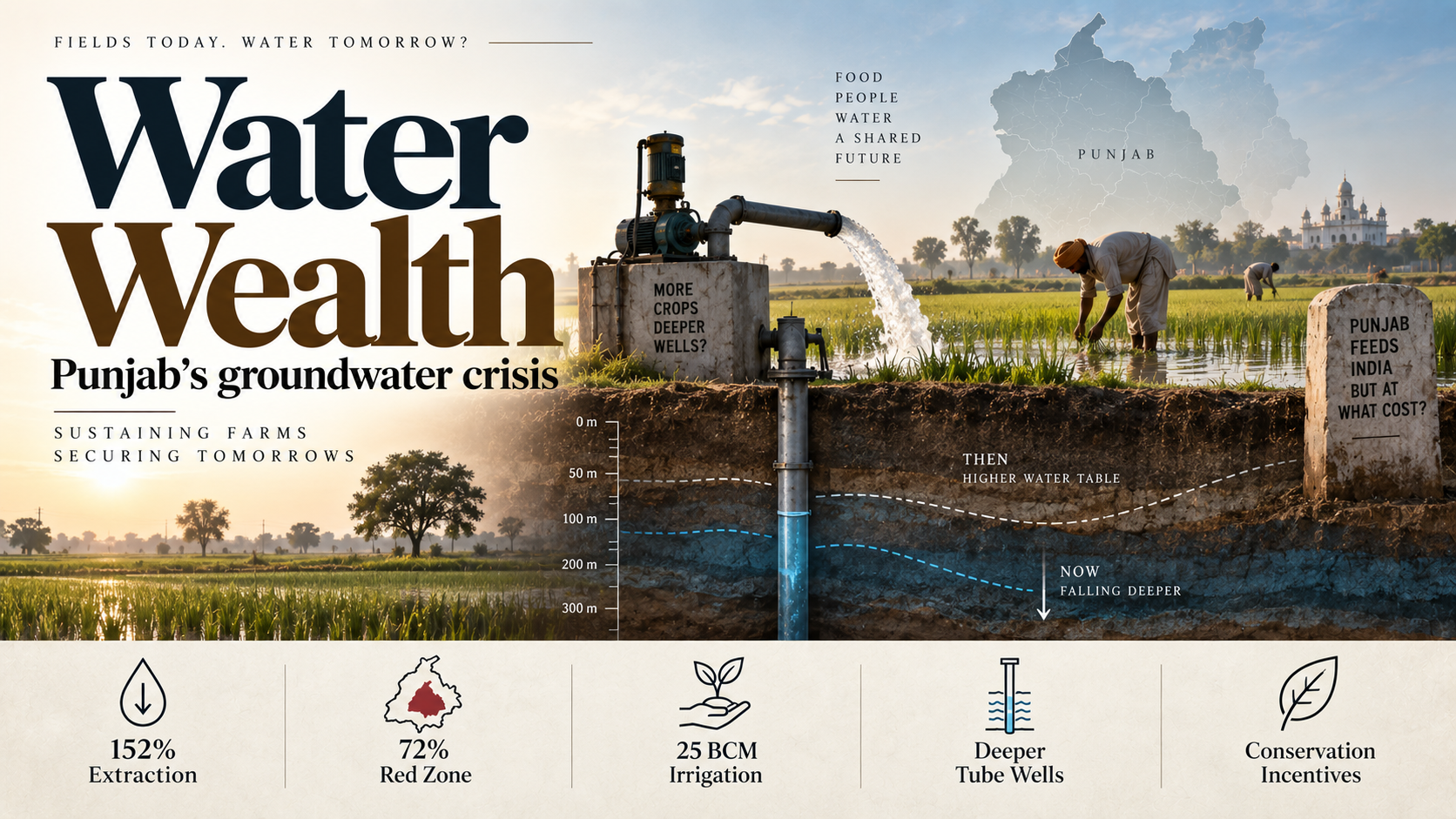
Punjab’s groundwater extraction rate stands at 152 per cent, meaning the State draws half again as much each year as is annually replenished. Depletion has now begun to redistribute wealth among farmers. Those who can afford deeper tube wells continue to reach the falling water table. Those who cannot are forced to buy water from them, which hands larger landowners a claim on smaller cultivators. The conflict is between an electricity and procurement structure that makes extraction the safe choice and a conservation goal that requires additional extraction to become expensive.
How far has Punjab’s groundwater been drawn down?
- Extraction rate: The 2025-26 Dynamic Groundwater Assessment records the State’s groundwater extraction rate at 152 per cent.
- Blocks in the red zone: 72 per cent of Punjab’s 153 blocks sit in the red zone, the highest share among States.
- Marginal improvement: Interventions reduced the number of over-exploited blocks by five across the last two assessments.
- Deepening wells: The fraction of observation wells with water below 40 metres in the post-monsoon period grew by two percentage points between 2022 and 2025.
- Principal consumer: Irrigation for rice and wheat accounts for nearly 25 billion cubic metres a year in the latest estimate.
Why has the rice-wheat system held against its water cost?
- Origin in food security: The pattern began as a strategy to improve food security and settled into a concentrated rice-wheat cropping system.
- Three supports that removed risk: Assured procurement, subsidised electricity and access to groundwater made high-yield varieties, intensive irrigation, fertilizer use and mechanisation less risky than alternative modes of cultivation.
- Unaddressed barriers to switching: Farmers’ reluctance to take up other crops rests on uncertainties in storage options, prices, processing infrastructure and supply chains, and that reluctance has gone relatively unaddressed.
How does groundwater depletion widen the gap between farmers?
- Efficiency against capacity: A study in the Economic and Political Weekly found that farmers with marginal landholdings use water more efficiently. The same study found wealthier farmers better equipped to access lower water tables and to draw higher volumes.
- Forced water purchase: Farmers unable to afford the requisite tube wells buy water from those who own them. The purchase transfers wealth to larger landowners and creates unregulated dependencies.
- Returns against productivity: A study in Discover Sustainability reported that in Sangrur and Barnala larger farms earned higher returns and recorded lower groundwater productivity for paddy than smaller farms.
- Capital as the gate: Depletion raises the capital required for irrigation, which systematically privileges farmers with better access to finance.
What would make conservation pay the cultivator?
- Pani Bachao, Paisa Kamao: The scheme entitles a farmer to cash for every unused kilowatt-hour of pumping electricity below a threshold.
- Redirecting the electricity subsidy: Part of the electricity subsidy bill can instead directly support smallholder farmers.
- Collective irrigation assets: Irrigation infrastructure can be collectivised, so that access to water stops depending on owning a tube well.
- Benefit tied to the cultivator: Where benefits follow the cultivator, including tenants, rather than the owner of the land or the pump, welfare subsidises access to water rather than groundwater extraction.
Challenges to groundwater regulation in Punjab
- Efficiency gains overwhelmed by scale: State efforts to manage demand continue, and the volume of extraction outruns the gains those efforts produce. Eg. The count of over-exploited blocks fell by five and most of the State’s blocks stayed in the red zone.
The Fix: Set a declining annual extraction ceiling for each red zone block, so efficiency measures are judged against a volume target rather than against a block count. - Incentives measured in electricity, not water: Conservation payments are calculated on unused pumping units, which is a proxy for water and not a measure of it. Eg. Pani Bachao, Paisa Kamao pays for kilowatt-hours left unused below a threshold.
The Fix: Meter pumped volume at the connection, so payment tracks abstraction directly. - Voluntary enrolment: A scheme a farmer must opt into reaches those already confident about their water access, and not those most exposed to a falling table. Eg. Enrolment in Pani Bachao, Paisa Kamao remains low.
The Fix: Enrol every metered connection by default and allow farmers to opt out.
Conclusion
Punjab’s groundwater question has stopped being only a question about the aquifer. Depletion now decides which farmers can irrigate at all, and it converts water access into a form of wealth that moves from the smaller cultivator to the larger one. Conservation has to be paid for in a form that reaches the person farming the land, including the tenant, rather than the person who owns the pump. The thing to watch is whether the State converts part of its electricity subsidy into direct support tied to the cultivator.
