Why in the News
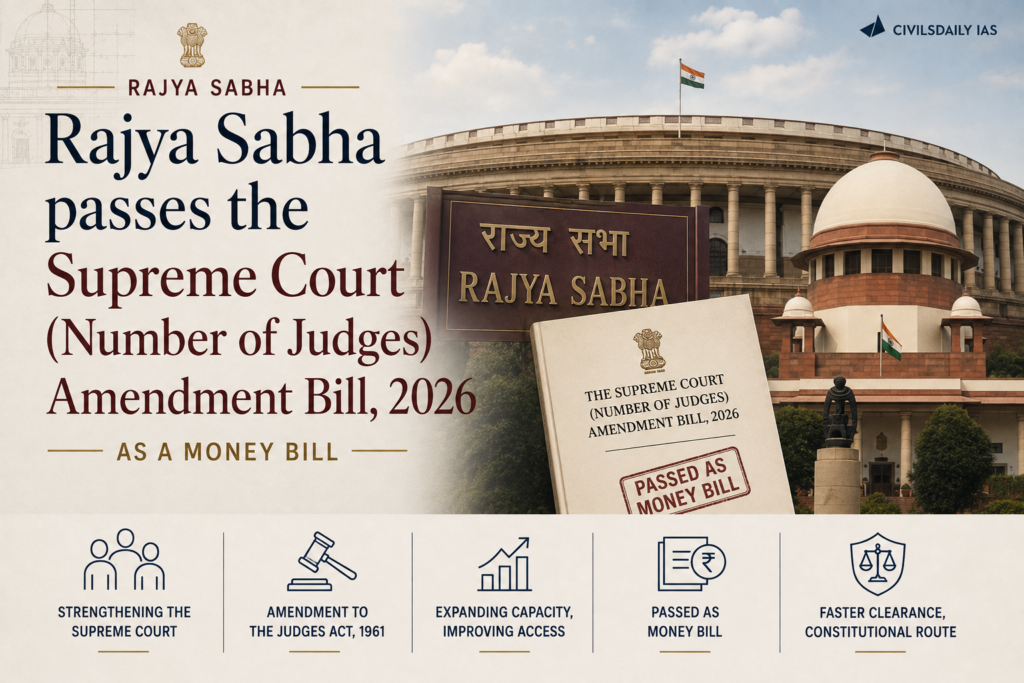
Parliament passed the Supreme Court (Number of Judges) Amendment Bill, 2026, increasing the sanctioned strength of the Supreme Court through the Money Bill route, triggering debate over the constitutional validity of bypassing the Rajya Sabha.
What is a Money Bill?
- Constitutional basis: Defined under Article 110 of the Constitution.
- Scope: A Bill is a Money Bill only if it deals exclusively with matters such as:
- Taxation, Government borrowing, Custody or withdrawal of money from the Consolidated Fund of India, Contingency Fun, and Appropriation of public money
- Speaker’s certification: The Speaker of the Lok Sabha decides whether a Bill is a Money Bill, and the certification is endorsed on the Bill.
- Limited role of Rajya Sabha: The Rajya Sabha can only recommend amendments within 14 days, which the Lok Sabha may accept or reject.
What does the Bill provide?
- Higher judicial strength: Increases the sanctioned strength of the Supreme Court from 34 to 38 judges, including the Chief Justice of India (CJI).
- Replaces an Ordinance: Substitutes the Ordinance promulgated in May 2026.
- Government’s objective: Reduce case pendency, improve judicial efficiency, and strengthen access to justice.
Why is the Money Bill route controversial?
- Constitutional issue pending: The validity of certifying certain laws as Money Bills is under consideration by a larger Constitution Bench of the Supreme Court.
- Concern over precedent: In the Aadhaar judgment (2018), the dissenting opinion described the use of the Money Bill route for substantive legislation as a “fraud on the Constitution.”
- Reduced parliamentary scrutiny: Since the Rajya Sabha has only an advisory role, critics argue that the route weakens bicameral legislative oversight.
“[2014] The power to increase the number of judges in the Supreme Court of India is vested in?
(a) The President of India.
(b) The Parliament.
(c) The Chief Justice of India.
(d) The Law Commission.