Why in the News
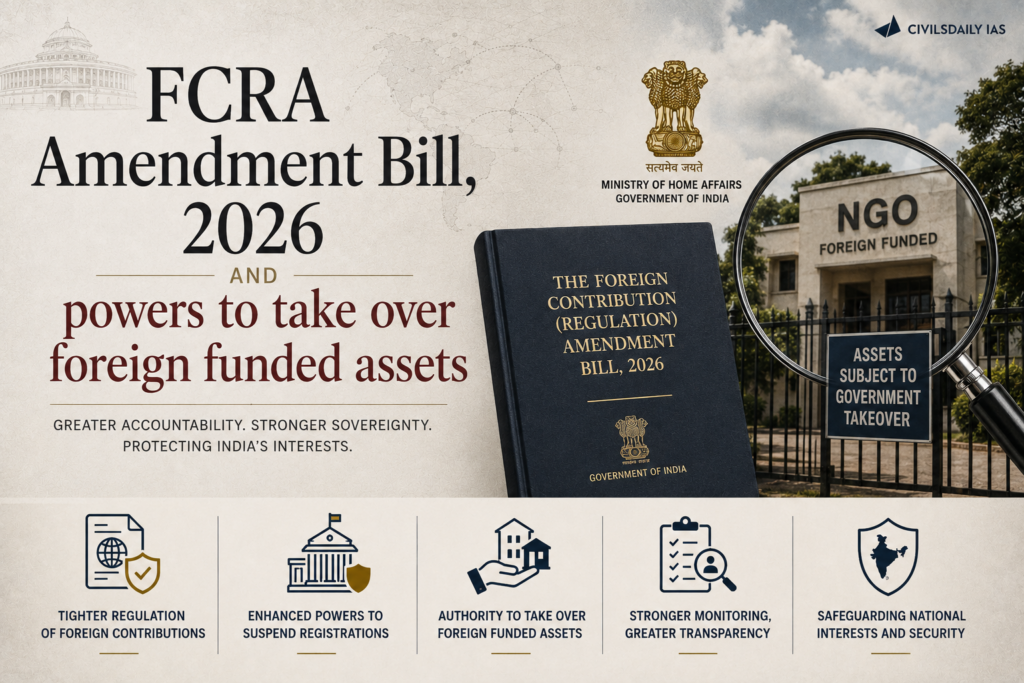
FCRA Amendment Bill, 2026 will amend the foreign funding law would let a designated authority take over the assets of organisations that lose their registration. The tension is between the state’s control over foreign money and the autonomy of civil society and religious bodies.
What is the Foreign Contribution (Regulation) Act, 2010?
- Governing law: The Foreign Contribution (Regulation) Act, 2010 (FCRA) regulates the acceptance and use of foreign donations by individuals and organisations.
- Registration: Bodies receiving foreign funds must register and route money through a designated bank account.
- Home Ministry: The Union Home Ministry administers registration, renewal, and cancellation.
Key Rules and Goals
- Main Goal: Stop foreign money from harming the country, public order, or politics.
- Who Cannot Get Funds: Politicians, judges, government workers, and news media cannot accept foreign money.
- Bank Routing: Groups must use a single, approved bank account to get these funds.
What does the amendment propose?
- Cessation clause: A new provision defines cessation of an FCRA certificate on cancellation or lapse. A certificate stops working if an organization fails to apply for renewal, gets denied, or lets the 5-year validity expire. The Bill proposes to increase oversight into processes relating to the handling of assets upon cancellation, surrender, or cessation of a certificate of registration, the management of defunct organisations, and other administrative and compliance processes.
- Asset vesting: On cessation, foreign contributions and assets vest in a government appointed Designated Authority, with proceeds going to the government.
- Retrospective reach: A clause would apply the vesting to assets already acquired.
Why is the Bill contested?
- Sweeping powers: Critics argue it lets the executive seize and sell the assets of non governmental organisations.
- Faith bodies: Christian and other religious institutions fear disproportionate impact.
- Constitutional concerns: Objections cite Articles 14, 25, 26 and 300A on equality, religious freedom, and property.
What are the challenges to the FCRA framework?
- Funding squeeze: Foreign contribution inflows have already fallen sharply after earlier tightening. Amnesty International India had to freeze operations in 2020 after the government froze its bank accounts over FCRA compliance disputes.
- Compliance burden: Small organisations struggle with reporting and renewal requirements.
- Chilling effect: Advocacy and rights groups face uncertainty over registration.
- Discretion risk: Wide discretion in cancellation invites arbitrariness.
- Judicial overhang: Asset vesting is likely to face challenge in the courts.
Conclusion
The Bill shifts the balance from regulating foreign money toward controlling the organisations that receive it. The next milestone is whether the government refers it to a Select Committee before passage.
Back2Basics
The Foreign Contribution (Regulation) Amendment Bill, 2026:
It was introduced in the Lok Sabha on March 25, 2026 and it establishes a framework for managing and disposing of assets and unutilised foreign contributions of organizations that lose their FCRA certification.
Key Provisions of the Bill
- Designated Authority: Creates an official body to supervise, manage, and temporarily or permanently vest assets created using foreign funds if an organization’s certificate is cancelled, surrendered, or expires.
- Places of Worship: Requires the authority to preserve the religious character of any asset that functions as a place of worship.
- Rationalized Penalties: Reduces maximum imprisonment terms for minor or technical violations of the Act from five years down to one year.
- Investigation Coordination: Mandates that state-level agencies secure central government approval prior to launching independent FCRA-related investigations.
PYQ Relevance
[UPSC 2015] Examine critically the recent changes in the rule governing foreign funding of NGOs under the Foreign Contribution (Regulation) Act (FCRA), 1976.