Why in the News?
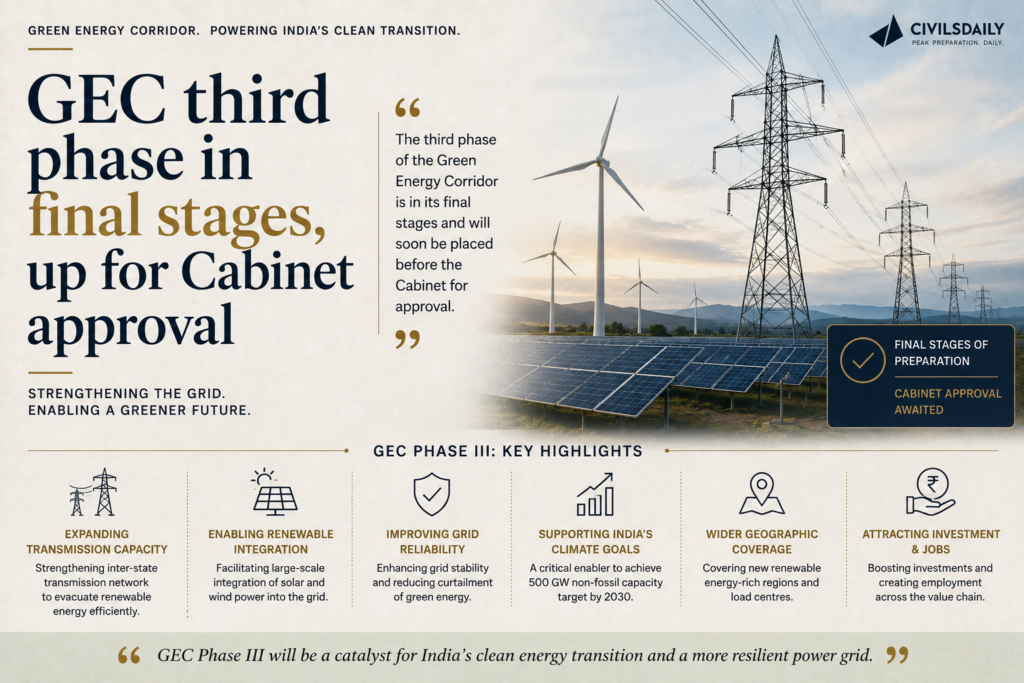
The government is in the final planning stages of the third phase of the intra-state Green Energy Corridor (GEC) and has sent the scheme to the Union Cabinet for approval. The phase carries an outlay of more than Rs 50,000 crore and targets the evacuation of about 135 gigawatts (GW) of renewable energy, marking a shift towards strengthening transmission from renewable-energy rich States.
What is the Green Energy Corridor (GEC)?
- Renewable evacuation network: GEC is a scheme to build transmission infrastructure that carries electricity from renewable-energy rich areas to demand centres.
- Grid synchronisation: It links variable solar and wind generation with conventional power stations in the grid so that renewable power can be evacuated reliably from one location to another.
What does GEC Phase III propose?
- Cabinet stage: The third phase has been sent to the Union Cabinet for final approval.
- Outlay: The scheme carries an outlay of more than Rs 50,000 crore.
- Evacuation target: The Ministry of New and Renewable Energy (MNRE) aims to evacuate about 135 GW of renewable energy in this phase.
- Focus area: The phase concentrates on augmenting intra-state transmission lines in renewable-energy rich States.
Why have earlier phases faced delays?
- Right of way: Difficulty in securing right of way for transmission lines held up Phase I.
- Award delays: Delay in awarding project packages slowed progress.
- Forest clearances: Delays in forest clearances stalled work.
- Great Indian Bustard clearances: Clearances tied to the protection of the critically endangered Great Indian Bustard (GIB), whose habitat overlaps solar and wind zones in Rajasthan and Gujarat, delayed Phase I.
- State and regulatory issues: Non-participation of States during tendering, tender consultation and regulatory issues affected Phase II.
Conclusion:
GEC Phase III awaits Cabinet clearance and, if approved, will extend intra-state transmission capacity to evacuate about 135 GW of renewable power. With most Phase II packages already awarded and expected to complete within two years, the next milestone is Cabinet approval and the resolution of recurring right-of-way, forest and GIB clearance bottlenecks that have delayed earlier phases.
Back2Basics: Green Energy Corridor (GEC) Scheme
- Ministry: Ministry of New and Renewable Energy.
- Objective: Build intra-state and inter-state transmission systems to evacuate renewable power.
- Structure: Implemented in phases, with intra-state components handled by State transmission utilities.
- Support: Funded through a mix of central grants, State contributions and multilateral loans.
- Beneficiaries: Renewable-energy rich States and the wider grid.
About Renewable Energy Transmission in India
- Definition: Renewable energy transmission moves power generated from solar, wind and other renewable sources to consumption centres across States.
- Why it matters: Renewable generation is concentrated in a few resource-rich States, so evacuation infrastructure is essential to avoid stranded capacity.
- India’s standing: India is among the world’s largest renewable energy markets and has set large capacity addition targets for 2030.
- Structural feature: Variable renewable output requires grid balancing with conventional and storage capacity.
Government Initiatives for Renewable Energy
- National Solar Mission: Promotes large-scale solar deployment under the National Action Plan on Climate Change.
- PM-KUSUM: Supports solar pumps and grid-connected solar for farmers.
- PM Surya Ghar: Muft Bijli Yojana: Promotes rooftop solar for households.
- Production Linked Incentive for solar modules: Builds domestic solar manufacturing capacity.
- Green Hydrogen Mission: Promotes production of green hydrogen using renewable power.
Key Facts about India’s Renewable Energy Sector
- 2030 target: India aims for 500 GW of non-fossil fuel electricity capacity by 2030.
- Nodal ministry: Ministry of New and Renewable Energy.
- Grid operator: Grid Controller of India manages national load dispatch.
- Species overlap: The Great Indian Bustard is a critically endangered species whose habitat intersects renewable zones, driving clearance conditions.
Challenges in Renewable Energy Transmission
- Land and right of way: Acquiring land and corridors for transmission lines is slow and contested.
- Clearance delays: Forest and wildlife clearances, including GIB-related conditions, hold up projects.
- State coordination: Uneven State participation in tendering and implementation delays intra-state work.
- Grid integration: Variable renewable output strains grid stability without adequate balancing.
- Financing and viability: Distribution company finances and cost recovery remain weak.
- Storage gap: Limited storage capacity constrains round-the-clock renewable supply.
Way Forward
- Fast-track clearances: Streamline forest and wildlife clearances with mitigation for GIB habitat, including undergrounding of lines where feasible.
- Strengthen State participation: Improve incentives and coordination for State utilities in tendering.
- Expand storage: Scale up battery and pumped-hydro storage alongside transmission.
- Timely awards: Reduce delays in awarding and executing project packages.
- Grid modernisation: Invest in smart grids and forecasting to manage variable generation.
PYQ Relevance
[UPSC 2022] Do you think India will meet 50 percent of its energy needs from renewable energy by 2030? Justify your answer. How will the shift of subsidies from fossil fuels to renewables help achieve the above objective? Explain.
Linkage: The PYQ examines India’s transition towards renewable energy and the challenges in achieving its 2030 targets. GEC Phase III strengthens renewable energy evacuation and grid infrastructure.
This supports India’s 2030 renewable-energy targets.
