Why in the news
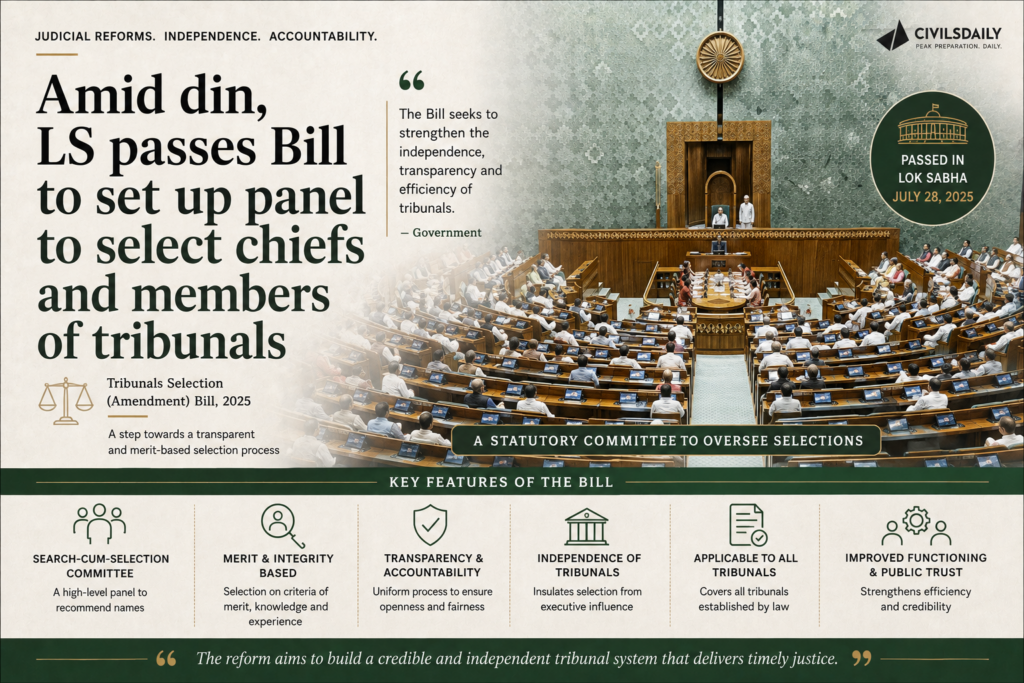
The Lok Sabha passed the Tribunals Reforms Bill, 2026 by voice vote without debate, creating a National Tribunals Commission (NTC) to select chairpersons and members of various tribunals. The Bill follows the Supreme Court striking down parts of the Tribunals Reforms Act, 2021 for violating separation of powers and judicial independence. It reopens the settled question of who controls tribunal appointments, the executive that the tribunals adjudicate against, or an independent body insulated from it.
What is the National Tribunals Commission (NTC)?
- Purpose: The NTC is a proposed statutory body to conduct the selection of chairpersons and members of tribunals through a single, uniform process. It centralises appointments that were earlier run separately for each tribunal.
- Composition: It will have a chairperson and four members, two judicial and two technical. A retired Supreme Court judge or a retired Chief Justice of a High Court will be eligible to head it.
- Seat and scope: It will be headquartered in New Delhi and will prescribe qualifications, selection, appointment, salaries, allowances, tenure, resignation, removal, and other service conditions of tribunal members.
- Origin: The Supreme Court itself directed the creation of an independent commission with professional expertise, transparent selection, and an oversight mechanism for appointments.
What is the current status of tribunal appointments in India?
- Statutory basis: Tribunals were introduced through the 42nd Constitutional Amendment, 1976, which added Part XIV-A and Articles 323A and 323B. They function as specialised adjudicatory bodies outside the regular court hierarchy.
- Bodies covered by the Bill: The selection process applies to the Central Administrative Tribunal, Armed Forces Tribunal, National Green Tribunal, Income Tax Appellate Tribunal, and the National Consumer Disputes Redressal Commission.
- Rationalisation drive: The Union government began rationalising tribunals in 2015 and Parliament passed the Tribunals Reforms Act, 2021 to that end. Parts of that Act were struck down by the Supreme Court.
- Existing safeguard: Judicial review of tribunal decisions by High Courts under Articles 226 and 227 remains, since the Court has held this power to be part of the basic structure.
Constitutional Provisions Related to Tribunals
- Article 323A: Empowers Parliament to establish administrative tribunals for service matters of public servants.
- Article 323B: Empowers appropriate legislatures to set up tribunals for other matters such as taxation, land reforms, and industrial disputes.
- 42nd Amendment, 1976: Inserted Part XIV-A and the two tribunal Articles into the Constitution.
- Article 226 and Article 227: Vest High Courts with writ jurisdiction and power of superintendence over tribunals, a check the Supreme Court has ruled cannot be ousted.
- Article 136: Retains the Supreme Court’s power to grant special leave to appeal against tribunal orders.
- Article 50: Directive Principle requiring separation of the judiciary from the executive, the value the appointment dispute turns on.
Why did the Supreme Court strike down parts of the 2021 Act?
- Separation of powers: The Court held that several provisions were contrary to separation of powers, as they gave the executive dominant control over appointments to bodies that adjudicate against the executive.
- Judicial independence: Provisions were found to undermine the independence of tribunal members whose tenure and removal the executive influenced.
- Conflict with precedent: The provisions were inconsistent with earlier judgments laying down standards for the appointment, tenure, and functioning of tribunal members.
- Short tenures and search committees: Earlier versions prescribed a four-year term and search-cum-selection committees weighted towards government nominees, which the Court repeatedly rejected as diluting judicial character.
How does the Bill respond to the Court’s concerns?
- Uniform process: The Law Minister stated the Bill brings uniformity to selection and appointment and improves efficiency, transparency, and independence.
- Judicial presence: A retired Supreme Court judge or retired High Court Chief Justice heading the commission answers the Court’s demand for professional and judicial expertise in selection.
- No jurisdictional change: The Minister clarified the legislation does not alter the jurisdiction of any tribunal, keeping the substantive powers of each body intact.
- Institutional oversight: A permanent commission replaces ad hoc, tribunal-by-tribunal appointment machinery, matching the oversight mechanism the Court directed.
Major debates surrounding tribunalisation in India
- Curtailment of ordinary courts: Tribunals divert cases from High Courts, raising the concern that they curtail the jurisdiction and constitutional role of the regular judiciary.
- Executive control versus independence: The core dispute is whether the government, a frequent litigant before tribunals, should dominate the appointment and service conditions of members who judge it.
- Effectiveness versus multiplicity: Tribunals were meant to reduce pendency, yet vacancies, poor infrastructure, and appeals routed back to constitutional courts have blunted that promise.
- Competing rulings: The line of Madras Bar Association cases and Rojer Mathew (2019) repeatedly set standards on tenure and composition that successive laws failed to meet, driving the current Bill.
- Access to justice: Whether specialised, low-cost adjudication genuinely widens access, or whether weak tribunals leave litigants worse off than in ordinary courts.
Challenges to the National Tribunals Commission
- Composition balance: Two technical members alongside two judicial members can still tilt selection towards executive preference if the technical members are serving or retired bureaucrats.
- Vacancy backlog: A new selection body does not by itself clear the large pending vacancies that have crippled tribunals such as the National Green Tribunal and Debt Recovery Tribunals.
- Infrastructure and funding: Tribunals depend on the parent ministry for premises, staff, and budget, which the commission does not address.
- Fresh litigation risk: Any residual executive dominance in the composition invites another round of constitutional challenge, extending the cycle of struck-down laws.
- Uniformity versus specialisation: A single commission for bodies as varied as the Armed Forces Tribunal and the consumer commission may struggle to weigh domain-specific expertise.
- Independence of secretariat: Day-to-day functioning still routes through executive-controlled staff, which can dilute the intended insulation.
Conclusion
The central question is not whether tribunals should exist but who controls the people who staff them, since executive dominance over appointments compromises the independence that specialised adjudication requires. The 2026 Bill responds to the Supreme Court’s direction by creating a judicially headed National Tribunals Commission with a uniform process. Its success depends on whether the composition genuinely insulates members from the executive they adjudicate against, and on whether vacancies and infrastructure gaps are addressed alongside the appointment reform.
What is the Separation of Powers Doctrine?
- About: It is the principle that legislative, executive, and judicial functions are distributed among distinct organs so that no single organ concentrates power.
- Rationale: It exists to prevent tyranny and protect liberty through mutual checks, and in India it underpins judicial independence as part of the basic structure.
- Indian form: India follows a functional, not rigid, separation, with checks and balances rather than watertight compartments, reinforced by Article 50 and judicial review.
Key Concerns Regarding Separation of Powers in India
- Executive encroachment on judiciary: Control over appointments, tenure, and funding of tribunals lets the executive influence bodies meant to be independent.
- Delegated legislation: Wide rule-making powers transfer effective law-making to the executive with limited legislative scrutiny.
- Judicial overreach: Expansive judicial activism blurs the line between adjudication and policy-making.
- Appointment tussles: Recurring friction between the executive and judiciary over the collegium and tribunal selections reflects an unsettled balance.
Statutory Framework Governing Tribunals
- Article 323A: Basis for administrative tribunals in service matters.
- Article 323B: Basis for tribunals in taxation, land reforms, and other listed matters.
- Administrative Tribunals Act, 1985: Established the Central Administrative Tribunal and State Administrative Tribunals.
- Tribunals Reforms Act, 2021: Rationalised tribunals and set service conditions, parts of which the Supreme Court struck down.
- Tribunals Reforms Bill, 2026: Proposes the National Tribunals Commission and repeals the 2021 Act once enacted.
Back2Basics: Landmark rulings on tribunals
- L. Chandra Kumar v. Union of India (1997): Held that judicial review by High Courts under Articles 226 and 227 is part of the basic structure and cannot be excluded; tribunals are supplementary, not substitutes, for courts.
- Union of India v. R. Gandhi (Madras Bar Association, 2010): Laid down that tribunal members must have judicial character and that executive dominance in selection is unconstitutional.
- Rojer Mathew v. South Indian Bank (2019): Struck down rules on tribunal appointments and service conditions for compromising independence.
- Madras Bar Association v. Union of India (2021): Reaffirmed minimum tenure and search committee composition standards, directly shaping the 2026 Bill.
Way Forward
- Insulated composition: Weight the selection body towards judicial members and independent experts rather than serving bureaucrats.
- Fill vacancies promptly: Use the commission to clear the standing backlog of member vacancies across tribunals on a time-bound basis.
- Single nodal ministry: Route tribunal administration and funding through a single, arm’s-length authority to end dependence on the litigating ministry.
- Fixed tenure and security: Guarantee tenure, salary, and removal protections consistent with the Supreme Court’s standards to prevent renewed litigation.
- Periodic performance audit: Institute an independent review of tribunal pendency, disposal, and infrastructure to keep them a genuine complement to courts.
“[2018, GS2, 15 marks] How far do you agree with the view that tribunals curtail the jurisdiction of ordinary courts? In view of the above, discuss the constitutional validity and competency of the tribunals in India.”
