Why in the News
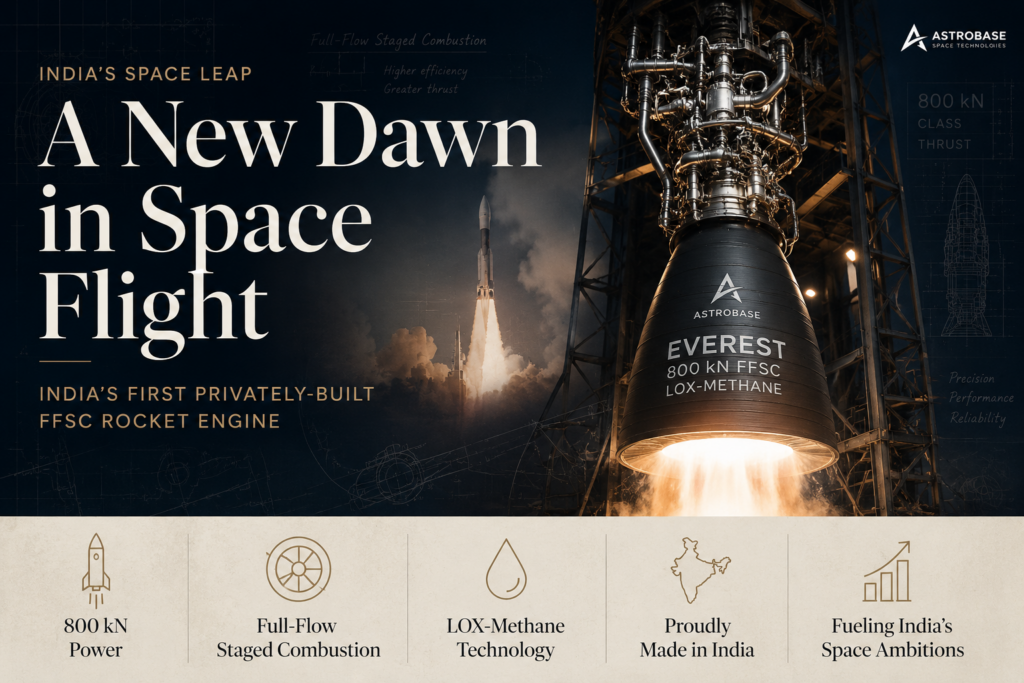
Bengaluru-based Astrobase Space Technologies unveiled EVEREST, India’s first privately built 800 kN Full-Flow Staged Combustion (FFSC) LOX-Methane engine on 7 August 2026. India is now the fourth country after Russia, the US and China with FFSC technology.
What is an FFSC Engine?
- About: An advanced liquid rocket engine architecture offering high thrust and efficiency.
- Full-flow: Fuel and oxidiser pass through separate pre-burners, driving turbopumps before entering the main chamber.
- Advantage: Almost all propellant contributes to thrust, improving efficiency and reusability.
What is LOX-Methane?
- LOX: Liquid Oxygen as oxidiser.
- Methane: Fuel that burns relatively cleanly, reducing engine deposits and aiding faster refurbishment and turnaround.
What is IN-SPACe?
- Indian National Space Promotion and Authorisation Centre, an autonomous agency under the Department of Space.
- Acts as a single-window agency to promote and authorise private space activities.
- Astrobase received support through its Technology Adoption Fund.
Why is EVEREST Significant?
- Technology: Makes India the 4th FFSC-capable nation.
- Reusability: Suitable for reusable launch vehicles with precise throttle control.
- Capacity: Could enable reusable systems carrying up to 30 tonnes to LEO.
- Manufacturing: Uses advanced manufacturing, including large-scale 3D printing.
- Timeline: Development began in 2024; integrated hot-fire tests are planned at Anantapur, with first flight targeted for December 2028.
Global Comparison
- Russia: Pioneer in FFSC technology.
- USA: SpaceX’s Raptor is the only operational FFSC engine.
- China: LandSpace has developed a commercial high-thrust FFSC engine.
- India: EVEREST marks its entry into FFSC technology.
Private Space Sector in India
- 2020 reforms: Opened space activities to private players through IN-SPACe.
- Indian Space Policy 2023: Enables greater private participation across the space value chain.
- NSIL: Commercial arm of the Department of Space.
- Firms such as Skyroot Aerospace and Agnikul Cosmos are developing indigenous launch technologies.
“[2026] Consider the following statements about involvement of private entities in India’s space programme:
1. IN-SPACe is an autonomous agency formed to facilitate participation of private entities.
2. Agnikul Cosmos launched the world’s first flight using 3D-printed rocket engine.
3. Skyroot Aerospace has developed liquid fuel for GSLV.
(a) 1 only
(b) 2 and 3 only
(c) 1 and 2 only
(d) 1, 2 and 3
