Why in the News?
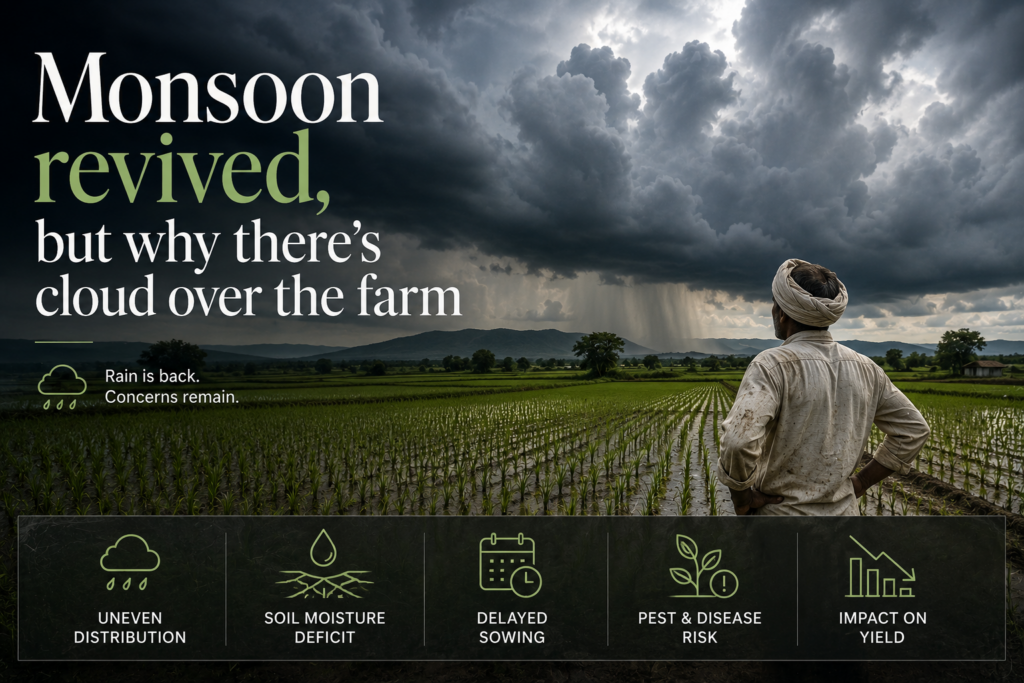
The southwest monsoon’s revival in July, despite a strengthening El Nino, has sharply narrowed the gap in area sown under kharif crops this season. The relief exposes a deeper tension between a recovering kharif and the mounting risks to the rabi season and to food inflation from El Nino’s lagged effect and a surge in global vegetable oil prices.
Why did a sowing gap open and how did July reverse it?
- Weak start: Rainfall in June was 38 percent below the long period average, making it the sixth driest June in India since 1901, with not a single low pressure system forming.
- Early shortfall: By 6 July farmers had planted only 350.85 lakh hectares, which was 20.8 percent below the 442.80 lakh hectares sown in the same period of 2025.
- July turnaround: In July the country recorded four low pressure systems against a normal of three. These moved slowly, producing about 24 affected days against a normal of 14, lifting all India July rainfall to 2.4 percent above the average.
- Recovery: By 7 August the 967.92 lakh hectares covered was only 1.8 percent lower than last year, with the pulses gap down to 1.8 percent, cotton to 0.4 percent, and oilseeds exceeding last year’s level.
What is El Nino and why does its effect lag?
- Definition: El Nino is the abnormal warming of surface waters in the central and eastern Pacific Ocean off Peru and Ecuador that suppresses monsoon rainfall over India.
- Lagged impact: El Nino’s effect on rainfall and temperatures comes with a lag of one to two months and can play out over five to six months or more.
- Current phase: It intensified from a weak to moderate phase in June into a moderate to strong event in July, and global agencies expect it to turn very strong during October to December.
Why is the worst not yet over?
- Late kharif needs rain: Crops need rainfall during August and early September for flowering and grain formation that determine yields. Meteorological Department has predicted a fresh low pressure system around 12 August.
- Delayed hit: Because El Nino’s rainfall suppressing effect lags, its worst impact is still to come.
- Rabi at risk: A strengthening El Nino raises temperatures, and a short warm winter harms wheat, mustard and potato yields, so the real threat is to the rabi season.
What does the FAO Food Price Index show?
- Index high: The United Nations Food and Agriculture Organization (FAO) food price index touched 131.1 points in July, up 1 percent from July 2025 and the highest since the 131.4 of January 2023, a three and a half year high. This means food prices are now at their highest level in about 3½ years.
- Vegetable oils drive it: The vegetable oils index reached 195.7 points, up 17.3 percent year on year and the highest since June 2022.
- Mixed components: The cereals index was 113.8 points, up 6.9 percent, while dairy fell 24.8 percent, sugar fell 8 percent, and meat rose just 0.8 percent.
- Causes: The rise is attributed to El Nino, heatwave hit crop yields in Europe, and supply disruptions from conflicts in West Asia and Ukraine.
Why are vegetable oils the real concern for India?
- Import exposure: The combined value of India’s imports of oilseeds, pulses and cotton was close to 25 billion dollars in 2025-26, which El Nino could push to a new high.
- Biofuel diversion: Firming vegetable oil prices stem mainly from diversion of palm, rapeseed and soyabean oil toward biofuel as petroleum prices harden.
- Fuel substitution: These oils are used to make fatty acid methyl esters, a substitute for petroleum diesel, linking food and fuel markets.
- Buffer available: The government held 92.6 million tonnes of rice and wheat on 1 July against a required minimum of 41.1 million tonnes, plus over 4 million tonnes of pulses, which can be offloaded to contain inflation.
Conclusion
The July monsoon revival has rescued the kharif season, cutting the sowing gap to under 2 percent even as El Nino strengthened. The central worry has shifted to the rabi season and to food inflation, since El Nino’s temperature and rainfall effects lag and global vegetable oil prices are at multi year highs. Ample public grain stocks give the government room to manage food inflation, but the rabi outlook and edible oil import bill remain the open risks.
Back2Basics:
Foundational Context: Climate Change and Food Security
- About: Food security means reliable physical and economic access to sufficient, safe and nutritious food, which climate variability directly threatens.
- Tropical vulnerability: Tropical countries face greater exposure because agriculture is rain dependent and heat sensitive.
- India context: A large share of India’s cropped area is rainfed, tying output to monsoon performance.
- Transmission channels: Erratic rainfall, heat stress, pest incidence and global price shocks each transmit climate risk to food systems.
FAO Food Price Index
- Convening body: Published by the United Nations Food and Agriculture Organization (FAO).
- What it measures: A weighted average of world prices of a basket of food commodities against a base period value taken as 100 for 2014 to 2016.
- Components: Tracks separate indices for cereals, vegetable oils, dairy, meat and sugar.
- Frequency: Released monthly.
- Recent reading: Touched 131.1 points in July, a three and a half year high.
Government Initiatives for Agriculture and Edible Oils
- National Mission on Edible Oils Oil Palm: Mission to raise domestic oil palm and edible oil production and cut import dependence.
- PM-AASHA: Umbrella scheme assuring remunerative prices to farmers, especially for oilseeds and pulses.
- Price Stabilisation Fund: Buffer stock mechanism to moderate volatility in pulses and other commodities.
- Minimum Support Price: Price assurance to encourage sowing of pulses and oilseeds.
Key Facts about the Monsoon and Kharif Season
- Sixth driest June: June 2026 was the sixth driest June since 1901.
- July rainfall: All India July rainfall was 2.4 percent above the long period average.
- Import bill: Oilseeds, pulses and cotton imports neared 25 billion dollars in 2025-26.
- Grain stocks: 92.6 million tonnes of rice and wheat held on 1 July against a 41.1 million tonne minimum.
Challenges in Indian Agriculture
- Rainfall dependence: A large rainfed area leaves output exposed to monsoon swings.
- Import reliance: High dependence on imported edible oils and pulses exposes India to global prices.
- Climate volatility: El Nino and heatwaves disrupt both kharif and rabi seasons.
- Price transmission: Global food and fuel price shocks feed domestic inflation.
- Storage and logistics: Post harvest losses and uneven buffer management persist.
- Yield gaps: Low productivity in pulses and oilseeds constrains self sufficiency.
Way Forward
- Raise oilseed output: Expand area and yields under the edible oils mission to cut imports.
- Diversify cropping: Promote pulses and climate resilient varieties in rainfed regions.
- Strengthen buffers: Use public grain and pulse stocks proactively to contain inflation.
- Improve forecasting: Sharpen monsoon and El Nino forecasting for sowing decisions.
- Invest in irrigation: Extend micro irrigation to reduce rainfall dependence.
PYQ Relevance
[UPSC 2023] Discuss the consequences of climate change on the food security in tropical countries.
Linkage: The PYQ directly addresses the impact of climate change and climatic variability on food security in tropical countries. El Niño, erratic monsoons, heat stress and global food prices show how climate risks affect India’s kharif, rabi and food inflation.
