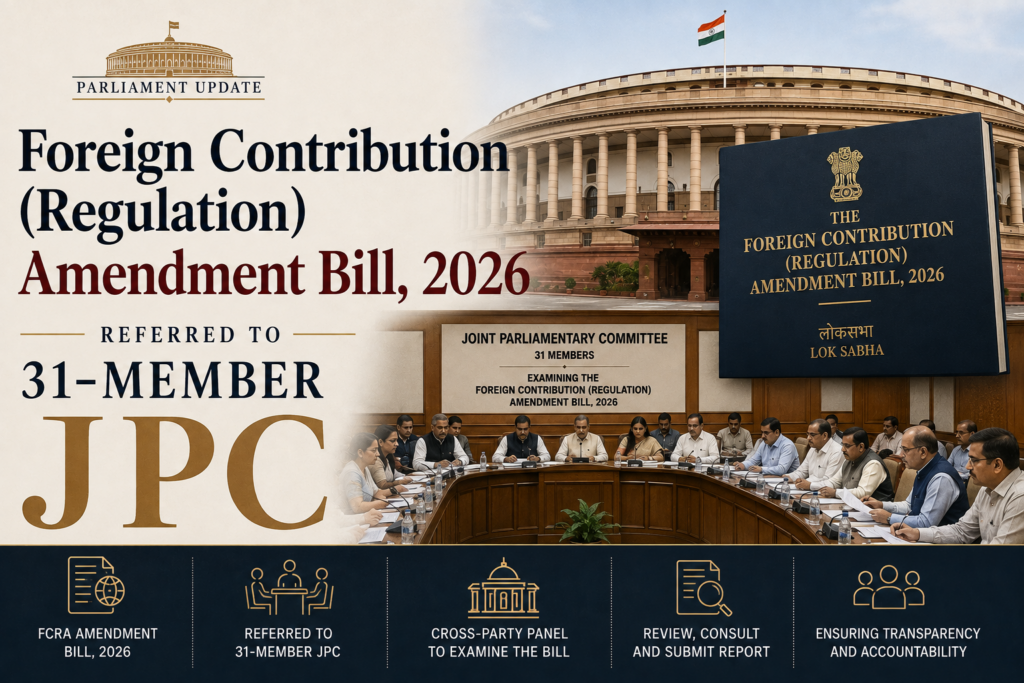
Why in the news?
The Lok Sabha adopted a motion referring the Foreign Contribution (Regulation) Amendment Bill, 2026, to a Joint Parliamentary Committee (JPC) after sustained Opposition protest and coordinated appeals from Christian organisations. The referral has exposed a tension between the state’s claim to regulate foreign funded civil society and the property and hearing rights of the organisations that funding built. Minority run schools, colleges and hospitals sustained by money from abroad stand most exposed to the Bill’s asset takeover provisions.
What is the Foreign Contribution (Regulation) Act, 2010?
- Governing statute: The Foreign Contribution (Regulation) Act, 2010 regulates the acceptance and use of foreign contributions and foreign hospitality by individuals and associations. It replaced the earlier Foreign Contribution (Regulation) Act, 1976.
- Registration mechanism: An organisation receiving foreign funds must register with the Ministry of Home Affairs and renew that registration every five years. Funds may be used only for the declared cultural, economic, educational, religious or social programme.
What is a Joint Parliamentary Committee (JPC)?
- Ad hoc committee: A JPC is a temporary committee of members drawn from both Houses to examine a specific bill or matter in detail and report back. This one has 21 Lok Sabha members nominated by the Speaker and 10 Rajya Sabha members nominated by the Chairman, a total of 31 members.
- Reporting deadline: The committee must submit its report to the Lok Sabha by the last day of the first week of the coming Winter Session.
What is the current status of the right to receive foreign contributions in India?
- Not a fundamental right: The Central government contends that the right to receive foreign contributions is not a fundamental right, and that access to foreign funds is a privilege the state may condition or withdraw.
- Renewal regime: About every registered body operates on a five year certificate, renewable on application, with the Ministry of Home Affairs holding discretion to refuse renewal on security grounds.
- Prior tightening: The 2020 amendments barred a registered body from transferring foreign funds to any other body, even one registered under the same Act, and cut the share of foreign funds usable for administrative expenses from one half to one fifth.
- Judicial check: The Kerala High Court on Tuesday set aside the Centre’s refusal to renew certificates of two NGOs, Save A Family Plan and Kerala Social Service Forum, holding that reasons must be specified in every order and that peaceful protest funding is not a national security threat.
Constitutional provisions related to foreign funding regulation:
- Article 19(1)(c): Guarantees the right to form associations, which the regulation of their funding directly affects.
- Article 19(1)(a): Protects freedom of speech and expression, engaged where funding refusal follows an organisation’s support for protest.
- Article 14: Requires that any classification and any exercise of discretion in refusing renewal be non arbitrary and reasoned.
- Article 300A: Provides that no person shall be deprived of property save by authority of law, engaged by the automatic vesting of NGO assets in a designated authority.
- Entry 10, Union List: Places foreign affairs and matters bringing the Union into relation with foreign countries within Parliament’s exclusive competence, the basis for central regulation of foreign funds.
What does the 2026 Bill change?
- Designated authority: The Bill creates a government designated authority to take over, manage or dispose of assets built from foreign funds when an organisation’s FCRA registration is suspended, cancelled or not renewed.
- Trigger on lapse: Registration can be lost not only by cancellation, but when renewal is refused, not applied for, or not granted before the old certificate expires.
- Automatic vesting: On that event the organisation’s foreign funds and everything built with them pass to the authority automatically, returning only if the body re registers within a period the government has yet to specify.
- Full takeover of part funded property: A building put up only partly with foreign money is taken over in full, and the organisation must separately apply to recover the share not paid for with foreign money.
- Limited appeal: An appeal to a district judge lies only against what the authority later does with the property, not against the refusal to renew, and the organisation has no right to be heard before that refusal.
Why are minority religious institutions most alarmed?
- Scale of dependence: Christian organisations run thousands of schools, colleges and hospitals built and sustained with money from churches and congregations abroad, which the takeover provisions place at risk.
- Retrospective reach: A hospital built decades ago can be taken over today merely because a certificate has been allowed to lapse, contradicting the Home Minister’s assurance that the Bill will not apply retrospectively.
- Geographic spread of protest: Hundreds marched in Aizawl under a newly formed council of churches, organisations in Kerala objected, the Nagaland Chief Minister sought a parliamentary review, and the Tamil Nadu Assembly unanimously resolved for withdrawal.
- External pressure: A United States Congressman described the Bill as an attack on Christians and warned it could strain India United States relations, one trigger for the government’s rethink.
- Institutional welcome for referral: The Catholic Bishops’ Conference of India and the National Council of Churches in India welcomed the referral while asking that major and minor offences be distinguished before assets are taken.
What are the major debates surrounding foreign funding regulation?
- Regulation versus autonomy: Church bodies concede that regulation of foreign funds is necessary and that action must follow against anti national activity, while resisting a design that punishes lapse of a certificate as harshly as proven wrongdoing.
- Discretion without reasons: Because the authority acts on the Centre’s instructions, the Centre can use opaque reasons to withdraw a licence, take over property, and then direct the body now holding it.
- Hearing and appeal gap: The absence of a pre decisional hearing and of any appeal against refusal to renew is the core fairness objection the JPC is asked to cure.
- Property proportionality: Full takeover of a building only partly financed by foreign money raises a proportionality question under the protection of property.
Challenges to fair FCRA regulation:
- Reasoned order deficit: Refusals often rest on undisclosed intelligence inputs, leaving organisations unable to contest the specific ground, as the Kerala High Court flagged.
- Chilling effect on civil society: Uncertainty over renewal deters legitimate service delivery in health and education that depends on predictable foreign inflows.
- Asset valuation disputes: Separating the foreign funded share of a mixed asset invites prolonged litigation over apportionment and valuation.
- Federal friction: State Assemblies have resolved against the Bill, exposing a centre state fault line over regulation of institutions operating within States.
- Compliance burden on small NGOs: Frequent re registration and strict expense caps fall hardest on small organisations lacking dedicated legal and accounting capacity.
- Selective enforcement risk: Broad discretion creates room for targeting organisations by community or by their political positions rather than by conduct.
Conclusion: The Bill’s central defect is that it lets the Centre seize the assets of a civil society body on the mere lapse of a certificate, without a hearing before refusal and without an appeal against it. The referral to a 31 member JPC defers passage rather than resolving the dispute. The committee must redraft the Bill to give organisations a hearing before renewal is refused and a right to appeal that refusal, with the report due by the first week of the Winter Session.
Statutory Framework Governing Foreign Funding of NGOs:
- Foreign Contribution (Regulation) Act, 2010: The principal Act requiring registration and prior permission for receipt of foreign contributions.
- Foreign Contribution (Regulation) Amendment Act, 2020: Barred sub granting of foreign funds, cut the administrative expense cap to one fifth, and mandated a designated FCRA account at a specified State Bank of India branch.
- Foreign Contribution (Regulation) Rules, 2011: Prescribe the procedure for registration, renewal, reporting and use of foreign contributions.
- Foreign Contribution (Regulation) Amendment Bill, 2026: The pending Bill introducing the designated authority and automatic vesting of assets, now before the JPC.
Back2Basics: FCRA registration
- Administering ministry: Ministry of Home Affairs, Foreigners Division.
- Eligibility: Associations with a definite cultural, economic, educational, religious or social programme, normally in existence for at least three years.
- Prohibited recipients: Election candidates, judges, government servants, members of legislatures, political parties and media organisations are barred from accepting foreign contributions.
- Validity and renewal: Registration is valid for five years and must be renewed through a fresh application before expiry.
Way Forward:
- Pre decisional hearing: Mandate notice and an opportunity to be heard before any refusal to renew or cancellation.
- Appeal against refusal: Provide a statutory appeal against the refusal itself, not only against later dealing with the property.
- Proportionate asset treatment: Restrict any takeover to the demonstrably foreign funded share of an asset, with independent valuation.
- Reasoned orders: Require every refusal to state specific, disclosable reasons, subject to security redaction reviewed by the appellate authority.
- Distinguish offences: Separate technical lapses, such as delayed renewal, from substantive violations before invoking asset consequences.
“[2015 GS2 12.5m] Examine critically the recent changes in the rules governing foreign funding of NGOs under the Foreign Contribution (Regulation) Act (FCRA), 1976.”
