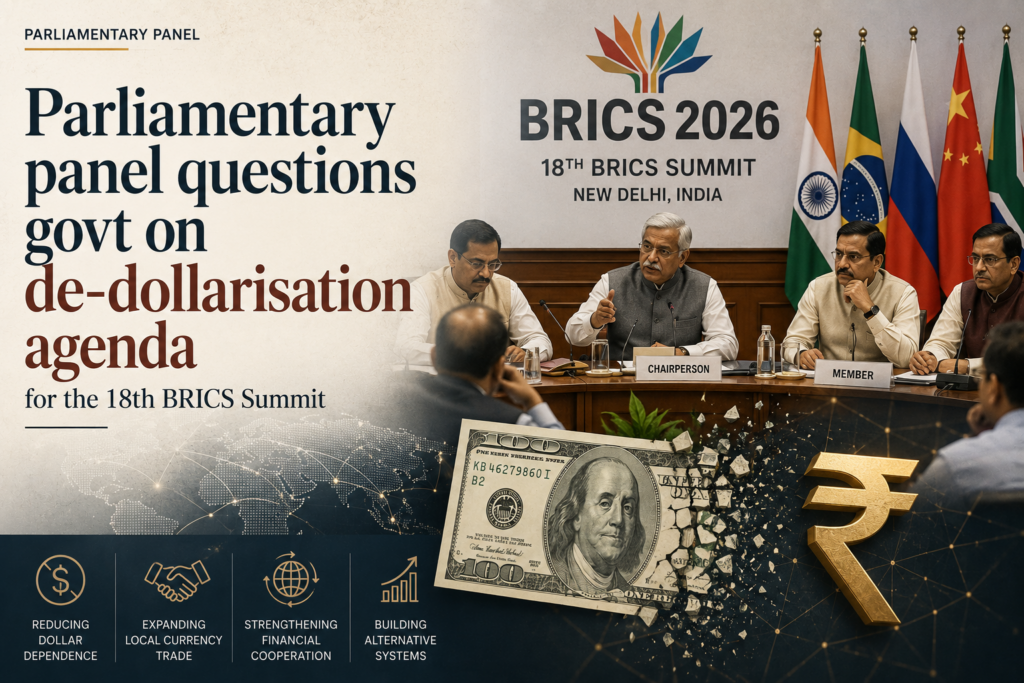
Members of the Parliamentary Standing Committee on External Affairs have asked the government whether it will push a de-dollarisation agenda at the 18th BRICS Summit, which New Delhi hosts in September 2026. The question exposes a tension between the pursuit of greater financial sovereignty and the risk of provoking US retaliation. India holds the rotating chairship of BRICS through 2026, which makes the host nation’s posture on the dollar a live diplomatic choice rather than an abstract one.
What is de-dollarisation?
- About: De-dollarisation is a deliberate reduction in the use of the US dollar for international trade invoicing, cross-border settlement, and foreign exchange reserves.
- Mechanism: Countries settle bilateral trade in their own national currencies or through a shared settlement arrangement, bypassing dollar clearing and dollar-denominated payment channels.
What is BRICS?
- About: BRICS is an intergovernmental grouping originally of Brazil, Russia, India, China, and South Africa, later expanded to admit new members, that coordinates positions on trade, finance, and reform of global governance.
- Chairship: The chairship rotates annually among members, and India assumed it on 1 January 2026 and leads the bloc until the end of the year.
What is a Central Bank Digital Currency (CBDC)?
- About: A CBDC is a digital form of a country’s sovereign currency issued and backed by its central bank, distinct from private cryptocurrencies.
- Relevance here: The Reserve Bank of India (RBI) has repeatedly advocated linking the official digital currencies of BRICS countries to facilitate cross-border trade and tourism payments.
Why is the parliamentary panel pressing the government?
- Direct question posed: The panel asked whether the government plans to push a de-dollarisation agenda at the summit New Delhi hosts in September.
- Financial sovereignty framing: Members questioned why the government was not pursuing greater financial sovereignty that could help countries bypass US sanctions.
- Host-nation leverage: They sought to know whether India, as the host nation, would push a BRICS-led de-dollarisation agenda.
- Stalled precedent cited: Members noted that India’s effort to establish a local currency trade mechanism with Russia had not taken off.
What is the case for reducing dollar reliance?
- RBI framework: The central bank has argued that linking BRICS digital currencies could reduce reliance on the US dollar amid rising geopolitical tensions.
- Sanctions insulation: A shared settlement mechanism would let member economies transact even when cut off from dollar clearing systems.
- Payment efficiency: Direct local currency settlement lowers conversion costs in cross-border trade and tourism payments.
Why does a de-dollarisation push carry risks?
- US retaliation threat: The US President has repeatedly warned BRICS countries against creating an alternative currency or challenging the dollar’s dominance, threatening punitive tariffs.
- Weak internal record: India’s own local currency trade mechanism with Russia has not taken off, exposing the practical difficulty of moving away from the dollar.
- Host-nation exposure: As chair and host, a visible Indian push would identify New Delhi with the agenda and concentrate any retaliatory response on it.
Conclusion
The panel has flagged the gap between the RBI’s advocacy for a BRICS payments architecture and the government’s caution on committing to de-dollarisation. The immediate status is that the government has not confirmed whether it will table the agenda. The next milestone is the 18th BRICS Summit in New Delhi in September 2026, where India’s posture as chair will become clear.
About BRICS
- Origin: The term BRIC was coined in 2001, the first leaders’ summit was held in 2009, and South Africa joined in 2010 to make it BRICS.
- Expansion: The bloc admitted new members from 2024 onward, widening its economic and geographic weight.
- Institutions: BRICS created the New Development Bank (NDB), headquartered in Shanghai, and the Contingent Reserve Arrangement (CRA) to provide financing and liquidity support.
- Weight: The grouping represents a large share of the world’s population and a substantial share of global output, giving it standing in debates over multilateral reform.
Back2Basics: New Development Bank (NDB)
- Convening body: Established by BRICS members to fund infrastructure and sustainable development projects.
- Headquarters: Shanghai, China.
- Function: Lends to member and partner economies, part of the bloc’s push to build financial institutions parallel to the World Bank and the International Monetary Fund (IMF).
“[2025] Consider the following statements with regard to BRICS:
I. The 16th BRICS Summit was held under the Chairship of Russia in Kazan.
II. Indonesia has become a full member of BRICS.
III. The theme of the 16th BRICS Summit was Strengthening Multilateralism for Just Global Development and Security.
Which of the statements given above is/are correct?
(a) I and II
(b) II and III
(c) I and III
(d) I only
