Why in the news?
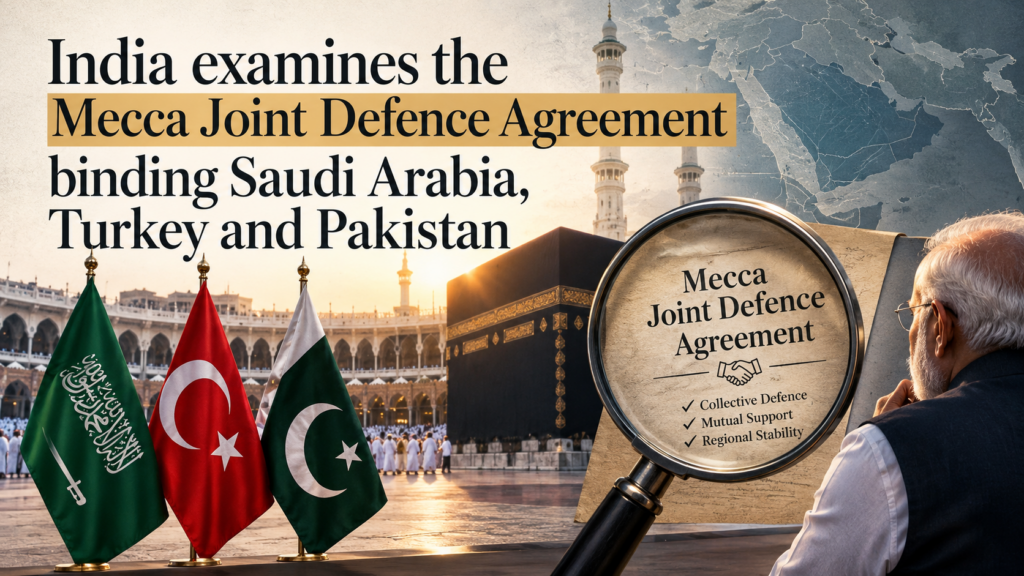
Saudi Arabia, Turkey, and Pakistan have signed the Mecca Joint Defence Agreement, a trilateral mutual defence pact that borrows the collective security logic of Article 5 of the NATO charter. The signing exposes a central question for New Delhi: whether the pact gives Pakistan a shield to escalate against India, or whether it is a loose instrument of strategic hedging without the integration of a real military alliance. India’s foreign ministry says it is tracking the situation carefully.
What is the Mecca Joint Defence Agreement?
- About: A mutual defence pact among Saudi Arabia, Turkey, and Pakistan, signed in 2026, that treats an armed attack on any one member as an attack on all.
- Design borrowing: It borrows elements of Article 5 of the North Atlantic Treaty Organisation (NATO) charter, including its collective security clause, marking a shift away from the US security umbrella toward regional self-reliance.
What is Article 5 of the NATO charter?
- Collective defence clause: It commits every member to treat an armed attack against one member as an attack against all, and to assist in response.
- Why it matters here: The Mecca pact replicates this trigger among three states, which raises the question of how Turkey reconciles it with its existing NATO obligations.
What is Operation Sindoor?
- About: An Indian military operation against terror infrastructure that serves as the reference case for how the three signatories behaved during an India-Pakistan confrontation.
- Behaviour observed: Turkey provided Pakistan diplomatic and rhetorical support and sold drones, but stopped short of tangible military assistance, and Saudi Arabia stayed silent.
What are the three power centres the pact combines?
- Pakistan: A declared South Asian nuclear power contributing a powerful conventional military and a functional nuclear arsenal, though it is unclear whether Islamabad has offered a nuclear umbrella.
- Saudi Arabia: Provides political and financial clout as leader of the Sunni world and controller of one of the world’s largest oil reserves.
- Turkey: The successor of the Ottoman Empire, contributing a powerful military, NATO operational experience, and a highly capable defence industry.
- Stated adversaries: The unstated targets are Iran, leader of the Shia world with proxies including Hezbollah and Hamas across Yemen, Iraq, Syria, and Lebanon, and Israel, an intelligence powerhouse and undeclared nuclear power.
What is the pattern of prior cooperation among the three?
- Bilateral base: Pakistan has provided military training and technical assistance to Saudi Arabian forces for decades.
- September 2025 pact: Riyadh and Islamabad signed a bilateral Strategic Mutual Defence Agreement, which evolved into the trilateral Mecca Agreement with Ankara’s participation.
- Force deployment: Pakistan deployed some 8,000 troops, a squadron of JF-17 fighter aircraft, drones, and HQ-9 air defence systems to Saudi Arabia.
- Financial and naval ties: Riyadh has repeatedly provided financial bailouts to Islamabad, and Turkey and Pakistan have exchanged warships and training aircraft.
Why does the pact worry India directly?
- Cold War precedent: Pakistan has a long record of hitching its wagon to pacts to oblige Western powers and gain geopolitical advantage against India, joining the Southeast Asia Treaty Organisation (SEATO) in 1954 to secure advanced weaponry for its struggle over Jammu and Kashmir.
- Global South rivalry: Saudi Arabia and Turkey are seen as piggybacking on Pakistan to seek a bigger strategic role in Asia and to challenge India’s ambition to lead the Global South.
- Forum coordination: The bloc can coordinate positions in international forums such as the United Nations (UN) and the Organisation of Islamic Cooperation (OIC) on issues including Kashmir and maritime security.
- Technology integration: Turkish defence industry output, funded by Saudi capital and deployed in Pakistan, can enhance Rawalpindi’s capabilities in unmanned aerial vehicles (UAVs), electronic warfare, and naval platforms.
Is this an “Islamic NATO” or strategic hedging? (the central tension)
- Case against alarm: Calling it an Islamic NATO is premature because NATO’s efficacy relies on a unified command, pre-assigned forces, and deep interoperability, while the Mecca pact lacks an integrated military headquarters, joint command mechanisms, and institutionalised doctrine.
- Divergent priorities: Saudi Arabia is focused on hedging against Iran and Houthi threats, Turkey on defence exports and Islamic-world leadership, and Pakistan on economic bailouts and leverage against India.
- Legal limit on the trigger: Mutual defence treaties apply strictly to unprovoked external aggression, so Indian counter-terrorism strikes against Pakistani terror infrastructure do not constitute a treaty trigger.
- Saudi restraint: Riyadh’s relationship with New Delhi has evolved into a multi-billion-dollar strategic partnership spanning energy, trade, and intelligence, and the Saudi Crown Prince has no interest in being dragged into a South Asian military conflict.
How could the interlocking alliances backfire?
- World War I analogy: A matrix of interlocking military alliances of exactly this kind triggered World War I, and repeating that blunder would be a serious risk.
- Unreconciled obligations: If Israel strikes a Saudi facility and Turkey responds under the Mecca pact, it is unclear whether the 32 NATO countries would be treaty-bound to support Turkey.
- Operational hedging: Saudi Arabia’s passivity when Pakistan clashed with Afghanistan, and Pakistan’s non-involvement when Saudi Arabia faced Iranian and Houthi strikes, show these pacts often pair political rhetoric with operational hedging.
How has the military balance on India’s borders shifted?
- Strike corps repurposed: The Indian Army converted a 60,000-strong strike corps configured for the India-Pakistan border into a mountain strike corps for the China border.
- Divisions reassigned: Two mountain divisions raised over the last two decades were assigned entirely to the China border.
- Earmarking change: Where 70 per cent of the Indian Army was once earmarked for the Pakistan border, only about 55 per cent is today.
What should India’s calibrated response be?
- Discreet engagement: Engage Saudi Arabia candidly through high-level channels to secure assurances that the pact’s defensive clauses apply only to the West Asian theatre and cannot be weaponised by Pakistan.
- Firm deterrence: Maintain a firm deterrence doctrine so that Indian responses to state-sponsored terrorism remain resolute and unaffected by third-party arrangements.
- Gulf partnerships: Double down on bilateral economic, trade, and strategic partnerships with Saudi Arabia and the broader Gulf Cooperation Council (GCC).
- Technology watch: Monitor Turkey-Pakistan military-industrial co-development and prioritise indigenous research to neutralise advanced drones, electronic warfare, and naval platforms.
- Procurement reform: Fast-track defence procurement, which has been slowed by bureaucratic caution since the Bofors scandal.
Conclusion
The Mecca Agreement is best understood less as a binding warfighting alliance and more as an instrument of strategic hedging for a volatile region, fusing Saudi capital, Turkish technology, and Pakistani manpower into a collective deterrence shield. The central idea is that its danger to India lies not in an immediate collective-defence trigger but in the technology integration and diplomatic bloc it creates. A pragmatic Indian strategy combines firm counter-terrorism deterrence, deep economic engagement in the Gulf, and targeted defence innovation at home.
West Asian Security Architecture: About
- US umbrella in retreat: The United States has signalled limits on its security guarantees to West Asian allies, prompting states to seek self-reliance.
- Israeli posture: Israel has demonstrated through its bombing of Iran-linked targets that it will accept no restraints on its perceived security interests.
- Realignment: Riyadh, Ankara, and Islamabad have come together in response, marking a shift away from dependence on Washington.
Back2Basics: Organisation of Islamic Cooperation (OIC)
- Convening body: An intergovernmental organisation of Muslim-majority states that coordinates political and economic positions.
- Relevance: The Mecca bloc can use the OIC to coordinate positions on issues including Kashmir.
- India’s stance: India is not a member and has consistently rejected OIC pronouncements on Kashmir as interference in internal affairs.
Challenges for India from the pact
- Diplomatic bloc formation: A formal political grouping can coordinate against Indian interests at the UN and OIC.
- Capability transfer: Turkish drone, electronic warfare, and naval technology reaching Pakistan raises the conventional threat.
- Two-front pressure: Deeper Pakistan alignments complicate India’s management of simultaneous China and Pakistan borders.
- Gulf balancing: India must protect its expanding Saudi and Gulf partnerships without endorsing the pact.
- Escalation ambiguity: Uncertainty over how the collective clause would be read in a crisis raises the risk of miscalculation.
Way Forward
- Bilateral reassurance: Secure written or channelled Saudi and Emirati assurances that the pact excludes India-Pakistan sub-conventional conflict.
- Deterrence signalling: Communicate that counter-terror responses will remain resolute and unlinked to third-party pacts.
- Indigenous capability: Accelerate counter-drone, electronic warfare, and naval research, seeking foreign partners ahead in these fields.
- Economic anchoring: Deepen Gulf trade and energy ties to make India indispensable to Riyadh’s long-term economic vision.
- Procurement speed: Streamline defence acquisition to close capability gaps quickly.
“[2023 GS2 15m] ‘The expansion and strengthening of NATO and a stronger US-Europe strategic partnership works well in India.’ What is your opinion about this statement? Give reasons and examples to support your answer.”
