| PYQ Relevance [UPSC 2016] Pradhan Mantri Jan-Dhan Yojana (PMJDY) is necessary for bringing unbanked to the institutional finance fold. Do you agree with this for financial inclusion of the poorer section of the Indian society? Give arguments to justify your option. Linkage: The PYQ tests whether PMJDY has translated bank-account access into substantive financial inclusion for the poor. The article extends the PYQ by examining the shift from account ownership to actual usage of savings, credit and insurance. |
Mentor’s Comment
The Pradhan Mantri Jan Dhan Yojana (PMJDY) completed twelve years on Independence Day 2026, having crossed 58 crore accounts with deposits of about ₹3 lakh crore. The milestone exposes the distance between owning a bank account and actually using savings, credit and insurance through it.
What is the Pradhan Mantri Jan Dhan Yojana (PMJDY)?
- About: National financial inclusion mission announced from the ramparts of the Red Fort on 15 August 2014 and formally launched at Vigyan Bhawan on 28 August 2014.
- Core entitlement: Every household in India was to have a bank account, a RuPay debit card and insurance cover.
- Zero balance design: The account can be opened and held without any minimum balance requirement.
- Credit attachment: An overdraft facility of up to ₹10,000 is attached to the account so that it functions as more than a deposit box.
- Administering authority: The Department of Financial Services, Ministry of Finance, runs the scheme through public and private sector banks.
What is Antyodaya?
- Definition: The principle that the most deprived person is the most deserving claimant on the fruits of development.
- Origin: The concept was propounded by both Mahatma Gandhi and Deendayal Upadhyaya.
What is the JAM trinity?
- Definition: The linking of Jan Dhan bank accounts, Aadhaar digital identity and Mobile connectivity into one delivery rail.
- Function: It allows a government payment to reach a verified individual account without passing through any intermediate handling point.
What is Direct Benefit Transfer (DBT)?
- Definition: The transfer of a subsidy or entitlement directly into the beneficiary’s bank account instead of through a physical distribution chain.
- Purpose: It removes the intermediate custody points at which cash and commodity leakage historically occurred.
What is Digital Public Infrastructure (DPI)?
- Definition: Publicly governed digital rails for identity, payments and data sharing on which both government and private services are built.
- The Indian stack: Aadhaar supplies identity, the Unified Payments Interface (UPI) supplies payments, and Jan Dhan accounts supply the account layer.
Why did political independence not deliver financial access to millions of Indians?
- A distant formal system: Decades after 1947, a bank account, formal credit, insurance and a reliable channel to receive government support could not be taken for granted.
- Leakage in delivery: A former Prime Minister acknowledged that when a rupee was sent from Delhi, only 15 paise reached the intended recipient.
- No delivery address: Without an account, a citizen had no address to which government money could be sent directly.
- Exclusion by balance: Minimum balance requirements made the formal banking system unusable for people whose incomes were small and irregular.
- Incomplete freedom: Political freedom remains incomplete where a citizen cannot save securely, receive money directly or reach the institutions through which economic opportunity flows.
Why is access to formal finance treated as a responsibility of the state?
- The Chanakya formulation: The launch invoked Sukhasya moolam dharmah, Dharmasya moolam artha, Arthasya moolam rajyam, that the root of happiness is dharma, the root of dharma is artha, and the root of artha is the state.
- The claim it carries: Economic means are fundamental to human well being, so creating access to those means is a state obligation and not a discretionary favour.
- The Antyodaya test: The architecture was built on the rule that the last person in the queue should not remain outside the system.
- Entry point, not benefit: The account was designed as an entry point into the formal economy, not as one more transfer to be received.
- A second independence: Sixty seven years after 1947, financial and digital literacy was placed at the centre of the Independence Day address as unfinished national business.
How was the Jan Dhan account designed so that the poorest could keep it?
- No entry cost: The zero balance account meant that having little money was no longer a reason to stay outside the banking system.
- A usable instrument: The RuPay debit card converted the account from a passbook into a transacting instrument.
- Small credit line: The overdraft facility gave the holder a formal alternative to the moneylender for a consumption shortfall.
- Embedded insurance: A ₹2 lakh accident insurance cover was attached to the RuPay card without a separate premium payment.
- Household unit: Coverage was defined at the household level, so the target was universality rather than a beneficiary list.
What do twelve years of numbers show about the scale of the first step?
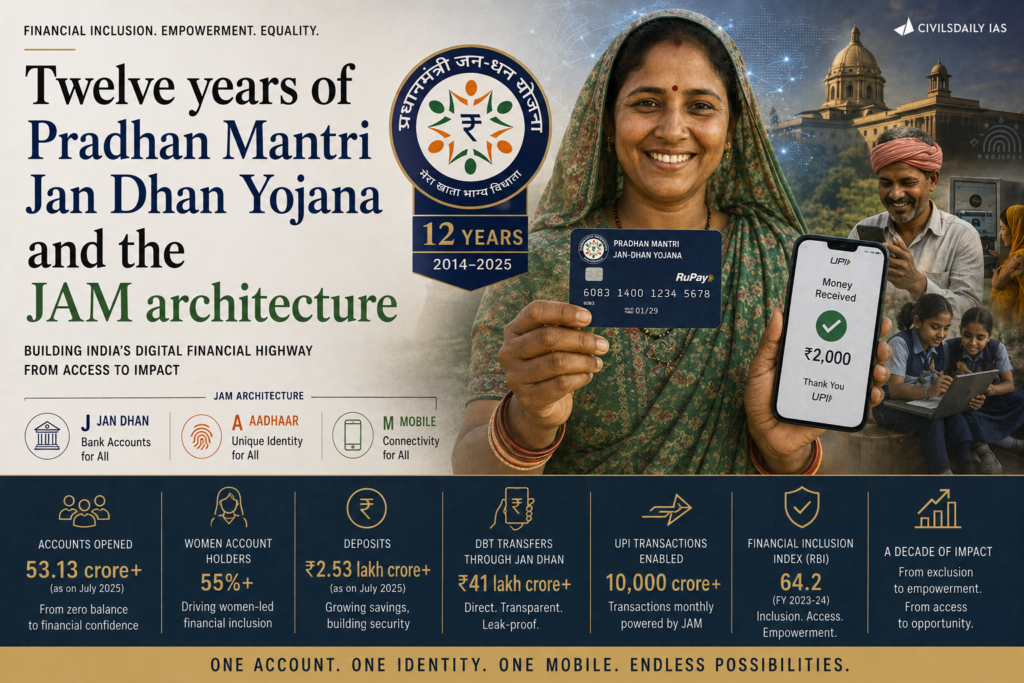
- Account base: The scheme had crossed 58 crore accounts by July 2026.
- Deposits held: Balances in these accounts run into about ₹3 lakh crore.
- Women’s share: More than half of all Jan Dhan accounts are held by women.
- Geographic spread: Roughly three fourths of the accounts are in rural and semi urban areas.
- Average balance: The two figures together imply an average balance of about ₹5,200 per account.
How did a bank account become the first layer of a national digital infrastructure?
- First layer of JAM: Jan Dhan supplied the account layer on which Aadhaar identity and mobile connectivity were stacked.
- A direct channel: Once accounts were linked to identity and mobile, the government gained a direct route through which benefits could reach a named individual.
- Transformed transfers: This changed what Direct Benefit Transfer could actually do, from a pilot idea to the default mode of payment.
- Continuity with UPI: The same infrastructure carried the Unified Payments Interface into everyday retail payments.
- Cross border reach: A merchant accepting a UPI payment in France in 2026 and a first time account holder of 2014 sit on the same financial infrastructure.
Does opening accounts amount to financial inclusion?
- The ownership side: With 58 crore accounts and near universal household coverage, the question of formal access has been settled.
- The usage side: Financial inclusion means participation in savings, payments, credit, insurance and economic opportunity, which an account count does not measure.
- What the balances say: An average balance of about ₹5,200 indicates that the account works mainly as a receiving channel rather than as a savings instrument.
- The credit gap: The overdraft remains the least used component of the design, so formal credit has not displaced the informal lender for most holders.
- Dormancy: Close to a fifth of Jan Dhan accounts have been reported inoperative, which means the rail exists but is not always carrying traffic.
Why does a bank account function as a marker of identity?
- Recognition with respect: The account gave people from marginalised sections a formal record of existence that the system had rarely offered them.
- Visibility: It made those on the periphery visible and counted within the financial system.
- The scheme’s own framing: The tagline Mera khaata, bhagya vidhata, my account the destiny maker, states the claim that the account itself changes standing.
- Forward link: Financial inclusion is now positioned as an input into the Viksit Bharat 2047 goal.
What are the challenges to the Pradhan Mantri Jan Dhan Yojana?
- Inoperative accounts: A large share of accounts records no customer induced transaction for long periods, e.g. the Finance Ministry ran a nationwide fresh KYC drive in 2024 covering roughly 11 crore inoperative Jan Dhan accounts.
- Overdraft under use: Banks sanction the overdraft to a small fraction of eligible holders because these borrowers carry no credit score, e.g. lenders treat a zero balance account with irregular inflows as an unscorable credit risk.
- Last mile agent viability: Business correspondents earn thin commissions on low value transactions, e.g. Bank Mitras in remote blocks handle deposits too small to cover travel and cash carrying costs.
- Duplicate accounts: The 2014 enrolment drive produced multiple accounts per household, e.g. families opened a second account to capture the accident cover, inflating the headline count.
- Unclaimed insurance: The accident cover lapses through ignorance of its conditions, e.g. holders do not know the RuPay card must have been used within a qualifying period before the accident for the claim to stand.
- Misuse of dormant accounts: Idle zero balance accounts are rented out as conduits for fraud proceeds, e.g. mule account networks flagged by the Indian Cyber Crime Coordination Centre have used dormant no frills accounts.
Conclusion
Twelve years of Jan Dhan have settled the question of access and left the question of use open. The visible achievement is 58 crore accounts; the durable one is the rail that now carries Direct Benefit Transfer and UPI. The unfinished work is converting a receiving account into a working relationship with savings, credit and insurance.
Back2Basics:
What is Financial Inclusion?
- About: Financial inclusion is the delivery of banking, payment, credit, insurance and pension services to every section of society at an affordable cost.
- Rationale: Exclusion from formal finance forces households into informal credit at punitive rates and denies the state a clean channel to transfer entitlements.
- Access: The first dimension is the availability of a formal account and a service point within reach of the household.
- Usage: The second dimension is the actual frequency and depth of transactions, savings and borrowing through that account.
- Quality: The third dimension covers consumer protection, grievance redress and financial literacy, and it is the dimension the Reserve Bank of India Financial Inclusion Index weights lowest.
Laws and Rules Governing Financial Inclusion in India
- Reserve Bank of India Act, 1934: Establishes the central bank and its power to direct banking policy, including branch authorisation and priority sector norms.
- Banking Regulation Act, 1949: Governs the licensing and conduct of banks, and is the basis for the Basic Savings Bank Deposit Account norms that permit zero balance accounts.
- Aadhaar Act, 2016: Section 7 permits the use of Aadhaar authentication as a condition for receiving a subsidy or benefit funded from the Consolidated Fund of India.
- Payment and Settlement Systems Act, 2007: Gives the Reserve Bank authority to regulate payment systems, and is the legal basis for the National Payments Corporation of India operating UPI, RuPay and the Aadhaar Enabled Payment System.
- Prevention of Money Laundering Act, 2002 and Rules: Prescribe the customer identification and record keeping obligations that govern account opening and periodic verification.
Pradhan Mantri Jan Dhan Yojana
- Ministry or Department: Ministry of Finance, Department of Financial Services.
- Launch year: 2014, announced on 15 August and launched on 28 August.
- Aims and objectives: Financial inclusion through zero balance accounts, insurance, overdraft and micro pension, forming the first leg of the JAM trinity.
- Targeted beneficiaries: Unbanked adults, with a household level coverage target.
- Key features: Basic Savings Bank Deposit accounts, an overdraft of up to ₹10,000, an accident cover of ₹2 lakh, and RuPay and Aadhaar Enabled Payment System interoperability.
- Record: The scheme holds a Guinness World Record for the most bank accounts opened in a single week during its 2014 rollout.
Government Initiatives for Financial Inclusion
- Pradhan Mantri Jeevan Jyoti Bima Yojana: Renewable one year life cover for account holders aged 18 to 50 at a low annual premium.
- Pradhan Mantri Suraksha Bima Yojana: Accident death and disability cover for account holders aged 18 to 70 at a nominal annual premium.
- Atal Pension Yojana: Guaranteed minimum pension for unorganised sector workers, delivered through the same bank accounts.
- Pradhan Mantri Mudra Yojana: Collateral free institutional credit to micro enterprises under the Shishu, Kishore and Tarun categories.
- Stand Up India: Bank loans for greenfield enterprises promoted by Scheduled Caste, Scheduled Tribe and women entrepreneurs.
- PM SVANidhi: Working capital loans to street vendors, extending formal credit to a category with no collateral.
Key Facts about Financial Inclusion in India
- JAM as a term: The JAM trinity entered official vocabulary through the Economic Survey that followed the launch of Jan Dhan.
- Financial Inclusion Index: The Reserve Bank publishes an annual composite index built on Access, Usage and Quality, with Usage carrying the largest weight.
- Priority Sector Lending: Scheduled commercial banks must direct 40 per cent of adjusted net bank credit to priority sectors, including weaker sections.
- Payments banks: A separate bank category was licensed to accept small deposits and offer payments without lending, expanding the service point network.
- Aadhaar Enabled Payment System: It allows cash withdrawal at a business correspondent point using fingerprint authentication alone, without a card or a branch.
Challenges in Financial Inclusion in India
- Thin rural service points: Banking outlets remain concentrated in towns, e.g. aspirational districts in central India depend on a single business correspondent covering several villages.
- Low insurance penetration: Micro insurance uptake stays low despite nominal premiums, e.g. renewal rates for the low cost life and accident schemes fall sharply after the first auto debit year.
- Weak grievance redress: New account holders rarely reach an effective complaint channel, e.g. unauthorised debit complaints from rural holders often stop at the branch level and never reach the Banking Ombudsman.
- Connectivity failures: Authentication depends on network availability, e.g. Aadhaar Enabled Payment System withdrawals fail in hilly and forest blocks where mobile data is intermittent.
- Financial literacy gap: Holders do not understand interest, penalty and claim conditions, e.g. overdraft users treat the limit as a grant rather than as a loan carrying interest.
- Gendered control of accounts: Women hold accounts that male household members operate, e.g. transfers under women centred schemes are frequently withdrawn by another family member at the agent point.
Way Forward
- Shift the metric: Measure the scheme on transaction frequency, credit uptake and insurance claims settled rather than on accounts opened.
- Build alternative credit scoring: Use account transaction history and Account Aggregator consented data to underwrite the overdraft for holders with no formal credit record.
- Fix agent economics: Revise business correspondent commissions to reflect distance and transaction cost so that remote service points remain viable.
- Run a dormancy clearance cycle: Institutionalise periodic verification and reactivation drives instead of one off campaigns.
- Embed literacy in delivery: Attach a short standardised explanation of overdraft interest and insurance claim conditions to every account and card issued.
- Harden the rail against misuse: Apply transaction pattern monitoring to dormant zero balance accounts to detect mule account recruitment early.
