Why in the News
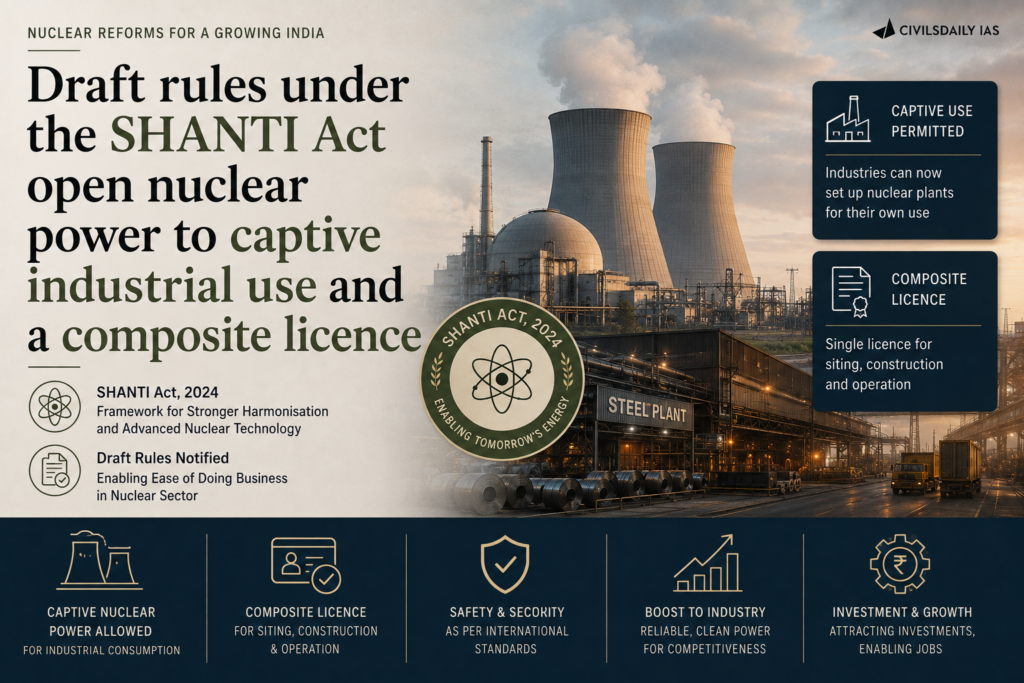
The Department of Atomic Energy released draft rules under the Sustainable Harnessing and Advancement of Nuclear Energy for Transforming India (SHANTI) Act on 14 August 2026, opening nuclear power generation to private and captive users. Comments are invited until 4 September 2026.
What is the SHANTI Act?
- Replaces the earlier state monopoly framework with a licensing regime for non-government operators.
- Covers private participation, captive generation, foreign reactor technology, safety and nuclear liability.
- Provides a single composite licence for building, owning, operating and decommissioning a reactor.
Key Provisions
- Captive nuclear power: Industries can generate nuclear electricity mainly for their own consumption.
- In-principle approval: Allows land acquisition and vendor negotiations before final licensing.
- Foreign technology: Imported designs must be certified by the regulator in the country of origin and already operational.
- Nuclear liability: Operators must maintain insurance or financial security; a Nuclear Liability Fund is proposed.
- Eligible users: Aluminium, cement, data centres, semiconductor fabs and Artificial Intelligence (AI) facilities.
Key Concern
- The country-of-origin certification may speed up safety approval but restrict technology sourcing to a few countries. Requiring continued support and retaining Intellectual Property Rights (IPR) with foreign developers could also limit technology transfer and indigenous reactor design.
India’s Nuclear Programme
- Stage 1: Pressurised Heavy Water Reactors (PHWRs) using natural uranium.
- Stage 2: Fast Breeder Reactors (FBRs) using plutonium.
- Stage 3: Thorium-based reactors using Uranium-233 (U-233).
- Target: 100 GW nuclear capacity by 2047.
Challenges
- Supplier liability concerns
- Limited regulatory independence
- Land and public acceptance
- Uranium and fuel constraints
- Nuclear waste management
- High project costs and long construction timelines
Prelims Pointers
- DAE: Department of Atomic Energy
- AERB: Atomic Energy Regulatory Board
- NPCIL: Nuclear Power Corporation of India Limited
- BHAVINI: Bharatiya Nabhikiya Vidyut Nigam Limited
- NPT: Nuclear Non-Proliferation Treaty
- NSG: Nuclear Suppliers Group
- India is not a signatory to NPT and received an NSG waiver in 2008.
[2018, GS3, 15 marks] With growing energy needs should India keep on expanding its nuclear energy programme? Discuss the facts and fears associated with nuclear energy.”
[2020] In India, why are some nuclear reactors kept under “IAEA safeguards” while others are not ?
a) Some use uranium and others use thorium
b) Some use imported uranium and others use domestic supplies
c) Some are operated by foreign enterprises and others are operated by domestic enterprises
d) Some are State-owned and others are privately-owned
