Why in the News
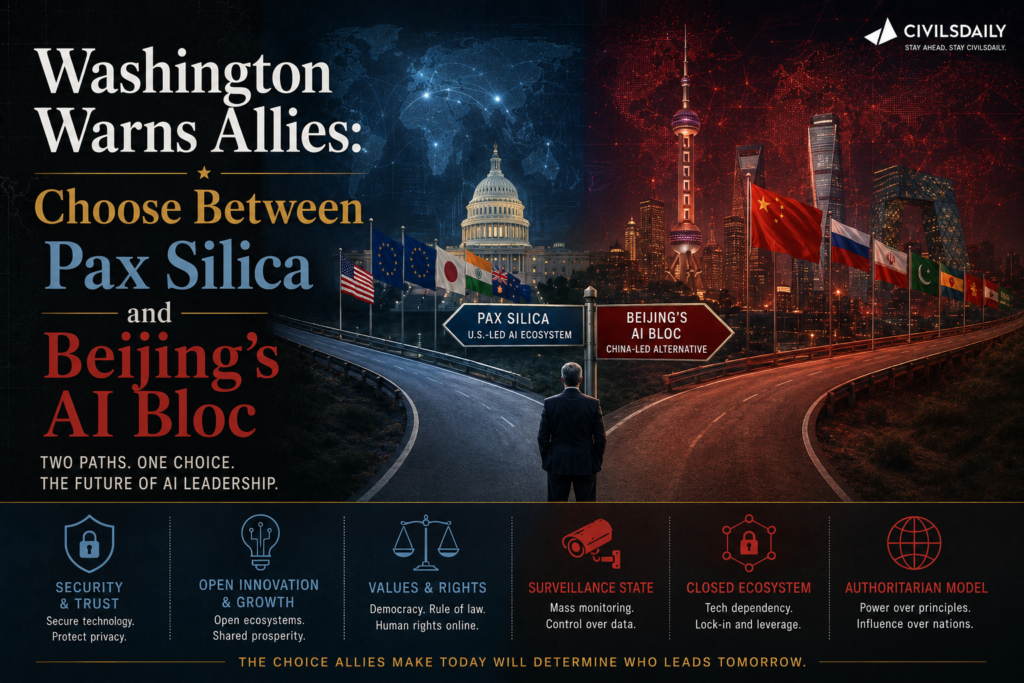
A draft United States letter warns the 35 signatories of its artificial intelligence (AI) Opportunity Statement that signing up to Beijing’s competing framework will exclude them from the American led Pax Silica coalition. The demand converts a supply chain initiative into a test of exclusive alignment. Kazakhstan, a potential source of critical minerals that has joined both coalitions, is the immediate trigger.
What is the Pax Silica initiative?
- About: Pax Silica was launched by Washington last year to secure supply chains for AI models, semiconductors and critical minerals.
- Purpose: It was built for the technology rivalry with Beijing, treating minerals and chips as the inputs that decide who builds the most capable AI.
- Membership: About two dozen countries have joined, including close allies Japan, Australia and South Korea.
- Legal character: The framework is not binding, so membership carries no treaty obligation.
- The new condition: Members that also join Beijing’s rival body face exclusion from the coalition.
What is the AI Opportunity Statement?
- About: A United States statement signed in June by 35 countries that wish to align AI cooperation with Washington.
- Coverage: Its signatories include members of the Pax Silica framework and other countries outside it, and the draft warning letter is addressed to this full list.
What is the World Artificial Intelligence Cooperation Organization?
- About: A rival body launched in July by the Chinese President as a challenge to United States influence over the AI sector.
- Its offer: It promotes China’s open weight technology, positioning access to models rather than access to chips as the basis of membership.
What are open weight AI models?
- About: Models whose trained parameters are published for download, allowing anyone to run and adapt them on their own hardware.
- Why it matters strategically: Adoption does not require a continuing commercial relationship with the developer, so influence spreads without any agreement being signed.
What does the draft letter actually demand?
- A binary choice: Dozens of countries are to be told they must pick sides in the AI race with China.
- The penalty: Signing Beijing’s competing framework means exclusion from the United States led coalition.
- The stated objective: Washington hopes to starve China of resources in the race to build the most sophisticated AI.
- Why that matters: The most capable models are treated as usable for military or economic dominance, which is what makes inputs a security question.
- The evidentiary basis: The warning rests on an internal draft and a United States official, not on a published policy.
Why do critical minerals sit at the centre of the AI race?
- Minerals precede chips: Semiconductors, servers and power systems depend on rare earths, gallium, germanium and graphite before any model can be trained.
- Refining, not mining, is the chokepoint: China dominates the midstream separation and refining stages even for ore mined elsewhere.
- Export controls as leverage: Beijing has used licensing of gallium, germanium, graphite and rare earth magnets as a direct policy instrument.
- Why Kazakhstan matters: It is a key potential source of critical minerals, which is why its dual membership set off alarm in Washington.
- The self limiting problem: Excluding a supplier country does not create refining capacity anywhere else.
What do the individual signatories’ positions show about the cost of forcing a choice?
- Kazakhstan, the hedger: It is the only country so far known to have joined both initiatives, using its mineral endowment to sell access to both blocs rather than choose.
- Japan, the equipment supplier: A Pax Silica member whose firms control critical semiconductor manufacturing equipment, photoresists and wafer materials that no bloc can replace quickly.
- South Korea, the memory chip producer: A Pax Silica member whose memory chip makers run large fabrication capacity inside China, so exclusivity carries a direct commercial cost.
- Australia, the mining leg: A Pax Silica member with rare earth deposits and a dedicated critical minerals financing facility, but with separation capacity that has historically depended on offshore processing.
- China, the rival architecture: Beijing counters chip and minerals leverage with the World Artificial Intelligence Cooperation Organization and freely downloadable models.
- United States, the coalition builder: Washington combines export controls on advanced chips with Pax Silica membership, and now with the threat of exclusion.
Why does the exclusivity demand cut against the United States’ own supply goal?
- Suppliers gain from hedging: A mineral rich state earns more by selling access to both coalitions than by picking one.
- A framework with no enforcement: Pax Silica is not binding, so exclusion is the only available lever and it is a blunt one.
- Open weight models cannot be fenced: Chinese models spread by download, so denying a country coalition membership does not deny it Chinese technology.
- Refining dependence persists: The coalition can exclude a supplier and still find that separation and processing run through China.
- Retaliation risk: Beijing can curtail exports of critical minerals essential to advanced technology production while Western supply chains are still being built.
Where does India stand in the AI and critical minerals contest?
- Minerals Security Partnership: India joined the Minerals Security Partnership in June 2023, a United States convened grouping to catalyse investment in critical mineral supply chains.
- National Critical Mineral Mission: Approved in January 2025 with an outlay of about 16,300 crore rupees, it targets exploration, recovery from tailings and overseas asset acquisition.
- IndiaAI Mission: Approved in March 2024 with about 10,371 crore rupees, covering compute capacity, datasets, foundation model support and safe AI.
- Summit diplomacy: India chaired the Global Partnership on Artificial Intelligence and hosted its summit in New Delhi in December 2023, and was named the next AI summit host after the Paris AI Action Summit of February 2025.
- The strategic autonomy problem: India sits in United States aligned mineral platforms and in BRICS and the Shanghai Cooperation Organisation alongside China, so an exclusivity demand of the Pax Silica kind directly conflicts with its standing position.
Challenges to Pax Silica
- No enforcement mechanism: A framework that is not binding cannot police dual membership. e.g. Kazakhstan has joined both Pax Silica and the Chinese body without penalty so far.
- Substitution by the rival supplier: Excluded states can buy the same inputs and models from Beijing. e.g. China’s export licensing of rare earth magnets from April 2025 halted assembly lines at European car plants, demonstrating who controls the flow.
- Cost falls on allies first: Export control regimes hit allied firms’ revenues before they hit the target. e.g. Dutch lithography equipment makers lost a large share of their China sales after successive export restrictions.
- Midstream capacity cannot be built quickly: Mining new deposits does not solve separation and refining. e.g. Australian rare earth concentrate was long shipped to Malaysia for separation rather than processed at home.
- Price volatility deters new investment: Mineral projects need long horizons that commodity cycles destroy. e.g. lithium prices fell sharply from their 2022 peak, stalling announced projects worldwide.
- Open weight diffusion defeats membership rules: Model access spreads independently of any coalition. e.g. a Chinese open weight reasoning model released in January 2025 was downloaded and self hosted worldwide within weeks.
- Third country resistance to bloc politics: Middle powers resist being made to choose. e.g. several Global South states hold membership of both Western and Chinese digital and minerals platforms simultaneously.
Conclusion
The AI contest has moved from controlling exports of chips to controlling membership of coalitions, and the United States is testing whether exclusivity can be enforced on countries that hold the minerals. The instrument is weak, since Pax Silica binds no one, open weight models spread by download, and refining capacity stays with China regardless of who is excluded. Kazakhstan’s dual membership is the first demonstration that suppliers will hedge. For India, an exclusivity demand of this type collides directly with a foreign policy built on membership of competing platforms.
“[2025] Consider the following statements:
I. India has joined the Minerals Security Partnership as a member.
II. India is a resource-rich country in all the 30 critical minerals that it has identified.
III. The Parliament in 2023 has amended the Mines and Minerals (Development and Regulation) Act, 1957 empowering the Central Government to exclusively auction mining lease and composite license for certain critical minerals.
Which of the statements given above are correct?
(a) I and II only
(b) II and III only
(c) I and III only
(d) I, II and III
