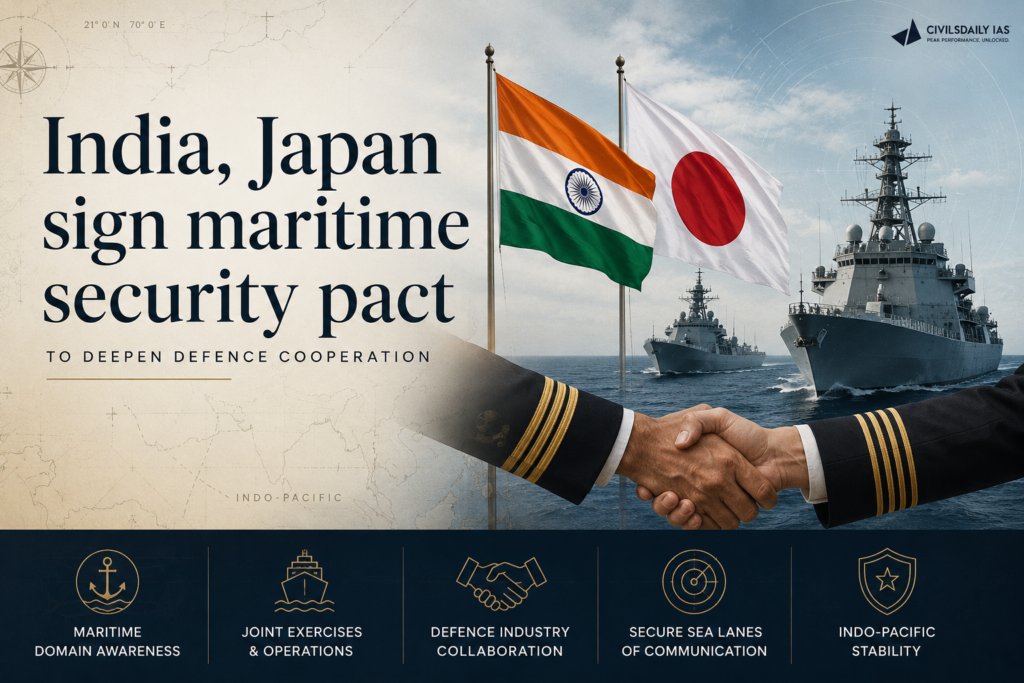
Why in the News
India and Japan signed a Memorandum of Arrangement on Maritime Security Cooperation on 20 August 2026, after bilateral talks between the two Defence Ministers in New Delhi. The arrangement converts a relationship built on periodic exercises into a standing operational framework covering maritime domain awareness, logistics access and ship repair. It also opens naval shipbuilding and design to joint development, moving the partnership from equipment transfer towards co-production.
What is the Memorandum of Arrangement on Maritime Security Cooperation?
- Nature of the instrument: A Memorandum of Arrangement is a signed framework document recording the agreed areas of cooperation between two defence establishments. It creates a standing basis for activity without the binding force of a treaty.
- Parties it links: The arrangement connects the Indian Navy with the Japan Maritime Self-Defense Force.
What is Maritime Domain Awareness?
- Definition: Maritime Domain Awareness (MDA) is the effective understanding of everything in the maritime space that affects security, safety, economy or the environment. It rests on tracking, identifying and sharing information on vessel movements.
- Why it is built with partners: No single navy can watch an entire ocean, so MDA depends on pooling radar, satellite and automatic identification system feeds across countries.
What are Sea Lines of Communication?
- Definition: Sea Lines of Communication (SLOCs) are the primary maritime routes along which trade, energy and naval forces move between ports. Disruption of a SLOC affects supply rather than territory.
- Why they are defended jointly: A SLOC crosses several jurisdictions and the high seas, so its protection depends on coordinated patrolling and port access rather than any one state’s territorial control.
What is the UNICORN antenna system?
- What it is: UNICORN is a Japanese shipborne integrated communications antenna system that houses multiple antennas inside a single composite mast. It lowers a warship’s radar cross section by removing external antenna clutter.
What is ATLA?
- Full form and role: The Acquisition, Technology and Logistics Agency (ATLA) is Japan’s defence procurement and technology development body under its Ministry of Defense. It is the counterpart to India’s Defence Research and Development Organisation (DRDO) for joint technology work.
What is the Japan India Special Strategic and Global Partnership?
- The label: It is the highest tier of India’s bilateral relationships, adopted in 2014, under which defence, economic and technology cooperation between the two countries is organised.
What does the arrangement operationally commit the two navies to?
- Information sharing: The two sides agreed to deepen operational cooperation through information sharing, naval exercises, ship repair and logistics support.
- Maritime domain awareness and rescue: The framework covers maritime domain awareness, search and rescue, and humanitarian assistance and disaster relief between the Japan Maritime Self-Defense Force and the Indian Navy.
- Protection of sea lanes: The Ministers agreed to strengthen coordination for the protection of Sea Lines of Communications through reciprocal naval visits, joint exercises, and personnel and subject matter expert exchanges.
- Logistics and port access: Logistical support was extended to include access to ports and maintenance and repair facilities.
- Mine countermeasures: The two countries will move towards greater cooperation in mine countermeasures.
How does the partnership move beyond equipment transfer into co-development?
- Naval shipbuilding and design: The two sides will explore joint development in naval shipbuilding and design, leveraging Japan’s technological expertise and India’s production capabilities.
- Make in India framework: They will discuss greater use of India’s shipbuilding capabilities under the Make in India framework.
- Reciprocal ship repair: Both countries will work towards reciprocal provision of ship repair facilities.
- First equipment marker: The shipborne UNICORN integrated communications antenna system was identified as the symbol of the growing defence equipment partnership, with a commitment to its early realisation.
- Research and industry channels: DRDO and ATLA will deepen cooperation in advanced defence technologies, and a Defence Industry Forum will be convened.
What does the expansion of joint exercises signal about interoperability?
- Existing exercise set: The Ministers welcomed the expansion of bilateral military exercises, including Dharma Guardian and the Japan India Maritime Exercise (JIMEX), the two navies’ bilateral maritime exercise.
- Veer Guardian 26: The planned Veer Guardian 26 air exercise will see Japanese fighter aircraft participate in an exercise in India for the first time.
- Greater complexity: The two sides agreed to enhance the complexity of bilateral exercises rather than repeat existing formats.
- Unmanned systems and short notice drills: They agreed to integrate unmanned systems and to explore short notice joint exercises, which test readiness rather than choreography.
- Special forces and theatre commands: The two countries will promote exchanges between their Special Operations Forces and pursue cooperation with India’s integrated theatre commands after their establishment.
What institutional machinery will carry the cooperation forward?
- A standing Working Group: The two sides agreed to establish a Working Group headed at the Director General and Joint Secretary level.
- Domains it coordinates: The Working Group spans operational, intelligence, equipment, technology and industrial domains.
- Industry channel: A Defence Industry Forum will be convened alongside the research level cooperation.
- Ministerial channel: The two sides agreed to accelerate discussions for the fourth India Japan 2+2 Foreign and Defence Ministerial Dialogue, to be held in Tokyo this year.
- Political framing: Both reaffirmed their commitment to deepen defence cooperation under the Japan India Special Strategic and Global Partnership and to work towards a free and open Indo Pacific amid heightened global tensions.
Challenges to the India Japan maritime security arrangement
- Japan’s own legal constraints on transfers: Article 9 of Japan’s 1947 Constitution and the Three Principles on Transfer of Defence Equipment and Technology limit what Tokyo can sell or co-develop abroad. Eg. The US 2 amphibious aircraft deal, negotiated with India for over a decade, lapsed without an order.
- Cost and schedule risk in Japanese technology tie ups: High specification Japanese systems carry costs that Indian procurement budgets absorb poorly. Eg. The Mumbai Ahmedabad High Speed Rail Project, built on Japanese technology and a Japanese loan, slipped from its 2022 target to 2027 or later.
- Thin use of the existing logistics pact: Reciprocal access agreements deliver value only when used outside exercise windows. Eg. The Acquisition and Cross Servicing Agreement signed in September 2020 has been used largely around scheduled exercises rather than for continuous deployments.
- Naval balance shifting faster than the partnership: The regional force ratio is moving against both partners while the arrangement is still being institutionalised. Eg. The People’s Liberation Army Navy crossed 340 battle force ships by 2021, overtaking the United States fleet in numbers.
- Indian yard capacity limits co-production: Joint naval shipbuilding assumes yard capacity India has not yet built. Eg. India’s share of global shipbuilding is under 1 percent, in a sector dominated by China, South Korea and Japan.
- Incomplete theatre command reform: Cooperation with India’s integrated theatre commands is conditional on those commands existing. Eg. The Inter Services Organisation (Command, Control and Discipline) Act, 2023 created the legal basis for joint commands, but no theatre command had been stood up when the arrangement was signed.
- Chokepoint risks a bilateral pact cannot fix: Sea lane disruption often originates from non state actors outside either navy’s operating area. Eg. Houthi attacks in the Red Sea forced shipping to reroute around the Cape of Good Hope, adding weeks to voyages.
Conclusion
India and Japan have moved from periodic exercises to a signed operational framework covering maritime domain awareness, logistics access and ship repair, with naval shipbuilding and design opened to joint development. The arrangement’s institutional carrier is a Working Group at Director General and Joint Secretary level spanning operational, intelligence, equipment, technology and industrial domains. The next milestone is the fourth India Japan 2+2 Foreign and Defence Ministerial Dialogue, to be held in Tokyo this year, with the Veer Guardian 26 air exercise bringing Japanese fighter aircraft to India for the first time.
“[2019, GS2, 10] ‘The time has come for India and Japan to build a strong contemporary relationship, one involving global and strategic partnership that will have a great significance for Asia and the world as a whole.’ Comment.”
