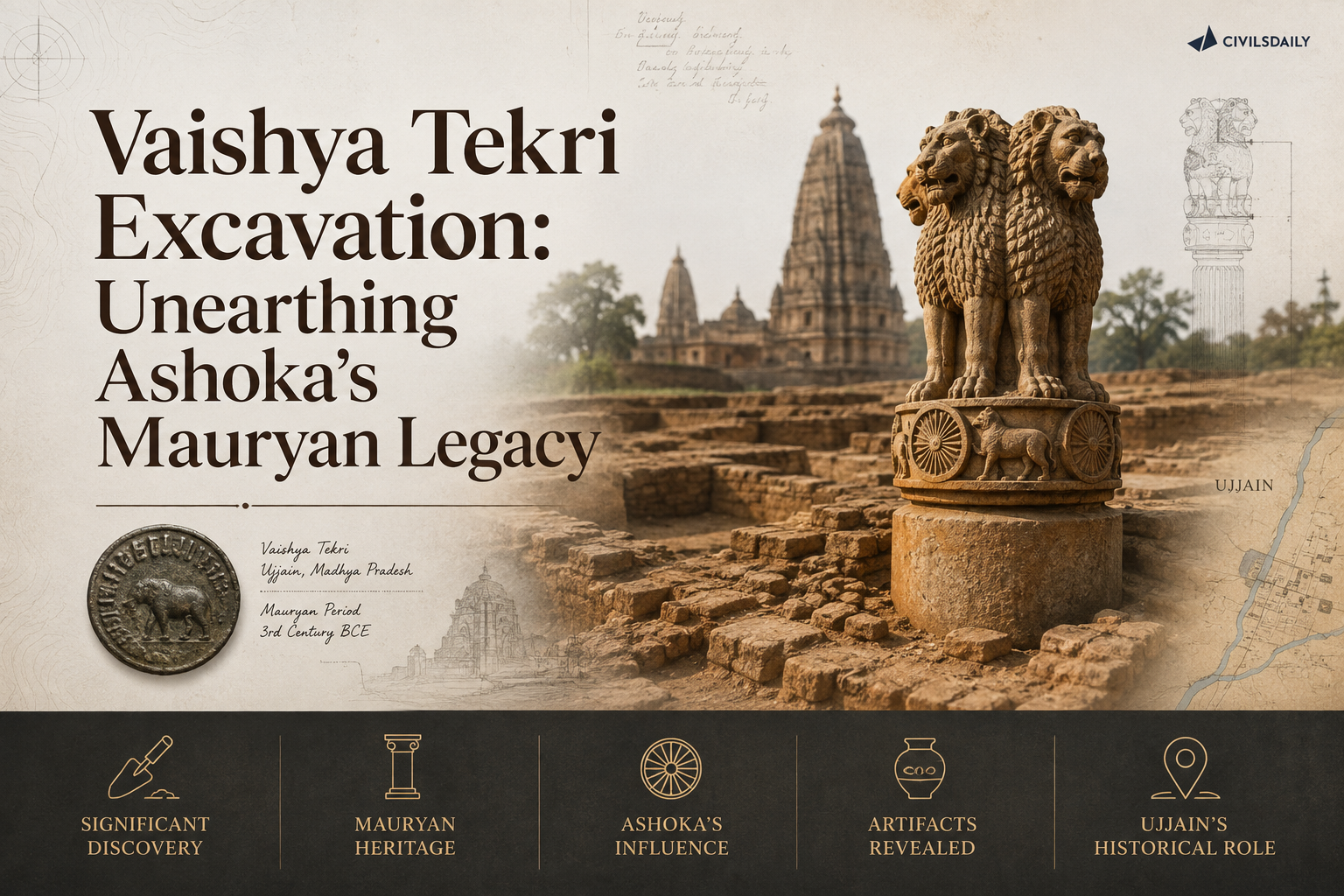
Why in the News
An ongoing excavation at the Vaishya Tekri mound in Ujjain has uncovered a Buddhist stupa dated to the Mauryan period, adding physical evidence to the tradition that Ashoka served as Mauryan viceroy over Ujjain and the surrounding Avanti province before he became emperor. Ujjain’s connection to Ashoka has so far rested mainly on textual and traditional accounts, including his association with the city of Vidisha and with Devi, traditionally described as his consort during his time there. A dated stupa at Vaishya Tekri gives that tradition an archaeological anchor it did not previously have at this specific site.
What has the excavation at Vaishya Tekri found?
- A Buddhist stupa dated to the Mauryan period: Excavators have uncovered the remains of a stupa, a dome-shaped Buddhist commemorative structure typically built to enshrine relics, at the Vaishya Tekri mound, with the structure’s dating placed within the Mauryan period.
- Located at a mound with a known but under-explored history: Vaishya Tekri has long been recognised as an archaeologically significant mound in Ujjain, but the current excavation is what has produced the specific Mauryan-period stupa evidence.
- Physical evidence for a previously text-based tradition: The tradition that Ashoka governed Avanti province from Ujjain as a Mauryan prince before becoming emperor has rested on textual and inscriptional sources; a dated Mauryan-period Buddhist structure at Ujjain itself gives that tradition a corresponding physical find.
How does this connect to Ashoka’s association with Ujjain, Vidisha, and Devi?
- Ujjain as Ashoka’s provincial capital under his father: Textual tradition holds that Ashoka was appointed viceroy of Avanti province, governing from Ujjain, during the reign of his father, Bindusara, before Ashoka’s own accession as emperor.
- Vidisha’s connection through Devi: Tradition associates Ashoka with Devi, described as his consort during his time in the region, whom he is said to have met at or near Vidisha, a city close to Ujjain within the same Avanti province.
- Stupa construction consistent with early Buddhist patronage in the region: A Mauryan-period Buddhist stupa at Ujjain is consistent with the broader pattern of early Buddhist architectural patronage across the Avanti region during and after Ashoka’s association with it, including the well-documented stupas at nearby Sanchi.
Back2Basics: Vaishya Tekri, Ujjain
- An archaeological mound in Ujjain, Madhya Pradesh, long identified as a site of historical significance within the ancient city associated with the Avanti Mahajanapada, one of the sixteen great kingdoms of ancient India.
- Ujjain’s ancient layers have previously yielded evidence of settlement dating from well before the Mauryan period, making it one of the longer continuously significant urban sites in central India.
- Its Mauryan-period association rests on textual tradition identifying it as the seat of Ashoka’s viceroyalty over Avanti province prior to his accession as emperor.
- Sits within the same historical region as Vidisha and Sanchi, both major centres of early Buddhist architectural activity.
“[2022] Consider the following pairs :
Site of Ashoka’s major rock edicts Location in the State of
1. Dhauli — Odisha
2. Erragudi — Andhra Pradesh
3. Jaugada — Madhya Pradesh
4. Kalsi — Karnataka
How many pairs given above are correctly matched ?
(a) Only one pair
(b) Only two pairs
(c) Only: three pairs
(d) All four pairs
