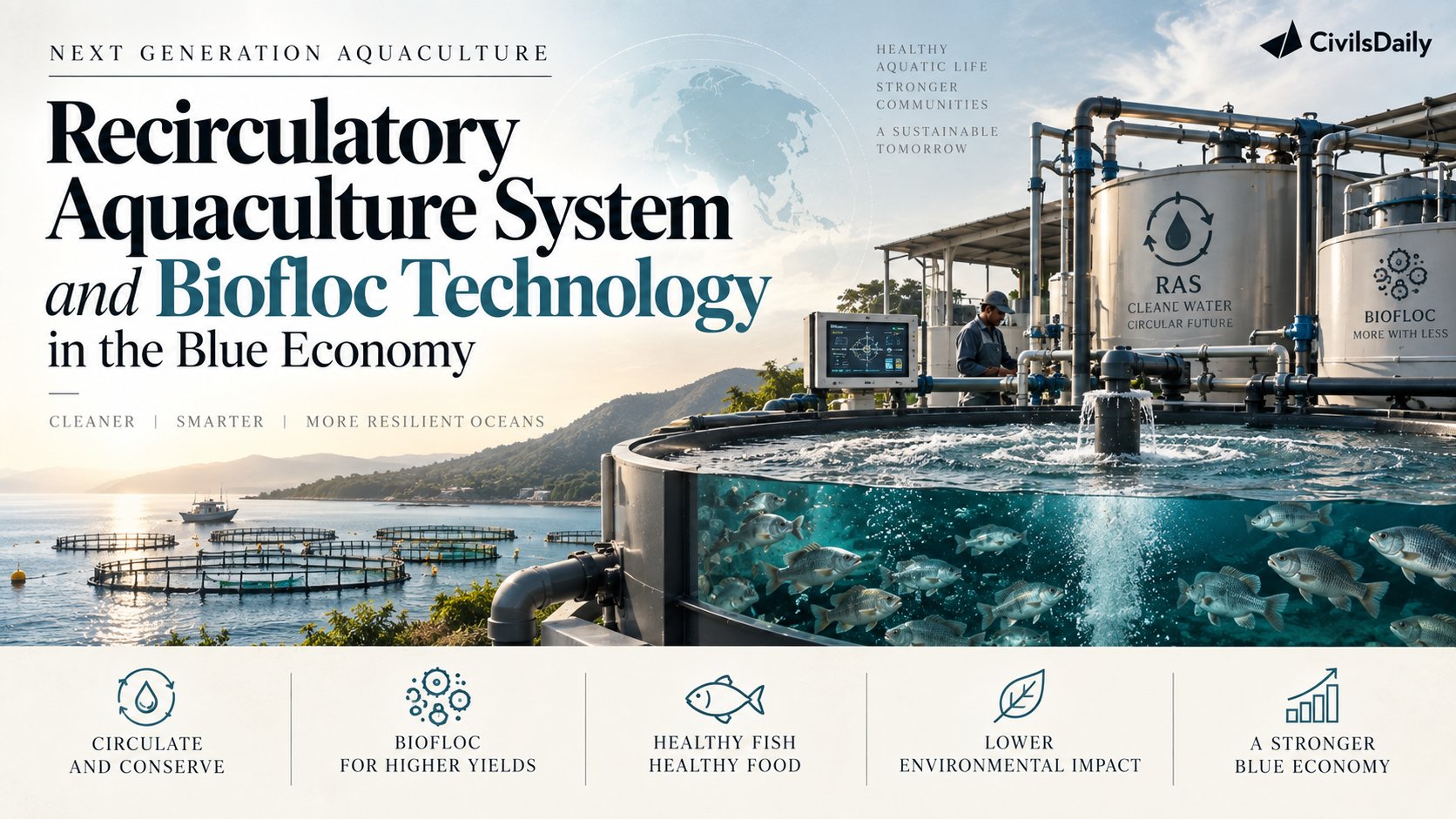
Why in the News
India is the world’s second-largest fish producer and second-largest aquaculture producer. India is also the largest producer and exporter of shrimp. The fisheries sector supports the livelihoods of nearly 3 crore fishers and fish farmers. Government initiatives are promoting Recirculatory Aquaculture Systems (RAS) and Biofloc technology under PM Matsya Sampada Yojana (PMMSY).
Growth of India’s Fisheries Sector
- Annual fish production increased from 95.79 lakh tonnes in 2013-14 to 198 lakh tonnes in 2024-25.
- Inland fisheries and aquaculture production increased by 147%, from 61.36 lakh tonnes to 151.60 lakh tonnes.
- Seafood exports increased from ₹30,213 crore in 2013-14 to ₹73,890 crore in 2025-26.
- Since 2015, cumulative government investments exceeding ₹39,272 crore have supported the fisheries sector.
Recirculatory Aquaculture System (RAS)
- RAS is an intensive fish farming system based on water treatment and recirculation.
- Water is continuously treated and reused to maintain suitable conditions for fish growth.
- It can recycle up to 90-95% of water.
- Enables fish farming in areas where conventional aquaculture may not be feasible.
- Allows production units to be located closer to urban markets and export hubs.
- Supports year-round fish production, better biosecurity and controlled farming conditions.
Biofloc Technology
- Biofloc is an intensive aquaculture technique that uses beneficial microorganisms.
- Microorganisms help improve water quality by utilising organic wastes and nutrients.
- The microbial biomass forms flocs, which can also provide nutritional benefits to cultured fish.
- Enables intensive production with efficient use of water and nutrients.
- Particularly useful where land and water availability are limited.
Government Support under PMMSY
- 9,467 RAS units have been approved.
- 4,573 Biofloc units have been approved.
- Around ₹4,120 crore has been invested under PMMSY for these technologies.
- These systems are helping shift aquaculture towards intensive, commercially viable and resource-efficient production.
Importance for Blue Economy
- Resource efficiency: Reduces water consumption and improves waste utilisation.
- Higher productivity: Facilitates intensive and year-round fish farming.
- Geographical expansion: Allows aquaculture in diverse agro-climatic conditions.
- Export competitiveness: Improves quality, traceability and biosecurity.
- Employment: Creates opportunities across production, processing, marketing and exports.
- High-value aquaculture: Supports species such as shrimp, trout, seabass, tilapia, murrel and pangasius.
- Entrepreneurship: Promotes specialised activities such as ornamental fish farming.
Geographical Applications
- Controlled systems: Ornamental fish and other specialised aquaculture activities.
- Jammu & Kashmir, Ladakh, Uttarakhand and Himachal Pradesh: Cold-water aquaculture, particularly trout.
- Saline and brackish-water areas: Export-oriented shrimp farming.
[2023] With reference to the role of biofilters in Recirculating Aquaculture System, consider the following statements:
1. Biofilters provide waste treatment by removing uneaten fish feed.
2. Biofilters convert ammonia present in fish waste to nitrate.
3. Biofilters increase phosphorus as nutrient for fish in water.
How many of the statements given above are correct?
(a) Only one
(b) Only two
(c) All three
(d) None.
