Source: The Hindu, Page 8 Published: 15 October 2026
Why in the News
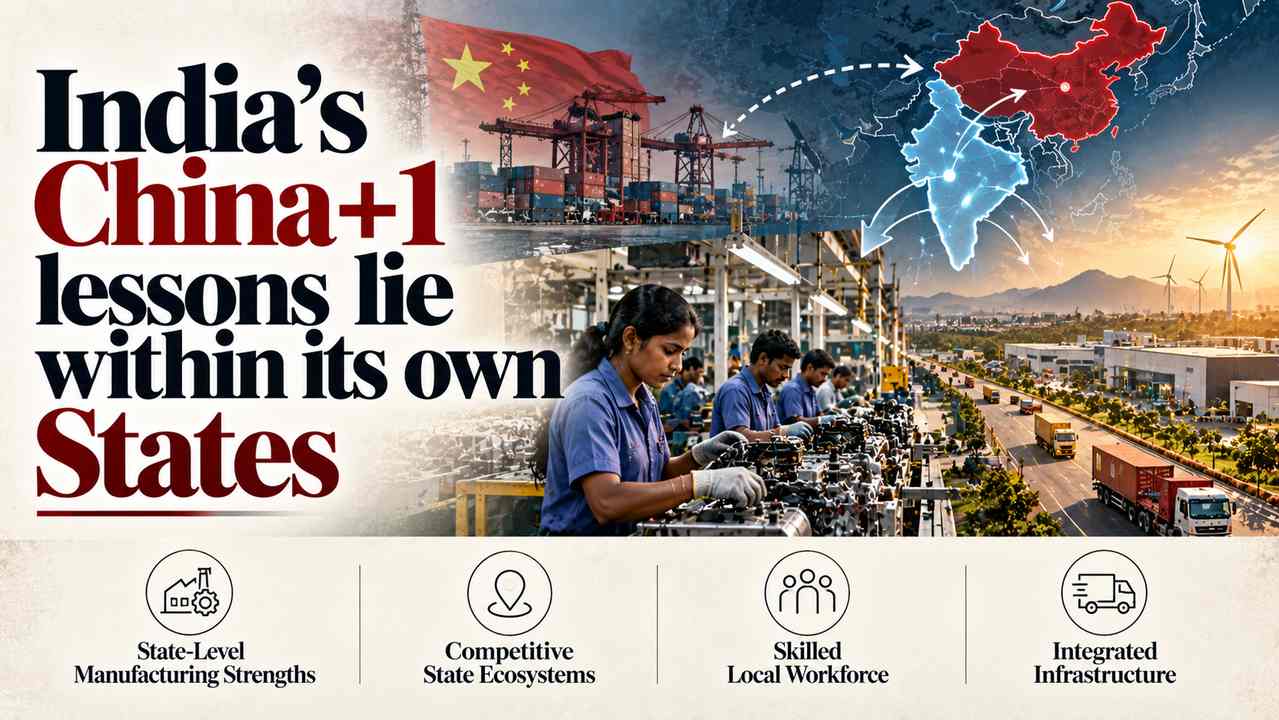
Global firms adding factories outside China pick a State, not “India”, according to a 2026 East Asian Institute study based on 50 interviews with executives and policymakers. The best models for other States are at home, in Tamil Nadu and Karnataka.
Why do States, not India, win China+1 investment?
- What it is: China+1 means global firms keep factories in China but add another country, like a shop keeping a second supplier in case the first fails.
- The State as the unit: Firms do not see India as one monolithic market. They pick a State, which offers the land, power, approvals, workers and suppliers a factory needs.
- Models sought abroad: Policy debate urges India to copy Vietnam, Mexico or Poland, yet the most instructive factories are already rising near Chennai and Bengaluru.
- The takeaway: Where a factory lands depends on what a State has built over decades, not on a national pitch.
How did Tamil Nadu and Karnataka build their pull?
- Tamil Nadu’s cluster: Foxconn assembles iPhones at Sriperumbudur and Tata Electronics has expanded at Hosur. Fresh approvals under the Electronics Components Manufacturing Scheme (ECMS), a subsidy for parts makers, are commitments, not finished factories.
- Decades of preparation: None of this began with China+1. Tamil Nadu spent four or five decades building technical education, an automobile and components industry and a supplier base.
- Limits of the model: Tamil Nadu now runs short of land, power and labour. So it relies on migrant workers and courts capital intensive manufacturing and innovation led exports.
- Karnataka’s talent route: Bengaluru began with software and engineering talent, not an automobile base. Foxconn has a campus at Devanahalli, and Tata Electronics took over Wistron’s iPhone plant at Narsapura in a late 2023 deal.
What can national incentives do, and what can they not?
- Tariff plus subsidy: The Production Linked Incentive (PLI) pays firms on extra output made in India. A 20 per cent duty plus a 6 per cent PLI payout means competitors “cannot compete”.
- PLI succession: The electronics PLI ended in March 2026. The Cabinet approved a successor scheme in July.
- ECMS spread: In January the Centre cleared 22 ECMS proposals across eight States, calling it “geographically balanced industrial growth”.
- Press Note 3 eased: In March the Cabinet eased Press Note 3, the rule that curbs investment from countries sharing a land border with India.
What do the investment and trade numbers hide?
- Tamil Nadu ranks fifth: In the Department for Promotion of Industry and Internal Trade (DPIIT) data on foreign direct investment (FDI) inflows, Tamil Nadu is only fifth, at about 6%.
- Head office rule: DPIIT records FDI against the company’s head office State, so it says little about where factories are built.
- Assembly, not components: “Very few components are manufactured in India”, so backward linkages (local suppliers feeding the factory) remain thin.
- Slow sourcing: One firm has reached only about 600million**ofits**1 billion target for buying inputs in India, because local value addition takes years to build.
- Trade gap: Electronics imports run at more than twice exports, so component manufacturing has ground to cover.
Challenges
- Thin domestic value: One executive called the exports “assembled products with 20 per cent inputs in India”.
- Regional concentration: Growth is “largely happening in the southern and western parts”, not in Bihar, Chhattisgarh or Jharkhand.
- Policy continuity: Investors want commitments honoured across political turnover, tested after Tamil Nadu’s change of government in May 2026.
- Thin subsidies: Spreading subsidies thinly will not replicate Tamil Nadu’s supplier networks or Karnataka’s technical labour pool.
Way Forward
- Document State playbooks: Lagging States should study how Tamil Nadu and Karnataka prepared land, trained workers, cleared approvals, nurtured suppliers and retained investors.
- Locate FDI by plant: DPIIT should also record FDI by the State where the plant is built.
- Supplier development: Component schemes should favour local firms that supply parts to existing assemblers.
Conclusion
India’s gains from firms leaving China have come from States that spent decades building industrial ecosystems, not from national incentives alone. Whether lagging States build supplier networks and skilled workforces, not thinner subsidies, will decide if the shift spreads beyond the south and west.
Key numbers
- FDI equity shares, October 2019 to March 2026 (DPIIT): Maharashtra 31%, Karnataka 21%, Gujarat 15%, Delhi 13%.
- ECMS approvals, January 2026: ₹41,863 crore, 33,791 expected direct jobs.
- Electronics trade, 2025-26: exports about $48 billion; imports about $116 billion.
- Foxconn, Devanahalli: about 50,000 jobs targeted; women about 80% of workforce.
PYQ
[2025, GS3, 15 marks] Discuss the rationale of the Production Linked Incentive (PLI) scheme. What are its achievements? In what way can the functioning and outcomes of the scheme be improved?
