Why in the News
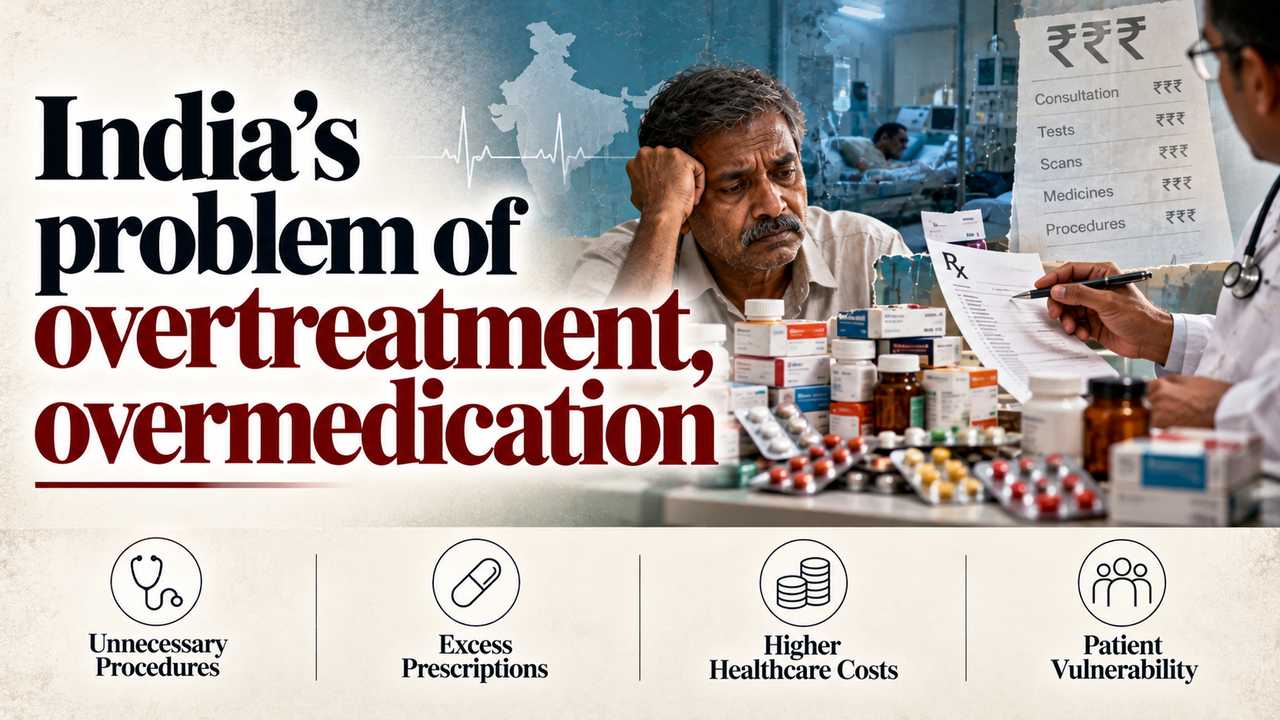
Modern medicine’s growing power to test and treat is increasingly turning into overtreatment and overmedication: tests, medicines and procedures a patient does not need. In India this sits alongside undertreatment, since many still lack essential primary care, affordable medicines and timely treatment.
What is overtreatment, and how does it begin?
- What it is: Overtreatment is a cascade: a test spots a chance abnormality, which leads to more tests, a diagnosis and a possibly permanent prescription. It is like a car service that keeps finding parts to replace.
- Prevention turned treatment: A check up meant to prevent illness can end in long term medication or surgery.
- The takeaway: The harm comes from a chain no one stops, so patients carry medicines and procedures they never needed.
What drives overtreatment?
- Unnecessary testing: A 2016 review found routine health check packages often include unwarranted tests. These cause false positives, anxiety and overdiagnosis, meaning labelling conditions that would never have caused harm.
- Fragmented, specialist led care: Patients with common problems go straight to specialists, and chronic patients see several, each optimising one part of care, so the patient is treated in parts.
- Healthcare as a marketplace: Tests, supplements and devices are sold as products, and payment rewards activity:
- the fee for service model pays per test and procedure, and many patients think a visit incomplete without a prescription;
- insurance creates moral hazard, behaviour that changes because someone else pays: people skip preventive care (ex ante), and hospitals and patients choose costlier care after illness (ex post).
- Patient expectations: Worried patients want something tangible, so reassurance looks like inaction. Busy doctors often comply.
- Defensive medicine: Clinicians fearing a missed rare diagnosis order another test as the safer option, yet every test can uncover abnormalities that would never cause harm.
Why are older adults most at risk?
- Polypharmacy: Polypharmacy, taking several medicines at once, affects about 49% of older adults in India, by a 2021 review of Indian studies.
- Five or more medicines: A 2025 study found roughly one in three older adults take five or more prescribed medicines.
- Inappropriate medicines: The same study found potentially inappropriate medicines in 28.8% of cases.
- Medication reviews: Not everyone on several medicines is overtreated, but the figures show why medication reviews and deprescribing, stopping medicines no longer needed, must become routine.
What does the global Choosing Wisely movement show?
- Middle income spread: Overtreatment was first recognised in high income countries and is now visible across many middle income nations.
- Choosing Wisely: This global movement asks doctors and patients to choose interventions more carefully, with specialty societies listing tests and treatments to question (2012 to 2023).
- Scale of the lists: Nearly 80 specialty societies published close to 700 recommendations on low value care, care that adds cost or risk without benefit.
Challenges
- Weak primary care: About 40% of public health funds reach primary care, against the two thirds target in the National Health Policy, 2017.
- Antibiotic overuse: Over prescription of antibiotics has made India a global hotspot for antimicrobial resistance (AMR), where drugs stop working against infections.
- Patients pay directly: Households pay about two fifths of all health spending out of pocket (2021-22), so needless tests drain family budgets.
Way Forward
- Primary care first: Restore the family physician as first contact for non emergency needs, referring patients onward and reconciling prescriptions.
- Review and stop dates: Give every prescription a review date and, where suitable, a stop date, and hold structured medication reviews for people on five or more medicines.
- Indian lists: Professional societies and the Indian Council of Medical Research (ICMR) should list low value tests and treatments, and hospitals should measure unnecessary care avoided.
- Four patient questions: Before any test or treatment, patients should ask why it is needed, what happens if they wait, its benefits and risks, and the alternatives.
- Pay for outcomes: Payment systems and insurers should reward outcomes and continuity of care, not volume.
Conclusion
India must fix too little care and too much care at once, and both trace back to a weak first point of contact. Whether insurers and professional bodies begin to reward restraint will show if Indian medicine can learn when not to act.
Government Initiatives for Primary Healthcare
- Ayushman Arogya Mandirs (AAMs): Over 1.85 lakh centres, formerly Health and Wellness Centres, provide primary care including screening for non communicable diseases.
- Pradhan Mantri Bhartiya Janaushadhi Pariyojana (PMBJP): Jan Aushadhi Kendras sell generic medicines at 50% to 90% lower prices.
Matching Previous Year Question
“[2014, GS3, 12 marks] Can overuse and the availability of antibiotics without doctor’s prescription, the contributors to the emergence of drug-resistant diseases in India? What are the available mechanisms for monitoring and control? Critically discuss the various issues involved.”
