💥Mains Ready By December. Smash Mains & Smash PYQ Admissions Open

GS Paper: GS1-01.Indian Culture- Salient aspects of Art Forms, Literature and Architecture from ancient to modern times.

  • What is ‘Mandala’ in Art?

    Some residents of Liverpool in the UK are marveling over a mandala art the size of one and a half football pitches in length created by artist James Brunt with materials such as leaves and rocks.

    What is Mandala Art?

    • Literally meaning “circle” or “centre” in Sanskrit, a mandala art is defined by a geometric configuration that usually incorporates the circular shape in some form.
    • Mandala patterns are a centuries-old motif that are used to depict the cosmos, and have been adapted by artists the world over, each of whom have added their own interpretation and painted it as their own.
    • While it can also be created in the shape of a square, a mandala pattern is essentially interconnected.

    Its origin

    • It is believed to be rooted in Buddhism, appearing in the first century BC in India.
    • In Hinduism, the mandala imagery first appeared in Rig Veda (1500 – 500 BCE).
    • Over the next couple centuries, Buddhist missionaries travelling along the Silk Road took it to other regions.
    • By the sixth century, mandalas have been recorded in China, Korea, Japan, Indonesia and Tibet.

    The meaning of the motif

    • It is believed that by entering the mandala and moving towards its center, one is guided through the cosmic process of transforming the universe .
    • It depicts transition from one of suffering to that of joy.
    • A traditional Buddhist mandala, a circular painting drawn with coloured sand, aided in meditation, with the main objective of aiding its creator to discover their true self.
    • In Hinduism, a mandala or yantra is in the shape of a square with a circle at its center.
    • There are various elements incorporated within the mandala, each of which has its own meaning.
    • For instance, the eight spokes of the wheel (the dharmachakra) represent the eightfold path of Buddhism, the lotus flower depicts balance, and the sun represents the universe.
    • Facing up, triangles represent action and energy, and facing down, they represent creativity and knowledge.

    Mandala in modern Indian art

    • Deep-rooted in ancient philosophy, the mandala has attained varied forms in the hands of modern and contemporary Indian artists.
    • While it continues to appear in thangka paintings, it has a central place in the practice of mainstream artists associated with the tantric and neo-tantric spiritual movements.
    • Choosing to transition from the more figurative depictions of the previous generations of Indian artists, in the 1960s Sohan Qadri and Prafulla Mohanty gained widespread recognition for their works.
    • Their work is imbibed in tantric symbolism, such as mandalas that are also used in the rituals of tantric initiation.
    • Geometric compositions also dominated works of artists such as Biren De, GR Santosh, Shobha Broota, and famously SH Raza, who visualised the bindu as the center of his universe and the source of energy and life.


    UPSC 2023 countdown has begun! Get your personal guidance plan now! (Click here)

  • Who was Raja Ravi Varma?

    Ahead of the 175th birth anniversary fete of the legendary artist Raja Ravi Varma, erstwhile royal family of Kilimanoor has urged the Union government to posthumously confer the Bharat Ratna, the country’s highest civilian award, on him.

    Raja Ravi Varma

    • Raja Ravi Varma was born in April 1848 in Kilimanoor, Kerala, to a family which was very close to the royals of Travancore.
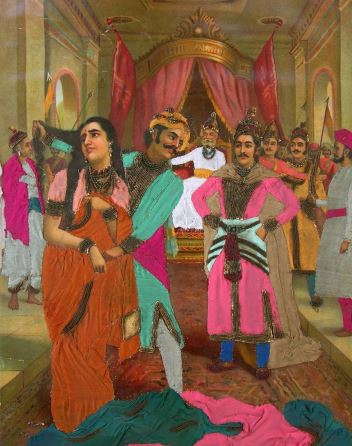
    • Often referred to as the father of modern Indian art, he is widely known for his realistic portrayal of Indian gods and goddesses.
    • While he majorly painted for the royalty, he is also credited for taking art to the masses with his prints and oleographs.
    • At a young age, he would draw animals and everyday scenes on the walls in indigenous colours made from natural materials such as leaves, flowers and soil.
    • His uncle, Raja Raja Varma, noticed this and encouraged his talent.
    • Patronised by Ayilyam Thirunal, the then ruler of Travancore, he learnt watercolour painting from the royal painter Ramaswamy Naidu, and later trained in oil painting from Dutch artist Theodore Jensen.

    How he become an artist of the royals?

    • Varma became a much sought-after artist for the aristocrats and was commissioned several portraits in late 19th century.
    • Arguably, at one point, he became so popular that the Kilimanoor Palace in Kerala opened a post office due to the sheer number of painting requests that would come in for him.
    • He travelled across India extensively, for work and inspiration.

    Fame as a notable painter

    • Following a portrait of Maharaja Sayajirao of Baroda, he has commissioned 14 Puranic paintings for the Durbar Hall of the new Lakshmi Vilas Palace at Baroda.
    • Depicting Indian culture, Varma borrowed from episodes of Mahabharata and Ramayana for the same.
    • He also received patronage from numerous other rulers, including the Maharaja of Mysore and Maharaja of Udaipur.
    • As his popularity soared, the artist won an award for an exhibition of his paintings at Vienna in 1873.
    • He was also awarded three gold medals at the World’s Columbian Exposition in Chicago in 1893.

    Nature of his artforms

    • Much of his celebrated art also borrows heavily from Indian mythology.
    • In fact, he is often credited with defining the images of Indian gods and goddesses through his relatable and more realistic portrayals often painted with humans as models.
    • The depictions include Lakshmi as the goddess of wealth, Saraswati as the goddess of knowledge and wisdom, and Lord Vishnu with his consorts, Maya and Lakshmi.

    How he took Indian art to the masses?

    • Raja Ravi Varma aspired to take his art to the masses and the intent led him to open a Lithographic Press in Bombay in 1894.
    • The idea, reportedly, came from Sir T Madhava Rao, former Dewan of Travancore and later Baroda, in a letter where he pointed out to Varma that since it was impossible for him to meet the large demand for his work, it would be ideal for him to send some of his select works to Europe and have them produced as oleographs.
    • Varma, instead, chose to establish a printing press of his own.
    • The first picture printed at Varma’s press was reportedly The Birth of Shakuntala, followed by numerous mythological figures and saints such as Adi Shankaracharya.

    Major works

    • It is believed that he had made around 7,000 paintings before his death at the age of 58.
    • But only one painting is now left in ‘Chithrashala,’ the artist’s studio at Kilimanoor Palace — an unfinished portrait of ‘Parsi lady’ which was his last work.
    • Some of his popular works include ‘Lady in the Moonlight’, ‘Nair Lady Adorning Her Hair’, ‘Malabar Lady with Violin’, ‘Lady with Swarbat’, and ‘Maharashtrian Lady with Fruits’.

    Try this PYQ:


    There are only two known examples of cave paintings of the Gupta period in ancient India. One of these is paintings of Ajanta caves. Where is the other surviving example of Gupta paintings?

    (a) Bagh caves

    (b) Ellora caves

    (c) Lomas Rishi cave

    (d) Nasik caves


    [wpdiscuz-feedback id=”6l9gnsan2c” question=”Please leave a feedback on this” opened=”1″]Post your answers here.[/wpdiscuz-feedback]


    Back2Basics: Bharat Ratna

    • Bharat Ratna – ‘Jewel of India’ is the highest civilian award of the country.
    • It is conferred for exceptional Service to the nation in various fields such as Science arts, literature and recognition of public service of the highest order.
    • The award can be granted posthumously and since its establishment, seven awards were granted posthumously.
    • The award was established by formal President of India Rajendra Prasad on 2nd January 1954.
    • The concept of awarding this award posthumously was not there in the original statute declared in January 1954.
    • Provision to award posthumously was finally added in January 1966 statute of this prestigious award.
    • The medallion is cast in Bronze.
    • The medallion is designed like the leaf of a pipal tree with a sunburst in the centre and Bharat Ratna is engraved underneath it.


    UPSC 2023 countdown has begun! Get your personal guidance plan now! (Click here)

  • Anayoottu Ritual of Kerala

    Anayoottu, an annual ritual at the Sree Vadakkunnathan Temple, Thrissur was recently held.

    Why in news?

    • There is a history behind this annual ritual at the temple.
    • Kerala’s elephant pooram was selected, along with other cultural forms of the country, for display at the opening ceremony of the Asian Games held in Delhi in 1982.
    • Elephants were transported all throughout the country to New Delhi.

    What is Anayoottu?

    • The Aanayoottu (gaja pooja/ feeding of elephants) is a festival held in the precincts of the Vadakkunnathan temple in City of Thrissur, in Kerala.
    • The festival falls on the first day of the month of Karkkidakam (timed against the Malayalam calendar), which coincides with the month of July.
    • It involves a number of unadorned elephants being positioned amid a multitude of people for being worshipped and fed.
    • Crowds throng the temple to feed the elephants.

    Mythology behind

    • It is believed that offering poojas and delicious feed to the elephants is a way to satisfy Lord Ganesha—the god of wealth and of the fulfillment of wishes.
    • The Vadakkunnathan temple, which is considered to be one of the oldest Shiva temples in southern India, has hosted the Aanayottoo event for the past few years.


    UPSC 2023 countdown has begun! Get your personal guidance plan now! (Click here)

  • In news: National Emblem of India

    A day after the National Emblem cast on top of the under-construction Parliament unveiled, controversy has erupted over its aggressive posture.

    National Emblem of India

    • On 26 January 1950, a representation of the Lion Capital of Ashoka placed above the motto, Satyameva Jayate, was adopted as the State Emblem of India.
    • The emblem is an adaptation of the Lion Capital of Ashoka, an ancient sculpture dating back to 280 BCE during the reign of the Maurya Empire.
    • It was originally made of Chunar sandstone.
    • The statue is a three-dimensional emblem showing four lions.

    Features of the emblem

    • The actual Sarnath capital features four Asiatic lions standing back to back, symbolizing power, courage, confidence, and pride, mounted on a circular base.
    • At the bottom is a horse and a bull, and at its center is a Dharma chakra.
    • The abacus is girded with a frieze of sculptures in high relief of The Lion of the North,
    • The Horse of the West, The Bull of the South, and The Elephant of the East, separated by intervening wheels, over a lotus in full bloom, exemplify the fountainhead of life and creative inspiration.
    • Carved from a single block of sandstone, the polished capital is crowned by the Wheel of the Law.

    Historical significance

    • One of the Buddha’s names is ‘Shakya Simha’, meaning ‘Lion of the Shakyas’.
    • The Buddha’s first sermon at Sarnath was known as the ‘Simhanada’ (Lion roar) of the Buddha.


    UPSC 2023 countdown has begun! Get your personal guidance plan now! (Click here)

  • Sannati and Kanaganahalli Buddhist Sites

    Left almost unattended to for 20 years after excavation, the ancient Buddhist site on the bank of Bhima river near Kanaganahalli (forming part of Sannati site) in Kalaburagi district, has finally got some attention.

    About Sannati

    • Sannati is a small village on the banks of the River Bhima in Chittapur Taluka of Kalaburagi (Gulbarga).
    • It came into prominence after the collapse of the roof of the Kali temple in Chandralamba temple complex in 1986.
    • The collapse revealed the historically valuable Ashokan edicts written in Prakrit language and Brahmi script at the foundations of the temple, attracting historians from across India.
    • While the Stupa is believed to be one of the largest of its time.
    • The stone-portrait is considered to be the only surviving image of the Mauryan Emperor which had the inscriptionRaya Asoko’ in Brahmi on it.

    Significance of Sannati

    • Further revelations led to the discovery of the magnificent Maha Stupa, which had been referred to as Adholoka Maha-Chaitya (The Great Stupa of the Netherworlds) in the inscriptions.
    • More importantly, a sculpture-portrait of Ashoka seated on his throne with his queens was also discovered.
    • Historians believe that the Sannati Ranamandal (war zone) was a fortified area spread over 210 acres, of which only a couple of acres have been excavated so far.

    Try this PYQ:

    In which of the following relief sculpture inscriptions is ‘Ranyo Ashokan’ (King Ashoka) mentioned along with the stone portrait of Ashoka?

    (a) Kanganahalli

    (b) Sanchi

    (c) Shahbazgarhi

    (d) Sohgaura


    [wpdiscuz-feedback id=”tkeut67v6e” question=”Please leave a feedback on this” opened=”1″]Post your answers here.[/wpdiscuz-feedback]


    UPSC 2023 countdown has begun! Get your personal guidance plan now! (Click here)

  • Festivals in news: Puri Rath Yatra

    Lakhs of devotees thronged the coastal town of Puri town to witness the annual Rath Yatra with three decorated chariots of sibling deities Lord Balabhadra, Lord Jagannath and Devi Subhadra towed in front of the 12th century Shree Jagannath Temple.

    About Jagannath Rath Yatra

    • Ratha Jatra, the Festival of Chariots of Lord Jagannatha is celebrated every year at Puri, the temple town in Orissa, on the east coast of India.
    • It involves a public procession with a chariot with deities Jagannath (Vishnu avatar), BalaBhadra (his brother), Subhadra (his sister) and Sudarshana Chakra (his weapon) on a ratha, a wooden deula-shaped chariot.
    • The huge, colourfully decorated chariots, are drawn by hundreds and thousands of devotees on the bada danda, the grand avenue to the Gundicha temple, some two miles away to the North.
    • It attracts over a million Hindu pilgrims who join the procession each year.

    Back2Basics: Puri Temple Architecture

    • Jagannath Temple is a very big temple and covers an area of 37000m2. The height of the outer wall is 6.1m.
    • It is surrounded by a high fortified wall 6.1 m high is known as Meghanada Pacheri.
    • The main portion of the temple is also surrounded by a wall known as Kurma Bheda.
    • The temple is built in Rekha Deula style and has four distinct sectional structures, namely –
    1. Deula, Vimana or Garba griha (Sanctum sanctorum) where the triad deities are lodged on the ratnavedi (Throne of Pearls)
    2. Mukhashala (Frontal porch)
    3. Nata mandir/Natamandapa, which is also known as the Jagamohan (Audience Hall/Dancing Hall), and
    4. Bhoga Mandapa (Offerings Hall)

    Try this question from CSP 2019:

    Q.Building ‘Kalyaana Mandapas’ was a notable feature in the temple construction in the kingdom of-

    (a) Chalukya (b) Chandela (c) Rashtrakuta (d) Vijayanagara


    [wpdiscuz-feedback id=”pdpfj71jer” question=”Please leave a feedback on this” opened=”1″]Post your answers here.[/wpdiscuz-feedback]


    UPSC 2023 countdown has begun! Get your personal guidance plan now! (Click here)

  • Festival in news: Sao Joao Festival

    As in every monsoon, Catholics in Goa will celebrate Sao Joao, the feast of St John the Baptist.

    Note: The name typically sounds like a North-Eastern festival, but it is not.

    What is Sao Joao and where is it celebrated in Goa?

    • In Goa, Catholics celebrate all the feasts of the Roman Catholic Church, which include the feast of St John the Baptist on June 24.
    • John the Baptist is the person who he had baptised Jesus Christ on the river Jordan.
    • Traditionally, there are spirited Sao Joao festivities in the villages of Cortalim in South Goa and Harmal, Baga, Siolim and Terekhol in North Goa.
    • However, over the years, pool parties and private Sao Joao parties in Goa have been a “complete package of merriment and joy” for tourists.

    Course of celebration

    • The celebrations will include revellers sporting crowns made of fruits, flowers and leaves, and the major draw of the feast is the water bodies – wells, ponds, fountains, rivers – in which the revellers take the “leap of joy”.
    • Enjoyed by children and adults alike, the festival also includes playing the traditional gumott (percussion instrument), a boat festival, servings of feni, and a place of pride for new sons-in-law.

    What does jumping into water bodies symbolise?

    • The youngsters in Goa celebrate this occasion with revelry and perform daredevil feats, by jumping into over flowing wells or rivulets.
    • The boys are found merrily jumping into the water to commemorate the leap of joy, which St John is said to have taken in the womb of his mother St Elizabeth when virgin Mary visited her.


    UPSC 2023 countdown has begun! Get your personal guidance plan now! (Click here)

  • Festivals in news: Mela Kheerbhawani

    Kashmiri Hindus, locally known as Pandits, will celebrate the Zyestha Ashtami at the Mata Kheerbhawani temple at Tulmulla in central Kashmir’s Ganderbal.

    Kheerbhawani Temple

    • The temple is dedicated to the goddess Ragnya Devi.
    • The festival, known as Mela Kheerbhawani, is the largest gathering of Hindus in Kashmir after the annual Amarnath Yatra.
    • Situated 30 km from Srinagar city, it is one of the most sacred pilgrimage sites for Kashmiri Hindus.
    • The temple gets its name from kheer, or milk and rice pudding that pilgrims pour into the spring inside the temple complex as an offering to the goddess.
    • Hundreds of local Muslims, too, traditionally join the celebrations.

    Legend of the festival

    • Legend has it that the water of the temple’s spring changes colour from white to red and black.
    • The colour of the water is said to predict the impending future.
    • If it changes to black, it is seen as inauspicious or an impending disaster.
    • Kashmiri Pandits say that the water had turned black before they were forced to flee Kashmir during the militancy of 1990.


    Tap to read more about:

    Festivals, Dances, Theatre, Literature, Art in News


    Try this PYQ:

    Q.Consider the following pairs:

    Traditions- Communities

    1. Chaliha Sahib Festival- Sindhis
    2. Nanda Raj Jaat Yatra- Gonds
    3. Wari-Warkari- Santhals

    Which of the pairs given above is/are correctly matched?

    (a) 1 only

    (b) 2 and 3

    (c) 1 and 3

    (d) None of the above


    [wpdiscuz-feedback id=”v159hy69b5″ question=”Please leave a feedback on this” opened=”1″]Post your answers here.[/wpdiscuz-feedback]


    UPSC 2023 countdown has begun! Get your personal guidance plan now! (Click here)

  • Sant Kabir: the extraordinary poet-saint of the Bhakti Movement

    President Kovind inaugurated the Sant Kabir Academy and Research Centre Swadesh Darshan Yojana and paid tribute to the Bhakti saint, Kabir at Maghar, his resting place in Uttar Pradesh.

    Kabir and the Bhakti Movement

    • The Bhakti movement, which began in the 7th century in South India, had begun to spread across north India in the 14th and the 15th centuries.
    • The movement was characterized by popular poet-saints who sang devotional songs to God in vernacular languages.
    • Most of the preaching were meant for abolishing the Varna system and promoting Hindu-Muslim unity.
    • They emphasized an intense emotional attachment with God.

    Who was Sant Kabir?

    • One school within the Bhakti movement was the Nirguni tradition and Sant Kabir was a prominent member of it.
    • In this tradition, God was understood to be a universal and formless being.
    • Many of the saints of the Bhakti movement came from the ranks of the lower to middle artisanal classes.
    • Kabir was an alleged ‘low caste’ weaver (Julaha), Raidas was a leather worker and Dadu a cotton carder.
    • Their radical dissent against orthodoxy and rejection of caste made these poet-saints extremely popular among the masses and their ideology of egalitarianism spread across India.

    His life

    • He was born in Varanasi and lived between the years 1398 and 1448, or till the year 1518 according to popular belief.
    • He was from a community of ‘lower caste’ weavers of the Julaha caste, a group that had recently converted to Islam.
    • He learned the art of weaving, likely studied meditative and devotional practices under the guidance of a Hindu guru and grew to become an eminent teacher and poet-singer.
    • Kabir’s beliefs were deeply radical, and he was known for his intense and outspoken voice which he used to attack the dominant religions and entrenched caste systems of the time.
    • He composed his verses orally and is generally assumed to be illiterate.

    His literary works

    • Kabir’s compositions can be classified into three literary forms – dohas (short two liners), ramanas (rhymed 4 liners), sung compositions of varying length, known as padas (verses) and sabdas (words).
    • There are myriad legendary accounts on the other hand, for which there exists less of a factual historical basis.

    Kabir’s critique of religion and caste

    • Kabir is in modern times portrayed as a figure that synthesized Islam and Hinduism.
    • While he did borrow elements from different traditions, he very forcefully proclaimed his independence from them.
    • He did not only target the rituals and practices of both Hinduism and Islam, but also dismissed the sacred authority of their religious books, the Vedas and the Quran.
    • He even combined Allah and Ram in his poems.
    • He sought to eradicate caste distinctions and attempted to create an egalitarian society, by stressing the notion that a Bhakt (devotee) was neither a Brahmin nor an ‘untouchable’ but just a Bhakt.

    Kabir’s legacy

    • Kabir’s own humble origins and his radical message of egalitarianism fostered a community of his followers called the Kabir Panth.
    • A sect in northern and central India, many of their members are from the Dalit community.
    • All regard Kabir as their guru and treat the Bijak as their holy scripture.
    • The Bijak contains works attributed to Kabir and is argued by historians to have been written in the 17th century.
    • Several of Kabir’s verses and songs form a vital part of the Guru Granth Sahib.

    Try this PYQ from CSP 2019:

    Q.Consider the following statements:

    1.Saint Nimbarka was a contemporary of Akbar.

    2.Saint Kabir was greatly influenced by Shaikh Ahmad Sirhindi.

    Which of the statements given above is/are correct?

    (a) 1 only

    (b) 2 only

    (c) Both 1 and 2

    (d) Neither 1 nor 2


    [wpdiscuz-feedback id=”tgyb8v05uq” question=”Please leave a feedback on this” opened=”1″]Post your answers here.[/wpdiscuz-feedback]


    UPSC 2023 countdown has begun! Get your personal guidance plan now! (Click here)

  • Ancient sculptures recovered from Australia, US

    Ten antiquities (sculptures) retrieved from Australia and the United States were handed over to the Government of Tamil Nadu.

    Some of the returned antiquities, and how they had gone missing:

    (1) Dvarapala:

    • Retrieved in 2020 from Australia, this stone sculpture belongs to the Vijayanagar dynasty dating to the 15th-16th century.
    • He is holding a gada in one hand and has another leg raised up to the level of his knee.
    • The sculpture was burgled from Moondreeswaramudayar Temple, Tiruneveli in1994.

    (2) Nataraja:

    • Retrieved in 2021 from the US, this image of Nataraja, a depiction of Shiva, in his divine cosmic dance form, is in tribhanga posture, standing on the lotus pedestal.
    • It is dateable to the 11th-12th century. Possibly, ananda tandava or the Dance of Bliss is portrayed here.
    • The sculpture was burgled from the strong room of Punnainallur Arulmigu Mariyamman Temple, Thanjavur, in 2018.

    (3) Kankalamurti:

    • Retrieved in 2021 from the US, Kankalamurti is depicted as a fearsome aspect of Lord Shiva and Bhairava.
    • The sculpture is four-armed, holding ayudhas such as damaru and trishula in the upper hands and a bowl and a trefoil shaped object, as a treat for the playful fawn, in the lower right hand.
    • The idol is dateable to the 12th-13th century, and was stolen from Narasinganadhar Swamy Temple, Tirunelveli in 1985.

    (4) Nandikeshvara:

    • Retrieved in 2021 from the US, this bronze image of Nandikeshvara is dateable to the 13th century.
    • It is shown standing in tribhanga posture with folded arms, holding an axe and a fawn in the upper arms, with his forearms in namaskara mudra.
    • This sculpture was stolen from Narasinganadhar Swamy Temple, Tirunelveli, in 1985.

    (5) Four-armed Vishnu:

    • Retrieved in 2021 from the US, dateable to the 11th century, and belonging to the later Chola period.
    • The sculpture has Lord Vishnu standing on a padma pedestal holding attributes such as shankha and chakra in two hands; while the lower right hand is in abhaya mudra.
    • It was stolen from Arulmigu Varadharaja Perumal Temple, Ariyalur, in 2008.

    (6) Goddess Parvati:

    • Retrieved in 2021 from the US, the image depicts a Chola-period sculpture dateable to the 11th century.
    • She is shown holding a lotus in the left hand whereas the right is hanging down near her kati.
    • This sculpture was also stolen from Arulmigu Varadharaja Perumal Temple, Ariyalur in 2008.

    (7) Standing child Sambandar:

    • Retrieved in 2022 from Australia. Sambandar, the popular 7th-century child saint, is one of the Muvar, the three principal saints of South India.
    • The sculpture is dateable to the 11th century.
    • The legend goes that after receiving a bowl of milk from Goddess Uma, the infant Sambandar devoted his life to composing hymns in praise of Lord Shiva.
    • The sculpture displays the saint’s childlike quality, while also empowering him with the maturity and authority of a spiritual leader.
    • It was stolen from Sayavaneeswarar Temple, Nagapattinam, between 1965 and 1975.


    UPSC 2023 countdown has begun! Get your personal guidance plan now! (Click here)