Mains Ready By December. Smash Mains & Smash PYQ Admissions Open

GS Paper: GS2-18.Bilateral, regional and global groupings and agreements involving India and/or affecting India’s interests.

  • Black Sea Grain Initiative

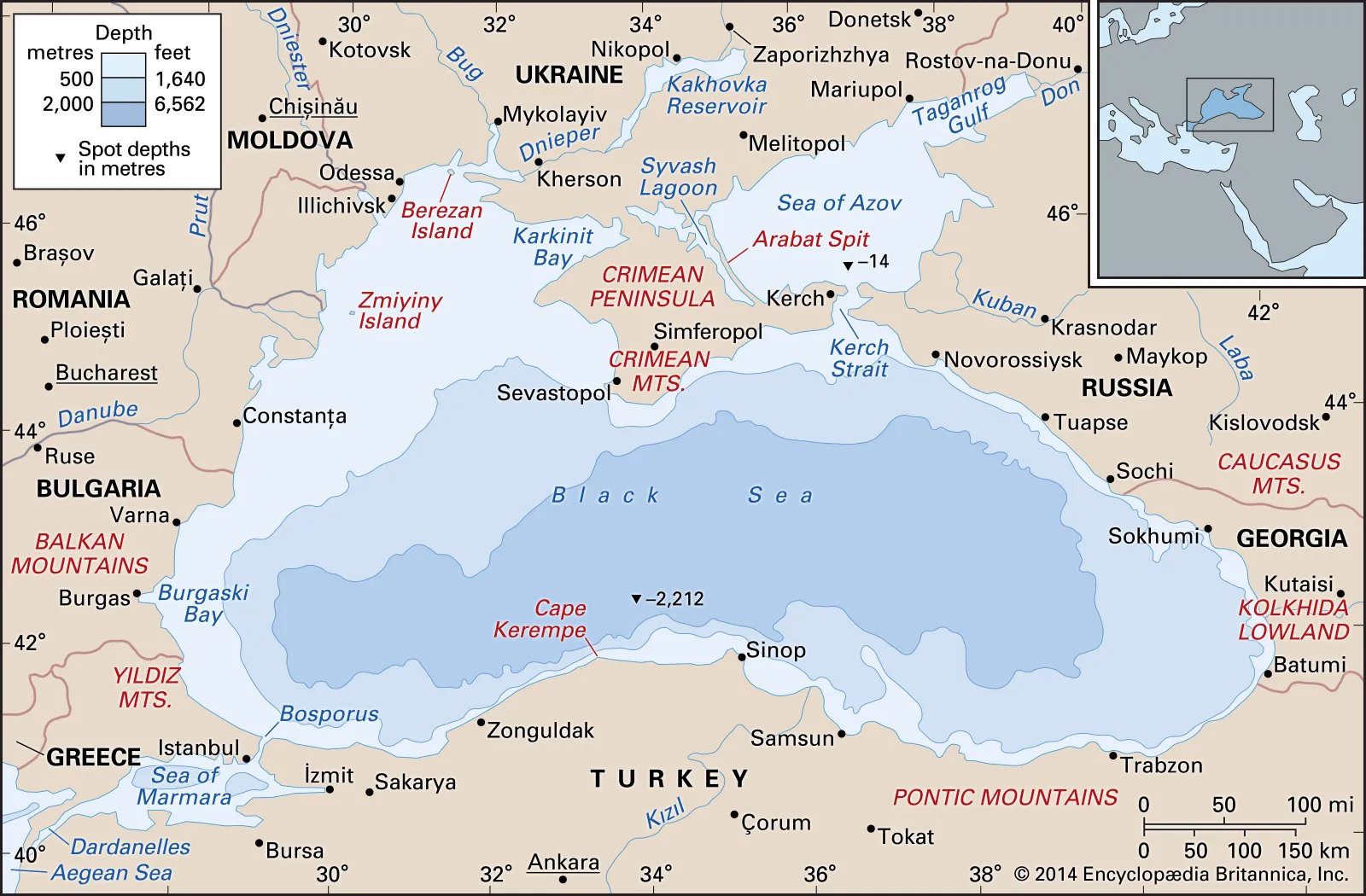
    black sea

    The UN Secretary-General Antonio Guterres has called for the renewal of the Black Sea Grain Initiative as Russia has agreed to resume its participation.

    Black Sea Grain Initiative

    • The Initiative eased Russia’s naval blockade and saw the reopening of three key Ukrainian ports.
    • The agreement to create the sea corridor was negotiated by representatives from Ukraine, Russia, the UN and Turkey in July this year.
    • The agreement created procedures to safely export grain from certain ports to attempt to address the 2022 food crisis.
    • It provides a safe maritime humanitarian corridor for Ukrainian exports (particularly for food grains) from three of its key ports, namely, Chornomorsk, Odesa and Yuzhny/Pivdennyi in the Black Sea.

    Outcomes of this deal

    • Approximately 9.8 million tonnes of grains have been shipped so far since the deal was brokered.
    • People hoarding the grain in the hope of selling it for a sizable profit owing to the supply crunch were now obligated to sell.
    • The initiative has also been credited for having made a huge difference to the global cost of living crisis.

    What would suspension of the deal mean?

    • In a nutshell, the deal’s suspension was expected to re-introduce the price pressures on grain prices, especially that of wheat, with inventory being at historical lows.
    • It could particularly impact countries in the Middle East and Africa such as Egypt, Turkey, Lebanon, Sudan and Yemen which have benefitted from the resumption and are particularly dependent on Russian and Ukrainian exports

    About Black Sea

    black sea

    • The famed water body is bound by Ukraine to the north and northwest, Russia and Georgia to the east, Turkey to the south, and Bulgaria and Romania to the west.
    • It links to the Sea of Marmara through the Bosphorus and then to the Aegean through the Dardanelles.

    Significance of Black Sea for Russia

    • Domination of the Black Sea region is a geostrategic imperative for Moscow.
    • Black Sea has traditionally been Russia’s warm water gateway to Europe.
    • For Russia, the Black Sea is both a stepping stone to the Mediterranean.
    • It acts as a strategic buffer between NATO and itself.
    • It showcases the Russian power in the Mediterranean and to secure the economic gateway to key markets in southern Europe.
    • Russia has been making efforts to gain complete control over the Black Sea since the Crimean crisis of 2014.


    Click and get your FREE Copy of CURRENT AFFAIRS Micro Notes

  • Fateful Triangle China,USA and India and Changing World Order

    China

    Context

    • America’s national security strategy issued by the Joe Biden Administration last week and the Chinese Communist Party’s 20th Congress this week promise to reshape the geopolitics of Asia and the Indo-Pacific.

    Historical background of USA-CHINA

    • Context of World War II: Asia has seen multiple phases in the US-China relationship. In the second half of the 19th century, American missionaries began to arrive in China and began to generate empathy for the nation. During World War II, Washington backed Chinese nationalists in their fight against Japanese occupation.
    • US efforts to isolation China: The US tried to isolate China from 1949 when the communists prevailed over the nationalists.
    • Cooperation to counter Soviet: The 1970’s saw the US and communist China come together to counter the Soviet Union.
    • Multiple Economic engagement: The 1980s saw the beginning of an economic engagement that turned into a huge commercial and technological partnership from the 1990s.

    China

    What is the USA’s assumption and China’s ambition?

    • China as responsible stakeholder: The US establishment dismissed the idea of China as potential threat and bet that Beijing could become a “responsible stakeholder” in the world order.
    • Democratization of Chinese society is inevitable: America also believed that China’s growing economic prosperity would inevitably lead to greater democratisation of its society.
    • Visible decline of west: China, however, has steadily moved in the other direction, especially under Xi, who has convinced himself that the West is in terminal decline.
    • China’s ambition to change the world order: Xi is determined to seize this moment to reshape the Asian as well as the global order to suit Chinese interests. At the same time, China has become increasingly repressive at home.
    • Explicit expression of ambition: Xi made no effort to hide China’s new geopolitical ambition nor has he been defensive about his authoritarian rule. This, in turn, bestirred the US into rethinking its China policy in the second decade of the 21st century.

    China

    How China is asserting itself?

    • Asserting own version of Global order: Beijing, argues that recent history points to the superiority of the Chinese system over the Western one. And it offers its own versions of a global order – economic, political and social. Since the end of the Cold War, ideological arguments had receded into the background but are now back in significant play.
    • China offering model Economic Globalization: China continues to sing praises of the model of economic globalisation that has facilitated Beijing’s rise over the last four decades. But under Xi, China has emphasised the importance of self-reliance in the name of a “dual circulation strategy”.
    • Leveraging world’s dependence for strategic gain: At the same time, Beijing has sought to enhance the world’s dependence on its economy and leverage it for strategic benefit. The profound political backlash against trade and economic cooperation with China in the US led to the questioning of economic globalisation in the Trump years.
    • China building the powerful military: As China became a richer country, it also focused on building a powerful army. Using both the instruments of hard power, China under Xi has actively sought to undermine US alliances in Asia and mount pressure on American forward military presence in Asia.

    China

    How USA’s policy is changing towards China?

    • Structured policy of rivalry: The traditional soft attitude to China yielded to a more confrontational approach during the Donald Trump presidency. Joe Biden has developed that into a more structured policy of competing with China.
    • Combine challenge of China and Russia: The National Security Strategy of the Trump administration postulated the return of great power rivalry and the need to respond to the challenges presented by Russia and China. Biden’s NATIONAL SECURITY STRATEGY builds on that proposition and identifies China as the more demanding challenge than Russia, despite Moscow’s aggression against Ukraine.
    • China is more capable than Russia: In his foreword to the National security strategy, Biden says “Russia poses an immediate threat to the free and open international system, recklessly flouting the basic laws of the international order today, as its brutal war of aggression against Ukraine has shown.” He names China, on the other hand, as “the only country with both the intent to reshape the international order and, increasingly, the economic, diplomatic, military and technological power to advance that objective”. While the European challenge is real, the Biden Administration now sees the Indo-Pacific as the principal strategic theatre.
    • Projecting China as autocracy against the democracy: The US has sought to locate the conflict with China (and Russia) as a fundamental struggle between “democracies and autocracies”. Recognising the limited enthusiasm for the framing in Asia, the National security strategy now talks of broadening the coalition to include countries that may not be democratic. Beijing, on the other hand, argues that recent history points to the superiority of the Chinese system over the Western one.
    • Building the bilateral alliances: The US is now pushing back. The principal instrument in the US response has been rebuilding the traditional bilateral alliances with Japan and Australia as well as constructing new partnerships with countries like India and developing new regional coalitions.

    India’s role in shaping the world order

    • Convergence of National interest wit USA: Today, Indian and American policies are converging. For both Delhi and Washington, Beijing presents the main national challenges.
    • Reducing economic dependence on China: On the economic and technological front, both India and the US are trying to reduce their exposure to China.
    • Keeping independent foreign policy: On the geopolitical front, a US plan to look beyond formal alliances suits Delhi, which is wedded to an independent foreign policy.
    • Opportunity for cooperation: It is never easy to translate abstract convergence into concrete policies. The current churn in Asia provides Delhi and Washington with a historic opportunity to build on the new convergences in the areas of trade, technology, and geopolitics.

     Conclusion

    • changing world order will have short term repercussion on economic front for developing country like India. India has a great opportunity to be the rule maker of new global order rather than just a rule follower. World order of 21st century will revolve around the fateful triangle of India, China and USA.

    Mains Question

    Q.Why the present world order is challenged by China? What role India can play as rule maker of new World order?

    UPSC 2023 countdown has begun! Get your personal guidance plan now! (Click here)

  • International Solar Alliance approves funding mechanism

    To bolster investments in solar power projects, the International Solar Alliance (ISA), in its General Assembly approved the ‘Solar Facility’, a payment guarantee mechanism.

    What is Solar Facility?

    • It is expected to stimulate investments into solar projects through two financial components:
    1. Solar Payment Guarantee Fund and
    2. Solar Insurance Fund
    • The thrust of the facility is to attract private capital to flow into “underserved markets” in Africa.
    • The ISA would aim to crowdsource investments from various donors across the globe and proposed projects in Africa would be able to purchase payment guarantees or partial insurance premium from these funds.

    Why such move?

    • ISA’s mission is to unlock US $1 trillion (₹80 lakh crore) of investments in solar power by 2030 while reducing cost of the technology and its financing.

    What is International Solar Alliance (ISA)?

    • The ISA is an alliance of more than 121 countries, most of them being sunshine countries, which lie either completely or partly between the Tropic of Cancer and the Tropic of Capricorn.
    • It is headquartered in Gurugram, India.
    • The primary objective of the alliance is to work for efficient exploitation of solar energy to reduce dependence on fossil fuels.
    • The alliance is a treaty-based inter-governmental organization.
    • The initiative was launched by PM Modi at the India Africa Summit and a meeting of member countries ahead of the 2015 United Nations Climate Change Conference in Paris in November 2015.

    Objectives of the ISA

    • To mobilize investments of more than USD 1000 billion by 2030
    • To take coordinated action for better harmonization, aggregation of demand, risk and resources, for promoting solar finance, solar technologies, innovation, R&D, capacity building etc.
    • Reduce the cost of finance to increase investments in solar energy in member countries
    • Scale up applications of solar technologies in member countries
    • Facilitate collaborative research and development (R&D) activities in solar energy technologies among member countries
    • Promote a common cyber platform for networking, cooperation and exchange of ideas among member countries

    What does ISA formation signify?

    • Climate action commitment: It symbolizes about the sincerity of the developing nations towards their concern about climate change and to switch to a low-carbon growth path.
    • Clean energy: India’s pledge to the Paris summit offered to bring 40% of its electricity generation capacity from non-fossil sources (renewable, large hydro, and nuclear) by 2030.
    • Global electrification: India has pledged to let solar energy reach to the most unconnected villages and communities and also towards creating a clean planet.
    • Global cooperation: It is based on world cooperation irrespective of global boundaries.
    • India’s Soft power: For India, possible additional benefits from the alliance can be a strengthening of ties with the major African countries and increasing goodwill for India among them.

    Key initiatives

    [A] Global Solar Atlas

    • ISA alliance has partnered with World Bank to launch Global Solar Atlas at an ISA event at the World Future Energy Summit in Abu Dhabi.
    • Global Solar Atlas is a free online tool that displays annual average solar power potential at any location in the world and thus identify potential sites for solar power generation.

    [B] OSOWOG Initiative

    • Under the ISA project, India envisaged having an interconnected power transmission grid across nations for the supply of clean energy.
    • The vision behind the OSOWOG mantra is ‘The Sun Never Sets’ and is a constant at some geographical location, globally, at any given point of time.
    • With India at the fulcrum, the solar spectrum can easily be divided into two broad zones viz. far East which would include countries like Myanmar, Vietnam, Thailand, Lao, Cambodia etc. and far West which would cover the Middle East and the Africa Region.

    Implementation

    • The OSOWOG would have three phases.
    1. Phase I: Middle East, South Asia and South-East Asia would be interconnected
    2. Phase II: Solar and other renewable energy resources rich regions would be interconnected
    3. Phase III: Global interconnection of the power transmission grid to achieve the One Sun One World One Grid vision

    Benefits of the project

    • Attracting investment: An interconnected grid would help all the participating entities in attracting investments in renewable energy sources as well as utilizing skills, technology and finances.
    • Poverty alleviation: Resulting economic benefits would positively impact poverty alleviation and support in mitigating water, sanitation, food and other socio-economic challenges.
    • Reduced project cost: The proposed integration would lead to reduced project costs, higher efficiencies and increased asset utilization for all the participating entities.

    Various challenges

    • Lack of Funding: Providing the money for promoting solar electricity among the members is a challenge. The Alliance has very little money of its own.
    • Expensive implementation: The cost of power has two components. The variable cost is the payment made for the numbers of units of electricity purchased. In addition, the buyer is required to pay a certain amount towards the fixed cost of solar supply.
    • Battery-based Storage: Solar electricity is available only during the day when the sun shines. Thus, the storage of electricity is a difficult task.
    • Cross-border transmission: Solar electricity has to overcome the roadblocks of transmission.  Cross-border transmission of electricity requires the establishment of transmission lines from the producer to the consumer country.
    • Peak hour load:  The demand for electricity, however, is more during the morning and evening which are called “peak hours”. But it can be produced when the sun is shining.
    • Climate change: Sudden overcast and rainfall in many parts of the tropics has been a major issues these days. Such weather hampers solar energy production
    • Desired global consensus: It is hindered with the issues of intricate geopolitics, unfavourable economics, unwarranted globalisation and undue centralization that act against the concept.
    • Highly ambitious: In a nation like India, it took us this long to connect all the regions of the country through a national grid and we are talking about ‘one world, one grid’.

    Way forward

    • ISA should focus on its core goals such as- aggregating demand, tariff, technical collaborations, and financial assistance for achieving its target.
    • It further needs to ensure that solar benefits are clear and tangible to users beyond its cost ambitions.
    • ISA should demonstrate business models that are viable for users, suppliers and financiers.
    • Further, the alliance should support member countries in implementing policies to expedite these business models.
    • Geo-politically, this is being touted as a clever strategy however financially and technology-wise, this has to make sense.


    UPSC 2023 countdown has begun! Get your personal guidance plan now! (Click here)

  • UN World Geospatial Information Congress (UNWGIC)

    UNWGIC

    PM has inaugurated the second United Nations World Geospatial Information Congress (UNWGIC) in Hyderabad.

    What is UNWGIC?

    • The first United Nations World Geospatial Information Congress was held in Deqing, Zhejiang Province, China in 2018.
    • The United Nation Committee of Experts on Global Geospatial Information Management (UN-GGIM) organizes the UNWGIC every four years.
    • It is hosted by the Ministry of Science and Technology of the Government of India.
    • The objectives are enhancing international collaboration among the Member States and relevant stakeholders in Geospatial information management and capacities.
    • The theme of UNWGIC 2022 is ‘Geo-Enabling the Global Village: No one should be left behind’.

    Objectives of UNWGIC

    • The move aims to provide high-quality and trustworthy geospatial data to support global and national policy agendas.
    • It also stresses international cooperation and coordination in the development of human data linked to geography.
    • It promotes societal development and well-being, addresses environmental and climate challenges, and embraces digital transformation and technological advancement.

    Why collaborate on geospatial technology?

    • Geospatial technology can be used to create intelligent maps and models which help to collect geographically referenced data.
    • Decisions based on the value and importance of resources, most of which are limited, can become easy through geospatial technology.
    • Intelligent maps and models can be created using geospatial technology.
    • It can be used to reveal spatial patterns hidden in large amounts of data that are complex to access collectively through mapping.


    UPSC 2023 countdown has begun! Get your personal guidance plan now! (Click here)
  • Pakistan to take part in SCO anti-terror exercise hosted by India

    Pakistan has been invited to the closing ceremony of the ongoing Joint Anti-Terror Exercise (JATE) within the ambit of the Shanghai Cooperation Organisation (SCO) being hosted by India.

    What is the news?

    • The National Security Guard (NSG) is hosting the multinational JATE “Manesar Anti-Terror 2022”, under the framework of the SCO Regional Anti-Terrorist Structure (RATS).
    • Pakistan team would be participating in the event as a member of the SCO.

    What is SCO RATS?

    • Regional Anti-Terrorist Structure (RATS) is a permanent organ of the SCO which serves to promote cooperation of member states against the three evils of terrorism, separatism and extremism.
    • It is headquartered in Tashkent.
    • Its head is elected to three-year term.
    • Each member state of SCO sends permanent representative to RATS

    About Shanghai Cooperation Organization’s (SCO)

    • The SCO, in which China plays an influential role, is also comprised of Kazakhstan, Kyrgyzstan, Russia, Tajikistan, Uzbekistan, India and Pakistan.
    • India and Pakistan were admitted into the bloc in 2017.
    • It is Eurasian economic, political and security organisation headquartered in Beijing, China.
    • Its main objective is military cooperation between member states.
    • It is primarily centred on security-related concerns of Central Asian members with main threats being terrorism, separatism and extremism.
    • It was established in June 2001 as a successor of Shanghai Five mechanism which was established in 1996 with China, Kazakhstan, Kyrgyzstan, Russia and Tajikistan as members.
    • Iran, Afghanistan, Belarus and Mongolia enjoy observer status of SCO.
    • Turkey, Azerbaijan, Armenia, Cambodia, Sri Lanka and Nepal are dialogue partners of SCO.


    UPSC 2023 countdown has begun! Get your personal guidance plan now! (Click here)

  • International Day of Non-Violence event at UN

    International

    The International Day of Non-Violence event, held at the UN headquarters in New York, saw a life-size hologram of Gandhi displayed.

    International Day of Non-Violence

    • Every year, since 2007, the day is observed on October 2, the birth anniversary of Mahatma Gandhi.
    • Iranian Nobel Laureate Shirin Ebadi, in January 2004, first proposed the idea of dedicating a day to non-violence, around the world.
    • In 2007, the UN General Assembly (UNGA) passed a resolution to commemorate October 2 as the International Day of Non-Violence, with the core objective to “disseminate the message of non-violence, including through education and public awareness.”

    What does the term “non-violence” stand for?

    • The UN defines the term as a rejection of the use of physical violence in order to achieve social or political change.
    • The UNGA resolution reaffirms the universal relevance of the principle of non-violence and establishes a desire to secure a culture of peace, tolerance, understanding and non-violence.
    • The theory emphasises that the power of rulers depends on the consent of the populations, and non-violence therefore seeks to undermine such power through withdrawal of the consent and cooperation of the populace.


    UPSC 2023 countdown has begun! Get your personal guidance plan now! (Click here)

  • India and UNSC

    UNSCContext

    • There is greater support for India to be a permanent member of the UN Security Council and also a broad global consensus over the need to reform the Council, said External Affairs Minister S Jaishankar. India has once again renewed its bid for permanent membership of UNSC.

    What is UNSC?

    • The United Nations Security Council (UNSC) is one of the six principal organs of the United Nations (UN) and is charged with ensuring international peace and security, recommending the admission of new UN members to the General Assembly, and approving any changes to the UN Charter.
    • Its powers include establishing peacekeeping operations, enacting international sanctions, and authorizing military action. The UNSC is the only UN body with the authority to issue binding resolutions on member states.

    UNSCWhat is the composition of UNSC?

    • Presently there five permanent members (P-5) with veto and 10 non-permanent members without veto elected for tenure of 2 years.
    • India has been the non-permanent member multiple times. Presently India is serving its tenure that will end in December 2022.

    UNSCWho are P-5 members?

    • The victors of World War 2 – USA, RUSSIA, CHINA, UK, FRANCE.

    What are the hurdles that India facing?

    • Elite club: Most exclusive club in international relations. All other clubs have been breached. Until a quarter century ago, the nuclear weapon club had five members, the same five as the P-5.India, Pakistan, North Korea and Israel have since joined the club. But UNSC is unbreachable till date.
    • All are reluctant: The inescapable fact is that none of the P-5 wants the UNSC’s ranks to be increased. One or the other of them might make some noise about supporting one or more of the aspirants. Each is confident that someone among them will torpedo the enlargement of the club. Declarations of support for India’s candidature need to be taken with a fistful of salt.
    • Veto issue: Former UN Secretary-General Kofi Annan bluntly told India not to expect to get the veto power. Though India has said it will not accept a seat without veto power.
    • China-Pakistan axis: China, which has historically blocked India’s aspirations to become a permanent member of the UNSC. Beijing has an “all-weather ally” in Islamabad, another neighbour who also strongly opposes India’s candidature to the UNSC.
    • Odd man out: Four out of the five permanent members of the United Nations Security Council have bilaterally expressed official affirmations of support for India’s candidature to a permanent seat in an expanded UN Security Council.
    • Coffee club opposition: Members like Italy, South Korea, Canada, Spain, Mexico, Turkey, Argentina, Pakistan, and others, who have together formed the Uniting for Consensus (UfC) movement. Also known as the Coffee Club, the movement argues that bids for permanent seats by India, Japan, Germany, and Brazil (G4 countries) must not be considered without first reaching an international consensus regarding the form and size of the new Security council.

    UNSCWhat are the Efforts taken by India?

    • Text based negotiation: External affairs minister is canvassing for the country’s candidature, meeting his counterparts from several countries. He has repeated the call, made often in the past, for a text-based negotiation on what has been euphemistically referred to as the reform of the United Nations Security Council (UNSC), i.e., negotiation on a written document outlining the proposed reform instead of just holding forth verbally.
    • Woking together with G-4: INDIA, JAPAN, GEMANY, BRAZIL works together to get permanent UNSC seat however these efforts are opposed by coffee club.
    • Multilateral engagements: By expanding its footprint in multilateral organisations, India is gearing up to become a global rule-maker.
    • Distinguished group of experts suggested a few years ago that a new category of semi-permanent members should be created. Countries would be elected for a period of eight to 10 years and would be eligible for re-election. India ought to give serious consideration to this idea.
    • With or without veto: According to former foreign secretary Chinmaya gharekhan, if by some miracle we are offered or manage to obtain permanent membership without veto, we must grab it. Even a permanent membership without veto will be tremendously helpful in protecting our interests.

    Conclusion

    • Looking at the present geopolitical divide India’s dream of seat at the highest table is unlikely to get fulfilled in near future. India must analyse the utility of UNSC membership for securing its national interest. India should not give up anything in bargain against UNSC seat which harms its international interest.

    Mains question

    Q. India’s quest for UNSC is like “Sisyphus carrying the boulder  just to see how it falls”. In this context Analyse the utility of Permanent seat at UNSC.


    UPSC 2023 countdown has begun! Get your personal guidance plan now! (Click here)

  • Why India has lashed out at the US over its F-16 package to Pakistan?

    f-16

    EAM S Jaishankar has lashed out at the US for its decision to provide Pakistan with a $450 million package for F-16 case fighter aircraft upgrade.

    F-16 and Pakistan

    • The F-16 is a single-engine multirole fighter aircraft originally developed by General Dynamics for the United States Air Force (USAF).
    • Designed as an air superiority day fighter, it evolved into a successful all-weather multirole aircraft.
    • The F-16 were inducted into Pakistan Air Force in 1983 during the Soviet-Afghan War.

    Suspicion over US move

    • This is the first American military assistance package to Pakistan after the Trump Administration.
    • Mr Trump ended defence and security co-operation with Pakistan in 2018 after accusing it of giving only “lies and deceit” for the billions of dollars that the US had “foolishly” given it.

    What specific reasons has the Biden Administration given for its decision?

    • As per US version, the proposed sale does not include any new capabilities, weapons, or munitions.
    • The upgrade package aimed to retain interoperability with US and partner forces in ongoing counter-terrorism efforts and in preparation for future contingency operations.

    Why did US provide F-16 to the US?

    • India has been concerned about the F-16s from the time the US first gave Pakistan F-16s as a reward for its assistance in the first Afghan war.
    • The US then had supplied weapons and money to Pakistan to unleash armies of jihadists against the Soviet Army.
    • When the US objective was achieved with the Soviet Union’s departure from Afghanistan, the US too resized its relations with Pakistan.
    • The Pressler Amendment, aimed against Pakistan’s nuclear ambitions, froze it out of military assistance.
    • A decade later, the Bush Administration not only approved the release of previously blocked F-16s, but also provided a refurbishment package, and sale of new F-16s.

    India’s concerns

    • As pointed out by EAM, how the F-16s help in counter-terrorism remains unclear.
    • Jaishankar questioned the merits of the US-Pakistan partnership.
    • He said that the relations had “not served” either country (but created more troubles for India).
    • This move by the US will alter the basic military balance in the region.
    • The decision to provide military aid to Pakistan incensed India as the F-16 was used against Indian warplanes following the 2019 Balakot air strikes.

    Conclusion

    • Washington’s $450 million package has only resurrected old prejudices centred on the US not being a dependable ally for ever.
    • India needs to respond firmly and in no uncertain terms to the PAF’s F-16 upgrade programme to convey the message that India cannot be taken for granted.
    • India will have to effectively enhance the conventional combat capability of the IAF to continue to meet the challenge of a resurgent PAF.


    UPSC 2023 countdown has begun! Get your personal guidance plan now! (Click here)

  • PM Modi pitches for ‘Full Transit Right’ among SCO members

    With Pakistan PM listening, Prime Minister Modi urged Shanghai Cooperation Organisation member states to “give each other full right to transit”.

    Why in news?

    • PM Modi framed the right to transit in the context of connectivity and how it could help establish reliable and resilient supply chains in the region.

    Why did PM pitch this?

    • Lack of transit across Pakistan’s territory has been a challenge for India to access Central Asian markets.
    • Iran’s President also said that despite the impressive potential, infrastructural connections in the field of transit between members of the SCO are not so extensive.
    • Iran already provides special priority to the development of the North-South Corridor and has made huge investments.

    What is International North-South Transport Corridor (INSTC)?

    • The INSTC is a 7,200 km-long multimodal transportation network encompassing sea, road, and rail routes to offer the shortest route of connectivity.
    • It was established on 12th September 2000 in St. Petersburg, by Iran, Russia and India for the purpose of promoting transportation cooperation among the Member States.
    • It links the Indian Ocean to the Caspian Sea via the Persian Gulf onwards into Russia and Northern Europe.
    • It will move freight between India, Iran, Afghanistan, Armenia, Azerbaijan, Russia, Central Asia and Europe.

    Significance of INSTC

    • Trade facilitation: INSTC is aimed at reducing the carriage cost between India and Russia by about 30 percent and bringing down the transit time by more than half.
    • New corridor in making: It has the potential to transform the economies of countries along the corridor into specialized manufacturing, logistics, and transit hubs by facilitating access to newer markets.
    • Multimodal transit: The recent Suez Canal blockade, which cost the global economy hefty damage amounting to US$9 billion, has amplified the optimistic outlook towards the INSTC as a cheaper and faster alternative multimodal transit corridor.

    Benefits offered to India

    • Export promotion: The INSTC connects India with Central Asia, and Russia, and has the potential to expand up to the Baltic, Nordic, and Arctic regions, increasing the scope of trade multifold.
    • Ease of trade: For India, it provides a shorter trade route with Iran, Russia, and beyond to Europe, creating scope for increased economic engagement.
    • Alternative Route to Central Asia: It opens up a permanent alternative route for India to trade with Afghanistan and Central Asia, given the hurdles in the direct route through Pakistan.


    UPSC 2023 countdown has begun! Get your personal guidance plan now! (Click here)

  • India raises Sri Lankan Tamil issue in UN

    gyanvapi

    India voiced concern over the “lack of measurable progress” in Sri Lanka’s promised political solution to the long-pending Tamil national question.

    Back in news: Tamil Issue

    • India has made an unexpected (for SL) reference to the crisis-hit island nation’s “debt-driven” economy in the context of its current crisis.
    • Indian delegation noted the lack of measurable progress by Government of Sri Lanka on their commitments of a political solution to the ethnic issue.
    • It sought for full implementation of the 13th Amendment of the Constitution, delegation of powers to Provincial Councils and holding of Provincial Council elections at the earliest.

    Has India retreated from supporting Sri Lanka?

    • India’s statement comes ahead of a resolution on Sri Lanka that will likely face a vote at the Council.
    • Since 2009, India has voted thrice in favour of the UN resolution on Sri Lanka — two were critical — and abstained twice, in 2014 and 2021.
    • Irrespective of its vote, India has consistently underscored the need for a political settlement within the framework of a united Sri Lanka, ensuring justice, peace, equality and dignity for the Tamils of Sri Lanka.

    Issues faced by Tamils in Sri Lanka

    • According to Freedom House’s Freedom in the World 2016 report on Sri Lanka, Tamils report systematic discrimination in areas including government employment, university education, and access to justice.
    • A large portion of the Tamil population still remains displaced.

    What is the Tamil issue in Sri Lanka?

    • Violent persecution against the Tamil population erupted in the form of the 1956, 1958, 1977, 1981 and 1983 anti-Tamil pogroms in Sri Lanka.
    • Over 13 years since the end of Sri Lanka’s civil war, in which tens of thousands of civilians were killed and disappeared, survivors continue demanding justice and accountability for war-time crimes.
    • In the post-war years, Sri Lanka’s human rights defenders have frequently flagged concerns over persisting militarisation, especially in the Tamil-majority north and east; repression, and the shrinking space for dissent.

    What is the 13th Amendment?

    • It is an outcome of the Indo-Lanka Accord of July 1987, signed by the then PM Rajiv Gandhi and President J.R. Jayawardene, in an attempt to resolve the ethnic conflict and civil war.
    • The 13th Amendment led to the creation of Provincial Councils and assured a power-sharing arrangement to enable all nine provinces in the country, including Sinhala majority areas, to self-govern.
    • Subjects such as education, health, agriculture, housing, land and police are devolved to the provincial administrations.

    Why is it contentious?

    • The 13th Amendment carries considerable baggage from the country’s civil war years.
    • It was opposed vociferously by both Sinhala nationalist parties and the LTTE.
    • The opposition within Sri Lanka saw the Accord and the consequent legislation as an imprint of Indian intervention.
    • It was widely perceived as an imposition by a neighbour wielding hegemonic influence.
    • The Tamil polity, especially its dominant nationalist strain, does not find the 13th Amendment sufficient in its ambit or substance.
    • However, some find it as an important starting point, something to build upon.

    Why India objects over this?

    • Because of restrictions on financial powers and overriding powers given to the President, the provincial administrations have not made much headway.
    • In particular, the provisions relating to police and land have never been implemented.

    Why is it significant?

    • Till date, the Amendment represents the only constitutional provision on the settlement of the long-pending Tamil question.
    • In addition to assuring a measure of devolution, it is considered part of the few significant gains since the 1980s, in the face of growing Sinhala-Buddhist majoritarianism.


    UPSC 2023 countdown has begun! Get your personal guidance plan now! (Click here)