Mains Ready By December. Smash Mains & Smash PYQ Admissions Open

GS Paper: GS2-18.Bilateral, regional and global groupings and agreements involving India and/or affecting India’s interests.

  • Road Safety in India

    The United Nations is holding a high-level meeting on Global Road Safety on June 30 and July 1, 2022 to review the progress and challenges.

    Road Accidents in India: A lookover

    • In spite of several years of policymaking to improve road safety, India remains among the worst-performing countries in this area.
    • Total 1,47,913 lives lost to road traffic accidents in 2017 as per Ministry of Road Transport and Highways statistics.
    • The National Crime Records Bureau (NCRB) figure for the same year is 1,50,093 road accident deaths.

    Why in news?

    • The persistently high annual death toll brings into question the country’s ability to meet Sustainable Development Goal (SDG) 3.6.
    • This aims to halve the fatalities and injuries from road traffic accidents by 2030.

    Lancet’s findings on road safety

    • A new analytical series on road safety worldwide, published by The Lancet, proposes that India and other countries could cut accident-related deaths by 25 to 40%.
    • This is based on evidence that preventive interventions produce good outcomes when applied to four well-known risk factors:
    1. High speed
    2. Driving under the influence of alcohol
    3. Not using proper helmets
    4. Not wearing seat-belts and not using child restraints

    Issues highlighted in developing countries

    • The structural problems linked to unplanned motorisation and urbanisation remain.
    • In India, speedy highway construction takes place without reconciling fast and slow-moving traffic.
    • There is a rampant presence of ramshackle vehicles, wrong-side driving, absence of adequate traffic police forces etc.

    Why are there so many road fatalities in India alone?

    • Weak enforcement of traffic laws: People hardly oblige to traffic rules and find easier to bribe policemen rather than paying hefty challans.
    • Speeding issue: More accidents on the highways have been attributed to higher vehicle speeds and higher volume of traffic on these roads.
    • Engineering bottlenecks: Issues such as gaps in the median on the national highways, untreated intersections, and missing crash barriers are some of the biggest engineering issues.
    • Behavioural issue: Driver violations such as wrong-side driving, wrong lane usage by heavy vehicles, and mass violation of traffic lights, intoxication are the biggest behavioural issues.
    • Lack of Golden hour treatment: Lack of rapid trauma care on highways leads to such high fatalities.

    Various steps taken by India

    • India amended Motor Vehicles Act in 2019, but its implementation by State governments is not uniform or complete.
    • A National Road Safety Board was constituted under the Act, with advisory powers to reform safety.
    • The World Bank has approved a $250 million loan to support for India State Support Programme for Road Safety.

    Issues with implementation

    • The focus of State governments, however, remains conventional, with an emphasis on user behaviour (drivers and other road users), education and uneven enforcement.
    • Low emphasis is placed on structural change such as raising engineering standards for roads, signages, signals, training for scientific accident investigation, raising policing skills and fixing responsibility on government departments for design, creation and maintenance of road infrastructure.

    What can be done to cut death and injury rates?

    • The ambitious amendments to the Motor Vehicles Act in 2019 (MV Act) have not yielded significant results.
    • Major interventions in India, first suggested by the Sundar Committee (2007) and ordered by the Supreme Court in Rajasekaran vs Union of India have not made a dent in the problem.

    Key findings of Sundar Committee

    • The Sundar Committee pointed out that India lacked a technically competent investigation arm that could determine the cause of accidents.
    • There is little clarity on whether the States have formed such units to aid traffic investigation, or whether the insurance industry has pressed for these to accurately determine fault.
    • In the absence of scientific investigation, perceptions usually guide the fixing of liability.

    Solutions provided by the Lancet

    • The Lancet calculated that 17% of road traffic injury-related deaths could be avoided if trauma care facilities improved.
    • This is significant as several accidents take place in rural areas on highways, and victims are taken to poorly-equipped district hospitals or medical college hospitals.
    • While positive user behaviour — slower travel, wearing of helmets, seat belts and so on — could save thousands of lives.
    • In the short term, slowing down traffic, particularly near habitations, segregating slower vehicles, enforcing seat belt and helmet use and cracking down on drunken drivers could produce measurable gains.

    Imbibing road safety: Way forward

    • Road safety education
    • Better road design, maintenance and warning signage
    • Crackdown on driving under influence of alcohol and drugs
    • Strict enforcement of traffic rules
    • Encouraging better road behaviour
    • Ensuring road worthiness of a vehicle
    • Better first aid and paramedic care

    Do you know?

    The ‘golden hour’ has been defined as ‘the time period lasting one hour following a traumatic injury during which there is the highest likelihood of preventing death by providing prompt medical care.


    UPSC 2023 countdown has begun! Get your personal guidance plan now! (Click here)
  • The significance of PM’s visit to the UAE

    Context

    Prime Minister Narendra Modi’s visit to the UAE on June 28 was his fourth, having visited the country earlier in August 2015, in February 2018 and again in August 2019.

    Why do the Gulf and UAE matters to India?

    • The UAE has given crucial support to India in the Islamic world, first by inviting our late External Affairs Minister Sushma Swaraj as a guest of honour at an OIC foreign ministers meeting in Abu Dhabi.
    • The UAE stood with us on Jammu and Kashmir following the abrogation of Article 370.
    • The Gulf is our third-largest trading partner.
    • The Gulf region is our principal source of hydrocarbons.
    • It is also a major source of foreign investment.
    • The region is home to some 8 million Indians who send in over $50 billion annually in remittances.

    Deepening bilateral ties

    • CEPA: In a virtual summit with Sheikh Mohamed in February 2022, both sides signed a Comprehensive Economic Partnership Agreement (CEPA).
    • CEPA is a significant milestone that was negotiated and finalised in just 88 days and promises to increase bilateral trade from $60 billion to $ 100 billion in five years.
    •  It is expected to help Indian exports in areas ranging from gems and jewellery and textiles to footwear and pharmaceuticals, apart from enhanced access for Indian service providers to 11 specific sectors.
    • Vision statement: An ambitious, forward-looking Joint Vision Statement titled, “Advancing the India and UAE Comprehensive Strategic Partnership: New Frontiers, New Milestones” was also issued.
    • The Dubai-based DP World and India’s National Skills Development Council signed an agreement to set up a Skill India Centre in Varanasi to train local youth in logistics, port operations and allied areas so that they can pursue overseas employment.

    New avenues for multilateral cooperation

    • The rapid normalisation of ties between the UAE and Israel following the Abraham Accords of August 2020 has also opened new avenues of trilateral and multilateral cooperation.
    • Technology, capital and scale: Some Israeli tech companies are already establishing a base in Dubai and seeking to marry niche technologies with Emirati capital and Indian scale. 
    • 2I2U: The US has announced that President Joe Biden’s forthcoming visit to West Asia will see a virtual summit of what it calls the 2I2U, a new grouping that brings together India, Israel, the US and UAE.

    Conclusion

    The UAE today is India’s closest partner in the Arab world. Both countries need to expand the areas of cooperation and deepen their engagement.

    UPSC 2023 countdown has begun! Get your personal guidance plan now! (Click here)


    Back2Basics: Abraham Accords

    • The Israel–UAE normalization agreement is officially called the Abraham Accords Peace Agreement.
    • It was initially agreed to in a joint statement by the United States, Israel and the United Arab Emirates (UAE) on August 13, 2020.
    • The UAE thus became the third Arab country, after Egypt in 1979 and Jordan in 1994, to agree to formally normalize its relationship with Israel as well as the first Persian Gulf country to do so.
    • Concurrently, Israel agreed to suspend plans for annexing parts of the West Bank.
    • The agreement normalized what had long been informal but robust foreign relations between the two countries.
  • G-20 summit expected to be in Delhi

    India is expected to host the G-20 summit in Delhi, while a number of States, including Jammu and Kashmir and north-eastern States, have been asked to suggest venues for about 100 “preparatory” meetings.

    Why in news?

    • The clarifications came in response to questions being raised over reports in the media about the possibility of holding the summit itself in Jammu and Kashmir.
    • Pakistan had issued a strong protest last week, sent formal demarches to Foreign Ministries in G-20 member-states, asking them not to attend such meetings.
    • Pakistan (alone) believes J&K is internationally recognised disputed territory.

    Why such move?

    • The participation of the delegates from G-20 countries will be a major boost to the efforts of the Centre to project the situation in J&K as normal.
    • This is especially after J&K’s special constitutional position was ended in 2019.

    What is G-20?

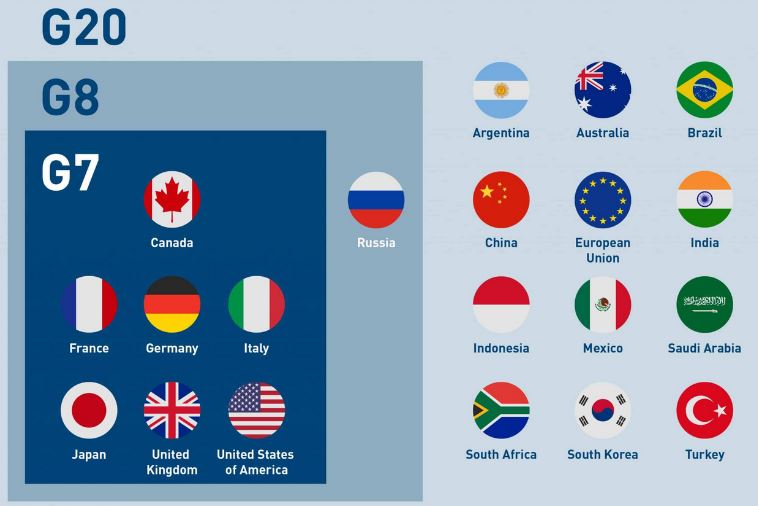
    • Formed in 1999, the G20 is an international forum of the governments and central bank governors from 20 major economies.
    • Collectively, the G20 economies account for around 85 percent of the Gross World Product (GWP), 80 percent of world trade.
    • To tackle the problems or address issues that plague the world, the heads of governments of the G20 nations periodically participate in summits.
    • In addition to it, the group also hosts separate meetings of the finance ministers and foreign ministers.
    • The G20 has no permanent staff of its own and its chairmanship rotates annually between nations divided into regional groupings.

    Aims and objectives

    • The Group was formed with the aim of studying, reviewing, and promoting high-level discussion of policy issues pertaining to the promotion of international financial stability.
    • The forum aims to pre-empt the balance of payments problems and turmoil on financial markets by improved coordination of monetary, fiscal, and financial policies.
    • It seeks to address issues that go beyond the responsibilities of any one organization.

    Members of G20

    The members of the G20 consist of 19 individual countries plus the European Union (EU).

    • The 19 member countries of the forum are Argentina, Australia, Brazil, Canada, China, France, Germany, India, Indonesia, Italy, Japan, Mexico, Russia, Saudi Arabia, South Africa, South Korea, Turkey, United Kingdom and the United States.
    • The European Union is represented by the European Commission and by the European Central Bank.

    Its significance

    • G20 is a major international grouping that brings together 19 of the world’s major economies and the European Union.
    • Its members account for more than 80% of global GDP, 75% of trade and 60% of population.

    India and G20

    • India has been a member of the G20 since its inception in 1999.


    UPSC 2023 countdown has begun! Get your personal guidance plan now! (Click here)

  • G7

    Context

    The meeting of G7 leaders that concluded in Bavaria was attended by India as an observer.

    About G7

    • The G-7 or ‘Group of Seven’ includes Canada, France, Germany, Italy, Japan, the United Kingdom, and the United States.
    • It is an intergovernmental organisation that was formed in 1975 by the top economies of the time as an informal forum to discuss pressing world issues.
    • Initially, it was formed as an effort by the US and its allies to discuss economic issues.
    • The G-7 forum now discusses several challenges such as oil prices and many pressing issues such as financial crises, terrorism, arms control, and drug trafficking.
    • It does not have a formal constitution or a fixed headquarters. The decisions taken by leaders during annual summits are non-binding.
    • Canada joined the group in 1976, and the European Union began attending in 1977.
    • The G7 is trying hard not to be yesterday’s club.
    • It is still a powerful grouping, with seven of its members in the top 10 economies of the world, three of them permanent members of the UNSC.

    Important outcomes of the G7 meeting

    • Statement on support for Ukraine: A standalone G7 Statement on Support for Ukraine was issued.
    • There was an unconditional commitment that the grouping will provide financial, humanitarian, military and diplomatic support and stand with Ukraine for as long as it takes.
    • Russia was also warned that any use of chemical, biological and nuclear weapons would be met with severe consequences.
    • Further intensification of sanctions against Russia was contemplated.
    • Tough language on China: Significantly, the G7 final communique has tough language on China as well.
    • It says there is no legal basis for China’s expansive maritime claims in the South China Sea, it calls on China to press Russia to withdraw troops from Ukraine and expresses grave concern about the country’s human rights situation.
    • It calls on China to respect universal human rights and fundamental freedoms in both Tibet and Xinjiang, highlighting the issue of forced labour in the latter.

    Significance of India’s observer status

    • The fact is that even the G7 knows its clout has declined compared to, say, 20 years ago.
    • That explains the move to invite key G20 countries as observers to its summits.
    • As for India, its importance lies in the undeniable truth that no global problem can be seriously tackled without New Delhi’s involvement.
    • For India, G7 summits have always been an invaluable opportunity to exchange views not just in a plurilateral format but also in the bilateral meetings on the margins of the main meetings.
    • 2 statements: India has lent its name to two statements issued by the G7. One is titled “Resilient Democracies Statement” and the other is “Joining Forces to Accelerate Clean and Just Transition towards Climate Neutrality”.
    • The first statement talks of democracies as reliable partners seeking to promote a rules-based international order and supporting democracy worldwide including through electoral assistance.
    • The other statement to which India is a signatory is the one on clean and just transition towards carbon neutrality.

    Conclusion

    India’s participation in this meeting as an observer serves to advance its foreign and security policy objectives and will keep it in good stead when it assumes the G20 presidency in December.

    UPSC 2023 countdown has begun! Get your personal guidance plan now! (Click here)

  • Turkey backs Sweden and Finland’s NATO bid

    Turkey has agreed to support Finland and Sweden joining the NATO military alliance after weeks of angering partners by insisting it would veto the Scandinavian countries’ accession.

    What is NATO?

    • NATO is a military alliance established by the North Atlantic Treaty (also called the Washington Treaty) of April 4, 1949.
    • It sought to create a counterweight to Soviet armies stationed in Central and Eastern Europe after World War II.
    • Its original members were Belgium, Canada, Denmark, France, Iceland, Italy, Luxembourg, the Netherlands, Norway, Portugal, the United Kingdom, and the United States.
    • NATO has spread a web of partners, namely Egypt, Israel, Sweden, Austria, Switzerland and Finland.

    Expansion of NATO: Transforming Europe

    • The war in Ukraine has already changed the geopolitics of Europe and the world.
    • The admission of Finland and Sweden to NATO would bring about a transformation in the continent’s security map by giving NATO a contiguous long frontier in western Russia.
    • Finland and Russia share a 1,300-km border — and doubling it from the present 1,200 km, parts of it in northern Norway, Latvia and Estonia, and Poland and Lithuania.
    • In addition, Sweden’s island of Gotland in the middle of the Baltic Sea would give NATO a strategic advantage.
    • Furthermore, when Sweden and Finland join NATO, the Baltic Sea — Russia’s gateway to the North Sea and the Atlantic Ocean — would be ringed entirely by NATO members.

    Why Nordic countries are willing to join NATO?

    • Although the debate over joining NATO was ongoing in both countries for nearly three decades, Russia’s annexation of Crimea pushed both towards NATO’s “open door” policy.
    • Still, there was little political consensus in either country, especially in Sweden where the Social Democrats have long been against the idea.
    • However, February 24 changed everything the date on which Russia invaded Ukraine.

    A knee jerk reaction?

    • If Putin’s invasion of Ukraine was meant to deter NATO’s eastward expansion, the war has had the opposite effect.
    • If admitted, Sweden and Finland will become its 31st and 32nd members.

    Russian response

    • Back in March, Russia had evoked a threatening response to take retaliatory measures by stationing its nuclear and hypersonic weapons close to the Baltic Sea.
    • Russia denounced the problems with Finland and Sweden but the NATO’s expansion at the expense of these countries does not pose a direct threat to us.
    • But the expansion of military infrastructure into this territory will certainly provoke their response, warned Mr Putin.
    • Sweden had already said it would not allow NATO bases or nuclear weapons on its territory.

    Hurdles for Finland, Sweden

    • At the moment the main obstacle to their applications in Turkey, a member since 1952 and which has NATO’s second-largest army after the US.
    • Turkish president Erdogan has objected to their applications on the ground that the two countries had provided safe haven to the leaders of the Kurdish group PKK.
    • Many Kurdish and other exiles have found refuge in Sweden over the past decades.
    • PKK is an armed movement fighting for a separate Kurdistan, comprising Kurdish areas in Turkey, Iraq, Iran and Syria.
    • Neither of these countries have a clear, open attitude towards terrorist organisation.

    What could Turkey gain?

    • Turkey is expected to seek to negotiate a compromise deal to seek action on Kurdish groups.
    • Erdogan could also seek to use Sweden and Finland’s membership to wrest concessions from the United States and other allies.
    • Turkey wants to return to the US-led F-35 fighter jet program — a project it was kicked out of following its purchase of Russian S-400 missile defense systems.
    • Alternatively, Turkey is looking to purchase a new batch of F-16 fighter jets and upgrade its existing fleet.

    How does this affect Turkey’s image in the West?

    • Turkey is reinforcing an image that is blocking the alliance’s expansion for its own profit.
    • It also risks damaging the credit it had earned by supplying Ukraine with the Bayraktar TB2 armed drones that became an effective weapon against Russian forces.

    Is Turkey trying to appease Russia?

    • Turkey has built close relations with both Russia and Ukraine and has been trying to balance its ties with both.
    • It has refused to join sanctions against Russia — while supporting Ukraine with the drones that helped deny Russia air superiority.


    UPSC 2023 countdown has begun! Get your personal guidance plan now! (Click here)

  • Partners in the Blue Pacific (PBP) Initiative

    To reinforce its Indo-Pacific strategy, the US – along with Australia, New Zealand, UK and Japan – announced a new Partners in Blue Pacific (PBP) initiative.

    What is Partners in the Blue Pacific (PBP) initiative?

    • The PBP is a five-nation “informal mechanism” to support Pacific islands and to boost diplomatic, economic ties in the region.
    • It speaks of enhancing “prosperity, resilience, and security” in the Pacific through closer cooperation.
    • It simply means that through the PBP, these counties — together and individually — will direct more resources here to counter China’s aggressive outreach.
    • The initiative members have also declared that they will “elevate Pacific regionalism”, and forge stronger ties with the Pacific Islands Forum.
    • The areas where PBP aims to enhance cooperation include “climate crisis, connectivity and transportation, maritime security and protection, health, prosperity, and education”.

    How is China trying to transform its ties in the Pacific?

    • As China signed a security pact with Solomon Islands in April, the deal flagged serious concerns about the Chinese military getting a base in the southern Pacific.
    • This is very close to the US island territory of Guam, and right next to Australia and New Zealand.
    • The deal, which boosted Beijing’s quest to dominate crucial shipping lanes criss-crossing the region, rattled the US and its allies.
    • It also triggered urgent moves to counter China’s growing Pacific ambition amid a power vacuum fuelled by apparent lack of US attention.

    What is being done by the US and its allies to counter China?

    • Before launching the PBP this month, the US and its partners started the Indo-Pacific Economic Framework for Prosperity (IPEF).
    • Away from the Pacific, the G7 on Monday (June 27) announced a plan — Partnership for Global Infrastructure and Investment (PGII) — to rival China’s BRI.
    • It promises to raise $600 billion to fund development projects in low and middle-income countries.


    UPSC 2023 countdown has begun! Get your personal guidance plan now! (Click here)

  • G-20

    The Jammu and Kashmir administration has constituted a committee to coordinate with the delegates of G-20 countries scheduled to participate in a meeting to be held in the Union Territory (UT) next year.

    Why such move?

    • The participation of the delegates from G-20 countries will be a major boost to the efforts of the Centre to project the situation in J&K as normal.
    • This is especially after J&K’s special constitutional position was ended in 2019.

    What is G-20?

    • Formed in 1999, the G20 is an international forum of the governments and central bank governors from 20 major economies.
    • Collectively, the G20 economies account for around 85 percent of the Gross World Product (GWP), 80 percent of world trade.
    • To tackle the problems or address issues that plague the world, the heads of governments of the G20 nations periodically participate in summits.
    • In addition to it, the group also hosts separate meetings of the finance ministers and foreign ministers.
    • The G20 has no permanent staff of its own and its chairmanship rotates annually between nations divided into regional groupings.

    Aims and objectives

    • The Group was formed with the aim of studying, reviewing, and promoting high-level discussion of policy issues pertaining to the promotion of international financial stability.
    • The forum aims to pre-empt the balance of payments problems and turmoil on financial markets by improved coordination of monetary, fiscal, and financial policies.
    • It seeks to address issues that go beyond the responsibilities of any one organization.

    Members of G20

    The members of the G20 consist of 19 individual countries plus the European Union (EU).

    • The 19 member countries of the forum are Argentina, Australia, Brazil, Canada, China, France, Germany, India, Indonesia, Italy, Japan, Mexico, Russia, Saudi Arabia, South Africa, South Korea, Turkey, United Kingdom and the United States.
    • The European Union is represented by the European Commission and by the European Central Bank.

    Its significance

    • G20 is a major international grouping that brings together 19 of the world’s major economies and the European Union.
    • Its members account for more than 80% of global GDP, 75% of trade and 60% of population.

    India and G20

    • India has been a member of the G20 since its inception in 1999.


    UPSC 2023 countdown has begun! Get your personal guidance plan now! (Click here)

  • How Hanoi and New Delhi are fortifying defence ties

    Context

    The two countries recently deepened bilateral cooperation with the signing of the Joint Vision Statement on India-Vietnam Defence Partnership towards 2030 during the recent visit of Defence Minister Rajnath Singh to Vietnam.

    About the Joint Vision Statement

    • India and Vietnam Wednesday signed a Joint Vision Statement on India-Vietnam Defence Partnership towards 2030, “which will significantly enhance the scope and scale of existing defence cooperation”.
    • Boosting the scale and scope of defence cooperation: The Joint Vision Statement is aimed at boosting the scope and scale of the existing defence cooperation between the two nations.
    • Mutual logistic support: The two sides also signed a Memorandum of Understanding (MoU) on mutual logistics support.
    • Elevating CSP: This is the first agreement of its kind that Hanoi has entered into with any other country and elevates the standing of Comprehensive Strategic Partnership (CSP) which Hanoi shares with New Delhi since 2016 (along with only Russia and China).

    Enhanced maritime cooperation

    • Both countries find convergence in their approaches towards the maintenance of stability and security of the Indo-Pacific.
    • This approach has translated into diplomatic and political support in the context of developments within the region and manifested in the form of tangible and functional cooperation instruments — the most vital being bilateral defence partnership.
    • Because of the volume of maritime trade that passes through sea lanes of communication in the Indo-Pacific and potential as well as estimated energy reserves in these waters, maritime cooperation between countries in the region have expanded exponentially.

    Emphasis on the cooperative mechanism

    • The enhanced geostrategic prominence and attendant uncertainties vis-à-vis China’s expanding and often abrasive footprints in the Indo-Pacific have resulted in an overall increase in emphasis on cooperative mechanisms and frameworks across the region.
    • Defence partnership between the two countries has been growing steadily following the signing of the Defence Protocol in 2000 and today covers extensive navy-to-navy cooperation.

    Dealing with Chinese transgression

    • Vietnam has and continues to be one of the most vocal countries with respect to China’s periodic transgressions in the South China Sea.
    • Freedom of navigation: In India, Vietnam has found an equally uncompromising partner when it comes to the question of violations of freedom of navigation and threats to sovereign maritime territorial rights as enshrined under international maritime law.
    • New Delhi has supported Vietnam’s position in the South China Sea with respect to Beijing’s destabilising actions and coercive tactics backing by reiterating the irrefutability of the UNCLOS.
    • India has also not backed down from continuing ONGC Videsh Ltd (OVL)’s oil exploration project in Block 128 (which is within Hanoi’s EEZ) despite China’s protests.
    • Emphasis on naval diplomacy: It is also in the last few years that Vietnam has augmented its emphasis on naval diplomacy and strengthened its ties with the US alongside the extension of its engagement with India and other ASEAN members.
    • Despite the fact that the China factor has provided impetus to the solidification of ties, it is also important to consider that mutual cooperation is not driven solely by it.
    • Support in the rubric of Indo-Pacific: Both countries have expanded areas of collaboration and are supportive of each other’s individual and multilateral involvements within the rubric of the Indo-Pacific.

    Conclusion

    Convergences between New Delhi and Hanoi has naturally found expression in bilateral relations and the two countries are poised to develop their partnership further in the coming years.

    UPSC 2023 countdown has begun! Get your personal guidance plan now! (Click here)


    Back2Basics: About UNCLOS

    • UNCLOS is sometimes referred to as the Law of the Sea Convention or the Law of the Sea treaty.
    • It came into operation and became effective from 16th November 1982.
    • It defines the rights and responsibilities of nations with respect to their use of the world’s oceans, establishing guidelines for businesses, the environment, and the management of marine natural resources.
    • It has created three new institutions on the international scene :
      1. International Tribunal for the Law of the Sea,
      2. International Seabed Authority
      3. Commission on the Limits of the Continental Shelf
  • BRICS

    Context

    China is hosting the 14th BRICS summit in virtual mode. The focus of the summit will be centred on the conflict and the association’s future.

    About BRICS

    • BRICS is an acronym for the grouping of the world’s leading emerging economies, namely Brazil, Russia, India, China and South Africa.
    • The BRICS Leaders’ Summit is convened annually.
    • It does not exist in form of an organization, but it is an annual summit between the supreme leaders of five nations.
    • The grouping was formalized during the first meeting of BRIC Foreign Ministers on the margins of the UNGA in New York in September 2006.
    • The first BRIC Summit took place in 2009 in the Russian Federation and focused on issues such as reform of the global financial architecture.
    • South Africa was invited to join BRIC in December 2010, after which the group adopted the acronym BRICS.
    • South Africa subsequently attended the Third BRICS Summit in Sanya, China, in March 2011.
    • The Chairmanship of the forum is rotated annually among the members, in accordance with the acronym B-R-I-C-S.

    Significance of BRICS

    • Economically, militarily, technologically, socially and culturally, BRICS nations represent a powerful bloc.
    • 40 per cent of the world’s population: They have an estimated combined population of 3.23 billion people, which is over 40 per cent of the world’s population.
    • 25 per cent of global GDP: They account for over more than a quarter of the world’s land area over three continents, and for more than 25 per cent of the global GDP.
    • Two fastest growing large economies: The grouping comprises two of the fastest-growing nations, India and China.
    •  It has proved its mettle to an extent by establishing the BRICS New Development Bank (NDB) and the Contingency Reserve Arrangement (CRA).

    How the Ukraine crisis creates challenges for the BRICS

    • The leaders of BRICS countries — Brazil, Russia, India, China and South Africa — will navigate the crucial dilemma of evolving a common stance on the Russian-Ukraine conflict.
    • The primary agenda of BRICS was rebalancing an international system dominated by the West.
    • However, the Ukraine crisis could act as a distraction from that primary agenda.
    • The geopolitical considerations of its members can come in the way of attaining the grouping’s original goal.
    • Target of economic warfare: Some of the BRICS members could be potential targets of the kind of economic warfare deployed by the West against Russia.
    •  The West has so far not expected the BRICS countries to stringently adhere to its sanctions against Russia.
    • But it will be naïve to expect that they will persist with this attitude.

    Way forward

    1] Create institutional arrangement

    • Challenging the economic might of the West in the near future might be close to impossible.
    • Despite the group comprising China, India and Russia, intra-BRICS trade accounts for less than 20 per cent of global trade.
    • BRICS is far from having its own payment mechanisms, international messaging systems or cards.
    • The Ukraine crisis should drive home the need to create institutional arrangements that can cushion against similar financial turbulence in the future.

    2] Recalibrate structure and expand

    • BRICS requires a recalibration of its structure and agenda.
    • Creating financial mechanisms and technological institutions could turn BRICS into a G20 for developing nations.
    • It’s time to revisit the idea of expanding the grouping by inviting new members.
    • This could also impart new vigour to the BRICS’s developmental goals.

    3] Economic cooperation between India and China

    • Economic cooperation between India and China is vital for the success of any future BRICS endeavour.
    • The border conflict has created a mistrust of China in India.
    • In the current situation, New Delhi is unlikely to take an anti-West stance.
    • India, unlike China, is neither a UN Security Council member nor does it have major sticking points with the West.
    • At the same time, India is not a part of the Western camp.
    • That does open up the possibility of New Delhi taking a more proactive position in BRICS.
    • The two powers need to come together for the sake of global governance reform.

    Conclusion

    The Ukraine crisis could be an occasion for the leaders of BRICS nations to commit themselves to the original goal of the bloc. It’s an opportunity they shouldn’t let go of.

    UPSC 2023 countdown has begun! Get your personal guidance plan now! (Click here)

  • PM to attend G-7 summit in Germany

    PM Modi will fly to the Germany as a special invitee to the meeting of G-7 countries.

    Group of 7

    • The G-7 or ‘Group of Seven’ includes Canada, France, Germany, Italy, Japan, the United Kingdom, and the United States.
    • It is an intergovernmental organisation that was formed in 1975 by the top economies of the time as an informal forum to discuss pressing world issues.
    • Initially, it was formed as an effort by the US and its allies to discuss economic issues.
    • The G-7 forum now discusses several challenges such as oil prices and many pressing issues such as financial crises, terrorism, arms control, and drug trafficking.
    • It does not have a formal constitution or a fixed headquarters. The decisions taken by leaders during annual summits are non-binding.
    • Canada joined the group in 1976, and the European Union began attending in 1977.

    Evolution of the G-7

    • When it started in 1975—with six members, Canada joining a year later—it represented about 70% of the world economy.
    • And it was a cosy club for tackling issues such as the response to oil shocks.
    • Now it accounts for about 40% of global GDP.
    • Since the global financial crisis of 2007-09 it has sometimes been overshadowed by the broader G20.
    • The G-7 became the G-8 in 1997 when Russia was invited to join.

    Why was Russia expelled?

    • The G-7 was known as the ‘G-8’ for several years after the original seven were joined by Russia in 1997.
    • The Group returned to being called G-7 after Russia was expelled as a member in 2014 following the latter’s annexation of the Crimea region of Ukraine.
    • Since his election in 2016, President Trump has suggested on several occasions that Russia be added again, given what he described as Moscow’s global strategic importance.

    Why in news now?

    • New Delhi is preparing for more pressure from the G-7 countries.
    • These countries (Canada, France, Germany, Italy, Japan, the UK, the US and the EU) have unitedly imposed sanctions on Russia since it invaded Ukraine.
    • They want India to cooperate in restricting its purchase of Russian oil, not circumvent the sanctions by using a rupee-rouble mechanism.
    • It also wants India to lift the ban on the export of wheat.

    Relevance of G7 for India

    • India will get more voice, more influence and more power by entering the G7.
    • After UN Security Council (UNSC), this is the most influential grouping.
    • If the group is expanded it will collectively address certain humongous issues in the global order.
    • Diplomatically, a seat at the high table could help New Delhi further its security and foreign policy interests, especially at the nuclear club and UNSC reforms.
    • It will further protect its interests in the Indian Ocean.

    Challenges for India’s entry

    • The decision to expand the grouping cannot be taken by the US alone.
    • There needs to be a consensus.
    • However, a special invitation to India is no mean achievement.


    UPSC 2023 countdown has begun! Get your personal guidance plan now! (Click here)