Mains Ready By December. Smash Mains & Smash PYQ Admissions Open

GS Paper: GS2-18.Bilateral, regional and global groupings and agreements involving India and/or affecting India’s interests.

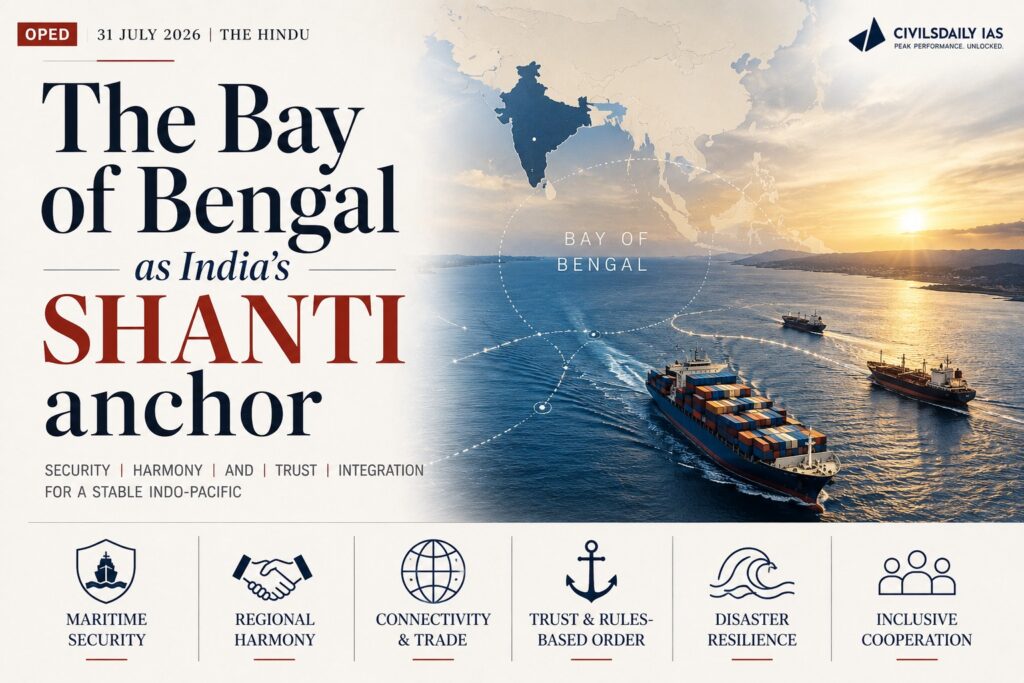
  • [31st July 2026] The Hindu OpED: The Bay of Bengal as India’s SHANTI anchor

    PYQ Relevance
    [UPSC 2022]
    What are the maritime security challenges in India? Discuss the organisational, technical and procedural initiatives taken to improve the maritime security.
    Linkage: It examines India’s maritime security challenges and initiatives to strengthen regional maritime governance.The article analyses SHANTI as India’s new framework to enhance maritime cooperation, security, and resilience in the Bay of Bengal through BIMSTEC.

    Mentor’s Comment

    The External Affairs Minister introduced Securing Holistic Advancement through Norms, Trust and Integrity (SHANTI) on 13 July while launching India’s candidature for the United Nations Security Council (UNSC) 2028-29 term, naming the Bay of Bengal as the region to operationalise it first. The framework arrives in a region where growing naval and infrastructure capacity has outpaced any shared set of maritime norms among its littoral states.

    What is SHANTI?

    1. Full form and origin: SHANTI stands for Securing Holistic Advancement through Norms, Trust and Integrity, introduced on 13 July alongside India’s UNSC candidature announcement.
    2. Lineage: It builds on Security and Growth for All in the Region (SAGAR), articulated in 2015 around the idea of equity in development, and Mutual and Holistic Advancement for Security and Growth Across Regions (MAHASAGAR), announced in 2025 to widen that vision to the interconnectedness of security across the Indo Pacific and the Global South.
    3. Function: SHANTI is presented as a normative framework, offering shared principles for maritime security, disaster response, the blue economy and environmental resilience, rather than a new institution or treaty.
    4. Rollout sequence: The Bay of Bengal is named as the first region where SHANTI is meant to move from principle to practice, before any wider application across the Indo Pacific.

    What is BIMSTEC?

    1. The Bay of Bengal Initiative for Multi Sectoral Technical and Economic Cooperation (BIMSTEC) is a regional grouping of Bangladesh, Bhutan, India, Myanmar, Nepal, Sri Lanka and Thailand, connecting South and Southeast Asia around the Bay of Bengal.
    2. At its National Security Advisers’ meeting in New Delhi in July 2026, BIMSTEC members adopted common principles for maritime law enforcement and humanitarian assistance and disaster relief. They also agreed to hold their first joint maritime security exercise in the Bay in November 2026.

    Why is the Bay of Bengal treated as SHANTI’s proving ground?

    1. Strategic centrality: The Bay links India’s Act East policy with the Association of Southeast Asian Nations (ASEAN), gives access to the Malacca Strait, and connects the eastern Indian Ocean to major global trade and energy routes.
    2. Comparative advantage: The western Indian Ocean is marked by active conflict and fragile economies. The Bay’s littoral states instead face similar, non military challenges such as cyclones, coastal erosion, fisheries management and undersea cable protection, which makes cooperation more feasible than confrontation.
    3. Institutional gap: The region is not short of institutions but suffers from fragmentation among them, and SHANTI is framed as a common framework to align existing mechanisms rather than add another one.
    4. Geopolitical pressure: China’s reliance on the Malacca Strait, often called its Malacca dilemma, has driven an expanding Chinese presence through ports and infrastructure projects in the same littoral states SHANTI seeks to anchor.

    Can SHANTI move beyond being another acronym?

    1. Fragmentation risk: The region’s stated problem is institutional fragmentation, and a new framework risks adding to that fragmentation unless it visibly aligns existing mechanisms.
    2. Stewardship versus dominance: India’s convening role depends on being accepted as a preferred security partner and first responder, a position that rests on restraint rather than the naval and economic weight India commands in the region.
    3. Early stage outputs: Concrete outcomes so far are limited to a declaration of common principles, a first joint maritime exercise scheduled for November 2026, and a white shipping information sharing agreement still under discussion, none of which are yet operational.
    4. Norms without enforcement: SHANTI rests on shared principles rather than a binding treaty, leaving compliance dependent on the willingness of littoral states rather than an enforceable obligation.

    What are the challenges to SHANTI?

    1. Overlap with existing bodies: SHANTI must coordinate with, rather than duplicate, existing mechanisms such as BIMSTEC, the Indian Ocean Rim Association and the Indian Ocean Naval Symposium, each with its own membership and mandate.
    2. Financing gap: Disaster response, undersea cable protection and blue economy cooperation require capital that several BIMSTEC members cannot supply on their own, raising the risk that shared projects become dependent on Indian or external financing.
    3. Limited replicability: The Bay of Bengal is easier ground precisely because it lacks the active conflict of the western Indian Ocean, so success there does not guarantee the same framework will work in more contested Indo Pacific waters.
    4. Competing infrastructure presence: Continued Chinese port and infrastructure investment in the same littoral states complicates India’s claim to a natural convening role.
    5. Dependence on voluntary compliance: Because SHANTI is a set of norms rather than a binding agreement, its durability depends on continued political will among BIMSTEC members rather than any enforcement mechanism.

    Conclusion

    SHANTI’s substance will not be judged by its acronym but by whether the Bay of Bengal’s BIMSTEC linked initiatives, the first joint maritime exercise due in November 2026 and the pending white shipping information sharing agreement, convert shared principles into functioning practice. Until those steps are completed, SHANTI remains a stated framework rather than a demonstrated one.

    Back2Basics:

    BIMSTEC

    1. The Bay of Bengal Initiative for Multi Sectoral Technical and Economic Cooperation was formed in 1997 and renamed after Bhutan and Nepal joined in 2004, expanding it from its original five members to seven.
    2. Its secretariat is based in Dhaka, Bangladesh, and its membership spans Bangladesh, Bhutan, India, Myanmar, Nepal, Sri Lanka and Thailand.
    3. The 6th BIMSTEC Summit, held in Bangkok in April 2025, adopted the Bangkok Vision 2030 and a Maritime Transport Agreement covering national treatment for vessels, crew and cargo among member states.
    4. BIMSTEC connects South Asia and Southeast Asia and has expanded its cooperation beyond trade into security, disaster management, energy and connectivity.

  • India’s “almost great power” status collides with domestic polarisation and stalled reform

    Why in the News

    India’s “almost great power” status is assessed against domestic political polarisation and stalled economic reforms. The piece argues these widen the gap between India’s geopolitical ambition and its material capability.

    Why does the gap between ambition and capability persist?

    1. Reform stall: Structural economic reforms needed to sustain great power level growth rates have slowed, limiting the material base India’s geopolitical ambitions depend on.
    2. Domestic polarisation: Political polarisation at home diverts governance bandwidth and consensus building capacity away from the sustained reform effort great power status requires.
    3. Capability versus signalling: India’s diplomatic signalling of great power ambition has outpaced the material capability, in economic scale and military modernisation, needed to back that signalling consistently.

    Conclusion

    The central idea is that India’s great power ambition is a signalling exercise running ahead of the material capability domestic reform stagnation and polarisation have failed to build. Closing the gap requires resuming the reform effort at home, not further diplomatic signalling abroad.

  • US critical minerals self-sufficiency push collides with 2027 deadline

    Why in News

    The United States is facing challenges in achieving self-sufficiency in defence critical minerals before its January 2027 target. The effort is complicated by China’s dominance, which accounts for over 80% of global critical minerals refining capacity.

    Project Vault (United States)

    • Project Vault is a US initiative to build a Strategic Critical Minerals Reserve and reduce dependence on Chinese supply chains.
    • It aims to stockpile critical minerals, expand domestic mining and refining, and secure supplies for defence, semiconductors, clean energy and advanced manufacturing.
    • The initiative is supported by up to US$12 billion through government financing and private investment.
    • It complements broader US efforts to establish resilient supply chains with trusted partner countries and strengthen strategic mineral security.

    Why China Dominates

    • Controls a large share of mining, refining and processing capacity.
    • Built an integrated mine-to-manufacturing supply chain over several decades.
    • Benefits from state support, advanced processing technology and economies of scale.
    • Has previously used export restrictions as a strategic tool in geopolitical disputes.

    [2026] Which of the following statements about Rare Earth Elements (REEs) and Critical Minerals is/are correct?

    1. Modern technological innovations including Artificial Intelligence, robotics and space exploration extensively utilise Rare Earth Elements (REEs).

    2. China has the highest share in mining of REEs followed by India.

    3. The Government of India launched the National Critical Mineral Mission (NCMM) in 2025 to establish a robust framework for self-reliance in the critical mineral sector.

    4. Rare Earth Elements are a set of 13 metallic elements.

    (a) 1 and 3 only (b) 3 only (c) 1, 3 and 4 (d) 1, 2 and 4

  • Do not surrender to China, do not depend on the U.S.

    PYQ Linkage
    [UPSC 2024]:
    “The West is fostering India as an alternative to reduce dependence on China’s supply chain and as a strategic ally to counter China’s political and economic dominance.” Explain this statement with examples.
    Linkage: The PYQ discusses the West-India-China triangle, supply-chain diversification, and countering Chinese dominance. The article’s prescribed path of supply-chain resilience and diversification away from China directly extends this PYQ’s theme, while adding the caution against over-reliance on the U.S. as well.

    Mentor’s Comment

    The Trump administration’s unpredictable policies, punitive tariffs, withdrawal of preferential trade status, renewed outreach to Islamabad, and tightened H-1B visa rules, have triggered a domestic business-lobby push to reset India’s China policy. The debate pits the risk of continued dependence on an unreliable United States against the risk of premature capitulation to a revisionist, hostile China. At stake is whether India abandons hard-won post-Galwan strategic leverage in a moment of geopolitical anxiety.

    Why has an unpredictable Washington triggered a domestic push to reset India’s China policy?

    1. Trump-era volatility: The current U.S. administration hit India with punitive tariffs on steel and aluminium, stripped its preferential trade status, and renewed ties with Islamabad, alongside tightened H-1B visa rules.
    2. Lobby’s core claim: An influential business lobby argues India’s confrontational China posture has been synchronised with Washington’s “containment” agenda rather than India’s own national interests.
    3. Economic dependency argument: The lobby contends deep reliance on Chinese technology, supply chains, industrial inputs and capital means a dogmatic anti-China stance stymies India’s own growth while barely denting Beijing’s economy.
    4. Flip-flop risk framing: Washington’s historical pattern of escalating tensions one day and striking bilateral deals the next could leave an overextended India exposed to Chinese retaliation.
    5. Partial concession: The warning against subordinating Indian interests to an unpredictable Washington is valid on its own terms. This validity does not by itself justify a China reset.

    Why is a hasty, unreciprocated economic embrace of China a dangerous prescription?

    1. Convenience mistaken for security: The reset proposal confuses tactical business convenience with long-term national security.
    2. Cost of premature capitulation: It ignores a decade of unprovoked Chinese hostility, deepens asymmetric dependency, and strips India of leverage as the global order enters its most volatile phase since the Cold War.
    3. Motive critique: The primary domestic driver of the reset argument is a business lobby focused on short-term balance sheets, seeking cheap Chinese capital, machinery and active pharmaceutical ingredients (APIs).
    4. Structural blind spot: This view treats international trade as an apolitical transaction, divorced from the realities of comprehensive national power.
    5. Selective memory: Advocating a return to the pre-2020 status quo requires forgetting twelve years of relentless PLA and CCP aggression, recasting a coherent containment strategy as isolated border skirmishes.

    What is China’s actual record of territorial aggression and economic coercion against India?

    1. Border aggression timeline: Depsang (2013), Chumar (2014), Doklam (2017) and the fatal Galwan Valley clashes (2020) mark systematic attempts to alter the Line of Actual Control (LAC) through salami-slicing tactics.
    2. Territorial claims: China continues to assert claims over the entire state of Arunachal Pradesh and renames geographical features in areas it does not control.
    3. Demographic weaponisation: Stapled visas are issued to residents of Jammu and Kashmir and Arunachal Pradesh to contest India’s internal geography.
    4. Economic coercion: China has withheld critical machinery and industrial inputs and weaponised its monopoly over rare earths and tunnel-boring machines during bilateral disputes.
    5. Pakistan nexus: China provided Islamabad real-time tactical satellite data and intelligence during Operation Sindoor (May 2025), shifting from military supplier to an active, hostile participant in Pakistan’s security architecture against India.

    Why is the assumption that economic concessions will produce Chinese reciprocity a myth?

    1. Structural goal mismatch: China’s foreign policy in Asia is built on establishing a unipolar continent; Beijing does not view New Delhi as a peer.
    2. Diplomatic obstruction: China has used its UNSC veto to shield Pakistan-based terrorist organisations and has blocked India’s bids for UNSC permanent membership and Nuclear Suppliers Group (NSG) membership.
    3. Trade deficit risk: Unconditional market access would expand an already asymmetric trade deficit, with China’s annual trade surplus over India already exceeding $100 billion.
    4. Kill-switch risk: Deepening reliance hands Beijing an economic lever that could paralyse Indian industry and strip New Delhi of independent strategic decision-making in a future crisis.
    5. Behavioural logic: China respects power and exploits vulnerability. Signalling that India cannot sustain a prolonged stand-off would confirm that Beijing’s multi-domain pressure strategy is working.
    6. Leverage once lost: Post-Galwan restrictions on Chinese apps, investment and telecom infrastructure are crucial diplomatic leverage, not emotional reactions. Dismantling them for minor economic relief would be an act of unilateral disarmament.

    Is India’s China-reset debate really a false choice between two unreliable powers?

    1. Valid criticism, wrong conclusion: Washington’s unpredictable shifts make it unwise to rely entirely on the U.S. as a security guarantor.
    2. Structural reality: The United States will always prioritise its own domestic and global calculations, leaving New Delhi to stand alone on the heights of Ladakh.
    3. False binary: Washington’s unreliability does not require India to run into the arms of an actively hostile neighbour.
    4. Middle space: An immense strategic space exists between subordinating India’s national interests to the U.S. and conceding an unconditional economic and political surrender to China.

    What strategic path should India actually tread instead of tilting toward either power?

    1. Strategic patience: Internal fortification, not reactive alignment with either power, is the correct approach for New Delhi.
    2. Supply-chain resilience: India must accelerate diversification of trade partnerships across Europe, East Asia and the Global South.
    3. Domestic capacity-building: Domestic manufacturing capability must be built aggressively, even at the cost of short-term inflation.
    4. Structural framing: China represents a generational, structural challenge to India’s rise, not a cyclical irritant resolvable through a reset.
    5. Risk of panic-driven policy: A hasty rethink driven by panic over Washington, or by a short-term-profit-driven business lobby, would leave India permanently exposed, economically vulnerable and strategically diminished.

    Conclusion

    India’s debate over resetting China policy conflates a legitimate criticism of U.S. unpredictability with an illegitimate case for capitulating to Beijing. A decade of Chinese salami-slicing, economic coercion, and intelligence support to Pakistan during Operation Sindoor makes reciprocity from Beijing implausible, while abandoning post-Galwan restrictions on Chinese capital and technology would amount to unilateral disarmament. Neither subordinating strategic autonomy to Washington nor surrendering economic leverage to Beijing serves India’s interests. What remains unresolved is how India absorbs the short-term costs of supply-chain diversification and domestic manufacturing build-up without domestic political pressure forcing a premature tilt toward either power.

  • Trump’s new forced labour tariffs face global pushback and legal questions

    Why in News?

    The United States’ new forced labour tariffs under Section 301, covering more than 60 countries, face legal pushback from Brazil and Australia over WTO compliance.

    Key Highlights

    • Tariffs are imposed under a Section 301 forced labour enforcement investigation, covering over 60 trading partners.
    • Brazil and Australia are contesting the tariffs’ compliance with WTO rules.
    • The dispute remains open, legally and diplomatically.

    Section 301 (U.S. Trade Act, 1974)

    • Empowers the Office of the United States Trade Representative (USTR) to investigate and respond to unfair foreign trade practices.
    • Authorises the U.S. to impose tariffs or other trade restrictions if another country’s actions are found to burden or restrict U.S. commerce.
    • Frequently used in disputes involving intellectual property, market access, subsidies, and labour practices.

    World Trade Organization (WTO)

    • Established in 1995, succeeding the General Agreement on Tariffs and Trade (GATT), 1947.
    • Headquarters: Geneva, Switzerland.
    • Objective: Ensure rules-based, predictable, and non-discriminatory international trade.
    • Functions include administering trade agreements, resolving disputes, monitoring trade policies, and providing technical assistance.

    Value Addition

    • Most-Favoured-Nation (MFN) Principle (Article I, GATT): WTO members must treat all trading partners equally unless an exception applies.
    • Dispute Settlement Understanding (DSU): Discourages unilateral trade retaliation and requires members to resolve disputes through the WTO mechanism.
    • Relevance for India: Increasing use of unilateral tariffs by major economies can affect export competitiveness and test the credibility of the multilateral trading system.

    [2018, GS2, 15 marks] What are the key areas of reform if the WTO has to survive in the present context of ‘Trade War’, especially keeping in mind the interest of India?”

  • India’s foreign policy must look seaward

    Why in the News?

    Of the 14 Indians killed in West Asia conflict-related attacks since 28 February, at least eight were seafarers. This exposes how India’s foreign policy apparatus treats its roughly 3.2 lakh seafarers as a shipping matter until a crisis turns them into a consular emergency.

    Why does responsibility for an Indian seafarer’s safety become unclear at exactly the moment it matters most?

    1. A single jurisdictional authority: A seafarer may be recruited in Mumbai, hired by a Singapore-based company, placed on a ship flagged to Panama, carrying Kuwaiti oil, and attacked off Oman, leaving no single authority fully responsible.
    2. India’s consular system is organised by territory, but seafarers are not: A seafarer crosses multiple jurisdictions during a single voyage, and an Indian mission may not know a national is nearby until a ship is seized, abandoned, or attacked.
    3. The scale problem: India’s seafarer workforce stands at about 3.2 lakh (June 2025), nearly three times its size in 2014. This makes India the second largest supplier of seafarers globally after the Philippines, according to the 2026 Seafarer Workforce Report.
    4. Abandonment data confirms the gap is systemic: International Transport Workers’ Federation (ITF) data show 1,125 Indian seafarers were abandoned in 2025. This was the highest for any country, with responsibility split among the flag state, port authority, shipowner, insurer, and Indian mission.

    What has the government actually done, and where does it fall short?

    1. The Seafarer First response: Introduced after the recent West Asia strikes, it includes a dashboard tracking ships, threats, and crew welfare, along with a liaison officer for each affected family.
    2. A targeted precaution: On 15 July, the government advised shipowners, managers, and recruitment agencies to avoid deploying Indian seafarers on vessels transiting the Strait of Hormuz until further orders.
    3. An existing but narrow enforcement tool: The Directorate General of Shipping (DGS) order of 14 May bars licensed recruitment agencies from placing seafarers on 366 vessels linked to crew abandonment, unless compliance conditions are met. However, seafarers currently have to search for the list themselves before accepting employment.
    4. The dashboard’s structural limit: It can track ships, but cannot compel a flag state or shipowner to act, nor secure access to a detained seafarer.

    What would closing the gap actually require?

    1. A standing maritime consular protocol: Clearly defining institutional responsibility from the moment a distress signal is received, instead of responding only after a crisis unfolds.
    2. Designated port-level officers: Indian missions at major shipping hubs should have officers familiar with port authorities, hospitals, insurers, and legal systems before emergencies arise.
    3. Multilateral pressure on flag states: India, the Philippines, and Indonesia could jointly push through the International Maritime Organization (IMO) and the International Labour Organization (ILO) for stronger standards on legal assistance and repatriation.
    4. A seafarer’s right to know before signing: Mandatory disclosure of a vessel’s true ownership, sanctions status, insurance validity, and history of crew abandonment, along with the right to refuse deployment to high-risk regions without penalty.

    Conclusion

    India’s maritime ambitions extend beyond ports, shipping, and naval power. Protecting the country’s 3.2 lakh seafarers requires a permanent maritime consular framework, stronger international cooperation, and greater legal safeguards. India’s responsibility to its citizens should not end with a foreign flag on the vessel.

    Back2Basics

    1. Flag of Convenience (FoC): The practice of registering a merchant ship in a country other than that of its owners to benefit from lower taxes or lighter regulations, often complicating legal accountability for crew welfare.
    2. Maritime Labour Convention (MLC), 2006: An International Labour Organization (ILO) convention that establishes minimum global standards for seafarers’ working and living conditions, including wages, health protection, and repatriation rights.

    PYQ Relevance

    [UPSC 2025] Why is maritime security vital to protect India’s sea trade? Discuss maritime and coastal security challenges and the way forward.

    Linkage: The PYQ examines India’s maritime security, sea trade, and challenges in protecting maritime interests. The article extends maritime security beyond naval issues to the safety, consular protection, and welfare of Indian seafarers during international crises.

  • Trump’s Saudi nuclear gambit marks a shift

    Why in the News?

    USA’s decision to sign a civil nuclear cooperation agreement with Saudi Arabia marks a significant shift in Middle East geopolitics. In this context, many argue that India should accelerate its own nuclear export readiness in response.

    What is the substance of the US-Saudi agreement, and why is it controversial?

    1. The core deal: The agreement would help Saudi Arabia build a civilian nuclear energy programme and reduce dependence on hydrocarbons, with American companies building Saudi reactors to secure a long term position in the kingdom’s nuclear infrastructure.
    2. The enrichment controversy: The main point of contention is the possibility of a uranium enrichment facility in Saudi Arabia, even as Washington seeks to roll back Iran’s nuclear capabilities, creating an apparent contradiction.
    3. The strategic rationale behind the contradiction: The rise of Iran’s regional influence has pushed the UAE towards its own civilian nuclear programme; a Saudi facility built and supervised by American companies is presented as reducing proliferation risk while giving Riyadh strategic parity with Tehran.
    4. Congressional and diplomatic hurdles: The agreement faces scrutiny in the US Congress and opposition from Israel’s supporters and the non-proliferation community.

    How is the nuclear deal linked to the broader regional diplomatic picture?

    1. Tied to Israel normalisation: Washington is linking the nuclear deal to Saudi recognition of Israel, which Riyadh has so far declined under the Abraham Accords framework.
    2. A triangular negotiation: The agreement could become part of a broader negotiation among USA, Saudi Arabia, and Israel covering regional security, Palestinian statehood, and the future of Arab-Israeli relations.

    Where does India stand in this emerging nuclear industrial competition, and what does the editorial recommend?

    1. India is largely absent: This reflects decades of resistance within India’s atomic energy sector to reforms enabling export-oriented industrial participation.
    2. The editorial’s recommendation: The US-Saudi deal should accelerate implementation of India’s SHANTI Act framework to prepare Indian industry for exporting nuclear technology across the Middle East.
    3. A call for political support: India should support the US-Saudi agreement, provided it is backed by strong non-proliferation safeguards, and should offer assistance to Saudi Arabia’s civilian nuclear programme.

    Conclusion

    The US-Saudi nuclear agreement reflects USA’s use of civil nuclear cooperation as a tool of regional strategic balancing, linking energy security, non-proliferation, and Saudi-Israel normalisation. For India, it is a strategic opportunity to strengthen its civil nuclear industry and emerge as a future nuclear technology exporter.

    Back2Basics

    1. SHANTI Act, 2025: A proposed legislative reform intended to open India’s civil nuclear sector to private and foreign investment in reactor construction and technology exports, reducing the traditional state monopoly in atomic energy.
    2. Abraham Accords: The 2020 diplomatic framework under which several Arab states normalised relations with Israel. Saudi Arabia has not yet joined the framework.

    PYQ RELEVANCE

    [UPSC 2018] In what ways would the ongoing US-Iran Nuclear Pact Controversy affect the national interest of India? How should India respond to this situation?

    Linkage: The PYQ examines the geopolitical implications of nuclear diplomacy in West Asia and its impact on India’s strategic interests. The article analyses the proposed US-Saudi civil nuclear agreement, its implications for regional power balance, nuclear non-proliferation, and India’s strategic and nuclear diplomacy in West Asia.

  • New US tariffs leave India better off than competitors; Trump’s tariff mania is inextricable from his politics

    Why in the News?

    The Trump administration began imposing permanent tariffs under Section 301 of the US Trade Act, 1974 on 60 trading partners after its earlier International Emergency Economic Powers Act (IEEPA) tariffs were struck down by the US Supreme Court. This places India in a more favorable bracket than China and Vietnam even as such tariffs function as domestic politics rather than sound economics.

    How does the new four tier tariff structure actually work, and where does India sit in it?

    1. Legal foundation shift: The administration is rebuilding the tariff regime under Section 301 of the Trade Act, 1974 (targeting alleged forced labour in imports) after its International Emergency Economic Powers Act (IEEPA) tariffs were declared illegal by the US Supreme Court in February.
    2. The four tiers: The most favourable group (EU, Taiwan) faces a Section 301 tariff calculated only to bring the total to 10% where the Most Favoured Nation (MFN) rate is below that; the second tier, including India and 16 others such as Pakistan, Sri Lanka, Canada, and Mexico, faces a flat additional 10%; the third tier (Japan, South Korea, Switzerland) faces a flat 12.5%; the least favourable tier of 38 countries, including China and Vietnam, also faces a flat 12.5%.
    3. India’s rate fell during negotiation: India’s tariff dropped from 12.5% first proposed in March to 10%, after India amended its Foreign Trade Policy on 14 June to explicitly ban imports made using forced labour.
    4. India’s export performance defied predictions: Despite tariff measures since early 2025, India’s merchandise exports to the US grew 0.9% (from US$86.5 billion to US$87.3 billion) in 2025-26, according to an ICRIER report, though this was driven entirely by products on the US exclusion list (pharmaceuticals and electronics), while non-excluded exports fell 11.2%.

    What is the real reason the USTR gives for the tariffs, and is that reason coherent?

    1. The stated aim: The US Trade Representative (USTR) says countries that import forced labour goods gain an unfair cost advantage, harming American workers.
    2. The geopolitical tell: All 60 countries under investigation were found “guilty,” with the most favourable grouping being the EU and Taiwan and the least favourable being China and Vietnam, a grouping that tracks geopolitical alignment more than measurable differences in forced labour enforcement.
    3. The stated target is explicit: The tariffs are primarily meant to force countries to reduce dependence on China, with which the US is engaged in a trade war.
    4. New textile quotas complicate India’s advantage: Tariff Rate Quotas (TRQs) granted to Bangladesh, Cambodia, Indonesia, and Malaysia for importing US cotton could divert textile and apparel sourcing away from India, despite its overall favourable tariff position.

    Why do tariffs persist as policy despite weak economic evidence for them?

    1. Tariffs function as a domestic tax, not a foreign penalty: Research by economists Mary Amiti, David Weinstein, and Stephen Redding shows tariff costs are largely borne by American businesses and consumers through higher prices, not by foreign producers.
    2. Global supply chains blunt the intended effect: More than half of global trade consists of intermediate goods; tariffs on inputs such as steel or electronics raise costs for the very domestic manufacturers they are intended to protect.
    3. Trade deficits have not shrunk: The US continues to run a record merchandise trade deficit despite successive tariff rounds, since deficits are driven by savings, investment, and consumption, not tariffs, while global supply chains have rerouted through Vietnam, Mexico, and other intermediary economies.
    4. The political logic that survives the economic failure: Every successful political narrative needs someone to blame, someone to protect, and a visible policy action signalling resolve; tariffs provide all three even when they fail economically, whereas structural reforms require patience and produce fewer immediate political gains.

    Conclusion

    India’s tariff position is more favourable than China’s or Vietnam’s largely due to geopolitical considerations presented through the language of forced labour, rather than a consistent trade policy standard. At the same time, while India may benefit in the short term from trade diversion, new textile sourcing quotas for competing countries could reduce that advantage over the longer term.

    PYQ Relevance

    [UPSC 2018] What are the key areas of reform if the WTO has to survive in the present context of ‘Trade War’, especially keeping in mind the interest of India?

    Linkage: The PYQ examines the implications of global trade wars, protectionism, WTO reforms, and India’s trade interests in the evolving international trading system. The article analyses the new US tariff regime, its geopolitical and economic motivations, its implications for the multilateral trading order, and the opportunities and challenges it creates for India’s exports and trade strategy.

  • India has ridden out crisis of Iran war but a much bigger challenge is upon it

    Why in the News

    Donald Trump’s foreign policy has exposed a challenge for India as serious as the 1991 Balance of Payments (BoP) crisis, this time centred on commerce, critical minerals, computer chips, and AI infrastructure rather than a single macroeconomic emergency.

    How does 2026 mirror 1991, and how does it differ?

    1. Financial position is stronger, but growth is not: India’s finances in 2026 are far more robust than in 1991, yet GDP growth remains at 6%, consistent with the 30 year average but well below the 8% benchmark, as the rupee depreciated and Foreign Institutional Investors (FIIs) moved capital out.
    2. A Gulf war shock recurs: Just as the 1990-91 Gulf War pushed up India’s import bill in 1991, the West Asia conflict in 2026 has driven energy shortages and inflation.
    3. The security backstop has changed form, not disappeared entirely: In 1991, the Soviet collapse removed India’s counterweight to China and the US; in 2026, Washington’s retreat from alliances and interest in a “G-2” accommodation with Beijing again leaves India without a reliable security backstop.
    4. China’s lead has widened, not narrowed: China’s GDP was only slightly larger than India’s by 1991; by 2026 it stands at US$20 trillion against India’s US$4 trillion, and at current growth rates the gap will widen from US$16 trillion to US$24 trillion by 2050.

    What makes the “four Cs” challenge harder to fix than the 1991 crisis?

    1. Commerce and manufacturing: Manufacturing has stagnated despite 30 years of policy encouragement, unlike the relatively simple structural reforms that resolved the 1991 crisis.
    2. Critical minerals and rare earths: India has reserves but has not adequately mapped or mined them, and processing capacity is a separate unresolved challenge, with dependence on China ranging from 50% to nearly 100% across minerals and metals.
    3. Computer chips: NITI Aayog estimates that 90% to 95% of India’s semiconductor demand will still be met by imports until 2035.
    4. AI infrastructure: India has strengths in AI adoption and AI talent but little presence in the AI value chain itself.

    What is the deeper tension the piece does not resolve?

    1. Geopolitical alignment is unresolved: The piece poses, without answering, whether India should pursue a “hide-and-bide” strategy with both the US and China, or attempt a more ambitious reset with Beijing modelled on how China itself used American imports, investment, and innovation after 1972.
    2. Pakistan’s positioning has hardened: Pakistan is again “triumphalist,” deeply integrated with China’s military, and was a mediator between the US and Iran in 2026, echoing its 1991 alignment with the winning side of the Cold War.

    Conclusion

    India has absorbed the immediate economic shock of the Iran war, but the underlying four Cs problem (commerce, critical minerals, chips, and AI) is structurally harder than the 1991 crisis and cannot be fixed by macroeconomic reform alone. The piece calls for a coordinated national effort on the scale of a Manhattan Project, while leaving India’s broader geopolitical alignment between the US and China explicitly unresolved.

    Back2Basics

    1. India Semiconductor Mission (ISM): The Union government’s programme to build domestic semiconductor design, fabrication, and packaging capacity, aimed at reducing India’s near total reliance on imported chips.
    2. Critical Minerals Mission: The government’s initiative to secure critical mineral supply chains essential for clean energy, electronics, and defence technologies, given India’s dependence on imports, particularly China, for processing capacity.

    PYQ Relevance

    [UPSC 2025] India aims to become a semiconductor manufacturing hub. What are the challenges faced by the semiconductor industry in India? Mention the salient features of the India Semiconductor Mission.

    Linkage: The PYQ examines challenges in building India’s semiconductor ecosystem and reducing dependence on strategic technology imports. The article situates semiconductors within the broader “four Cs” challenge, arguing that strengthening domestic chip manufacturing is vital for India’s long-term economic and strategic resilience.

  • Warning signals for India from NATO’s Ankara Summit

    PYQ Relevance
    [UPSC 2023] The expansion and strengthening of NATO and a stronger US-Europe strategic partnership works well in India.” What is your opinion about this statement? Give reasons and examples to support your answer.
    Linkage: Examines the strategic implications of NATO’s evolving role and the US-Europe security partnership for India’s foreign and security policy. The article analyses the Ankara Summit’s defence commitments, Europe’s defence-industrial constraints, and how NATO’s expansion and military spending directly affect India’s defence preparedness and strategic autonomy.

    Mentor’s Comment

    The 32 heads of state or government of the North Atlantic Treaty Organization (NATO) met at the Ankara Summit on July 7-8, 2026, to review progress since the 2025 Hague Summit and set out a roadmap for implementation. The summit locked in a fivefold rise in the defence-spending pledge and a commitment to build a Europe-wide Defence Industrial Base (DIB), even as Europe’s existing industry struggles to meet current demand.

    What four commitments came out of the Ankara Summit?

    1. Collective defence reaffirmed: All 32 allies affirmed an “ironclad commitment” to collective defence under Article 5 of the Washington Treaty and to the transatlantic bond.
    2. Five per cent spending pledge: Allies unanimously endorsed “The Hague defence commitment,” under which every NATO member undertook to allocate at least five per cent of GDP to defence by 2035, up from the earlier two per cent pledge.
    3. Support for Ukraine: NATO declared “unwavering support” for Ukraine’s freedom, sovereignty and territorial integrity.
    4. European defence industrial base: Members committed to building a high-technology, high-capacity, Europe-wide Defence Industrial Base (DIB), the network of firms, factories, laboratories and skilled workers needed to build and sustain military power.
    5. Focus on implementation: Discussions at Ankara centred on converting these political commitments into military capability through investment, industrial capacity and innovation.

    Can Europe’s defence industry deliver on the pledge?

    1. Pre-existing shortages: European defence giants MBDA and Rheinmetall had warned of ammunition production shortages even before The Hague’s five per cent pledge.
    2. Evidence from the Iran campaign: Operation Epic Fury, the U.S.-Israel bombing campaign against Iran, saw the U.S. fire more than 850 Tomahawk cruise missiles; at the current production rate of 85 a year, replacing them would take a decade.
    3. Coordination gap: Many NATO members have capable Defence Industrial Bases (DIBs) individually, but there is little coordination of alliance-wide priorities.
    4. Concentrated mismatch: The resulting strategic mismatch found during the Ukraine war has clustered in air defence missiles and interceptors, precision-guided munitions, and artillery rockets.
    5. Deepening dependency, not reducing it: The U.S. supplied half of Europe’s defence spending between 2022-2024, up from 28% in 2019-2021, and without a major revitalisation of Europe’s own industry, the five per cent pledge will only deepen dependence on the U.S.
    6. Rising U.S. sales to Europe: Foreign Military Sales (FMS) notifications to the U.S. Congress for European customers have quadrupled since 2008, to $76 billion in 2024.

    How does NATO’s spending surge affect global arms buyers like India?

    1. Buyer’s market turning seller’s market: As NATO spends more, the international arms market is shifting from a buyers’ market to a sellers’ market for the world’s big arms buyers, including India.
    2. First warning sign: U.S. firm General Electric Aerospace has delayed supplying F-404 fighter jet engines, critically needed for the Indian Air Force’s (IAF) Tejas Light Combat Aircraft (LCA) programme.
    3. Competing demand: Asian allies’ rising demand for U.S. weaponry is competing directly with ongoing European needs for the same suppliers.

    What must India do in response?

    1. Growing reliance on new-age technology: India’s defence increasingly depends on drones, artificial intelligence (AI), cyber warfare, electronic warfare, and resilient networks.
    2. Self-reliance as the necessary response: India’s defence industry must achieve self-reliance in these technology areas rather than depend on suppliers who are themselves overstretched fighting their own battles.
    3. Mitigating Supply Chain Vulnerabilities: Avoid over-reliance on single-source western suppliers like General Electric who face competing allied demands. Push local aerospace and defense firms (such as HAL and private sector partners) to prioritize delayed components like fighter jet engines.
    4. Giving a big push to the private sector: Funding and orders should be increased for domestic defense startups working in the fields of drones, artificial intelligence (AI), and cybersecurity.
    5. Further expansion of the ‘Negative Import List’: The scope of the existing ‘Positive Indigenisation List‘ should be further expanded. There should be further expansion of the ‘Negative Import List‘. India’s Positive Indigenisation Lists (PIL) ban military imports, forcing procurement strictly from domestic makers. Managed via the Srijan Portal, key tracks include the Department of Military Affairs (DMA) lists for major platforms and the Department of Defence Production (DDP) lists for components.

    Conclusion

    NATO’s Ankara Summit converted last year’s spending pledge into a five per cent-of-GDP commitment and a mandate to build a European Defence Industrial Base (DIB), but ammunition and missile shortages already visible in the Ukraine war show capacity, not political will, is now the binding constraint. Because higher NATO spending is shifting the global arms market from a buyers’ to a sellers’ market, without a rapid European industrial build-out the pledge will deepen dependence on the U.S. rather than reduce it, and it is squeezing supply for outside buyers like India, making self-reliance in new-age defence technologies the necessary Indian response.