Mains Ready By December. Smash Mains & Smash PYQ Admissions Open

GS Paper: GS2-18.Bilateral, regional and global groupings and agreements involving India and/or affecting India’s interests.

  • India-UK FTA Kicks In: What Changes for Consumers and Industry

    Why in the News?

    The India-UK Free Trade Agreement (FTA) came into effect this week, becoming India’s first comprehensive trade deal with a developed economy. The deal arrives amid a fracturing world trade order, delivering wide tariff concessions on both sides, but leaves India without an exemption from the UK’s forthcoming carbon border tax and without binding labour and environment commitments.

    Why does the timing of India’s first comprehensive FTA with a developed economy matter for its wider trade strategy?

    1. First mover with a developed economy: India has signed several trade agreements before, but none with a developed country of the UK’s profile, making this a template-setting deal rather than a routine one.
    2. Template for the EU negotiation: The agreement lays the framework for India’s ongoing negotiations with the European Union, meaning the concessions and exclusions accepted here will shape the opening position with a larger trading bloc.
    3. Timed against global protectionism: The deal takes effect as world trade order is fracturing, positioning bilateral deals as a hedge against multilateral trade uncertainty.
    4. Four years of negotiation under political volatility: The agreement was negotiated over four years and marked by repeated changes in the UK government, indicating that domestic political instability in partner countries is now a standing risk factor in India’s trade negotiations.

    What relief has the deal delivered to producers and exporters of labour-intensive goods?

    1. Textiles gain a level playing field: Indian textile exports currently face tariffs of up to 10% in the UK; the deal removes this disadvantage relative to competitors such as Bangladesh.
    2. Gems and jewellery duty eliminated: UK duty on Indian gems and jewellery exports, which stood at up to 12%, has been eliminated.
    3. Footwear duty eliminated: UK duty on Indian footwear exports, which stood at up to 16%, has been eliminated.
    4. Near-universal tariff elimination by the UK: The UK has eliminated tariffs on 99% of Indian exports, while India has reduced tariffs on around 90% of UK products, showing an asymmetric opening in India’s favour on goods trade.
    5. Steel exports secured through quota assurance: The UK will ensure India’s iron and steel export quotas rise, with exports projected to grow from around $850 million to over $1 billion.

    How does the deal reshape costs and access for Indian consumers and professionals?

    1. Car tariffs cut sharply: Tariffs on British cars will fall from up to 110% to 30% in year one, and to 10% by year five, under an annual quota starting at 20,000 vehicles and rising to 37,000 by year five.
    2. Scotch and alcoholic beverages made cheaper: Tariffs on British alcoholic beverages fall from 150% to 75% initially, and to 40% by year 10.
    3. Beauty, cosmetics and sports equipment tariffs cut: Tariffs on these UK product categories have also been removed or reduced, widening the consumer basket affected by the deal.
    4. Professionals gain social security relief: The deal exempts contributions to UK National Insurance for five years, benefiting an estimated 75,000 Indian professionals and around 900 firms by removing double social security contribution.

    What procedural changes accompany the tariff concessions, and what do they reveal about India’s approach to import dependence?

    1. Self-declaration of origin replaces certification: For the first time in an FTA, India has allowed exporters or producers in the UK to self-declare the country of origin, replacing the earlier system of certificates issued by designated authorities.
    2. Precedent for developed-country norms: This customs change could become the norm India accepts with other developed-country partners such as the EU and US, since self-declaration reduces the delays and hurdles associated with certificate-based origin verification.
    3. Reducing dependence on Chinese and ASEAN supply chains: India is using the customs shift partly to reduce its trade dependence on China and Association of Southeast Asian Nations (ASEAN) exporters.
    4. Medical devices tariff cut with phased sensitivity: India has removed tariffs of up to 14% on UK medical devices, with phased reductions retained for some sensitive items, showing selective rather than blanket liberalisation on the import side.

    Does the FTA deliver a binding, symmetric partnership, or does it leave India’s structural vulnerabilities on labour and climate-linked trade barriers unaddressed?

    1. Labour and environment chapter is non-binding: The labour and environment chapter of the agreement carries no binding force, meaning commitments in this chapter cannot be enforced against either party.
    2. Developed-country labour norms remain a latent barrier: Non-binding status is significant because western countries maintain strong labour and environment norms that tend to function as non-tariff barriers against exports from developing nations, even without a binding legal clause.
    3. No exemption from the UK’s carbon border tax: India did not secure an exemption from the UK’s proposed Carbon Border Adjustment Mechanism (CBAM: a pricing framework that levies a carbon cost on imported carbon-intensive goods, matching the cost already borne by comparable domestic products), which takes effect from January 1 next year.
    4. Asymmetry between market access and structural protection: Wide tariff elimination on goods trade has been achieved without matching protection against emerging non-tariff instruments such as carbon border taxes, leaving exporters exposed on a front the tariff negotiations did not cover.

    Conclusion

    The India-UK FTA delivers India’s broadest tariff and market-access gains yet with a developed economy, cutting duties on labour-intensive exports and consumer goods on both sides. This breadth of access is not matched by institutional depth: the labour and environment chapter remains unenforceable, and India secured no shield against the UK’s incoming carbon border tax. The deal’s real test lies ahead, in whether it becomes a template that corrects this asymmetry in the EU negotiation, or repeats it.
  • India-UK Comprehensive Economic and Trade Agreement (CETA) Comes into Force

    Why in News?

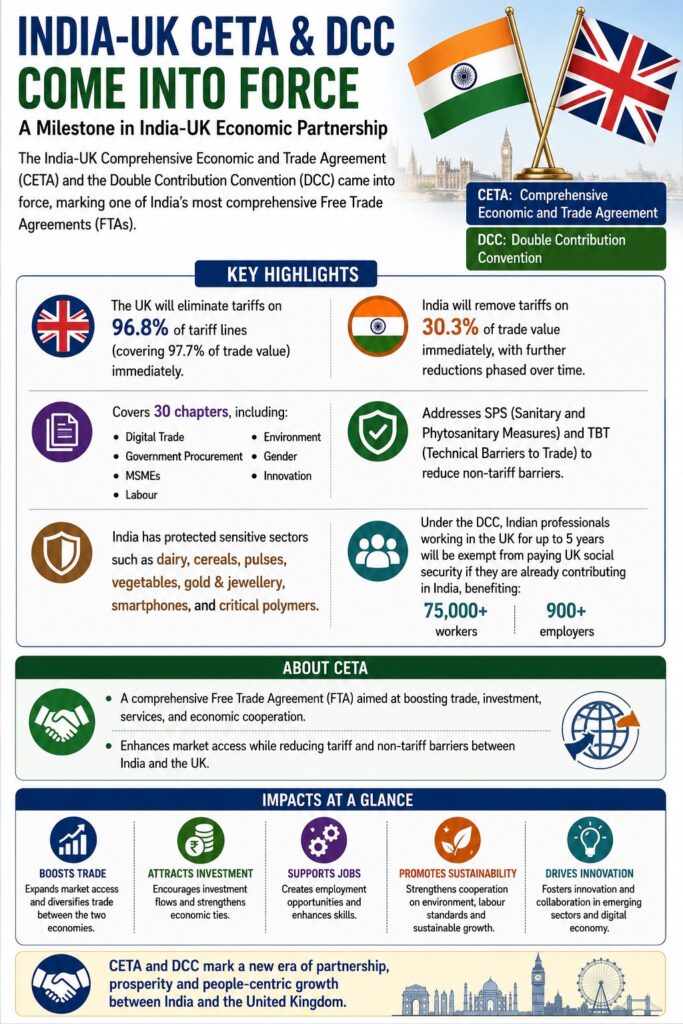
    The India-UK Comprehensive Economic and Trade Agreement (CETA) and the Double Contribution Convention (DCC) came into force, marking one of India’s most comprehensive Free Trade Agreements (FTAs)

    Key Highlights

    • CETA: Comprehensive Economic and Trade Agreement
    • DCC: Double Contribution Convention
    • The UK will eliminate tariffs on 96.8% of tariff lines (covering 97.7% of trade value) immediately.
    • India will remove tariffs on 30.3% of trade value immediately, with further reductions phased over time.
    • Covers 30 chapters, including: Digital Trade, Government Procurement, MSMEs, Labour, Environment, Gender, and Innovation
    • Addresses SPS (Sanitary and Phytosanitary Measures) and TBT (Technical Barriers to Trade) to reduce non-tariff barriers.
    • India has protected sensitive sectors such as dairy, cereals, pulses, vegetables, gold & jewellery, smartphones, and critical polymers.
    • Under the DCC, Indian professionals working in the UK for up to 5 years will be exempt from paying UK social security if they are already contributing in India, benefiting 75,000+ workers and 900+ employers.

    About CETA

    • A comprehensive Free Trade Agreement (FTA) aimed at boosting trade, investment, services, and economic cooperation.
    • Enhances market access while reducing tariff and non-tariff barriers between India and the UK.

    [2017] ‘Broad-based Trade and Investment Agreement (BTIA)’ is sometimes seen in the news in the context of negotiations held between India and

    [A] European Union

    [B] Gulf Cooperation Council

    [C] Organization for Economic Cooperation and Development

    [D] Shanghai Cooperation Organization

  • [15th July 2026] The Hindu OpED: India-U.S defence ties-big ambitions, little delivery

    PYQ Relevance[UPSC 2020]: What is the significance of Indo-US defence deals over Indo-Russian defence deals? Discuss with reference to stability in the Indo-Pacific region.
    Linkage: The PYQ examines India’s defence partnerships and their strategic significance in the Indo-Pacific. The article shows that despite stronger India-U.S. defence ties, technology transfer and co-development continue to face major hurdles.

    Mentor’s Comment

    The stalled negotiations over General Electric’s (GE) F414 fighter engine have once again exposed the gap between political promises and actual industrial cooperation in India-U.S. defence ties. The per-engine cost has nearly tripled, and GE is now seeking an $800 million investment from India. Although India has purchased over $22 billion worth of U.S. defence equipment since 2002, meaningful technology transfer and co-production remain limited. Institutional initiatives such as Defence Technology and Trade Initiative (DTTI), Initiative on Critical and Emerging Technologies (iCET) and India-U.S. Defence Acceleration Ecosystem (INDUS-X) have also delivered only modest results.

    Why has the GE F414 engine impasse become a symbol of the gap between India-U.S. defence ambition and industrial delivery?

    1. Flagship status: The F414 programme was unveiled as the flagship achievement of iCET during Indian Prime Minister’s 2023 Washington visit. It was meant to symbolise a shift from a buyer-seller relationship to genuine defence-industrial collaboration.
    2. Cost escalation: The estimated cost of each F414 engine has reportedly nearly tripled. It has risen from around ₹70-80 crore to over ₹200 crore.
    3. Investment demand: GE has sought an Indian investment of around $800 million (₹7,576 crore). This is to establish a dedicated production line.
    4. Web of interlinked negotiations: Hindustan Aeronautics Limited is negotiating procurement and licensed manufacture of the F414 for the Tejas Mk-II. The Defence Research and Development Organisation (DRDO) and the Aeronautical Development Agency separately engage GE over the same engine for the Advanced Medium Combat Aircraft and the Navy’s Twin-Engine Deck-Based Fighter. This overlap complicates resolution.
    5. Underlying disputes: Disagreements over technology transfer, intellectual property and export controls lie at the core of the unresolved negotiations.

    Does the two-decade record of India-U.S. defence institutions show a pattern of stagnation rather than isolated setbacks?

    1. DTTI’s fade: The Defence Technology and Trade Initiative, launched in 2012 to promote co-development and co-production, generated years of meetings. It delivered no significant military capability before fading into irrelevance.
    2. iCET’s unresolved flagship: iCET (2022) expanded the agenda to semiconductors, artificial intelligence, quantum technologies, telecommunications, space, biotechnology, drones and resilient supply chains. Its principal defence initiative, the F414 programme, remains unresolved.
    3. INDUS-X’s unmet promise: INDUS-X, launched in 2023 to link defence start-ups, academia and industry, has generated enthusiasm. It has yet to produce noteworthy co-development outcomes.
    4. Javelin missile stalled: Discussions on co-producing the Javelin anti-tank guided missile have remained unresolved for more than a decade.
    5. Stryker vehicle stalled: The proposed collaboration on the General Dynamics Stryker infantry combat vehicle has suffered a similar fate. Both now appear increasingly likely to be shelved quietly.
    6. MQ-9B as purchase, not partnership: India’s 2024 acquisition of 31 MQ-9B SkyGuardian and SeaGuardian remotely piloted aircraft, worth around $3.5 billion and routed through the U.S. Foreign Military Sales system, has resembled a purchase rather than the industrial collaboration originally envisaged. Its promised local assembly, partial manufacture and maintenance-repair-overhaul ecosystem have yet to materialise.

    Why does the India-U.S. defence relationship keep maturing as a procurement partnership rather than a technology-transfer partnership?

    1. India’s acquisition philosophy: India views defence partnerships as a means of acquiring advanced technologies, strengthening indigenous manufacturing and reducing dependence on imported matériel.
    2. U.S. strategic-asset philosophy: The U.S. regards advanced defence technologies as strategic assets governed by stringent export-control regulations, particularly the International Traffic in Arms Regulations (ITAR). Under this regime, release of technical data and manufacturing know-how stays subordinate to broader security considerations.
    3. India’s ask in the F414 talks: India has sought manufacturing expertise and intellectual property from GE to build long-term domestic capability.
    4. U.S. constraint in the same talks: The U.S. remains constrained by export-control regimes in these negotiations, regardless of Washington’s broader strategic objectives.
    5. Asymmetric outcome: The consequence is a relationship that has matured as a procurement partnership. It has developed far less as a mechanism for transferring capability and strengthening India’s atmanirbharta.
    6. Strategic expansion outpacing industrial delivery: Strategic ties have expanded through increasingly sophisticated military exercises, logistics agreements and enhanced interoperability. The industrial dimension of the relationship has failed to keep pace with this strategic expansion.

    What does the proposed Reciprocal Defence Procurement Agreement seek to change in India-U.S. defence trade?

    1. Next test of cooperation: DTTI, iCET and INDUS-X are seen as having largely disappointed. Officials in both countries are now looking to the proposed Reciprocal Defence Procurement Agreement (RDPA) as the next test of industrial cooperation.
    2. Reciprocal market access: The U.S. believes the RDPA could reshape bilateral defence trade by granting each country reciprocal access to the other’s procurement markets.
    3. Shift from one-way buying: The design moves away from India functioning solely as a buyer, proposing instead mutual entry into each other’s defence procurement systems.

    Would the Reciprocal Defence Procurement Agreement (RDPA) resolve the asymmetry in India-U.S. defence-industrial cooperation, or reproduce it?

    1. Competitive exposure risk: Reciprocity under the RDPA could expose India’s still-nascent defence manufacturers to direct competition with America’s larger, wealthier and technologically more advanced defence giants.
    2. Unequal starting positions: Whether reciprocal access creates genuine balance or simply institutionalises unequal competition remains unresolved. The size and technological gap between the two defence-industrial bases is the reason this question stays open.
    3. Track record of unmet promise: DTTI, iCET and INDUS-X have each fallen short of their announced ambitions. The RDPA carries the same risk of political framing outpacing industrial delivery.

    Conclusion

    The GE F414 impasse is the latest instance of a two-decade pattern in which India-U.S. defence initiatives are announced as historic breakthroughs but stall on one unresolved conflict: India’s demand for technology transfer against the U.S.’s export-control-driven approach to strategic technology. The relationship has matured as a procurement partnership, not a capability-transfer one. The proposed RDPA does not resolve this divide. It shifts the risk from stalled technology transfer to potential competitive exposure of India’s nascent defence industry, leaving the core imbalance between political ambition and industrial reality unaddressed.

  • [14th July 2026] The Hindu OpED: The Right Path for India’s Nuclear Power Development 

    PYQ Relevance[UPSC 2018] With growing energy needs should India keep on expanding its nuclear energy programme? Discuss the facts and fears associated with nuclear energy?
    Linkage: This PYQ directly tests the growth-versus-safety balance that is the article’s central tension.

    Mentor’s Comment

    The Government has opened India’s nuclear sector to public and private entrants, targeting 100 GW of nuclear capacity by 2047. This expansion has revived the debate on whether India should scale up using its own cost-competitive, indigenously developed reactor technology or turn to costlier foreign technology and untested small modular reactors (SMRs).

    Why did India’s nuclear programme become self-reliant instead of import-dependent?

    1. Sanctions after 1974: International sanctions followed India’s peaceful nuclear test of 1974, cutting off external technology and material supply.
    2. Partial opening in 2008: The India-United States civil nuclear deal ended restrictions on uranium and nuclear plant imports, but retained critical exceptions.
    3. Failed import route: Negotiations with major western nuclear plant suppliers were abandoned because their plants were far too expensive.
    4. AEC-industry partnership model: Every component of India’s nuclear plants was designed, developed, tested, and manufactured domestically through partnerships between the Atomic Energy Commission (AEC) and Indian firms.
    5. Capacity growth: Unit size rose from 220 MW to 500 MW, and 700 MW units are now operational; four units are under construction and ten more are being developed.
    6. Cost leadership: India’s nuclear plants now cost approximately $1,700 per kW, the cheapest in the world.

    Does India’s technological self-reliance weaken the case for importing foreign nuclear technology?

    1. Import proposals reflect a knowledge gap: Reports of plans to import nuclear power plants and technology indicate insufficient awareness of India’s own capabilities and price competitiveness.
    2. Market size does not equal optimal choice: India’s large potential nuclear market gives foreign suppliers a strong incentive to compete for a share of it, but supplier interest is not the same as national interest.
    3. Cost risk of importing: Importing technology at costs far higher than India’s domestic $1,700 per kW benchmark would erode the existing cost advantage.
    4. Technological vulnerability risk: Reliance on imported technology could create a new stream of dependence on foreign suppliers, reversing decades of self-reliance built after 1974.

    What technological path can deepen India’s self-reliance further?

    1. Fast Breeder Reactor (FBR) milestone: India’s 500 MW commercial fast breeder reactor is nearing commissioning after overcoming significant technical challenges.
    2. Current mainstay technology: India presently builds Pressurised Heavy Water Reactors (PHWR), which use natural uranium as fuel.
    3. Global mainstream technology: Light Water Reactors (LWR) use enriched uranium and are based on uranium enrichment technology, which is more widely used internationally than the PHWR route.
    4. Nuclear Suppliers Group (NSG) waiver constraint: NSG waiver was the 2008 exemption permitting India nuclear trade despite being outside the Non-Proliferation Treaty. This waiver permanently prohibits the transfer of enrichment and reprocessing technology to India.
    5. Case for indigenous LWR development: India should build its own LWR capability given adequate resources and a dedicated programme, rather than depend on a technology transfer route that is permanently closed.

    What is India’s institutional plan to scale nuclear capacity to 100 GW by 2047?

    1. 2047 target: The Government has decided that India will develop 100 GW of nuclear power capacity by 2047.
    2. Sector opened to new entrants: Both public and private sector players can now enter nuclear power generation.
    3. Enabling legislation: The Government has enacted legislation to open the sector that is described as well-crafted and investor-friendly.
    4. AEC technology-sharing for new entrants: The AEC has offered its 200 MW nuclear plant technology to new entrants.
    5. Smaller unit development: Smaller reactor unit sizes suited to emerging market needs can also be developed domestically through AEC-Indian firm partnerships.
    6. SMR market structure: Small Modular Reactors (SMRs): compact nuclear reactors, typically under 300 MW, designed for faster deployment than conventional plants. The Indian SMR market would function as a bilateral contractual matter between generator and buyer.

    Is scaling through domestic technology more feasible than importing small modular reactors?

    1. Price competitiveness achieved: Nuclear power in India is now price-competitive against thermal power.
    2. Scale economies favour domestic technology: A large domestic programme has scale effects that lower production costs further as it expands.
    3. Execution gains from new entrants: New entrants using proven domestic technology could reduce project execution costs and time.
    4. Imported technology raises costs: Bringing in foreign technology streams and equipment that produce far more expensive electricity does not merit serious consideration.
    5. SMRs remain unproven globally: Western SMR designs remain under development, with commercial deployment yet to begin, despite being proposed as a solution for the power demands of artificial intelligence data centres.
    6. Regulatory caution on foreign SMRs: A foreign-designed SMR should have operated satisfactorily for a few years elsewhere before deployment in India; there is little justification for deploying an untested SMR in India experimentally.

    What do international cost and safety examples show for India’s nuclear expansion?

    1. South Korea (cost benchmark): South Korean nuclear plants cost around $2,200 per kW, higher than India’s $1,700 per kW despite South Korea’s mature nuclear industry.
    2. France (mature-economy cost escalation): French nuclear plants cost over $5,500 per kW, reflecting higher costs even in a country with a long-established nuclear programme.
    3. United States (highest-cost comparator): US nuclear plants cost $15,000 per kW, the highest among the countries compared, underlining India’s relative cost advantage.
    4. Chernobyl, USSR (1986) (safety-incident precedent): A single nuclear accident at Chernobyl triggered strong public backlash across the West, bringing nuclear power development to a virtual standstill in many western countries for decades. This is the specific precedent cited as the safety risk India’s new entrants must guard against.

    Why must India’s nuclear expansion prioritise safety culture over speed?

    1. Exemplary record at stake: India’s record on nuclear plant safety has been exemplary till now, and this must be preserved as expansion proceeds.
    2. Industrial safety culture risk: Rapid expansion and the entry of new players is a major challenge given India’s prevailing industrial culture, where accidents at construction sites and operating industrial plants continue to occur.
    3. Backlash risk from a single mishap: A single nuclear mishap could trigger a strong public backlash similar to the post-Chernobyl reaction in the West, capable of stalling India’s nuclear programme.
    4. Recommended sequencing for new entrants: New entrants should initially develop only a few plants and establish a rigorous internal safety culture, subject to continuous external auditing, before scaling up.
    5. Gradual scaling preserves both goals: Scaling up can then take place gradually, without needlessly risking safety, while still working toward the 100 GW target by 2047.

    Conclusion

    India’s cost and technological self-reliance in nuclear power, built through decades of AEC-industry partnership after the 1974 sanctions, gives it little reason to import costlier foreign reactor technology or untested SMRs as it opens the sector to new entrants. The unresolved question is whether India’s weak general industrial safety culture can be reformed fast enough to match the pace of an expansion aiming for 100 GW by 2047; the article’s recommendation is that new entrants build a proven internal safety culture on a few plants first, scaling gradually rather than aggressively, so that self-reliance and safety are not sacrificed for speed.

  • What Is the India-Australia Uranium Supplies Agreement

    Why in the News?

    During the Indian Prime Minister’s visit to Australia, India and Australia finalised “administrative arrangements”, enabling private Australian mining entities to sign uranium supply contracts with private Indian companies under the 2015 Nuclear Cooperation Agreement. The announcement exposes a gap between India’s decade-old nuclear cooperation status with Australia and the still-limited commercial scale of actual uranium trade.

    What Does the Finalisation of the Administrative Arrangements Actually Change?

    1. Private Contract Access: Australian private mining entities involved in uranium extraction can now conclude commercial contracts directly with Indian private sector companies and joint ventures.
    2. Existing Legal Framework Unchanged: Exports remain governed by the Australia-India Nuclear Cooperation Agreement, 2015. All uranium supplied must be used exclusively for peaceful purposes under International Atomic Energy Agency (IAEA) watch.
    3. Domestic Trigger: The SHANTI Act, passed in December 2025, opened India’s nuclear sector to private players. This created the domestic legal space for Indian private companies to enter uranium contracts.
    4. Nature of the Change: The arrangement is administrative, not diplomatic. It operationalises an existing treaty rather than creating new cooperation.

    Why Was India Able to Access Australian Uranium Despite Not Signing the NPT?

    1. NPT Non-Signatory Status: India has not signed the Nuclear Non-Proliferation Treaty (NPT). This places it among a small group of non-signatory states.
    2. 2008 IAEA Safeguards Agreement: India signed a safeguards agreement with the IAEA in 2008. This followed the India-U.S. civil nuclear deal negotiated under Prime Minister Manmohan Singh and President George W. Bush.
    3. NSG Waiver: The 48-member Nuclear Suppliers Group (NSG) subsequently exempted India from the list of countries barred from nuclear-energy-related trade. This opened the legal route for supplier countries to export uranium to India.
    4. Foundation for Later Agreements: This NSG exemption became the basis for the civil nuclear agreements India signed with multiple partner countries, including Australia in 2015.
    5. Mutual Non-Proliferation Commitment: A 2009 joint statement between India and Australia recorded a mutual commitment to oppose nuclear weapons. This non-proliferation commitment was carried forward into the Nuclear Cooperation Agreement.
    6. Track Record as Enabler: India’s unblemished nuclear supply chain record and its nuclear energy programme supported Australia’s decision to treat India as an exception to its NPT-linked export policy.

    Where Does India Stand Among Australia’s Uranium Export Partners?

    1. Global Reserve Share: Australia holds more than a quarter of global uranium reserves. This gives weight to its choice of export partners.
    2. Existing Export List: Australia has exported uranium to the United States, Japan, South Korea, France, Sweden, Belgium, Finland, the United Kingdom, and Germany. All of these countries are NPT signatories.
    3. Common Mechanism: Each of these countries holds a bilateral safeguards agreement with Australia. This is the general mechanism through which Australia permits uranium exports.
    4. India’s Exceptional Position: India is the only country on this export list that has not signed the NPT. Its inclusion is an exception grounded in the NSG waiver, not in NPT membership.
    5. Limits of the Comparison: The source material lists destination countries without detailing the specific safeguard terms negotiated with each. The extent to which India’s arrangement mirrors or diverges from these bilateral agreements cannot be assessed from this article alone.

    What Explains the Timing of an Arrangement Under Negotiation for Two Decades?

    1. Long Negotiation History: Bilateral discussions on nuclear and energy cooperation between India and Australia have continued for nearly two decades. The two issues were addressed as early as November 12, 2009, during Prime Minister Kevin Rudd’s visit to India.
    2. Domestic Liberalisation Push: The SHANTI Act, passed in December 2025, created the private-sector opening on the Indian side that made commercial contracts under the arrangement meaningful.
    3. Energy Security Stress: India’s energy sector faces stress from the U.S.-Israel attack on Iran. This has forced India to diversify short-term hydrocarbon sourcing from Russia, the United States, and Venezuela.
    4. Long-Term Versus Short-Term Response: The Australia arrangement is positioned as a long-term energy planning measure. It is distinct from the short-term hydrocarbon diversification driven by the Iran-related disruption.
    5. Diplomatic Occasion: Prime Minister Modi’s visit to Australia provided the occasion for finalising the arrangement. The underlying treaty framework predates the visit by over a decade.

    Does the Arrangement Mark a New Opening or Formalise an Existing Trade?

    1. Trade Already Underway: At least 300 tonnes of uranium have been exported to India since 2018, under the 2015 agreement, before the current announcement.
    2. “Test Drive” Characterisation: The scale of exports since 2018 is understood as a “test drive.” This indicates that full-scale commercial trade had not begun despite the agreement being in force since 2015.
    3. Concerns About Indian Entities: Lingering concerns about Indian entities receiving Australian uranium contributed to the cautious, limited scale of exports before the current arrangement.
    4. What Is Actually New: The finalisation of administrative arrangements addresses the private-sector contracting gap. It does not change the underlying non-proliferation or safeguards architecture, which has been settled since 2008-2015.
    5. Unresolved Question: Whether private Australian and Indian entities will conclude contracts at commercial scale remains untested. The arrangement enables contracting; it does not guarantee it.

    Conclusion

    The finalisation of administrative arrangements does not create new nuclear cooperation between India and Australia. It unlocks private-sector participation within the government-to-government framework signed in 2015. Two structural preconditions made this possible: the 2008 NSG waiver that exempted India despite its non-NPT status, and the 2025 SHANTI Act that opened India’s nuclear sector to private companies. Exports since 2018 remained a limited “test drive”; the scale of future commercial deliveries now depends on Indian and Australian private entities actually concluding contracts, not on any further diplomatic breakthrough.

    PYQ Relevance

    [UPSC 2013] With growing scarcity of fossil fuels, atomic energy is gaining more and more significance in India. Discuss the availability of raw material required for the generation of atomic energy in India and in the world.

    Linkage: The PYQ directly addresses India’s nuclear energy expansion debate.The Australia uranium supply directly feeds the raw material question underlying this expansion debate.

  • [10th July 2026] The Hindu OpED: Building a durable India-Australia partnership

    PYQ Relevance[UPSC 2024] The West is fostering India as an alternative to reduce dependence on China’s supply chain and as a strategic ally to counter China’s political and economic dominance. Explain this statement with examples
    Linkage: The article shows India and Australia strengthening cooperation in critical technologies, resilient supply chains and maritime security to reduce dependence on China and manage its strategic influence in the Indo-Pacific.

    Mentor’s Comment

    Prime Minister Narendra Modi’s visit to Australia produced a cluster of institutional deliverables, a defence MoU, a maritime security roadmap, an operationalised uranium supply deal, and a new critical-technology partnership. The visit has sharpened the question of whether India and Australia have moved from independently arriving at similar strategic conclusions (convergence) to building genuinely interlocked capabilities and institutions (alignment).

    Why Is Strategic Convergence Between India and Australia Deepening?

    1. Shared hedging instinct: Both countries face structural risk from single-point dependence, Australia economically on China and militarily on the United States, India across its energy suppliers, defence platforms and critical minerals sourcing.
    2. Eroding trust in Washington: This year’s Lowy Institute Poll recorded Australian trust in the United States at a record low of 31%, with a narrow majority of Australians favouring distance from Washington under President Trump.
    3. Conflict-driven lesson on dependency: The Iran and Ukraine conflicts demonstrated that long-standing single-point dependencies, however historically stable, have become strategic liabilities.
    4. India’s parallel diversification: New Delhi is diversifying energy suppliers, defence platforms and critical minerals processing for the same underlying reason as Australia.
    5. Limits of unilateral hedging: No single country can balance China or hedge against American unpredictability alone, which makes partners such as India, Australia and Japan mutually reinforcing.

    What Institutional Steps Toward Alignment Did This Visit Deliver?

    1. Defence and security MoU: A Joint Declaration on Defence and Security Cooperation created a memorandum of understanding between Australia’s Maritime Border Command and the Indian Coast Guard.
    2. Maritime Security Collaboration Roadmap: Both countries adopted a roadmap to address shared threat perceptions across maritime domains.
    3. Uranium deal operationalised: The SHANTI Act, enacted last December, reformed the nuclear liability regime that had deterred foreign suppliers since the 2014 bilateral civil nuclear agreement. 
    4. Technology partnership launched: The summit launched the Australia-India Partnership on Cyber, Critical Technologies and Supply Chains (PACTS), positioned to build resilient technology partnerships through flexible minilateral arrangements. 
    5. Complementary minilateral framing: PACTS was framed as complementary to the Australia-Canada-India Technology and Innovation Partnership, both structured as flexible minilateral arrangements rather than formal alliances.

    Why Does Convergence Still Fall Short of Durable Alignment? 

    1. Indian Ocean overlap is real: India’s Information Fusion Centre-Indian Ocean Region and Australia’s closer attention to its western seaboard show converging maritime domain awareness.
      1. Information Fusion Centre-Indian Ocean Region: India’s hub for monitoring regional shipping movements and maritime threats.
    2. Shared threat assessments: Both navies have converged on assessments of shadow fleets, threats to undersea cables, and coercive activity below the threshold of conflict.
    3. Australia’s force posture points elsewhere: Australia’s most consequential defence decisions, including AUKUS, remain oriented toward the Western Pacific rather than the Indian Ocean.
    4. India’s strategic attention remains divided: India’s planners continue to split focus between continental threats and maritime challenges, limiting dedicated Indian Ocean bandwidth.
    5. Operational overlap is narrower than political rhetoric: The shared strategic ground between the two countries is real but narrower than the convergence visible at the political level.

    Why Has Economic Convergence Not Translated into Broad-Based Alignment?

    1. Trade growth is concentrated: Trade has grown sharply since the Economic Cooperation and Trade Agreement came into force, but gains sit disproportionately with large firms.
    2. SME awareness gap: Smaller exporters on both sides remain unaware of how to use the trade agreement’s provisions.
    3. Operationalisation gap flagged by experts: Track 1.5 dialogues have identified this awareness gap as a structural obstacle to broad-based trade alignment.
      1. Track 1.5 dialogue: a hybrid diplomatic format combining government officials and non-official experts.

    Why Does Australian Public Perception Lag Behind Elite Convergence?

    1. Wide perception gap with China: This year’s Lowy Poll found only 5% of Australians expect India to be the world’s most important power a decade from now, against 54% for China.
    2. High trust, low strategic recognition: Trust in India remains comparatively high among Australians, but this has not translated into recognition of India’s strategic weight.
    3. Elite-public disconnect: Convergence at the political and institutional level has not yet trickled down into wider Australian public awareness of India’s strategic heft.

    Can the Diaspora Bridge the Convergence-Alignment Gap?

    1. Diaspora scale: Indian-origin Australians are now the country’s largest immigrant-born community, surpassing the U.K.-born population for the first time.
    2. Existing recognition is narrow: A Centre for Australia-India Relations study finds Australians broadly recognise the diaspora as skilled migrants, students and workers, but only in that limited sense.
    3. Cultural asset is not alignment: Recognising the diaspora as a cultural or electoral asset differs from using it to build a public economic case for India.
    4. Institutionalisation is missing: Alignment requires institutionalising the diaspora’s role in helping Australian SMEs navigate Indian regulatory and business culture, and vice versa, rather than relying on individual champions.
    5. Migration politics complicate mobility: The mobility of Indian professionals remains entangled with Australia’s increasingly contested migration politics.
    6. Visit as fresh ballast: PM Modi’s remarks on Australian pension funds investing in India, framed as a marker of strategic trust rather than pure capital, provided renewed momentum for these conversations.

    Conclusion

    The India-Australia relationship rests on strong convergence: both countries are independently hedging against overdependence on China and an unpredictable Washington. Alignment, however, remains narrower than the political rhetoric suggests. Defence cooperation stays bounded by Australia’s Western Pacific-oriented force posture, trade gains remain concentrated among large firms, and Australian public perception of India continues to lag behind elite consensus. The partnership will deepen only if institutional steps, the Coast Guard MoU, the uranium deal, and diaspora-linked economic outreach, are sustained incrementally, since convergence alone does not guarantee durable alignment.

  • India-Australia Civil Nuclear & Strategic Partnership

    Why in News?

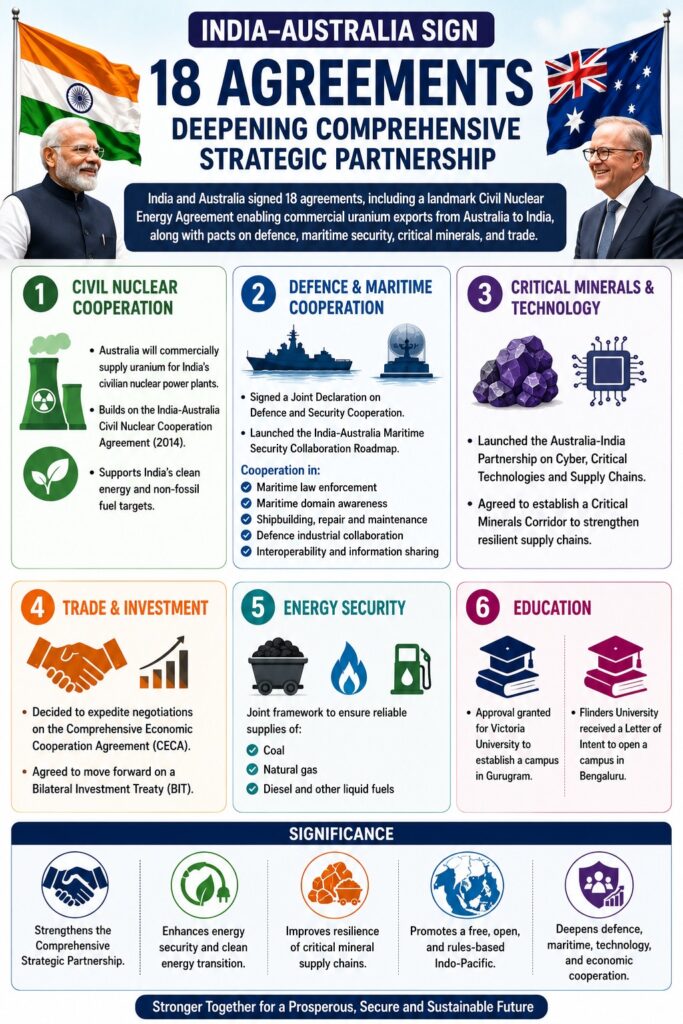
    India and Australia signed 18 agreements, including a landmark Civil Nuclear Energy Agreement enabling commercial uranium exports from Australia to India, along with pacts on defence, maritime security, critical minerals, and trade.

    Civil Nuclear Cooperation

    • Australia will commercially supply uranium for India’s civilian nuclear power plants.
    • Builds on the India-Australia Civil Nuclear Cooperation Agreement (2014).
    • Supports India’s clean energy and non-fossil fuel targets.

    Defence & Maritime Cooperation

    • Signed a Joint Declaration on Defence and Security Cooperation.
    • Launched the India-Australia Maritime Security Collaboration Roadmap.
    • Cooperation in Maritime law enforcement, Maritime domain awareness, Shipbuilding, repair and maintenance, Defence industrial collaboration, Interoperability and information sharing

    Critical Minerals & Technology

    • Launched the Australia-India Partnership on Cyber, Critical Technologies and Supply Chains.
    • Agreed to establish a Critical Minerals Corridor to strengthen resilient supply chains.

    Trade & Investment

    • Decided to expedite negotiations on the Comprehensive Economic Cooperation Agreement (CECA).
    • Agreed to move forward on a Bilateral Investment Treaty (BIT).

    Energy Security

    • Joint framework to ensure reliable supplies of Coal, Natural gas, Diesel and other liquid fuels

    Education

    • Approval granted for Victoria University to establish a campus in Gurugram.
    • Flinders University received a Letter of Intent to open a campus in Bengaluru.

    [2020] In India, why are some nuclear reactors kept under “IAEA safeguards” while others are not ?

    a) Some use uranium and others use thorium
    b) Some use imported uranium and others use domestic supplies
    c) Some are operated by foreign enterprises and others are operated by domestic enterprises
    d) Some are State-owned and others are privately-owned

  • [9th July 2026] The Hindu OpED: How India withstood the crisis in West Asia

    PYQ Relevance[UPSC 2017] The question of India’s Energy Security constitutes the most important part of India’s economic progress. Analyse India’s energy policy cooperation with West Asian countries
    Linkage: The PYQ directly examines the linkage between India’s energy security, economic growth and energy cooperation with West Asian countries. The article shows how sustained diplomatic engagement with West Asian partners, diversification of energy suppliers and strategic preparedness enabled India to maintain energy supplies and limit the economic impact of the West Asia crisis.

    Mentor’s Comment

    India’s fuel and LPG prices rose only marginally during the recent West Asia crisis even though the country imports nearly 90% of its crude oil through routes exposed to the Strait of Hormuz. This price resilience concealed a ₹74,781 crore loss absorbed by state-run Oil Marketing Companies, exposing the fiscal cost hidden behind India’s energy security architecture.

    Why did India appear structurally vulnerable to the West Asia energy shock?

    1. Import dependence: India imports almost 90% of its crude oil and is heavily dependent on the Gulf for oil, gas, and fertilizers.
    2. Third-largest oil importer: India ranks as the world’s third-largest oil importer, making it directly exposed to any disruption at the Strait of Hormuz.
    3. Historical precedent of instability: Sharp oil price increases have historically been a major source of macroeconomic instability for India, as seen in the 1973 oil shock and the 1991 balance-of-payments crisis.
    4. Sharp initial price signals: The Indian crude basket crossed $120 per barrel within weeks of the crisis. The import-linked cost of a domestic LPG cylinder rose above ₹1,600. War-risk premiums on shipping escalated sharply.
    5. Compounding risk factors: Rising freight costs and maritime risk combined with crude dependence to create the conditions for a severe external shock.

    How resilient was India’s fuel pricing compared to global peers?

    1. Petrol price comparison: Petrol prices in India rose by only 7.5% during the crisis. Germany saw a rise of nearly 14%, the U.K. 19%, the U.S. 45%, Pakistan and the Philippines over 50%, and Myanmar almost 90%.
    2. Diesel price comparison: India limited diesel price increases to just 8%. The UAE, a crude-producing country, saw diesel prices surge by about 85%.
    3. LPG affordability: A domestic LPG cylinder in India cost ₹942, and ₹642 for Ujjwala beneficiaries, despite India importing nearly 60% of its LPG requirement.
    4. Regional LPG comparison: India’s LPG price remained cheaper than in Pakistan, Nepal, and Sri Lanka, and dramatically lower than in the U.S., Australia, and Canada.

    Did India’s price stability represent genuine resilience or a deferred fiscal cost?

    1. Scale of losses: State-run Oil Marketing Companies incurred ₹74,781 crore in losses on petrol, diesel, and LPG sales up to June 30 as global crude prices surged.
    2. Absorption over pass-through: The government and public-sector OMCs chose to absorb the price shock rather than pass it fully to consumers.
    3. Trade-off exposed: Consumer price stability was protected at the direct cost of OMC balance sheets, converting a market shock into a fiscal one.
    4. Limits of the model: This absorption capacity depends on OMC financial health and government fiscal space. A prolonged or repeated shock would test the sustainability of this approach.

    What structural preparations enabled India to absorb the shock?

    1. Diplomatic relationships as energy security: Decades of engagement with Iran and Gulf partners kept communication channels open during peak tensions. Iran facilitated the movement of Indian ships and Gulf producers continued energy supplies.
    2. Supplier diversification: Energy partnerships with Russia, the U.S., Africa, and Latin America gave India flexibility to withstand disruption that was unavailable in earlier crises.
    3. A decade of energy planning: Higher ethanol blending, an expanding renewable energy base, larger strategic reserves, and stronger refining capacity built layered resilience over time.
    4. Whole-of-government coordination: The Ministries of External Affairs, Petroleum and Natural Gas, and Ports, Shipping and Waterways, along with the Indian Navy and the National Security Council Secretariat, coordinated to monitor risk, manage logistics, and protect supply.

    What does this episode signal for India’s future energy security strategy?

    1. Preparation precedes crisis: Resilience was the product of choices made years before the crisis, not of measures adopted during it.
    2. Foreign policy as an energy security tool: Diplomatic outreach functioned as a substitute for physical reserves during the acute phase of the crisis.
    3. Unresolved fiscal question: The crisis did not resolve the tension between consumer price protection and OMC financial sustainability. It only deferred that cost.
    4. Framing for national strategy: The episode is positioned as a template for future energy resilience under the government’s ‘Viksit Bharat’ framing.

    Conclusion

    India’s resilience during the West Asia crisis was not accidental. It was the outcome of a decade of supplier diversification, sustained diplomatic engagement with Iran and Gulf producers, strategic reserve-building, and whole-of-government coordination. This resilience, however, was purchased through a ₹74,781 crore fiscal absorption by public-sector Oil Marketing Companies rather than a costless outcome. The crisis therefore validates India’s energy security architecture while leaving open the question of how long consumer price insulation can be sustained through OMC losses if shocks recur or persist.

  • The significance of Astra missiles which Indonesia will purchase

    Why in the News?

    India and Indonesia signed a deal on July 8 for the export of Astra Mk1 beyond-visual-range air-to-air missiles (BVRAAM), marking India’s first-ever export of the indigenous Astra missile system. The deal signals India’s transition from a long-standing importer of air-to-air missile technology to a credible exporter of a combat-validated strategic weapons system. The export comes months after Operation Sindoor demonstrated the missile category’s operational relevance against Pakistan.

    What does the Astra export deal reveal about the maturity of India’s indigenous BVRAAM programme?

    1. First export milestone: The deal for Astra Mk1 to Indonesia is India’s first export of an indigenous beyond-visual-range air-to-air missile. It will arm Indonesia’s Su-30 fleet.
    2. Astra Mk1 specifications: Astra Mk1 has a range of 80 to 110 km. Its altitude reach is up to 20 km. Its speed is Mach 4.5.
    3. Platform integration: Astra Mk1 is integrated with the Sukhoi-30 MKI. It is planned for future integration with the Tejas Mk1A and the Rafale.
    4. Astra Mk2 progress: Astra Mk2 has an enhanced range of 200 km, up from a previously stated 160 km. It received Acceptance of Necessity from the Defence Acquisition Council in December.
    5. Astra Mk3 development: Astra Mk3, named Gandiva, is under development. It uses a Solid Fuel Ducted Ramjet engine that sustains thrust mid-flight instead of burning out like conventional rocket motors. Its underlying SFDR technology was flight tested this year, with a potential range beyond 350 km.

    Why does the Astra export mark a shift from import dependence to strategic self-reliance in India’s air combat capability?

    1. Combat validation: Operation Sindoor, India’s operation against Pakistan last year, demonstrated the operational criticality of longer-range BVRAAM missiles.
    2. Threat benchmark: Astra is positioned as India’s answer to the PL-15, a long-range, active radar-guided BVRAAM used by both China and Pakistan.
    3. Import substitution: The Astra programme reduces India’s dependence on imported BVRAAM systems such as the Meteor and the R-77.
    4. Procurement priority: Procuring more batches of modern BVRAAM missiles is now a stated focus area for the Indian Air Force.
    5. Export as validation: Exporting Astra to Indonesia signals external confidence in an Indian-origin weapons system. Domestic deployment alone would not carry this signal.

    What do the named foreign missile systems and export destinations show about India’s position in the global BVRAAM market?

    1. China’s PL-15: An active radar-guided, long-range BVRAAM in service with both the Chinese and Pakistani air forces. It forms the primary threat benchmark for Astra.
    2. European Meteor: A BVRAAM currently operated by the IAF as an imported system. It illustrates India’s prior reliance on foreign suppliers.
    3. Russian R-77: Another imported BVRAAM in IAF service. Astra is intended to substitute this system over time.
    4. BrahMos to Southeast Asia: India is separately set to supply the BrahMos supersonic cruise missile to Indonesia, Vietnam, and the Philippines. This indicates a broader pattern of missile exports to Southeast Asian states.

    How does the Astra-BrahMos export pattern position India in the Indo-Pacific strategic order?

    1. Common export destinations: Indonesia, Vietnam, and the Philippines are recipients or prospective recipients of Indian missile systems. All three have unresolved maritime disputes with China.
    2. Countering PL-15 proliferation: Supplying Astra to a PL-15-exposed region extends India’s indigenous missile technology as a counterweight to Chinese-origin systems in the neighbourhood.
    3. Defence diplomacy tool: Missile exports function as an instrument of strategic partnership-building beyond conventional trade or diplomatic engagement.
    4. Manufacturer credibility: Sustained export interest from multiple Indo-Pacific states strengthens India’s credibility as a defence manufacturing hub. This supports the Atmanirbhar Bharat objective in the defence sector.

    Conclusion

    The Astra Mk1 export to Indonesia marks India’s transition from importing BVRAAM technology to supplying a combat-validated indigenous system abroad. Operation Sindoor supplied the operational proof. The PL-15 threat supplied the strategic rationale. What remains unresolved is whether India’s fighter fleet can secure adequate quantities of the higher-range Mk2 and Mk3 variants quickly enough to keep pace with the systems they are designed to counter.

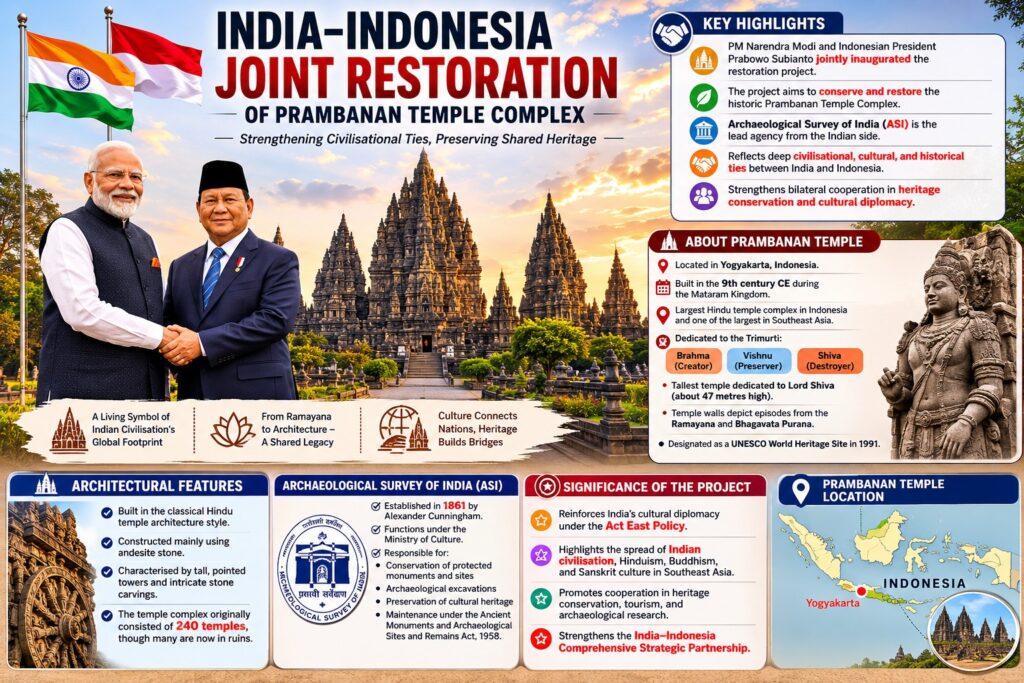
  • India and Indonesia Launch Joint Restoration Project at Prambanan Temple

    Why in News?

    India and Indonesia have launched a joint conservation and restoration project at the Prambanan Temple Complex, a UNESCO World Heritage Site in Yogyakarta, Indonesia, during Prime Minister Narendra Modi’s visit to Indonesia.

    Key Highlights

    • Prime Minister Narendra Modi and Indonesian President Prabowo Subianto jointly inaugurated the restoration project.
    • The project aims to conserve and restore the historic Prambanan Temple Complex.
    • The Archaeological Survey of India (ASI) is the lead agency from the Indian side.
    • The initiative reflects the deep civilisational, cultural, and historical ties between India and Indonesia.
    • It also strengthens bilateral cooperation in heritage conservation and cultural diplomacy.

    About Prambanan Temple

    • Located in Yogyakarta, Indonesia.
    • Built in the 9th century CE during the Mataram Kingdom.
    • It is the largest Hindu temple complex in Indonesia and one of the largest in Southeast Asia.
    • Dedicated to the Trimurti: Brahma (Creator), Vishnu (Preserver), and Shiva (Destroyer)
    • The tallest temple is dedicated to Lord Shiva, standing about 47 metres high.
    • The temple walls depict episodes from the Ramayana and Bhagavata Purana.
    • Designated as a UNESCO World Heritage Site in 1991.

    Architectural Features

    • Built in the classical Hindu temple architecture style.
    • Constructed mainly using andesite stone.
    • Characterised by tall, pointed towers and intricate stone carvings.
    • The temple complex originally consisted of 240 temples, though many are now in ruins.

    Archaeological Survey of India (ASI)

    • Established in 1861 by Alexander Cunningham.
    • Functions under the Ministry of Culture.
    • Responsible for:
      • Conservation of protected monuments and archaeological sites.
      • Archaeological excavations.
      • Preservation of cultural heritage.
      • Maintenance of ancient monuments under the Ancient Monuments and Archaeological Sites and Remains Act, 1958.

    Significance of the Project

    • Reinforces India’s cultural diplomacy under the Act East Policy.
    • Highlights the spread of Indian civilisation, Hinduism, Buddhism, and Sanskrit culture in Southeast Asia.
    • Promotes cooperation in heritage conservation, tourism, and archaeological research.
    • Strengthens the India-Indonesia Comprehensive Strategic Partnership.

    [2025] Who among the following led a successful military campaign against the kingdom of Srivijaya, the powerful maritime State, which ruled the Malay Peninsula, Sumatra, Java and the neighbouring islands?

    [A] Amoghavarsha (Rashtrakuta)

    [B] Prataparudra (Kakatiya)

    [C] Rajendra 1 (Chola)

    [D] Vishnuvardhana (Hoysala)