Mains Ready By December. Smash Mains & Smash PYQ Admissions Open

GS Paper: GS2-18.Bilateral, regional and global groupings and agreements involving India and/or affecting India’s interests.

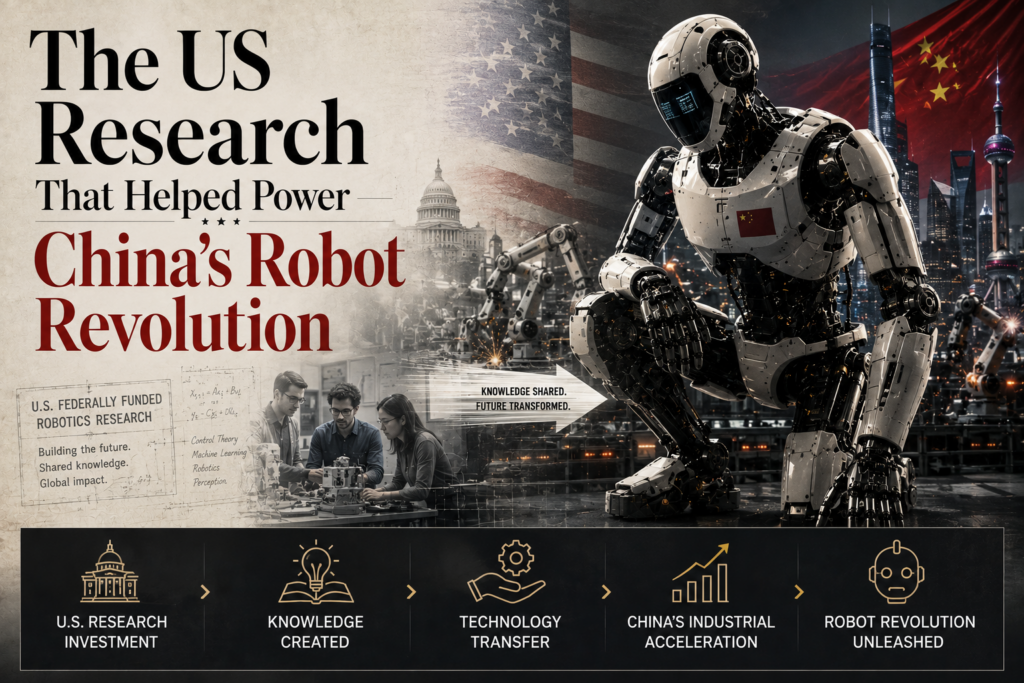
  • The US Research That Helped Power China’s Robot Revolution

    Why in the News

    China’s Unitree Robotics based the designs of its most successful quadruped robots on breakthroughs financed by the United States Army Research Laboratory, according to a former United States defence technology official and three researchers involved in the programme. The findings were published openly to advance the field, and the country that funded them has no mass producer of such robots, while the company that scaled them is now on the Pentagon’s list of Chinese military companies.

    What is the Robotics Collaborative Technology Alliance?

    1. What it was: The Robotics Collaborative Technology Alliance (RCTA) was a United States Army funded research consortium that ran from 2010 to 2020.
    2. Funding body: It was financed by the DEVCOM Army Research Laboratory (ARL) alongside other military programmes.
    3. Participants: It gathered government, academic and industry researchers from the University of Pennsylvania, the Massachusetts Institute of Technology (MIT), Boston Dynamics and NASA’s Jet Propulsion Laboratory, among other research institutions.
    4. Lead commercial partner: General Dynamics Land Systems, the Michigan based defence manufacturer that builds Abrams M1 tanks.
    5. Publication practice: The programme’s findings were published openly to stimulate progress in the field, which is common practice in publicly funded research.

    What is an actuator?

    1. Definition: An actuator is the component that converts electrical power into the movement of a robot’s joint, combining a motor, a gearbox and control electronics.
    2. Why it decides the design: Actuator torque, weight and cost set what a legged robot can do and what it costs, which is why an actuator design published in detail is effectively a manufacturing blueprint.

    What is DARPA?

    1. Definition: The Defense Advanced Research Projects Agency (DARPA) is the United States Department of Defense agency that funds high risk, early stage technology research with potential military application.
    2. Role here: DARPA financed the MIT laboratory work on which the later Army funded University of Pennsylvania advances were built.

    How did Army funded research travel from the laboratory to a Chinese manufacturer?

    1. 2016, motors moved into the legs: University of Pennsylvania researchers eliminated heavy central gearboxes and placed motors in the robots’ legs, which improved the machine’s ability to sense and respond to terrain.
    2. Built on DARPA funded work: That advance built on the MIT laboratory’s earlier work financed by DARPA.
    3. 2019, the Mini Cheetah: The MIT laboratory presented the Mini Cheetah, adding strength and the ability to perform backflips to the University of Pennsylvania features.
    4. The thesis that carried the design: Months earlier, an MIT researcher published a master’s thesis detailing the Mini Cheetah’s actuators.
    5. Copies within six months: Chinese firms were manufacturing actuator copies purchasable on the online retailer AliExpress within six months of that publication.
    6. Dimensional match: The dimensions of Unitree’s popular Go series were almost identical to the millimetre to the Mini Cheetah, per the MIT researcher involved in developing it.
    7. The scale product: The Army funded project became the first Unitree robot that had any kind of scale, per a former University of Pennsylvania researcher on the programme.
    8. 2023, the price point: Unitree’s $1,600 Go2 model, launched in 2023, let the company rapidly dominate the global quadruped robot market. Unitree was founded in 2016, three years before the Mini Cheetah was presented.

    What does the scale gap look like in numbers?

    1. Unitree’s volumes: The company sold more than 5,500 humanoids and 18,000 quadrupeds last year, per company filings.
    2. Valuation: Unitree is valued at about $9 billion ahead of its stock market debut, and its Shanghai initial public offering drew frenzied demand.
    3. United States output: No United States company has mass produced such robots, including Tesla, which has displayed prototypes of its Optimus humanoid for years.
    4. A different technology base: Boston Dynamics’ 2019 canine robot Spot used different technology from the Army funded line.
    5. The domestic commercialiser: Ghost Robotics commercialised the United States breakthroughs and supplies United States special forces with ruggedised robots, but its production is small and costly compared with Unitree’s.

    Why did the United States not capture the market it created?

    1. Capital preference: United States venture capital prefers high return software startups, which a robotics analyst described as a dropped ball on commercialising domestic research.
    2. Missing industrial inputs: The United States excels in innovation and software development but needs the capital, industrial base, highly skilled workforce and parts supply chains to scale up breakthroughs, per the dean of Penn Engineering.
    3. No production support after the research ended: The Army funded project kick-started the United States quadruped industry, but without support for large scale production Unitree consumed that space, per the former Army Research Laboratory director who oversaw it.
    4. Price competition threatens incumbents: Boston Dynamics argued in a Congressional hearing that China’s low pricing would drive United States firms out of the market.
    5. Asymmetry of actors: The contest is between private United States companies and a coordinated Chinese national strategy, per the founder of Ghost Robotics.

    What structural advantages does China’s manufacturing model carry?

    1. A stated ten year industrial plan: In 2015, China’s leadership set out a ten year plan to lead industries including green energy, electric vehicles and robotics.
    2. Tolerance for losses: Capital has since been channelled into risky bets on low margin advanced manufacturing.
    3. Critical minerals dominance: Rapid reverse engineering draws on China’s dominance in refining the critical minerals needed for magnets in robotics applications.
    4. Supplier density: Motors, gears and the artificial muscles known as actuators are supplied by a dense cluster of firms near Unitree’s base in Hangzhou.
    5. The pattern is not new: Backed by subsidies and component factory clusters, Chinese firms have already seized market share in solar panels, drones, electric vehicles and quantum communications, many of them first developed in the United States with government or military backing.

    How have United States authorities responded?

    1. June, Pentagon listing: The Pentagon added Unitree to its list of Chinese military companies, calling it a contributor to the Chinese defence industrial base.
    2. Effect of the listing: The designation falls short of a sanction but limits the United States military’s future use of Unitree technology.
    3. July, import ban: The Federal Communications Commission (FCC) banned imports of future models of foreign made humanoid and quadruped robots, including those from Unitree.
    4. Chinese response: China has threatened to retaliate against the FCC ban, and its Washington embassy accused the United States of abusing administrative power and of market distortion and unilateral bullying.
    5. Company position: Unitree has said its robots are for civilian use, and one Unitree robot has been shown on Chinese state television armed and accompanying People’s Liberation Army troops on an exercise.

    Should publicly funded research be published openly when a rival scales it faster?

    1. Nothing was taken improperly: Unitree did nothing underhanded in using the Army research, since the programme’s findings were published openly by design.
    2. The funder’s own defence: The Army Research Laboratory stated the research strengthened the broader United States robotics ecosystem and informed subsequent work across government and the private sector.
    3. Researchers reject secrecy: None of the United States robotics researchers involved advocated keeping such government financed research secret, arguing publication is important to scientific and technological advancement.
    4. Their alternative prescription: Policymakers should focus on enabling companies to commercialise such advances quickly enough to compete.
    5. Trade barriers are insufficient: Most experts supported the import ban but said the policy alone cannot build an industry capable of catching up, since it would take more than trade barriers to boost robotics manufacturing.

    Challenges to commercialising publicly funded robotics research

    1. Open publication transfers advantage immediately: A detailed design published for scientific benefit is also a manufacturing specification, e.g. actuator copies drawn from the Mini Cheetah thesis were on sale within six months.
    2. Hardware startups cannot match software returns: Venture funding avoids capital heavy, low margin manufacturing, e.g. Ghost Robotics supplies United States special forces but produces at small volume and high cost.
    3. No domestic component cluster: Motors, gears and actuators must be sourced abroad when no local supplier base exists, e.g. the supplier density around Hangzhou has no United States equivalent.
    4. Critical mineral chokepoint: Magnet grade rare earths are refined almost entirely in one country, e.g. China’s April 2025 export controls on rare earth magnets disrupted automotive and electronics production worldwide.
    5. Trade restrictions do not create capacity: A ban removes a supplier without creating a substitute, e.g. the FCC July ban covers future imported models while no United States firm mass produces quadrupeds.
    6. Dual use ambiguity complicates policy: A civilian product can appear in a military role without the manufacturer changing its position, e.g. an armed Unitree robot appeared with People’s Liberation Army troops on state television while the company maintains its robots are civilian.
    7. Price competition ends domestic production: Cheaper imports remove the volume a domestic manufacturer needs to survive, e.g. Boston Dynamics warned a Congressional hearing that China’s pricing would drive United States firms out.

    Conclusion

    Publicly funded, openly published United States military robotics research became the design basis for the world’s largest quadruped robot manufacturer, based in China. The failure was not in the research or in its disclosure but in the absence of capital, supplier depth and skilled manufacturing capacity to commercialise it domestically. Export bans and military company listings restrict a competitor’s access without supplying any of those three, so the structural gap remains open.

    Question (2024, GS2): “The West is fostering India as an alternative to reduce dependence on China’s supply chain and as a strategic ally to counter China’s political and economic dominance. Explain this statement with examples.

    Linkage: This touches upon the global strategic response to China’s “revolution” in manufacturing and technology, highlighting the shift to move away from Chinese-dominated supply chains.
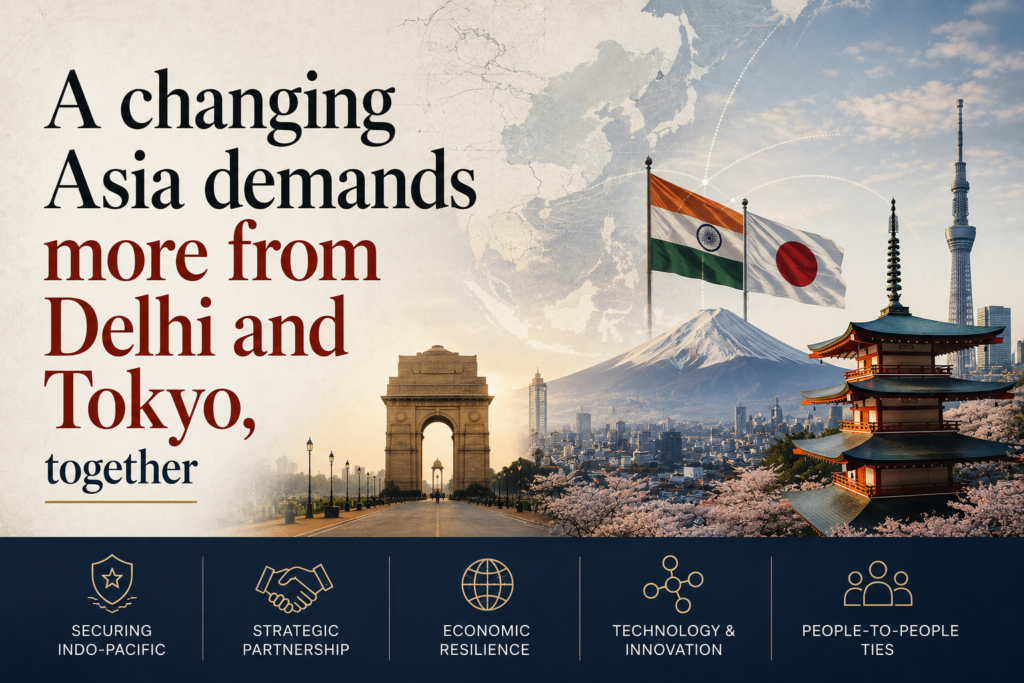
  • [19th August 2026] The Hindu OpED: A changing Asia demands more from Delhi and Tokyo, together

    Question (2019, GS2): “‘The time has come for India and Japan to build a strong contemporary relationship, one involving global and strategic partnership that will have a great significance for Asia and the world as a whole.’ Comment.”
    Linkage: This question directly mirrors the article, asking for an evaluation of how a strengthened partnership between Delhi and Tokyo can influence the broader Asian and global landscape.

    Mentor Comment

    The Japanese Defence Minister’s visit to India this week comes as Tokyo abandons its self imposed military restraint and adopts an active regional military diplomacy. The visit exposes a gap between an India Japan defence relationship that carries the full institutional architecture of a Special Strategic and Global Partnership and a level of operational and industrial cooperation that has stayed slow and incremental.

    What is the India Japan Special Strategic and Global Partnership?

    1. What it is: The Special Strategic and Global Partnership is the highest tier of India’s bilateral partnership framework with Japan, elevated to that designation in 2014 from the Strategic and Global Partnership established in 2006.
    2. Political apparatus: It rests on an Annual Summit between the two Prime Ministers, which India holds with very few countries.
    3. Security apparatus: It carries a 2+2 Foreign and Defence Ministerial Dialogue, a defence ministerial dialogue, a defence policy dialogue and service level staff talks.
    4. Operational apparatus: It includes regular exercises across the three services and a mutual logistics arrangement.
    5. Where it falls short: Defence industrial cooperation and operational coordination remain well behind the political rhetoric that the designation carries.

    What is the Official Security Assistance programme?

    1. What it is: Official Security Assistance is Japan’s grant mechanism, launched in 2023, for providing defence equipment and infrastructure to the armed forces of friendly countries, kept separate from its Official Development Assistance which cannot fund military use.
    2. What it signals: It marks the first time Japan has used military assistance as an instrument of statecraft, with early recipients including the Philippines, Malaysia, Bangladesh and Fiji.

    What is a counterstrike capability?

    1. What it is: A counterstrike capability is the ability to strike missile launch sites and related targets in an adversary’s territory after an attack has begun or is imminent, which Japan had previously renounced as inconsistent with an exclusively defensive posture.
    2. How Japan is acquiring it: Through purchase of American Tomahawk cruise missiles and simultaneous development of longer range indigenous weapons.

    What is the UNICORN naval communications antenna?

    1. What it is: UNICORN, the Unified Complex Radio Antenna, is an integrated composite mast that houses multiple communication and electronic warfare antennas inside a single stealth shaped structure, reducing a warship’s radar signature.
    2. Significance for the relationship: Its co development is the first bilateral defence co development project between India and Japan, announced during the Japanese Prime Minister’s Delhi visit last month.

    What is a Mogami class frigate?

    1. What it is: The Mogami class is a Japanese designed multi mission stealth frigate built for a small crew, combining anti submarine, mine countermeasure and surface warfare roles in a single hull.
    2. Why it matters here: Australia’s decision to acquire Japanese designed Mogami class frigates is the largest defence export Japan has secured since it eased its arms export restrictions.

    What is a logistics agreement?

    1. What it is: A logistics agreement, in this case the Acquisition and Cross Servicing Agreement, allows the armed forces of two countries to use each other’s bases and facilities for supplies, refuelling, spares and services on a reimbursable basis.
    2. Operational effect: It extends the reach of each navy without new basing, which is the practical foundation for sustained joint operations in the Indian Ocean and the Western Pacific.

    What is driving Japan’s shift away from military restraint?

    1. The primary driver: The rise of China as a great military power and Beijing’s growing political will to translate that power into concrete outcomes.
    2. The economic turning point: China overtook Japan as the world’s second largest economy in 2010, and its growing economic resources supported a massive expansion of military capabilities.
    3. The shared method of pressure: The People’s Liberation Army applies the same methods on Japan’s maritime frontier and along India’s contested Himalayan land border, namely persistent probing and the slow but definitive alteration of the territorial status quo.
    4. The compounding variable: The challenge from China is magnified for both capitals by the volatility of American policy, with the second American presidency reinforcing questions about the predictability of Washington’s regional commitments.
    5. What neither capital wants: Neither Tokyo nor Delhi seeks an Asia without America, since Japan remains deeply invested in its alliance with Washington and India sees a continuing American military presence as essential to a stable Asian balance.
    6. The policy turn: Japan’s prime minister who returned to office in 2012 accelerated the effort to adapt security policy to these circumstances.

    What did Japan’s old post war bargain look like?

    1. The basic trade: For much of the post war era Tokyo concentrated on economic reconstruction while relying on the United States for its security.
    2. Spending ceiling: Defence expenditure remained around 1 percent of gross domestic product.
    3. Export restriction: Arms exports were tightly restricted, effectively closing Japan’s defence industry to foreign customers.
    4. Force constraints: The Self Defence Forces operated within narrow political constraints on role, deployment and equipment.
    5. When it began to break: Those conditions began to change as the China challenge unfolded through the 2000s.

    What do Japan’s 2022 defence reforms actually contain?

    1. Spending target: Tokyo set the goal of raising defence related spending to around 2 percent of gross domestic product by 2027, and brought that target forward through additional spending last year.
    2. Counterstrike doctrine: Japan is acquiring long range counterstrike capabilities, including American Tomahawk missiles, alongside longer range indigenous weapons.
    3. Defensive layers: It is strengthening air and missile defence and building cyber and space capabilities.
    4. Unmanned systems and reach: It is investing in unmanned systems and in the capacity to operate farther from the Japanese islands.
    5. Industrial base: Tokyo is revitalising its defence industrial base and breaking down the old barriers between civilian technology and national security.
    6. Export liberalisation: It has eased restrictions on arms exports, which is what made a foreign frigate order possible.
    7. Security assistance: It has begun providing military equipment to friendly countries through the new Official Security Assistance programme.
    8. What the package amounts to: Taken together these changes are larger than a rearmament, because Tokyo is treating military power, defence technology, arms exports and security assistance as normal instruments of statecraft.

    What do Japan’s other partnerships demonstrate about the pace India Japan ties could reach?

    1. Australia, the frigate order: Australia’s decision to acquire Japanese designed Mogami class frigates is a breakthrough for a country that until recently imposed extraordinary restrictions on exporting weapons, and it shows that Japanese defence industry can now deliver a major platform to a partner.
    2. Australia, the access architecture: Canberra and Tokyo have expanded military exercises, reciprocal access, logistics and defence industrial cooperation, which is a deeper package than the logistics arrangement India and Japan currently hold.
    3. New Zealand: Japan is deepening defence ties with Wellington, and the Japanese Defence Minister came to Delhi after consultations in Canberra with his Australian and New Zealand counterparts, signalling a coordinated Indo Pacific circuit rather than a series of bilaterals.
    4. South Korea: Tokyo is reaching out to Seoul and other regional neighbours, which matters because it means Japan is willing to build security ties across historically difficult relationships.
    5. Europe: Japan is strengthening security engagement with European partners, extending the same instruments of exercises, access and industrial cooperation beyond Asia.

    What does the existing India Japan defence architecture already provide?

    1. Ministerial mechanism: A 2+2 dialogue bringing foreign and defence ministers of both countries into a single format.
    2. Sustainment mechanism: A logistics agreement giving each side reciprocal access to the other’s facilities for supplies and services.
    3. Exercise programme: Regular exercises across the three services, alongside participation in the trilateral and multilateral formats both countries belong to.
    4. The most recent political push: The Japanese Prime Minister’s Delhi visit last month called for more sophisticated exercises, stronger maritime domain awareness and deeper defence industrial cooperation.
    5. The first industrial output: That visit announced the first bilateral defence co development project, the UNICORN naval communications antenna.

    Why has the institutional architecture not translated into operational weight?

    1. The stated gap: India Japan defence cooperation has expanded and remains well behind the political rhetoric attached to the Special Strategic and Global Partnership.
    2. The slow node: Defence industrial cooperation has been painfully slow, which is why a single antenna counts as the first co development project after two decades of partnership.
    3. Exercises are not coordination: The armed forces exercise together without moving to operational coordination, so joint activity does not accumulate into joint capability.
    4. Asymmetric urgency: Japan is demonstrating greater purpose and urgency in responding to the changing balance of power, which places the burden of matching commitment on Delhi.
    5. The reassurance that removes the excuse: Unlike China, India has long welcomed the prospect of a stronger Japan, so there is no political obstacle on the Indian side to a larger partnership.
    6. Why a review agenda is insufficient: Treating the visit as an occasion to review bilateral exercises and exchanges repeats the incrementalism that produced the gap.

    Where should the partnership go next?

    1. Industrial ambition: Delhi and Tokyo need much greater ambition in joint research, development and coproduction of weapons and military technologies.
    2. Anti submarine warfare: Operational coordination should extend to anti submarine warfare, the domain where Japanese capability and Indian Ocean geography combine most directly.
    3. Maritime surveillance: Coordination in maritime surveillance would convert two separate domain awareness pictures into one.
    4. Air defence: Air defence cooperation follows from Japan’s investment in layered air and missile defence.
    5. Logistics: Logistics coordination would turn the existing agreement from an access arrangement into a sustained operating capability.
    6. Why now: The unfolding transformation of the Asian security environment is the reason the pace has to change, not the specific content of any one visit.

    Challenges to India Japan defence cooperation

    1. Slow defence industrial delivery: Joint projects take years to move from announcement to contract on both sides, e.g. the first bilateral co development project, the UNICORN antenna, was announced only last month after two decades of partnership.
    2. Technology transfer caution: Japan’s defence industry remains new to export and is protective of sensitive technology, e.g. the long negotiation over the US-2 amphibious aircraft never converted into an Indian order.
    3. Procurement process mismatch: India’s defence acquisition procedure and offset requirements do not align with Japanese corporate practice, e.g. Japanese firms have limited experience bidding into competitive Indian tenders with local content conditions.
    4. Cost sensitivity: Japanese platforms carry high unit costs relative to Indian budget norms, e.g. the US-2 aircraft’s price was a principal reason the proposal stalled.
    5. Divergence on Russia: India’s continued defence and energy relationship with Russia limits the sensitivity of technology Japan is willing to share, e.g. India’s Russian origin air defence and submarine fleet complicates interoperability planning.
    6. Dependence on American policy: Both partners calibrate against Washington’s commitments, so volatility in American policy slows their own planning, e.g. questions about the predictability of the second American presidency have reopened alliance debates in Tokyo.
    7. Domestic legal limits in Japan: Constitutional and legislative constraints on the Self Defence Forces still bound what Japan can commit to jointly, e.g. Article 9 of Japan’s Constitution continues to shape the scope of collective self defence.
    8. Chinese economic leverage: Both economies remain deeply linked to China, which raises the cost of visible security alignment, e.g. China’s rare earth export restrictions have exposed the vulnerability of both countries’ defence electronics supply chains.

    Conclusion

    Japan has changed the terms of its own security policy through the 2022 reforms, a spending target of around 2 percent of gross domestic product by 2027, counterstrike capabilities, eased arms exports and the Official Security Assistance programme, and has already converted that change into a frigate order from Australia. India and Japan possess the full institutional architecture of a security partnership, a 2+2 dialogue, a logistics agreement and tri service exercises, and have produced a single co development project in the UNICORN antenna. The gap is one of ambition rather than of instruments, and closing it means moving from exercises to operational coordination in anti submarine warfare, maritime surveillance, air defence and logistics.

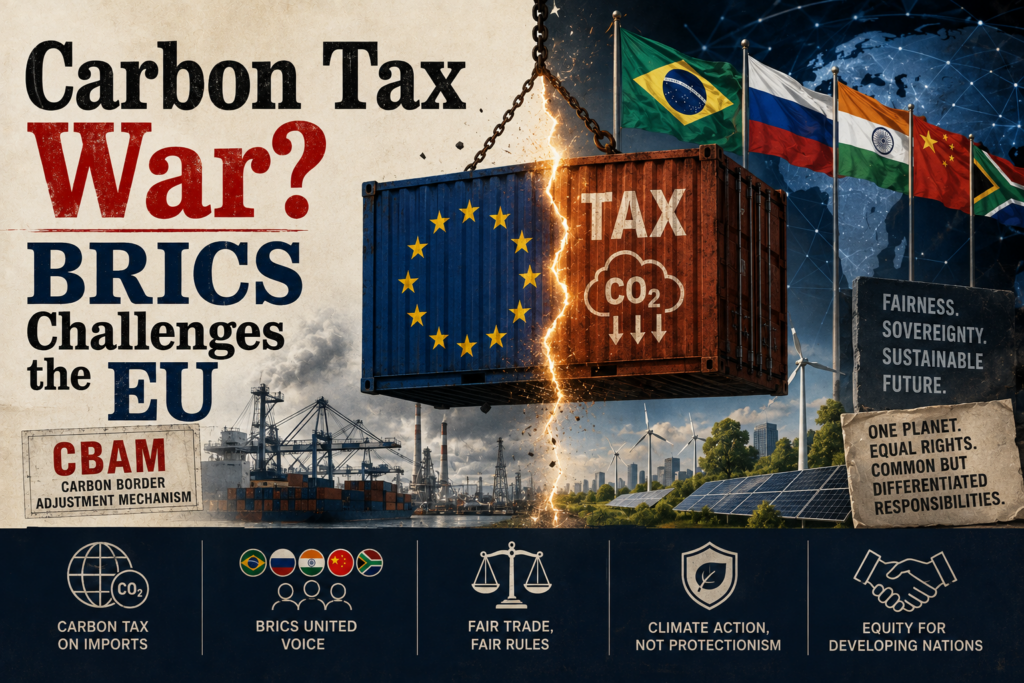
  • Carbon Tax War? BRICS Challenges the EU

    Why in the News

    Environment and climate Ministers of the BRICS grouping adopted a joint statement opposing “unilateral, punitive, discriminatory and protectionist” climate measures, naming the European Union’s Carbon Border Adjustment Mechanism (CBAM) among them. The statement lands in the first year in which CBAM actually charges money at the border, which converts an internal European climate instrument into a live trade cost for developing country exporters. The same document demands that developed countries deliver the adaptation finance they have already promised, linking the objection on trade to a claim on money.

    What is the Carbon Border Adjustment Mechanism (CBAM)?

    1. Definition: CBAM is an import levy on carbon intensive goods entering the European Union, priced against the emissions embedded in their production. It makes an importer pay for the carbon released abroad at the same price a European producer pays at home.
    2. Mechanism: Importers must purchase and surrender CBAM certificates matching the emissions embedded in each consignment. The certificate price is tied to the European carbon allowance price.
    3. Covered sectors: The mechanism applies to importers of iron and steel, aluminium, cement, fertilizers, hydrogen and electricity, the six sectors treated as most exposed to carbon costs.
    4. Timeline: CBAM was rolled out on 1 October 2023 with a reporting only phase, during which importers declared embedded emissions without paying. It entered its definitive phase from 1 January 2026, when the obligation to buy and surrender certificates began.
    5. Stated purpose: The European Union presents the measure as a means of preventing carbon leakage and of ensuring that its own climate ambition does not simply displace production abroad.

    What is carbon leakage?

    1. Definition: Carbon leakage is the shifting of carbon intensive production outside a jurisdiction because that jurisdiction’s climate policy raises production costs there and not elsewhere. Global emissions do not fall, they relocate.
    2. Why it drives border measures: A domestic carbon price without a border charge leaves domestic producers competing against untaxed imports. The border charge is the instrument used to close that gap.

    What is common but differentiated responsibilities and respective capabilities (CBDR-RC)?

    1. Definition: CBDR-RC is the founding principle of the international climate regime under which all countries share responsibility for the climate problem, but not equally. Obligations are calibrated to a country’s historical contribution to emissions and to its present capacity to act.
    2. How it was invoked here: The joint declaration used CBDR-RC to argue that all cooperation commitments, from forest fire protocols to circular economy standards, remain voluntary and calibrated to each country’s national circumstances.

    What is the New Collective Quantified Goal (NCQG)?

    1. Definition: The New Collective Quantified Goal is the post 2025 climate finance target agreed under the climate convention, replacing the earlier annual finance commitment made to developing countries. It fixes how much money developed countries must mobilise, and for what.
    2. The specific commitment at issue: The Ministers urged wealthy nations to deliver on the NCQG reached at the 30th Conference of the Parties (COP30) held at Belem, Brazil, including the commitment to triple adaptation finance to developing countries by 2035.

    What did the 12th BRICS Environment Ministers’ Meeting actually decide?

    1. Venue and chair: The 12th BRICS Environment Ministers’ Meeting was held in New Delhi under India’s chairship, and adopted its positions through a joint statement.
    2. Participation: Environment and climate Ministers and senior officials from eleven countries took part: Brazil, Russia, India, China, South Africa, the United Arab Emirates, Indonesia, Iran, Saudi Arabia, Egypt and Ethiopia.
    3. Position on border measures: Ministers recorded concern that carbon border measures such as CBAM “undermine developing countries’ efforts to address climate change and build resilience”, placing that language in the adaptation and climate resilience section of the statement.
    4. Quality of finance demanded: Support from developed countries must be “new, additional, predictable, adequate and accessible”, delivered through grants and concessional finance and without adding to the financial vulnerabilities of developing countries.
    5. Technical basis: The statement marked the culmination of a year of technical work by the BRICS Environment Working Group and its Contact Group on Climate Change and Sustainable Development.
    6. Handover: India formally handed hosting duties for the 13th edition to China, which will lead the meeting in 2027.

    Why does the definitive phase matter so much for India’s exports?

    1. Concentrated exposure: Iron and steel account for about 90 percent of India’s exports to the European Union that fall within the CBAM framework, so a sectoral measure operates as a single sector measure for India.
    2. Evidence of behavioural change already: A June 2026 analysis in Nature Climate Change, built on shipment level trade data and facility level emissions estimates, found that high emission Indian steel firms cut their export quantities and revenues to the European Union during the reporting phase, while lower emission firms held their export levels.
    3. Cost now real, not notional: During the reporting phase the obligation was informational. From 1 January 2026 the exporter’s emissions intensity translates directly into a certificate purchase by the buyer.
    4. Collision with the trade opening: The BRICS position arrives as India and the European Union move to implement a free trade agreement negotiated earlier this year, so tariff concessions on one track sit beside a new carbon related compliance cost on the other.
    5. Adaptation finance is the counterweight: Adaptation finance is used to help countries and communities cope with climate impacts, including measures to strengthen water security, agriculture and infrastructure, which is the ground on which the bloc pressed its finance claim.

    What do other jurisdictions’ carbon border and pricing measures show?

    1. United Kingdom: A UK CBAM is legislated to begin on 1 January 2027, covering aluminium, cement, fertilisers, hydrogen and iron and steel. It uses a fixed sectoral levy rate linked to the UK carbon price rather than tradable certificates, and it excludes electricity.
    2. European Union: The border charge is paired with the phase out of free allowances under the EU Emissions Trading System between 2026 and 2034. The design feature that matters is the pairing: the border cost rises as European industry loses its free permits.
    3. China: The national Emissions Trading Scheme was expanded in 2025 from power generation to steel, cement and aluminium. A domestic carbon price gives exporters a payment that can be set off against a border charge, converting revenue that would otherwise leave the country.
    4. Turkey: Legislation in 2025 created a national Emissions Trading System explicitly to retain carbon revenue domestically instead of surrendering it to the European border charge.
    5. United States: There is no federal carbon price. Proposals such as the Foreign Pollution Fee Act would levy an import charge based on emissions intensity relative to United States producers, a border measure with no domestic carbon price behind it.

    Where does the BRICS position pull against its members’ own choices?

    1. Objection and integration run together: The bloc calls the measure protectionist while India simultaneously implements a free trade agreement with the same partner, so the objection is lodged inside a deepening trade relationship rather than outside it.
    2. A domestic carbon price weakens the objection: Members building their own carbon markets, including India and China, gain a set off against CBAM only by adopting the very instrument they describe as an imposition.
    3. The measure is producing decarbonisation, unevenly: Lower emission Indian steel firms held their European market share while high emission firms retreated, which is the outcome CBAM claims to seek and the outcome that concentrates the cost on the least prepared producers.
    4. Voluntary cooperation limits the bloc’s own leverage: Insisting that every cooperation commitment stays voluntary and nationally calibrated protects policy space, and it also denies the bloc a collective standard it could offer as an alternative to CBAM.
    5. Finance and trade are separate tracks: Tripling adaptation finance by 2035 does not compensate an exporter for a certificate cost paid in 2026, so the two demands in the statement address different constituencies.

    Challenges to the Carbon Border Adjustment Mechanism

    1. Extraterritorial reach without representation: The charge is designed by a regulator that exposed exporters have no vote over. e.g. iron and steel form about 90 percent of India’s CBAM covered exports to the European Union, so a single foreign rulebook governs the bulk of that trade.
    2. Measurement and verification burden: Embedded emissions must be computed at installation level and verified, which small suppliers cannot do unaided. e.g. small Indian foundries and rolling mills supplying European buyers must commission third party verification that costs more than their margin on the consignment.
    3. Carbon price divergence: A domestic carbon payment offsets the certificate cost only to the extent of its price. e.g. prices under India’s Carbon Credit Trading Scheme are expected well below the European allowance price, leaving a large residual charge.
    4. Resource shuffling: A producer can reallocate output rather than cut emissions. e.g. a steelmaker can route its cleanest electric arc furnace line to the European Union and its blast furnace output to West Asia, lowering the reported figure without lowering total emissions.
    5. Downstream coverage gap: The mechanism covers raw materials but not most finished goods made from them. e.g. imported cars and machinery containing steel escape the charge while imported steel does not, creating an incentive to relocate downstream manufacturing outside the bloc.
    6. Trade law exposure: Developing countries argue the measure conflicts with the differentiation principle of the climate convention and with core trade disciplines. e.g. CBAM has been repeatedly contested in the World Trade Organization’s Committee on Trade and Environment by India, China, Brazil and South Africa.
    7. Revenue destination: The proceeds accrue to the imposing jurisdiction, not to the exposed exporter’s transition. e.g. CBAM revenue flows to the European Union budget while the BRICS statement asks for grant based adaptation finance, so the money moves in the opposite direction to the demand.

    Conclusion

    The definitive phase has converted a European domestic carbon price into a border cost carried largely by developing country exporters, and the BRICS statement is the first collective effort to frame that as a breach of differentiated responsibility rather than a technical trade irritant. The demand for tripled adaptation finance by 2035 sits alongside the objection because the bloc treats the two as one bargain. What remains unresolved is that neither the objection nor the finance demand reduces the certificate cost an Indian steel exporter pays in 2026, and only a credible domestic carbon price and lower emissions intensity will do that.

    Question (2025, GS3): “What are the challenges before the Indian economy when the world is moving away from free trade and multilateralism to protectionism and bilateralism? How can these challenges be met?”
    Linkage: The BRICS statement explicitly labels CBAM as a “protectionist” measure that converts a climate instrument into a trade cost, directly illustrating the challenge of rising protectionism.

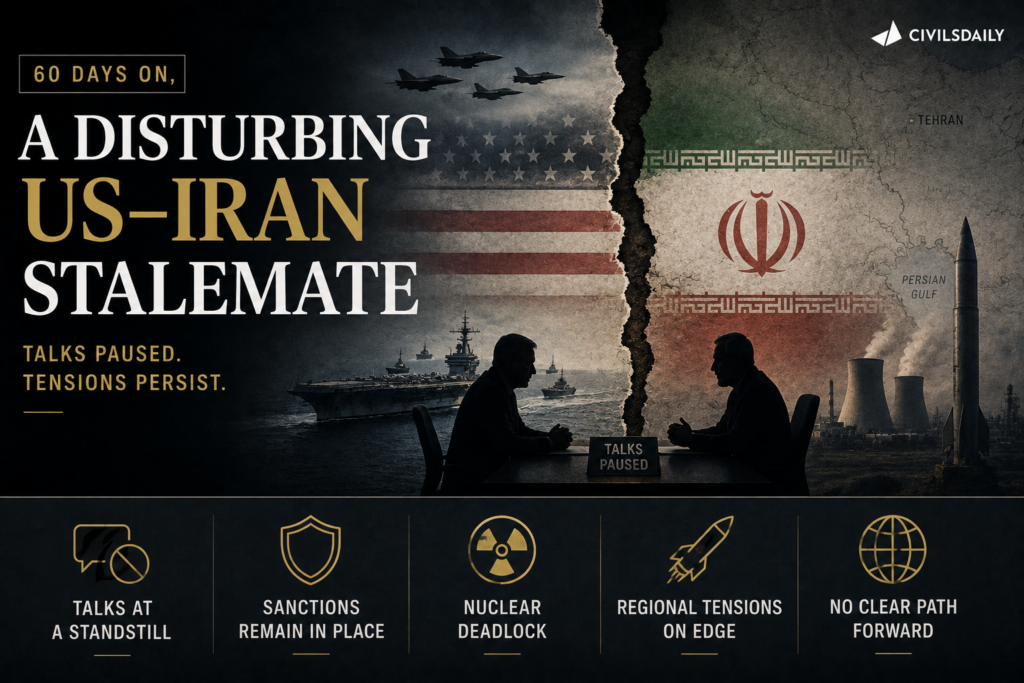
  • 60 days on, a disturbing US-Iran stalemate

    Why in the News

    The 60 day window for the United States and Iran to agree a long term peace framework expired on 17 August 2026 with no agreement. Both sides had already shut that window through late June and July while trading strikes, and the Strait of Hormuz remains blockaded by Iran and counterblockaded by the United States. A deadlock that neither side can end now holds global oil and gas movement hostage.

    What is the US Iran Memorandum of Understanding of 17 June?

    1. What it was: An interim understanding signed on 17 June 2026 that declared the immediate and permanent termination of military operations on all fronts.
    2. The clock: It set a 60 day timeframe, extendable by mutual consent, within which a broader agreement was to be reached.
    3. What the broader deal covered: Limits on Iran’s nuclear programme on one side and the lifting of United States sanctions on the other.
    4. The disputed clause: Point 5 was read by Tehran as giving it the right to manage the Strait of Hormuz, which it shares with Oman. Washington rejected that reading.
    5. How it collapsed: Hostilities resumed once Iran began firing on vessels it said were using an unapproved route through the waterway.
    6. Status on expiry: No long term framework exists. The interim text is the only agreed document and it is no longer being observed.

    What is the Strait of Hormuz?

    1. Location: A narrow sea passage connecting the Persian Gulf to the Gulf of Oman and the Arabian Sea, bordered by Iran to the north and Oman and the United Arab Emirates to the south.
    2. Why it matters: About a fifth of global oil and liquefied natural gas moved through it before the war, with no overland route able to absorb that volume.

    What is a naval blockade?

    1. Definition: A blockade is the use of warships to stop shipping from entering or leaving a coast or a waterway.
    2. The two sided version here: Iran has closed the strait to traffic it has not approved. The United States has answered with a counterblockade of Iranian ports that it says it can sustain indefinitely by rotating ships.

    What is the Bab el Mandeb Strait?

    1. Location: The passage between Yemen and Djibouti that links the Red Sea to the Gulf of Aden, and so links Suez traffic to the Indian Ocean.
    2. Current state: The Yemen based Houthi group enforces a partial blockade there, which puts a second chokepoint on the same route at risk.

    What are strategic petroleum reserves?

    1. Definition: Underground crude oil stocks held by the State to cover consumption when imports are cut off by war, sanctions or a supply shock.
    2. How they work: The reserve is filled when prices are low and released into refineries when supply stops, so the shock reaches the economy slowly rather than at once.

    Why did the 60 day framework fail to hold?

    1. Interpretation, not intent: The understanding began to unravel largely over disagreement on how its own terms should be read, not over a refusal to talk.
    2. The strait stayed shut: The framework never reopened the Strait of Hormuz, which Iran has effectively blockaded since the Israel and United States attack of 28 February 2026.
    3. The war widened instead: The 60 day period saw the Houthis and Saudi Arabia begin attacking each other, extending the conflict to a second waterway.
    4. Escalation on the ground: Iranian drones struck the office of the Kurdistan Regional Government’s prime minister in northern Iraq on 17 August.
    5. Policy shift in Tehran: A senior Iranian official stated that Iran has moved from a defensive to a fully offensive posture and would strike to break the American naval blockade if diplomacy failed.
    6. Parallel track: Iran and Oman have separately negotiated the coordinates of a jointly managed route through the strait, and progress there has been slow.

    Which figures define the scale of the disruption?

    1. Transit collapse: Traffic through the strait fell to two vessels in a day against more than 130 daily before the conflict.
    2. Share of world energy: About one fifth of global oil and liquefied natural gas flowed through the strait before the war.
    3. Timeline: The war was launched on 28 February 2026. The Memorandum of Understanding was signed on 17 June and its window closed on 17 August.
    4. Second chokepoint: Seven missiles were fired at the Bab el Mandeb Strait and the Mokha coastline in a single day, alongside Houthi claims of striking a Saudi landing ship and four patrol boats.
    5. Spillover count: The Kurdistan region of Iraq has been targeted more than 1,000 times by Iran and pro Iran armed groups since the war began.
    6. Environmental cost: A 160 km oil slick from a bulk carrier struck by a projectile spread off Qeshm island and threatened the Hara mangrove forests, a UNESCO biosphere reserve.
    7. India’s gas shift: Indian liquefied natural gas imports rose 15.4 percent to 7.08 million tonnes over May to July as Qatari supply collapsed.

    Why are both sides doubling down on economic warfare?

    1. Lesson learned in Washington: Bombing alone has not dislodged the government in Tehran, and the United States is running low on munitions.
    2. Lesson learned in Tehran: The United States has come to stay in the region, and ballistic missiles fired at American bases or at Israel will not change that.
    3. American instruments: Washington has rescinded sanction waivers on Iranian oil in the international market and threatens to hold its naval blockade of Iranian ports indefinitely.
    4. Iranian instrument: Tehran’s single point of leverage is the strait itself, which it can keep closed at low cost to its own military.
    5. Iran’s political bet: Tehran calculates that it can squeeze the American administration until the midterm elections and treats the stalemate as the new balance of power.
    6. The American constraint: With a midterm election approaching, the United States President must show that the pressure campaign is producing results without trapping the country in another foreign war.

    What do the positions of other States in the conflict demonstrate?

    1. Oman: It shares the strait with Iran and is negotiating a jointly managed route with Tehran, which makes a small mediating State the only working channel. The United States President has threatened to bomb Oman if it gets in the way of a deal.
    2. Gulf States and the Malacca model: Oman, backed by Gulf States, offered Iran a scheme of voluntary transit fees for using the strait, modelled on the arrangement used in the Strait of Malacca.
    3. Israel: It launched the war jointly with the United States on 28 February, which is why the closure of the strait is treated in Tehran as a response to an attack rather than an independent act.
    4. Saudi Arabia: It is now in direct exchange of fire with the Houthis, which shows how a bilateral war spreads to a second chokepoint through proxies.
    5. Yemen and the Houthis: A non State armed group enforces a partial blockade of the Bab el Mandeb using ballistic missiles and drones against naval and commercial shipping.
    6. Iraq and the Kurdistan region: Iranian drones and pro Iran armed groups have struck the autonomous region’s leadership more than 1,000 times, showing that the conflict travels through weak neighbouring States.
    7. Qatar: Its liquefied natural gas exports must cross the strait, which is why the shutdown forced buyers such as India to switch to United States, Nigerian, Omani and Angolan cargoes.

    Where does the stalemate turn against both sides?

    1. Each side believes time favours it: Tehran is waiting out the American electoral calendar. Washington is waiting for economic pain to force a concession.
    2. Neither can convert leverage: Neither party has gained decisive leverage to force a settlement, and neither can end the conflict on its own terms.
    3. Rhetoric against interest: The American position swings between threatening to bomb a mediating State and insisting that a negotiated settlement is possible.
    4. Cost falls on third parties: The deadlock means the rest of the world remains hostage to a conflict that neither side is capable of ending.
    5. Stalemate as an outcome: The likeliest result is not victory for either side but the deadlock itself becoming the new normal.
    6. Diplomacy is not a hedge: For States dependent on the strait, waiting for a settlement is a bet on two governments that have both chosen to wait.

    What does the stalemate demand of India?

    1. Managed so far: India has absorbed the consequences of the closure to date without a visible supply failure.
    2. Three interests exposed: A persisting stalemate puts India’s economic, energy and strategic interests at risk together, not one at a time.
    3. Diplomacy alone is insufficient: Negotiating access with either party does not remove the underlying dependence on a single waterway.
    4. Cut import dependence: India must reduce its overwhelming dependence on imported oil rather than manage each disruption as it arrives.
    5. Build larger reserves: Strategic petroleum reserve capacity has to be expanded well beyond present levels. Oil and Natural Gas Corporation is to reserve half of its 1.75 million tonne Mangaluru facility for strategic storage.
    6. Diversify and substitute: Gas sourcing has already shifted to the United States, Nigeria, Oman and Angola, and investment in alternative energy is the only durable substitute.

    Challenges to India’s energy security in a Hormuz disruption

    1. Single route concentration: A large share of Indian crude and gas passes one 21 nautical mile wide passage with no overland alternative. e.g. Qatari liquefied natural gas supply to India collapsed once the strait shut.
    2. Reserve cover is thin: Indian strategic reserves cover only a few days of national consumption against the 90 day standard used by International Energy Agency members. e.g. phase one caverns at Visakhapatnam, Mangaluru and Padur hold 5.33 million tonnes in total.
    3. Freight and insurance shock: War risk premiums and rerouting raise the landed cost of every cargo even when volumes are secured. e.g. Red Sea diversions around the Cape of Good Hope from 2024 added roughly two weeks to voyages from Europe.
    4. Currency and fiscal transmission: An oil price spike widens the current account deficit and pushes up subsidy and inflation pressure together. e.g. every $10 rise in the crude price is estimated to add close to 0.4 percent of gross domestic product to India’s import bill.
    5. Refinery configuration: Indian refineries are tuned to specific crude grades, so substitution is not simply a question of finding any seller. e.g. sour heavy Gulf grades cannot be replaced one for one by lighter Nigerian or United States crude.
    6. Diaspora and remittance exposure: About nine million Indians work in the Gulf, and a wider war puts both their safety and their transfers at risk. e.g. evacuation operations of the scale of Operation Ajay in 2023.
    7. Shipping and seafarer risk: Indian crews form a large share of global merchant manning and are directly exposed to attacks on commercial vessels. e.g. the drone strike on a merchant vessel in the Arabian Sea in December 2023.

    Conclusion

    The lapse of the 60 day window confirms that the closure of the Strait of Hormuz is no longer a temporary interruption but the working balance of power between two governments that both expect the other to break first. For India the practical consequence is that the exposure is structural and cannot be negotiated away one shipment at a time. Reduced dependence on imported crude, a materially larger strategic reserve and a faster shift to alternative energy are the only responses that survive whichever way the deadlock ends.

    About Global Maritime Chokepoints

    1. Definition: A chokepoint is a narrow shipping channel through which a large share of world trade must pass, so a closure at that point reroutes or halts global flows.
    2. Strait of Hormuz: The single largest oil chokepoint, carrying roughly 20 million barrels a day of petroleum liquids before the war, about a fifth of world consumption.
    3. Strait of Malacca: The busiest passage between the Indian and Pacific Oceans, carrying most of the crude bound for China, Japan and South Korea.
    4. Bab el Mandeb: The Red Sea entrance that connects Suez traffic to the Indian Ocean, about 18 nautical miles wide at its narrowest.
    5. Suez Canal and Panama Canal: Artificial chokepoints whose closure adds thousands of nautical miles to a voyage. e.g. the Ever Given grounding blocked Suez for six days in March 2021.
    6. Turkish Straits and Danish Straits: The Bosphorus and Dardanelles carry Black Sea grain and Russian crude. The Danish Straits carry Baltic exports.
    7. India’s position: India lies alongside the Indian Ocean sea lanes that connect Hormuz and Malacca, which makes it both exposed to and capable of policing these routes.

    Treaty Framework Governing Passage Through International Straits

    1. United Nations Convention on the Law of the Sea, 1982: The framework treaty governing maritime zones, navigation rights and the settlement of maritime disputes.
    2. Article 3: Allows a coastal State a territorial sea of up to 12 nautical miles, which is why the Strait of Hormuz falls within Iranian and Omani waters.
    3. Article 37: Applies the transit passage regime to straits used for international navigation between one part of the high seas and another.
    4. Article 38: Guarantees all ships and aircraft the right of transit passage, which cannot be suspended by the bordering States.
    5. Article 44: Bars States bordering a strait from hampering or suspending transit passage and requires them to publicise navigational hazards.
    6. Article 88 and Article 301: Reserve the high seas for peaceful purposes and bar the threat or use of force against the territorial integrity of any State.
    7. Iran’s position: Iran signed but has not ratified the Convention, and argues that the transit passage regime does not bind a non party.

    Laws and Rules Governing India’s Oil and Gas Security

    1. Petroleum Act, 1934: Regulates the import, transport, storage, production and refining of petroleum and petroleum products.
    2. Oilfields (Regulation and Development) Act, 1948: Governs the grant of exploration and production rights over petroleum and natural gas.
    3. Territorial Waters, Continental Shelf, Exclusive Economic Zone and Other Maritime Zones Act, 1976: Defines India’s maritime zones and the rights India exercises in each of them.
    4. Merchant Shipping Act, 1958: Governs registration, safety and manning of Indian flag vessels and the protection of Indian seafarers.
    5. Petroleum and Natural Gas Regulatory Board Act, 2006: Creates the downstream regulator for refining, transport, distribution and marketing, other than production.
    6. Essential Commodities Act, 1955: Allows the Union government to control the production, supply and distribution of petroleum products in a scarcity.
    7. Energy Conservation Act, 2001: Provides the legal base for efficiency standards and, after the 2022 amendment, for a domestic carbon credit trading scheme.

    Back2Basics: Strait of Hormuz

    1. Designation: A maritime chokepoint, tracked in the Places in News list as a strategic waterway rather than a protected area.
    2. Location: Between Iran on the north and Oman’s Musandam peninsula and the United Arab Emirates on the south.
    3. Connects: The Persian Gulf on one side to the Gulf of Oman and the Arabian Sea on the other.
    4. Dimensions: About 21 nautical miles wide at its narrowest, with inbound and outbound shipping lanes of about two miles each separated by a buffer.
    5. Littoral States: Iran, Oman and the United Arab Emirates. Qatar, Bahrain, Kuwait and Iraq have no route to the open ocean except through it.
    6. Islands: Qeshm, Hormuz, Larak, and the disputed Abu Musa and the Greater and Lesser Tunbs, held by Iran and claimed by the United Arab Emirates.
    7. Ecology: The Hara mangrove forests off Qeshm island, dominated by grey mangrove, form a UNESCO biosphere reserve.

    Government Initiatives

    1. Indian Strategic Petroleum Reserves Limited: Builds and operates India’s underground crude caverns. Phase one covers Visakhapatnam, Mangaluru and Padur with a combined 5.33 million tonnes.
    2. Strategic reserve phase two: Approved caverns at Chandikhol in Odisha and a second Padur facility, adding about 6.5 million tonnes of capacity.
    3. Hydrocarbon Exploration and Licensing Policy and Open Acreage Licensing Policy: Replace production sharing with a revenue sharing model and let bidders select blocks on their own initiative to raise domestic output.
    4. National Green Hydrogen Mission: Approved in 2023 to build five million tonnes of annual green hydrogen capacity by 2030 and cut fossil fuel imports.
    5. Ethanol Blended Petrol Programme: Substitutes imported crude with domestic ethanol. The 20 percent blending target was advanced to 2025 and met.
    6. PM Surya Ghar Muft Bijli Yojana: Supports rooftop solar in one crore households, shifting household demand away from fossil generation.
    7. Overseas equity oil: ONGC Videsh Limited holds producing assets abroad so that a share of India’s crude comes from equity rather than the spot market.

    Key Facts about India’s Oil and Gas Dependence

    1. Import dependence: India imports over 85 percent of the crude oil it consumes and about half of its natural gas.
    2. Consumption rank: India is the third largest consumer of crude oil in the world after the United States and China.
    3. Refining capacity: India is the fourth largest refiner globally, with Jamnagar in Gujarat the largest single refining complex in the world.
    4. Main suppliers: Russia, Iraq, Saudi Arabia, the United Arab Emirates and the United States are the largest sources of Indian crude imports.
    5. Gas sources: Qatar has been India’s largest supplier of liquefied natural gas, delivered under long term contracts through Hormuz.
    6. Reserve benchmark: International Energy Agency members hold 90 days of net import cover. India’s strategic reserves cover only a small fraction of that.
    7. Institutional link: India became an Association country of the International Energy Agency in 2017 and has sought full membership.

    Challenges in India’s Energy Security

    1. Import concentration by geography: A single region supplies a majority of Indian crude, so one regional conflict moves the whole import basket. e.g. West Asian suppliers accounted for the bulk of Indian crude before Russian barrels rose after 2022.
    2. Payment and sanctions exposure: Secondary sanctions can strand a supply relationship that is otherwise commercially sound. e.g. Indian refiners halted Iranian crude purchases in 2019 after the United States ended sanction waivers.
    3. Domestic production decline: Output from ageing fields keeps falling even as demand rises, widening the import gap. e.g. Mumbai High output has fallen steadily from its peak levels.
    4. Storage and pipeline gaps: Gas cannot reach demand centres without a completed grid, so imported cargoes are stranded at terminals. e.g. sections of the Urja Ganga pipeline in eastern India took over a decade to commission.
    5. Critical mineral dependence in the transition: A shift to electric mobility replaces oil dependence with lithium, cobalt and rare earth dependence. e.g. India imports nearly all of its lithium and cobalt requirement.
    6. Grid readiness for renewables: Variable solar and wind output needs storage and balancing capacity that does not yet exist at scale. e.g. curtailment of renewable generation in high output states during low demand hours.
    7. Price pass through politics: Retail fuel prices are politically managed, so a crude spike lands on oil marketing company balance sheets rather than consumers. e.g. under recoveries absorbed by public sector oil marketing companies during 2021 and 2022.

    Way Forward

    1. Expand strategic storage: Complete the phase two caverns and move Indian cover toward the 90 day benchmark used by International Energy Agency members.
    2. Commercialise reserve operation: Allow foreign and private participation in cavern filling so storage is built and rotated without full budgetary funding.
    3. Diversify supply geography: Hold standing contracts across West Asia, West Africa, the Americas and Russia so no single waterway carries a majority of volumes.
    4. Accelerate substitution: Scale ethanol blending, compressed biogas, green hydrogen and electric mobility so demand growth is not met by imported crude.
    5. Secure the sea lanes: Sustain Indian naval deployments for merchant escort in the Gulf of Aden and the Arabian Sea, and expand maritime domain awareness sharing.
    6. Build the gas grid: Complete the national gas grid and city gas networks so imported and domestic gas reaches demand centres.
    7. Deepen mineral supply chains: Secure lithium, cobalt and rare earth supply through overseas assets and domestic processing so the energy transition does not create a fresh chokepoint.

    “[2026] Ships from which of the following countries have to cross the Strait of Hormuz to reach out to the Indian Ocean?
    1. Bahrain
    2. Syria
    3. Qatar
    4. Egypt
    (a) 1 and 2
    (b) 1 and 3
    (c) 2 and 3
    (d) 3 and 4

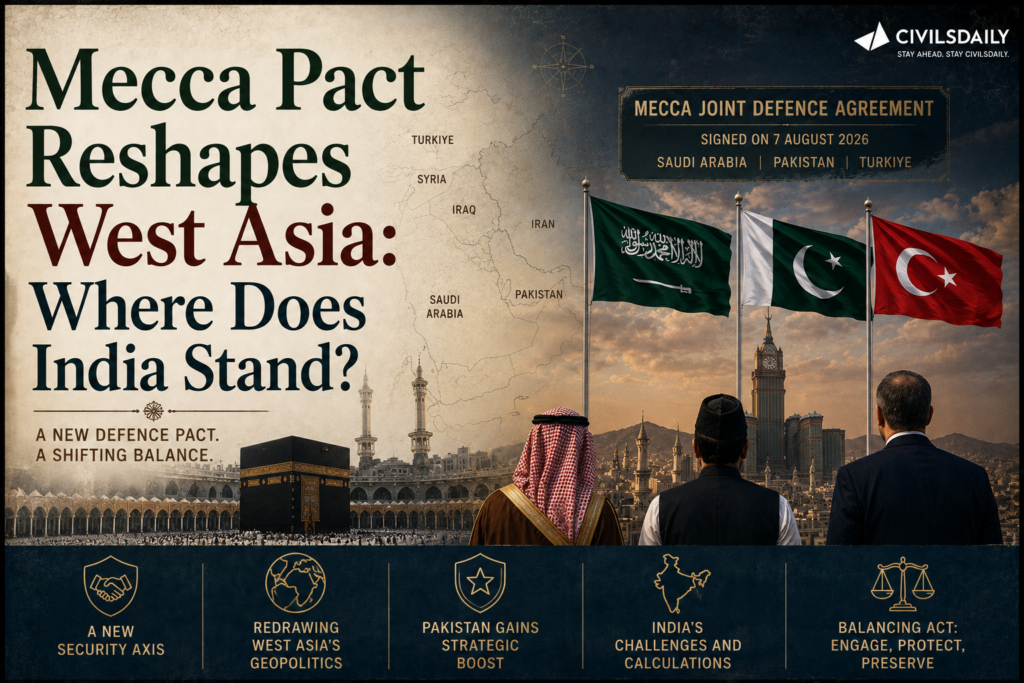
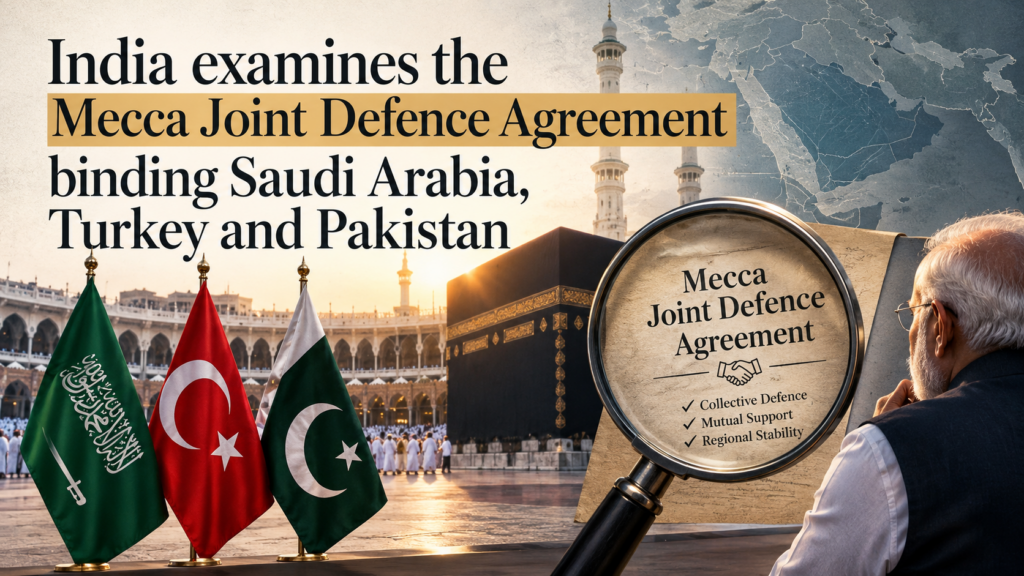
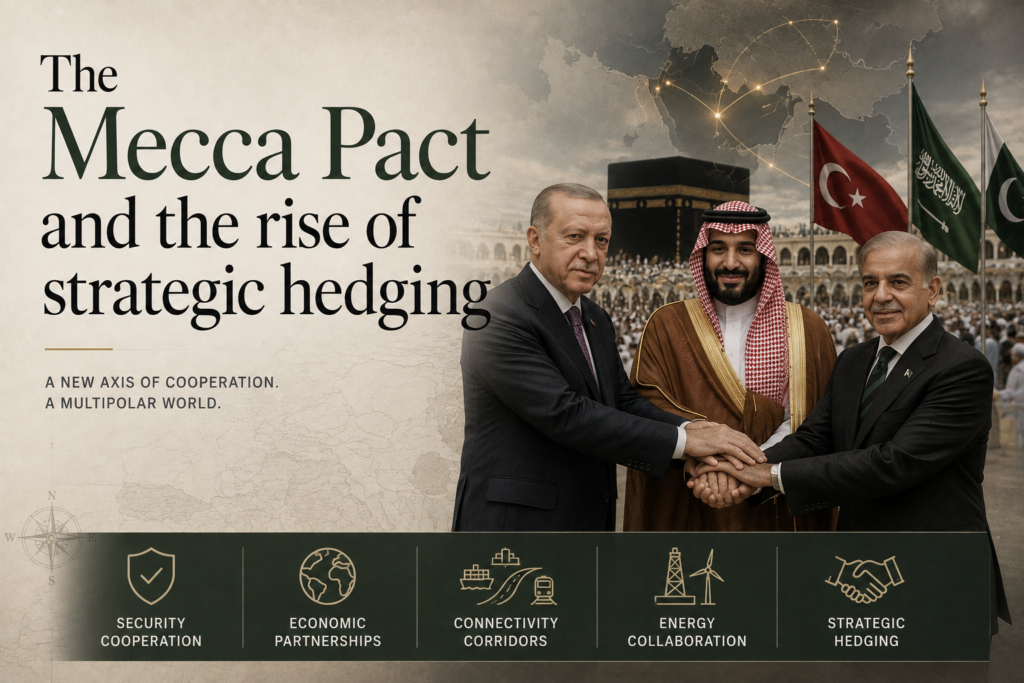
  • [17th August 2026] The Hindu OpED: Mecca Pact Reshapes West Asia: Where Does India Stand?

    Why in the News

    A collective defence pact signed in Mecca between Saudi Arabia, Turkiye and Pakistan has altered the security architecture of West Asia. The pact pools Saudi capital, Pakistani military strength and Turkish defence technology, and is aimed at deterring Israel rather than Iran. India built a decade of gains in the region and now has no declared strategy to answer this realignment.

    What did India build in West Asia over the past decade?

    1. 2016, Saudi recognition: Saudi Arabia awarded India’s Prime Minister its highest civilian honour, marking a shift in the political relationship.
    2. 2021, I2U2: The I2U2 agreement was signed, tying India into a grouping with Israel, the United States and the UAE.
    3. 2024, Chabahar: Iran leased Chabahar port to India, giving overland access towards Afghanistan and Central Asia that bypasses Pakistan.
    4. The UAE relationship: India cultivated a special relationship with the UAE built on remittances from Indian expatriate workers, investments by Indian business in the UAE, and UAE strategic investments in India.
    5. Where they stand now: These are gains from the past, and India’s footprint is contracting one country at a time.

    Why is the region’s security order breaking down now?

    1. A war that spread: In the last four months the United States and Israel war with Iran escalated into a regional conflict.
    2. Iran against the Gulf: Iran attacked GCC countries, ending the assumption that the Gulf monarchies sit outside the fighting.
    3. Saudi strikes in Iraq: Saudi Arabia hit Iraqi militias.
    4. Attacks at sea: The Houthis attacked Saudi ships.
    5. Israeli strikes: Israel carried out strikes in multiple countries.
    6. The American umbrella in doubt: Gulf states are rethinking the efficacy of the United States security umbrella and now see a threat from both Iran and Israel.
    7. A schism over method: The Gulf is split between handling that threat through engagement, the UAE approach, and through deterrence, which Saudi Arabia is contemplating.

    How has Pakistan converted the regional crisis into diplomatic capital?

    1. The mediator role: Pakistan’s role as mediator in the United States and Iran conflict is earning it reputational benefits across the region.
    2. The timing: It entered when no one else could bring the United States President and the Iranians to the table.
    3. Who had failed first: Turkiye, Qatar and Egypt had all attempted mediation without success.
    4. The pact as the payoff: The Mecca collective defence pact follows directly from that diplomatic moment.
    5. The Israel risk for India: A future Israel and Pakistan war would draw India in, given the close India Israel partnership.
    6. The Turkiye risk for India: Greater Turkish support for Pakistan in a future India Pakistan conflict cannot be ruled out.

    What do the positions of individual regional states reveal about the new architecture?

    1. Saudi Arabia, deterrence and a new maritime force: Riyadh is moving from engagement to deterrence, supplies the capital leg of the Mecca pact, and is raising a Saudi led maritime force for the Red Sea that India is not part of.
    2. Turkiye, technology as leverage: Ankara contributes defence technology to the pact and runs a deepening military relationship with Pakistan that India has no channel to discuss.
    3. Pakistan, military manpower as currency: Islamabad supplies the military strength the pact rests on, converting an army into diplomatic capital with Gulf financiers.
    4. United Arab Emirates, engagement over deterrence: Abu Dhabi manages the Iran and Israel threat through engagement, and carries mounting differences with Saudi Arabia plus positions against United Nations recognised governments in conflicts as far away as Sudan.
    5. Iran, from partner to belligerent: Tehran leased Chabahar to India in 2024 and has since attacked GCC states, putting India’s connectivity asset inside an active war zone.
    6. Israel, strikes that created the pact: Israeli operations across multiple countries made three regional states conclude they are next, which is the design logic of the Mecca pact.

    Why does India’s current posture carry risk?

    1. The Israel bet: India’s approach rests on confidence in Israel’s victory, drawn from Israel’s proximity to the United States.
    2. The American consensus is shifting: Both Make America Great Again Republicans and Democratic Socialists now question the once unquestioned United States support for Israel.
    3. Israel alone: Whether Israel can prevail without assured American backing is unsettled.
    4. The UAE bet: The second pillar of India’s regional position is the UAE relationship, resting on remittances, elite investment and Emirati investment in India.
    5. UAE exposure: The UAE’s differences with Saudi Arabia and its Sudan positions place that pillar at risk.

    What are the choices before India?

    1. Formal alignment: India can sign military alliances with Israel and the UAE.
    2. The cost of alignment: That would damage what is left of India’s relationships with Iran and Saudi Arabia.
    3. Continued inaction: India can do nothing, which is the current position.
    4. Cost of inaction, seafarers: Indian merchant mariners continue to be killed in the Strait of Hormuz.
    5. Cost of inaction, shipping: More Indian ships sink in the Bab-el-Mandeb.
    6. Reputational cost: A great power in the making appears hobbled in its own immediate maritime neighbourhood.
    7. The third way: India can devise an active regional political strategy instead of choosing between alignment and drift.

    What would an active Indian regional strategy involve?

    1. Renewed engagement with Saudi Arabia: India has no explicit differences with Riyadh, which makes it the cheapest relationship to rebuild.
    2. Arab and Iran trust building: India can work to rebuild trust between Arab states and Iran, beginning with the UAE and Iran relationship.
    3. Jordan’s security: India can offer defensive technologies to Jordan at a time when United States munitions are running low.
    4. Lebanon peacekeeping: India can take a role in the future UN peacekeeping presence in Lebanon, with UNIFIL forecast to end.
    5. A back channel with Turkiye: India can share its red lines on Turkiye’s relationship with Pakistan through a quiet channel.
    6. Red Sea shipping with Egypt: If India cannot join the Saudi led maritime force, it can work with Egypt on a parallel effort to protect India bound shipping from the Suez Canal to Bab-el-Mandeb.
    7. A military presence: India can examine a presence in the Red Sea region, in Somaliland or Socotra.
    8. Exercises with the region: Existing military training exchanges can be scaled into joint drills and exercises with a range of regional states.
    9. A Special Envoy for West Asia: India can appoint one who draws all the threads together, rather than one confined to the Israel and Palestine peace process.

    Challenges to India’s West Asia Strategy

    1. The alliance trap: Any formal military alignment with one camp forecloses the other, since Iran and Saudi Arabia both read Indian alignment as a choice against them. e.g. India’s Chabahar development slowed each time United States sanctions pressure on Iran tightened.
    2. The Turkiye and Pakistan axis: Turkish defence technology transfers to Pakistan directly degrade India’s conventional edge. e.g. Turkish origin Songar armed drones were used against Indian positions during the May 2025 hostilities.
    3. Chokepoint exposure: India’s trade and energy routes converge on two narrow straits it cannot secure alone. e.g. Houthi attacks from late 2023 forced Indian bound shipping to reroute around the Cape of Good Hope, raising freight and insurance costs.
    4. Attacks on Indian crewed shipping: Indian seafarers crew a large share of global merchant vessels and absorb the human cost of regional escalation. e.g. the drone strike on MV Chem Pluto off Porbandar in December 2023.
    5. Evacuation burden: Every escalation converts India’s diaspora presence into a mass evacuation operation. e.g. Operation Kaveri from Sudan in 2023 and Operation Sindhu from Iran and Israel in June 2025.
    6. No standing regional mechanism: India has no dedicated envoy or regional platform to convert bilateral goodwill into collective influence. e.g. the piece’s own recommendation for a Special Envoy for West Asia has no existing counterpart in the Indian system.
    7. Exclusion from new regional security structures: New arrangements are being built without Indian participation. e.g. the Saudi led Red Sea maritime force, which India is not part of.

    Conclusion

    West Asia’s security architecture is being rebuilt around a Saudi Arabia, Turkiye and Pakistan pact designed to deter Israel, and India has no strategy that matches the scale of that change. Formal alignment with Israel and the UAE costs India Iran and Saudi Arabia, and inaction costs it seafarers, ships and standing. The workable route is an active regional political strategy built on renewed engagement with Riyadh, trust building between the Arab states and Iran, and a dedicated envoy. India’s capacity to shape the region survives, its window does not.

    West Asia in India’s Foreign Policy

    1. About: West Asia covers the Gulf monarchies, Iran, Iraq, Israel, Turkiye and the Levant, treated in Indian policy as an extended neighbourhood rather than a distant theatre.
    2. Policy label: India’s approach shifted from Look West to Link West, moving beyond oil and labour transactions towards defence, technology and investment partnerships.
    3. Energy: West Asia remains a principal source of India’s crude oil imports, and Qatar is India’s largest supplier of liquefied natural gas.
    4. Diaspora: About 9 million Indians live and work in the Gulf, the largest concentration of the Indian diaspora anywhere.
    5. Remittances: India is the world’s largest recipient of remittances, receiving over 100 billion dollars annually, with the Gulf a major contributor.
    6. Trade: The UAE is among India’s top three trading partners, and the India UAE Comprehensive Economic Partnership Agreement took effect in May 2022.
    7. Connectivity: The India Middle East Europe Economic Corridor (IMEC) was announced on the margins of the G20 New Delhi Summit in September 2023.

    Back2Basics: Gulf Cooperation Council

    1. Formation: Established in 1981 at Abu Dhabi.
    2. Headquarters: Riyadh, Saudi Arabia.
    3. Members: Saudi Arabia, the United Arab Emirates, Kuwait, Qatar, Bahrain and Oman.
    4. Mandate: Coordination and integration among members in economic, defence, security and cultural affairs.
    5. Military arm: The Peninsula Shield Force, a joint military force raised in 1984.
    6. Economic instrument: A unified economic agreement and a customs union among the six members.
    7. India link: India is not a member, and engages the bloc through bilateral strategic partnerships and an India GCC ministerial mechanism.

    Government Initiatives for India’s West Asia Engagement

    1. Link West Policy: Reframes the Gulf and West Asia as a zone of strategic partnership rather than an energy and labour market alone.
    2. I2U2: Joint investment platform with Israel, the United States and the UAE across food security, clean energy and health.
    3. India Middle East Europe Economic Corridor: Rail and shipping corridor linking India to Europe through the Gulf, announced in September 2023.
    4. India UAE Comprehensive Economic Partnership Agreement, 2022: India’s first Gulf trade agreement, cutting tariffs on the bulk of traded goods.
    5. Chabahar long term contract, 2024: A ten year agreement for operating the Shahid Beheshti terminal, giving India a port outside the Strait of Hormuz.
    6. eMigrate portal and Pravasi Bharatiya Bima Yojana: Registration and mandatory insurance cover for Indian workers emigrating to Gulf destinations.
    7. Evacuation operations: Operation Sindhu, Operation Ajay and Operation Kaveri, evacuating Indians from Iran and Israel, Israel and Sudan respectively.
    8. Operation Sankalp: Indian Navy deployment in the Gulf of Oman and the Persian Gulf to escort Indian flagged merchant shipping.

    Key Facts about India and West Asia

    1. The Strait of Hormuz carries roughly a fifth of global oil consumption and has no practical bypass for most Gulf exporters.
    2. The Bab-el-Mandeb is the southern gate of the Red Sea and the compulsory approach to the Suez Canal.
    3. Chabahar is Iran’s only oceanic port, on the Gulf of Oman, and lies outside the Strait of Hormuz.
    4. India’s overseas military logistics access includes Duqm in Oman, agreed in 2018.
    5. I2U2 was agreed in 2021 and held its first leaders summit in July 2022.
    6. India is not a member of the Organisation of Islamic Cooperation, and was invited as guest of honour to its foreign ministers meeting at Abu Dhabi in 2019.
    7. The GCC has six members; the wider Arab League has 22.

    “[2025, GS2, 15 marks] “Energy security constitutes the dominant kingpin of India’s foreign policy, and is linked with India’s overarching influence in Middle Eastern countries.” How would you integrate energy security with India’s foreign policy trajectories in the coming years?”

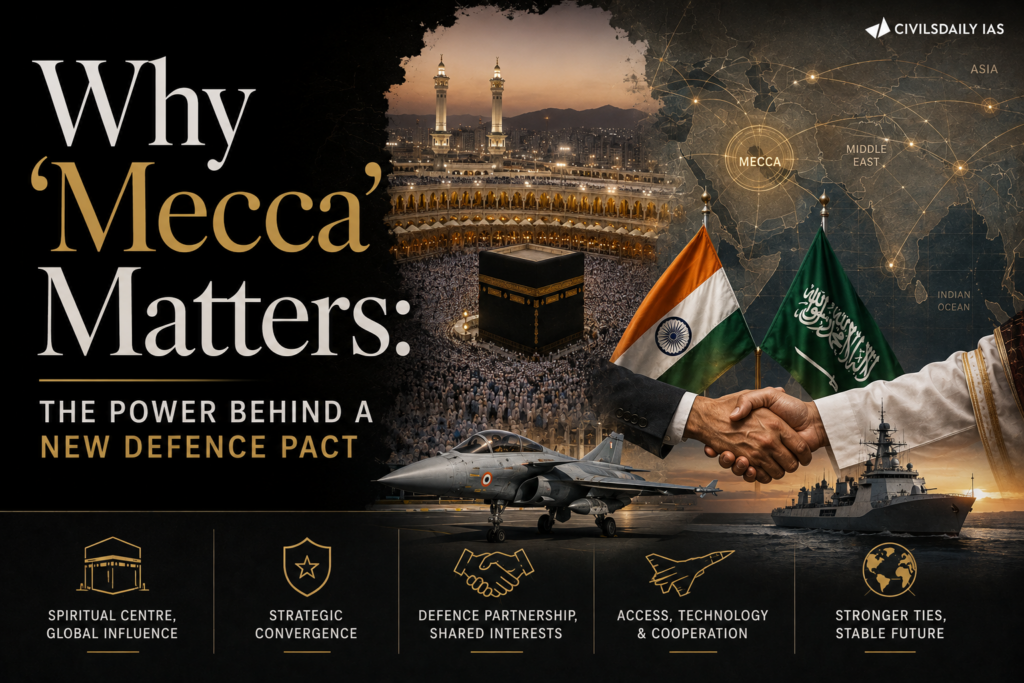
  • Power of the name: Why ‘Mecca’ matters in new defence pact

    Why in the News

    The Mecca Joint Defence Agreement, signed on 7 August 2026 by Saudi Arabia, Pakistan and Turkiye, takes its name from Islam’s holiest city. The naming choice is read as a deliberate framing device that lets each signatory claim a different benefit from the same text. The tension is between the civilisational legitimacy the name projects and the narrow, technical liabilities the agreement’s legal text actually creates.

    What is the Mecca Joint Defence Agreement?

    1. About: The Mecca Joint Defence Agreement is a trilateral defence arrangement between Saudi Arabia, Pakistan and Turkiye, signed on 7 August 2026.
    2. Naming: The agreement is named for the city of Mecca, which carries religious authority across the Muslim world.
    3. Legal character: The operative text keeps mutual obligations technical and limited, rather than creating an automatic collective defence commitment.
    4. Point of interest: The gap between the symbolic name and the limited legal commitment is the substance of the analysis.

    Why does the name carry strategic work?

    1. Saudi objective: The name lets Riyadh reassert leadership of the Muslim world by anchoring a security arrangement in custodianship of the holy cities.
    2. Pakistani objective: Islamabad can present the arrangement domestically as a holy alliance, converting a defence pact into religious legitimacy.
    3. Turkish objective: Ankara can frame defence exports as civilisational solidarity rather than as commerce.
    4. Shared function: One name allows three different domestic narratives without changing a word of the text.

    What is the comparable precedent in agreement naming?

    1. Abraham Accords, 2020: The normalisation agreements between Israel and several Arab states were named for the shared patriarch of Judaism, Christianity and Islam.
    2. Stated rationale: The naming was explained at the time as invoking a common religious ancestry to frame a political settlement.
    3. Effect achieved: The name softened a security and recognition arrangement into a civilisational reconciliation.
    4. Parallel drawn: The Mecca naming performs the same function for a defence arrangement, transferring the technique from normalisation to security.

    What does the arrangement mean for India?

    1. Pakistan’s external depth: A formal defence link with Saudi Arabia and Turkiye enlarges Pakistan’s strategic and financial backing.
    2. Gulf relationship: India’s ties with Saudi Arabia rest on energy supply, remittances from a large expatriate workforce and defence cooperation, which the arrangement does not displace.
    3. Turkiye divergence: Ankara’s position on Kashmir at multilateral forums remains the sharpest point of difference with India.
    4. Limits of the pact: The technical character of the obligations restricts how far Pakistan can invoke it in a bilateral contingency.

    Where does the analysis turn against its own framing?

    1. Symbolism versus obligation: A powerful name does not create an automatic defence commitment, and the text deliberately avoids one.
    2. Divergent interests: Saudi Arabia’s normalisation track with Israel and Turkiye’s position on Gaza are not aligned, which limits joint action.
    3. Reading risk: Treating the name as evidence of a bloc overstates cohesion the signatories have not committed to.
    4. The real signal: The arrangement marks a shift toward regional security architectures built outside United States security guarantees.

    Challenges to reading the pact as a bloc

    1. Absence of an automatic trigger: The text creates consultation obligations rather than an attack on one is an attack on all clause. e.g. the contrast with Article 5 of the North Atlantic Treaty.
    2. Divergent Israel policy: Signatories differ on normalisation with Israel. e.g. Saudi Arabia’s suspended normalisation track against Turkiye’s public position on Gaza.
    3. Financing dependence: Pakistan’s participation rests on financial support rather than reciprocal capability. e.g. repeated Saudi deposits with the State Bank of Pakistan during balance of payments stress.
    4. Competing regional groupings: Overlapping arrangements dilute exclusivity. e.g. the Gulf Cooperation Council and the Organisation of Islamic Cooperation covering the same members with different mandates.
    5. Defence supply asymmetry: Turkish defence exports create a supplier and buyer relationship, not an alliance of equals. e.g. Turkish drone sales across West Asia and North Africa.
    6. Iran factor: Any Sunni framed security architecture invites an Iranian counter alignment. e.g. the Iran Saudi normalisation of 2023 that the pact’s framing strains.

    Conclusion

    The naming of the agreement is the substantive act, since it manufactures a civilisational legitimacy that the legal text neither requires nor delivers. For India, the operative question is not the pact’s symbolism but whether Saudi Arabia’s energy and remittance relationship with India changes, which it has not. The next milestone is whether the signatories convert consultation obligations into a standing joint command or joint exercise schedule.

    Back2Basics: India and Saudi Arabia

    1. Diplomatic relations were established in 1947, with the relationship upgraded through the Delhi Declaration of 2006 and the Riyadh Declaration of 2010.
    2. The Strategic Partnership Council was established in 2019, with two ministerial committees covering political and security cooperation, and economy and investments.
    3. Saudi Arabia is among India’s top crude oil suppliers and hosts one of the largest Indian expatriate populations.
    4. India and Saudi Arabia conduct the Al Mohed Al Hindi naval exercise.
    5. Saudi Arabia is a partner in the India Middle East Europe Economic Corridor announced at the G20 summit in New Delhi in 2023.

    Way Forward

    1. Deepen the Gulf economic anchor: Convert the Strategic Partnership Council commitments into dated investment and energy supply agreements.
    2. Separate the Turkiye and Saudi tracks: Treat Ankara’s Kashmir position as a bilateral issue rather than allowing it to define the wider Gulf relationship.
    3. Institutionalise defence exchanges: Expand joint exercises and defence industrial cooperation with Gulf partners to keep the relationship independent of third party arrangements.
    4. Secure the energy corridor: Reduce single chokepoint exposure given that a large share of imports transit the Strait of Hormuz.
    5. Engage the Organisation of Islamic Cooperation constructively: Sustain outreach so multilateral resolutions do not consolidate against India by default.

    “[2023, GS2, 15 marks] ‘The expansion and strengthening of NATO and a stronger US-Europe strategic partnership works well in India.’ What is your opinion about this statement? Give reasons and examples to support your answer.”

  • White House transshipment report places India in Tier 1 of illegal transshipment risk

    Why in the News

    A White House report, The Great Transshipment Scam, places India in Tier 1 for elevated illegal transshipment risk, alleging that some Chinese goods are routed through India to evade US tariffs.

    Key Definitions

    • Illegal Transshipment: Routing goods through a third country and making minimal changes to disguise their actual country of origin and avoid tariffs.
    • Tariff Arbitrage: Earning a profit by routing goods through a country with a lower tariff.
    • Rules of Origin: Rules used to determine the country of origin of a product, generally based on where substantial transformation occurs.
    • Substantial Transformation: A manufacturing process that changes a product sufficiently to give it a new identity, character or use.
    • Screwdriver Factory: A facility that mainly assembles imported components with minimal domestic value addition.
    • Section 301: US law allowing action against foreign trade practices considered unfair or discriminatory.
    • Trade Diversion: Shifting trade flows from one country or route to another due to tariffs, restrictions or other trade barriers.

    What does the US report allege?

    • India is placed in Tier 1.
    • The Pune, Gujarat and Chennai production belt is specifically mentioned.
    • Pumps and compressors are cited as examples.
    • India, Mexico and Vietnam together accounted for an estimated $67 billion of transshipped goods in 2025.
    • No punitive action has yet been announced.

    Why does it matter for India?

    • Greater scrutiny of Indian exports.
    • China Plus One manufacturing could face stricter origin verification.
    • Dependence on Chinese components may complicate origin claims.
    • Tariff action could affect India’s access to the US market.

    [2025, GS3, 10 marks] What are the challenges before the Indian economy when the world is moving away from free trade and multilateralism to protectionism and bilateralism? How can these challenges be met?”

    [2017] Consider the following statements:
    1. India has ratified the Trade Facilitation Agreement (TFA) of WTO.
    2. TFA is a part of WTO’s Bali Ministerial Package of 2013.
    3. TFA came into force in January 2016.
    Which of the statements given above is/are correct?

    (a) 1 and 2 only

    (b) 1 and 3 only

    (c) 2 and 3 only

    (d) 1, 2 and 3

  • India examines the Mecca Joint Defence Agreement binding Saudi Arabia, Turkey and Pakistan

    Why in the news?

    Saudi Arabia, Turkey, and Pakistan have signed the Mecca Joint Defence Agreement, a trilateral mutual defence pact that borrows the collective security logic of Article 5 of the NATO charter. The signing exposes a central question for New Delhi: whether the pact gives Pakistan a shield to escalate against India, or whether it is a loose instrument of strategic hedging without the integration of a real military alliance. India’s foreign ministry says it is tracking the situation carefully.

    What is the Mecca Joint Defence Agreement?

    1. About: A mutual defence pact among Saudi Arabia, Turkey, and Pakistan, signed in 2026, that treats an armed attack on any one member as an attack on all.
    2. Design borrowing: It borrows elements of Article 5 of the North Atlantic Treaty Organisation (NATO) charter, including its collective security clause, marking a shift away from the US security umbrella toward regional self-reliance.

    What is Article 5 of the NATO charter?

    1. Collective defence clause: It commits every member to treat an armed attack against one member as an attack against all, and to assist in response.
    2. Why it matters here: The Mecca pact replicates this trigger among three states, which raises the question of how Turkey reconciles it with its existing NATO obligations.

    What is Operation Sindoor?

    1. About: An Indian military operation against terror infrastructure that serves as the reference case for how the three signatories behaved during an India-Pakistan confrontation.
    2. Behaviour observed: Turkey provided Pakistan diplomatic and rhetorical support and sold drones, but stopped short of tangible military assistance, and Saudi Arabia stayed silent.

    What are the three power centres the pact combines?

    1. Pakistan: A declared South Asian nuclear power contributing a powerful conventional military and a functional nuclear arsenal, though it is unclear whether Islamabad has offered a nuclear umbrella.
    2. Saudi Arabia: Provides political and financial clout as leader of the Sunni world and controller of one of the world’s largest oil reserves.
    3. Turkey: The successor of the Ottoman Empire, contributing a powerful military, NATO operational experience, and a highly capable defence industry.
    4. Stated adversaries: The unstated targets are Iran, leader of the Shia world with proxies including Hezbollah and Hamas across Yemen, Iraq, Syria, and Lebanon, and Israel, an intelligence powerhouse and undeclared nuclear power.

    What is the pattern of prior cooperation among the three?

    1. Bilateral base: Pakistan has provided military training and technical assistance to Saudi Arabian forces for decades.
    2. September 2025 pact: Riyadh and Islamabad signed a bilateral Strategic Mutual Defence Agreement, which evolved into the trilateral Mecca Agreement with Ankara’s participation.
    3. Force deployment: Pakistan deployed some 8,000 troops, a squadron of JF-17 fighter aircraft, drones, and HQ-9 air defence systems to Saudi Arabia.
    4. Financial and naval ties: Riyadh has repeatedly provided financial bailouts to Islamabad, and Turkey and Pakistan have exchanged warships and training aircraft.

    Why does the pact worry India directly?

    1. Cold War precedent: Pakistan has a long record of hitching its wagon to pacts to oblige Western powers and gain geopolitical advantage against India, joining the Southeast Asia Treaty Organisation (SEATO) in 1954 to secure advanced weaponry for its struggle over Jammu and Kashmir.
    2. Global South rivalry: Saudi Arabia and Turkey are seen as piggybacking on Pakistan to seek a bigger strategic role in Asia and to challenge India’s ambition to lead the Global South.
    3. Forum coordination: The bloc can coordinate positions in international forums such as the United Nations (UN) and the Organisation of Islamic Cooperation (OIC) on issues including Kashmir and maritime security.
    4. Technology integration: Turkish defence industry output, funded by Saudi capital and deployed in Pakistan, can enhance Rawalpindi’s capabilities in unmanned aerial vehicles (UAVs), electronic warfare, and naval platforms.

    Is this an “Islamic NATO” or strategic hedging? (the central tension)

    1. Case against alarm: Calling it an Islamic NATO is premature because NATO’s efficacy relies on a unified command, pre-assigned forces, and deep interoperability, while the Mecca pact lacks an integrated military headquarters, joint command mechanisms, and institutionalised doctrine.
    2. Divergent priorities: Saudi Arabia is focused on hedging against Iran and Houthi threats, Turkey on defence exports and Islamic-world leadership, and Pakistan on economic bailouts and leverage against India.
    3. Legal limit on the trigger: Mutual defence treaties apply strictly to unprovoked external aggression, so Indian counter-terrorism strikes against Pakistani terror infrastructure do not constitute a treaty trigger.
    4. Saudi restraint: Riyadh’s relationship with New Delhi has evolved into a multi-billion-dollar strategic partnership spanning energy, trade, and intelligence, and the Saudi Crown Prince has no interest in being dragged into a South Asian military conflict.

    How could the interlocking alliances backfire?

    1. World War I analogy: A matrix of interlocking military alliances of exactly this kind triggered World War I, and repeating that blunder would be a serious risk.
    2. Unreconciled obligations: If Israel strikes a Saudi facility and Turkey responds under the Mecca pact, it is unclear whether the 32 NATO countries would be treaty-bound to support Turkey.
    3. Operational hedging: Saudi Arabia’s passivity when Pakistan clashed with Afghanistan, and Pakistan’s non-involvement when Saudi Arabia faced Iranian and Houthi strikes, show these pacts often pair political rhetoric with operational hedging.

    How has the military balance on India’s borders shifted?

    1. Strike corps repurposed: The Indian Army converted a 60,000-strong strike corps configured for the India-Pakistan border into a mountain strike corps for the China border.
    2. Divisions reassigned: Two mountain divisions raised over the last two decades were assigned entirely to the China border.
    3. Earmarking change: Where 70 per cent of the Indian Army was once earmarked for the Pakistan border, only about 55 per cent is today.

    What should India’s calibrated response be?

    1. Discreet engagement: Engage Saudi Arabia candidly through high-level channels to secure assurances that the pact’s defensive clauses apply only to the West Asian theatre and cannot be weaponised by Pakistan.
    2. Firm deterrence: Maintain a firm deterrence doctrine so that Indian responses to state-sponsored terrorism remain resolute and unaffected by third-party arrangements.
    3. Gulf partnerships: Double down on bilateral economic, trade, and strategic partnerships with Saudi Arabia and the broader Gulf Cooperation Council (GCC).
    4. Technology watch: Monitor Turkey-Pakistan military-industrial co-development and prioritise indigenous research to neutralise advanced drones, electronic warfare, and naval platforms.
    5. Procurement reform: Fast-track defence procurement, which has been slowed by bureaucratic caution since the Bofors scandal.

    Conclusion

    The Mecca Agreement is best understood less as a binding warfighting alliance and more as an instrument of strategic hedging for a volatile region, fusing Saudi capital, Turkish technology, and Pakistani manpower into a collective deterrence shield. The central idea is that its danger to India lies not in an immediate collective-defence trigger but in the technology integration and diplomatic bloc it creates. A pragmatic Indian strategy combines firm counter-terrorism deterrence, deep economic engagement in the Gulf, and targeted defence innovation at home.

    West Asian Security Architecture: About

    1. US umbrella in retreat: The United States has signalled limits on its security guarantees to West Asian allies, prompting states to seek self-reliance.
    2. Israeli posture: Israel has demonstrated through its bombing of Iran-linked targets that it will accept no restraints on its perceived security interests.
    3. Realignment: Riyadh, Ankara, and Islamabad have come together in response, marking a shift away from dependence on Washington.

    Back2Basics: Organisation of Islamic Cooperation (OIC)

    1. Convening body: An intergovernmental organisation of Muslim-majority states that coordinates political and economic positions.
    2. Relevance: The Mecca bloc can use the OIC to coordinate positions on issues including Kashmir.
    3. India’s stance: India is not a member and has consistently rejected OIC pronouncements on Kashmir as interference in internal affairs.

    Challenges for India from the pact

    1. Diplomatic bloc formation: A formal political grouping can coordinate against Indian interests at the UN and OIC.
    2. Capability transfer: Turkish drone, electronic warfare, and naval technology reaching Pakistan raises the conventional threat.
    3. Two-front pressure: Deeper Pakistan alignments complicate India’s management of simultaneous China and Pakistan borders.
    4. Gulf balancing: India must protect its expanding Saudi and Gulf partnerships without endorsing the pact.
    5. Escalation ambiguity: Uncertainty over how the collective clause would be read in a crisis raises the risk of miscalculation.

    Way Forward

    1. Bilateral reassurance: Secure written or channelled Saudi and Emirati assurances that the pact excludes India-Pakistan sub-conventional conflict.
    2. Deterrence signalling: Communicate that counter-terror responses will remain resolute and unlinked to third-party pacts.
    3. Indigenous capability: Accelerate counter-drone, electronic warfare, and naval research, seeking foreign partners ahead in these fields.
    4. Economic anchoring: Deepen Gulf trade and energy ties to make India indispensable to Riyadh’s long-term economic vision.
    5. Procurement speed: Streamline defence acquisition to close capability gaps quickly.

    “[2023 GS2 15m] ‘The expansion and strengthening of NATO and a stronger US-Europe strategic partnership works well in India.’ What is your opinion about this statement? Give reasons and examples to support your answer.”

  • Parliamentary panel questions govt on de-dollarisation agenda for the 18th BRICS Summit

    Members of the Parliamentary Standing Committee on External Affairs have asked the government whether it will push a de-dollarisation agenda at the 18th BRICS Summit, which New Delhi hosts in September 2026. The question exposes a tension between the pursuit of greater financial sovereignty and the risk of provoking US retaliation. India holds the rotating chairship of BRICS through 2026, which makes the host nation’s posture on the dollar a live diplomatic choice rather than an abstract one.

    What is de-dollarisation?

    1. About: De-dollarisation is a deliberate reduction in the use of the US dollar for international trade invoicing, cross-border settlement, and foreign exchange reserves.
    2. Mechanism: Countries settle bilateral trade in their own national currencies or through a shared settlement arrangement, bypassing dollar clearing and dollar-denominated payment channels.

    What is BRICS?

    1. About: BRICS is an intergovernmental grouping originally of Brazil, Russia, India, China, and South Africa, later expanded to admit new members, that coordinates positions on trade, finance, and reform of global governance.
    2. Chairship: The chairship rotates annually among members, and India assumed it on 1 January 2026 and leads the bloc until the end of the year.

    What is a Central Bank Digital Currency (CBDC)?

    1. About: A CBDC is a digital form of a country’s sovereign currency issued and backed by its central bank, distinct from private cryptocurrencies.
    2. Relevance here: The Reserve Bank of India (RBI) has repeatedly advocated linking the official digital currencies of BRICS countries to facilitate cross-border trade and tourism payments.

    Why is the parliamentary panel pressing the government?

    1. Direct question posed: The panel asked whether the government plans to push a de-dollarisation agenda at the summit New Delhi hosts in September.
    2. Financial sovereignty framing: Members questioned why the government was not pursuing greater financial sovereignty that could help countries bypass US sanctions.
    3. Host-nation leverage: They sought to know whether India, as the host nation, would push a BRICS-led de-dollarisation agenda.
    4. Stalled precedent cited: Members noted that India’s effort to establish a local currency trade mechanism with Russia had not taken off.

    What is the case for reducing dollar reliance?

    1. RBI framework: The central bank has argued that linking BRICS digital currencies could reduce reliance on the US dollar amid rising geopolitical tensions.
    2. Sanctions insulation: A shared settlement mechanism would let member economies transact even when cut off from dollar clearing systems.
    3. Payment efficiency: Direct local currency settlement lowers conversion costs in cross-border trade and tourism payments.

    Why does a de-dollarisation push carry risks?

    1. US retaliation threat: The US President has repeatedly warned BRICS countries against creating an alternative currency or challenging the dollar’s dominance, threatening punitive tariffs.
    2. Weak internal record: India’s own local currency trade mechanism with Russia has not taken off, exposing the practical difficulty of moving away from the dollar.
    3. Host-nation exposure: As chair and host, a visible Indian push would identify New Delhi with the agenda and concentrate any retaliatory response on it.

    Conclusion

    The panel has flagged the gap between the RBI’s advocacy for a BRICS payments architecture and the government’s caution on committing to de-dollarisation. The immediate status is that the government has not confirmed whether it will table the agenda. The next milestone is the 18th BRICS Summit in New Delhi in September 2026, where India’s posture as chair will become clear.

    About BRICS

    1. Origin: The term BRIC was coined in 2001, the first leaders’ summit was held in 2009, and South Africa joined in 2010 to make it BRICS.
    2. Expansion: The bloc admitted new members from 2024 onward, widening its economic and geographic weight.
    3. Institutions: BRICS created the New Development Bank (NDB), headquartered in Shanghai, and the Contingent Reserve Arrangement (CRA) to provide financing and liquidity support.
    4. Weight: The grouping represents a large share of the world’s population and a substantial share of global output, giving it standing in debates over multilateral reform.

    Back2Basics: New Development Bank (NDB)

    1. Convening body: Established by BRICS members to fund infrastructure and sustainable development projects.
    2. Headquarters: Shanghai, China.
    3. Function: Lends to member and partner economies, part of the bloc’s push to build financial institutions parallel to the World Bank and the International Monetary Fund (IMF).

    “[2025] Consider the following statements with regard to BRICS:

    I. The 16th BRICS Summit was held under the Chairship of Russia in Kazan.

    II. Indonesia has become a full member of BRICS.

    III. The theme of the 16th BRICS Summit was Strengthening Multilateralism for Just Global Development and Security.

    Which of the statements given above is/are correct?

    (a) I and II

    (b) II and III

    (c) I and III

    (d) I only

  • [12th August 2026] The Hindu OpED: The Mecca Pact and the rise of strategic hedging

    PYQ Relevance
    [UPSC 2017]
    The question of India’s Energy Security constitutes the most important part of India’s economic progress. Analyze India’s energy policy cooperation with West Asian Countries
    Linkage: It connects the pact with India’s energy, strategic and security interests in West Asia. It helps analyse India’s response to emerging regional security alignments while safeguarding its strategic autonomy.

    Mentor’s Comment

    The Mecca Joint Defence Agreement signed on 7 August by Turkiye, Saudi Arabia and Pakistan commits the three states to treat an armed attack on any one of them as an attack on all. The pact exposes a shift in West Asian security away from sole reliance on external guarantors toward arrangements built by regional powers themselves. India, with large economic, energy and strategic stakes in the region, has said it is examining the implications and will safeguard its interests.

    What is the Mecca Joint Defence Agreement?

    1. Signing and parties: The mutual defence agreement was signed on 7 August between Saudi Arabia, Turkiye and Pakistan in Mecca.
    2. Core provision: An armed attack against any one of the three states is to be regarded as an attack against all three, aimed at strengthening collective deterrence against aggression.
    3. What it does not do: It does not terminate the three states’ dependence on the United States, since Saudi Arabia remains militarily tied to Washington, Turkiye stays in the North Atlantic Treaty Organization (NATO), and Pakistan retains its own relationship with the United States.

    What is strategic hedging?

    1. Definition: Strategic hedging is a policy of supplementing existing external security guarantees with independent arrangements, rather than replacing or breaking from those guarantees.
    2. Why states hedge: It lets a state demonstrate alternative options and reduce exposure to a single unreliable guarantor without provoking an open confrontation with that guarantor.

    What complementary strengths do the three partners bring?

    1. Saudi Arabia: It provides financial resources, energy power and political influence across the Arab and Islamic worlds.
    2. Turkiye: It contributes the strongest conventional military among the Muslim states of West Asia and a rapidly expanding indigenous defence industry.
    3. Pakistan: It brings a large professional military and decades of cooperation with Saudi Arabia, and its nuclear weapons force any adversary to factor that capability into an attack on any member.

    Why does each participant have distinct reasons to join?

    1. Saudi Arabia: The pact provides strategic insurance after the 2019 attacks on Saudi oil installations and the current confrontation with Iran exposed the risk of depending on a single external guarantor.
    2. Turkiye: It views the arrangement through strategic autonomy, expanding influence into the Gulf and South Asia and creating markets for its defence industry.
    3. Pakistan: The agreement widens its strategic horizons beyond the rivalry with India and converts its military capabilities into greater geopolitical influence.

    Why have earlier Arab and pan-Islamic security groupings repeatedly failed?

    1. Baghdad Pact and CENTO: The Baghdad Pact lost Iraq in 1959, became the Central Treaty Organisation (CENTO) and expired in 1979.
    2. United Arab Republic: The Egypt and Syria federation founded in 1958 as the peak of pan Arabism dissolved in 1961.
    3. Regional Cooperation for Development: Launched in 1964 by Iran, Turkiye and Pakistan, it became the Economic Cooperation Organisation in 1985 and achieved little.
    4. Gulf Cooperation Council (GCC): Founded in 1981, it could not stop three members blockading a fourth in 2017 and remains divided on Iran.
    5. Arab League and OIC: The Arab League and the Organisation of Islamic Cooperation (OIC) function as forums for declarations, not instruments of action.
    6. The working alternative: United States led coalitions delivered results, reversing Iraq’s annexation of Kuwait in 1991, intercepting Iranian salvos, and anchoring the current 13 nation Red Sea shipping coalition on United States Central Command.

    How should India read the pact?

    1. Not automatically anti Indian: India has cultivated close relations with Saudi Arabia over two decades, and Riyadh has strong economic incentives not to let the pact become an instrument in Pakistan’s disputes with New Delhi.
    2. Pakistan’s leverage: Inclusion in a mutual defense pact as a net security provider could embolden Islamabad, though direct military intervention by Saudi Arabia or Turkey in an India-Pakistan bilateral conflict remains unlikely.
    3. Intelligence and Industrial Sharing: Even without direct combat involvement, Pakistan could benefit from wider intelligence-sharing, diplomatic backing, or defense-industrial cooperation with Middle Eastern partners
    4. Turkiye as the complication: Ankara has repeatedly backed Pakistan on Kashmir and supplied weapons used against India, making it the harder partner to read.
    5. Suggested response: India should seek explicit reassurance from Riyadh that the pact does not apply to an India and Pakistan confrontation, and resist viewing the alignment only through the Pakistan lens.
    6. Official position: The government has said it is examining the pact from the standpoint of national security and regional stability and will take all necessary measures to safeguard national interests.

    What are the implications for Iran, Israel and the United States?

    1. Iran: The effect is complicated, since Turkiye and Pakistan share borders with Iran and have reasons to avoid confrontation with Tehran, so it is not a clear anti Iranian coalition.
    2. Israel: The fragmentation of the Muslim world has been a standing Israeli advantage, and a combination of Saudi finance, Turkish conventional strength and Pakistani nuclear capability alters strategic calculations.
    3. United States: The pact presents a paradox, since Washington long sought greater burden sharing by regional partners, but greater responsibility also produces greater autonomy and diminishes American leverage.

    Is the Mecca pact genuine security self reliance or another weak grouping?

    1. The sceptical reading:A seven-decade record of collapsed groupings shows that national interest often defeats supranational identity. This is captured in Suhrawardy’s formulation: “zero plus zero plus zero still amounts to zero.”(Suhrawardy’s formulation: It refers to a famous realist maxim coined by Huseyn Shaheed Suhrawardy, the Prime Minister of Pakistan during the 1956 Suez Crisis. He famously dismissed the idea of collective pan-Islamic or regional military alliances among weak developing states by stating that “zero plus zero plus zero still amounts to zero”)
    2. The hedge reading: The accord is best described not as Islamic security self reliance but as a hedge against American unreliability after erratic United States policy.
    3. The cumulative reading: When several major states begin hedging simultaneously, their combined actions can transform the regional order even without a formal realignment.
    4. Structural contradiction: Saudi Arabia and Turkiye both claim leadership of the Islamic world and diverge over the Muslim Brotherhood, so the accord does not dissolve the rivalry between Riyadh and Ankara.

    Conclusion

    The Mecca pact is an act of strategic hedging by regional powers seeking to supplement, not sever, their external guarantees, and its significance lies in the possibility of a more autonomous West Asian security architecture. Whether it becomes durable or joins the long list of weak groupings will turn on whether regional cooperation can outlast national interest. India cannot remain a spectator to this transformation, and the credible response is to expand its own military and security engagement in the region rather than react with alarm.

    Back2Basics:

    Foundational Context: India and West Asia

    1. About: West Asia, spanning the Gulf, the Levant and the wider region, is central to India’s energy security, remittances and diaspora, and maritime trade.
    2. Energy and diaspora: The region supplies a large share of India’s crude oil and hosts roughly nine million Indian workers, making stability there a direct national interest.
    3. Strategic posture: India follows a policy of de hyphenated engagement, maintaining ties simultaneously with the Gulf Arab states, Iran and Israel.
    4. Historical footnote: Undivided India was described as the anchor of Persian Gulf security, a role independent India stepped back from after 1947.

    Organisation of Islamic Cooperation (OIC)

    1. Type: Intergovernmental organisation of Muslim majority states, the second largest such body after the United Nations.
    2. Formation: Established in 1969.
    3. Headquarters: Jeddah, Saudi Arabia.
    4. Membership: 57 member states across four continents.
    5. Mandate: Safeguards and protects the interests of the Muslim world and coordinates member positions, largely through declarations rather than enforcement.
    6. India context: India is not a member, though it was invited as a guest of honour to the OIC foreign ministers meeting in 2019.

    Government Initiatives / Frameworks for India’s West Asia Engagement

    1. I2U2 Grouping: A grouping of India, Israel, the United Arab Emirates and the United States focused on water, energy, food security and technology cooperation.
    2. India Middle East Europe Economic Corridor (IMEC): A connectivity project linking India to Europe through the Gulf, announced on the sidelines of the G20 summit.
    3. Comprehensive Economic Partnership Agreement: India’s trade agreement with the United Arab Emirates deepening economic ties in the Gulf.
    4. Defence diplomacy: Growing military exercises and defence partnerships with Gulf states seeking to diversify their security partners.

    Key Facts about India and West Asia

    1. Crude imports: West Asia remains among the largest sources of India’s crude oil imports.
    2. Remittances: The Gulf is a leading source of inward remittances to India.
    3. Strait of Hormuz: A large share of India’s oil imports transit this chokepoint.
    4. Suez crisis reference: The pact debate recalls the 1956 Suez crisis, when Pakistan faced pressure to abandon the Baghdad Pact.

    Challenges to India’s West Asia Strategy

    1. Pakistan factor: Turkiye’s consistent support for Pakistan on Kashmir complicates India’s Gulf partnerships.
    2. Regional rivalries: Balancing ties with Saudi Arabia, Iran and Israel simultaneously constrains freedom of action.
    3. Energy exposure: Dependence on Gulf crude leaves India vulnerable to supply and price shocks from regional conflict.
    4. Capability gap: India lacks the power projection capacity to act as a security provider in the region despite being courted.
    5. Great power competition: Rising Chinese economic and diplomatic presence in the Gulf reduces India’s relative influence.

    Way Forward

    1. Expand military diplomacy: Deepen exercises, training and defence exports with Gulf states seeking to diversify partners.
    2. Seek bilateral reassurances: Obtain clear assurances from Riyadh that the pact does not apply to an India and Pakistan conflict.
    3. Diversify energy sources: Broaden crude sourcing and strategic reserves to reduce chokepoint exposure.
    4. Build connectivity: Accelerate IMEC and Gulf economic corridors to lock in long term stakes in the region.
    5. Sustain de hyphenated engagement: Maintain simultaneous ties with all regional actors without being drawn into any single bloc.