Mains Ready By December. Smash Mains & Smash PYQ Admissions Open

GS Paper: GS2-18.Bilateral, regional and global groupings and agreements involving India and/or affecting India’s interests.

  • Russia’s share in India’s oil imports jumps to 48% in June

    Why in the News

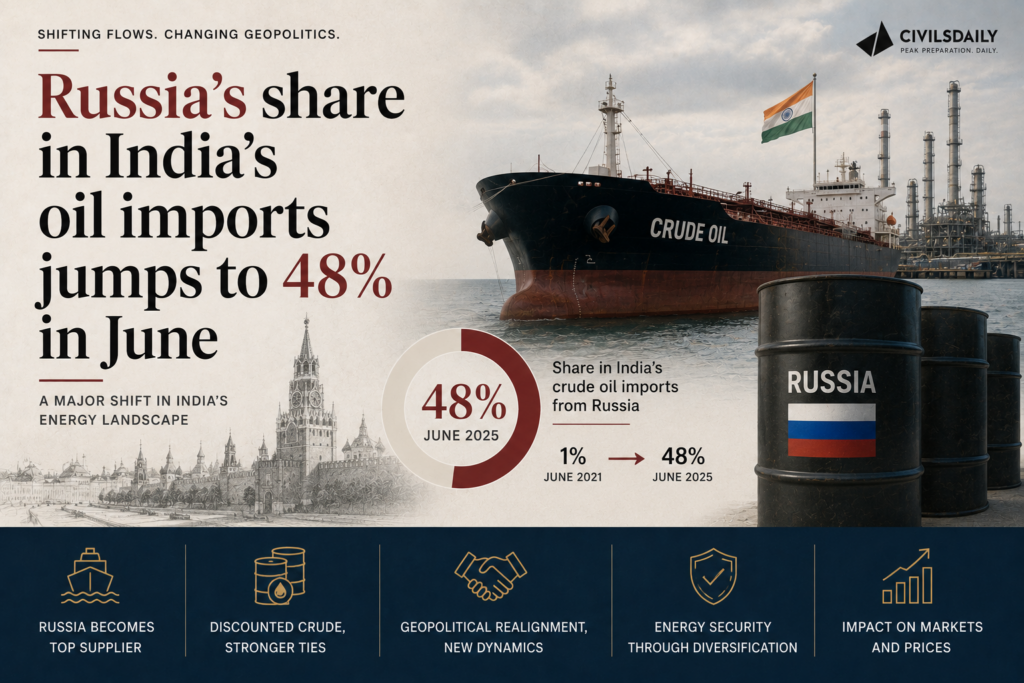
    Russia’s share in India’s crude oil imports rose to an all-time high of 48 percent in June 2026, even as India cut its total crude imports. This comes as the US Senate has passed a bill to levy tariffs of up to 100 percent on the top buyers of Russian oil and gas, placing India’s energy security and its trade exposure to the United States in direct tension.

    What is the Sanctioning Russia and Iran Act of 2026?

    1. Definition: The Lindsey O. Graham Sanctioning Russia and Iran Act of 2026 is a US bill that authorises secondary tariffs of up to 100 percent on countries that continue to buy Russian oil and gas. It targets the largest purchasers of these products from Russia.
    2. Status: The bill was passed by the US Senate and still requires passage by the US House of Representatives before it becomes law.

    What are the tariff triggers under the bill?

    1. Top-buyer test: Tariffs apply to a country that was among the five largest importers of Russian crude oil or natural gas in the 12 months preceding the Act’s enactment.
    2. Continuation test: The tariff applies if that country continues to import Russian oil or gas beyond 30 days after enactment.
    3. Sanctions-evasion clause: Tariffs can also be imposed on countries found to have helped Russia evade sanctions.
    4. India’s exposure: India, alongside China, is one of the top two importers of Russian oil, so it qualifies under these criteria.

    What do the June import figures show?

    1. Fall in total imports: June crude oil imports of 18.2 million metric tonnes (MMT) were 16.5 percent lower than in May 2026 and 13 percent lower than in June the previous year.
    2. Import bill still high: The June oil import bill was 22 percent lower than in May but still 40 percent higher than in June last year, due to elevated crude prices.
    3. Russian purchases held up: India imported 8.7 MMT of Russian oil in June, only 1 percent lower than May and 25 percent higher than a year earlier.
    4. Record Russian share: Russia’s share reached 48 percent by quantity and 48.6 percent by value, rising every month since March.
    5. UAE at a high: The United Arab Emirates (UAE) supplied 17.5 percent of imports by volume and 18 percent by value, its highest share so far.
    6. Concentration: Russia and the UAE together accounted for nearly two-thirds of India’s oil imports in June, the highest combined share from any two countries.
    7. Shrinking discount: The premium Russia charged India rose from a discount as recently as February 2026 to a premium of $10.6 per tonne in June, down from $77.7 per tonne in April.

    How has India pre-empted sanctions exposure?

    1. Ship-to-ship transfers: The Ministry of Petroleum and Natural Gas said exposure was pre-empted through ship-to-ship transfer operations in international waters via the Red Sea route through Yanbu and Fujairah.
    2. Avoiding a single choke point: The aim was to ensure that no single choke point or sanctions regime could halt India-bound cargo.
    3. Refinery flexibility: Indian refineries spent a decade acquiring the flexibility to switch between crude grades and shipping routes when disruption struck.

    Why does the record Russian share expose India?

    1. Energy security dependence: India cannot quickly cut back on Russian oil while supplies through the Strait of Hormuz remain constrained by the West Asia conflict.
    2. Trade and tariff risk: Continued high Russian purchases place India within the top-buyer criteria of the US bill, risking tariffs of up to 100 percent.
    3. Ambiguity on evasion: It is unclear whether India’s ship-to-ship arrangements would be treated as helping Russia evade sanctions.

    Conclusion

    India’s rising dependence on discounted Russian crude has hit a record 48 percent share, secured through diversified shipping routes even as total imports fell. This leaves India balancing its energy security against the risk of secondary tariffs under the US bill. The immediate milestone is the bill’s fate in the US House of Representatives, which will determine whether the tariff threat becomes law.

    Back2Basics:

    Strait of Hormuz

    1. Designation: A narrow strait linking the Persian Gulf to the Gulf of Oman and the Arabian Sea.
    2. Bordering states: Bordered by Iran to the north and Oman and the UAE to the south.
    3. Significance: One of the world’s most critical oil transit choke points, carrying a large share of seaborne crude.

    What is Energy Security? (Foundational Context)

    1. About: Energy security is the uninterrupted availability of energy sources at an affordable price.
    2. Rationale: It matters because India imports the bulk of its crude oil, leaving growth and prices exposed to external supply shocks.
    3. Core dimensions: It rests on availability, affordability, accessibility, and diversification of both sources and supply routes.

    Key Facts about India’s Oil Imports

    1. Import dependence: India imports over 85 percent of its crude oil requirement.
    2. Global standing: India is among the world’s largest crude oil importers and consumers.
    3. Key choke point: The Strait of Hormuz, between the Persian Gulf and the Arabian Sea, carries a large share of India’s West Asian crude.

    Challenges to India’s Energy Security

    1. High import dependence: Reliance on imports for most crude exposes the economy to price and supply shocks.
    2. Geopolitical concentration: A large combined share from Russia and the UAE concentrates supply risk in two sources.
    3. Choke-point vulnerability: Disruption at the Strait of Hormuz can constrain West Asian supply.
    4. Sanctions exposure: Purchases from sanctioned suppliers risk secondary tariffs and financial penalties.
    5. Price volatility: War-driven crude price spikes inflate the import bill and widen the current account deficit.

    Way Forward

    1. Diversify sources: Expand purchases from a wider set of suppliers to reduce concentration.
    2. Build strategic reserves: Enlarge strategic petroleum reserves to cushion supply shocks.
    3. Accelerate clean energy: Scale up renewables, biofuels, and electric mobility to cut import dependence over time.
    4. Secure shipping routes: Maintain logistical flexibility across grades and routes to withstand choke-point disruption.

    PYQ Relevance

    [UPSC 2025] Energy security constitutes the dominant kingpin of India’s foreign policy, and is linked with India’s overarching influence in Middle Eastern countries. How would you integrate energy security with India’s foreign policy trajectories in the coming years?

    Linkage: The PYQ examines the integration of India’s energy security with its foreign policy. India’s record 48% dependence on Russian crude highlights the geopolitical dimension of energy security. The article shows the need to diversify suppliers and routes while balancing ties with Russia, the US and West Asia.
  • India invites Bangladesh to BRICS amid a Dhaka reset

    Why in the News

    India has invited Bangladesh’s Prime Minister to the BRICS summit as the current BIMSTEC chair, even as tension persists over the Sheikh Hasina extradition. A parallel opinion piece urges a Delhi-Dhaka reset.

    What is BIMSTEC?

    1. Definition: The Bay of Bengal Initiative for Multi-Sectoral Technical and Economic Cooperation (BIMSTEC) links South and Southeast Asian states around the Bay of Bengal.
    2. Members: India, Bangladesh, Myanmar, Sri Lanka, Thailand, Nepal, and Bhutan.

    Why is a reset needed?

    1. Political friction: The extradition dispute over the former Bangladesh premier strains ties.
    2. Connectivity stakes: The Maitree Super Thermal Power Plant and the India-Bangladesh Friendship Pipeline anchor an energy and trade partnership worth protecting.
    3. Neighbourhood First: Bangladesh is central to India’s Neighbourhood First and Act East bridge, so drift carries strategic cost.

    Conclusion

    India is using multilateral platforms to keep a strained bilateral relationship functional. The next milestone is whether the extradition dispute is contained.

    Matching Previous Year Question

    “[2022, GS2, 10 marks] Do you think that BIMSTEC is a parallel organisation like the SAARC? What are the similarities and dissimilarities between the two? How are Indian foreign policy objectives realized by forming this new organisation?”

  • The Makkah Joint Defence Agreement reshapes Gulf security

    Why in the News

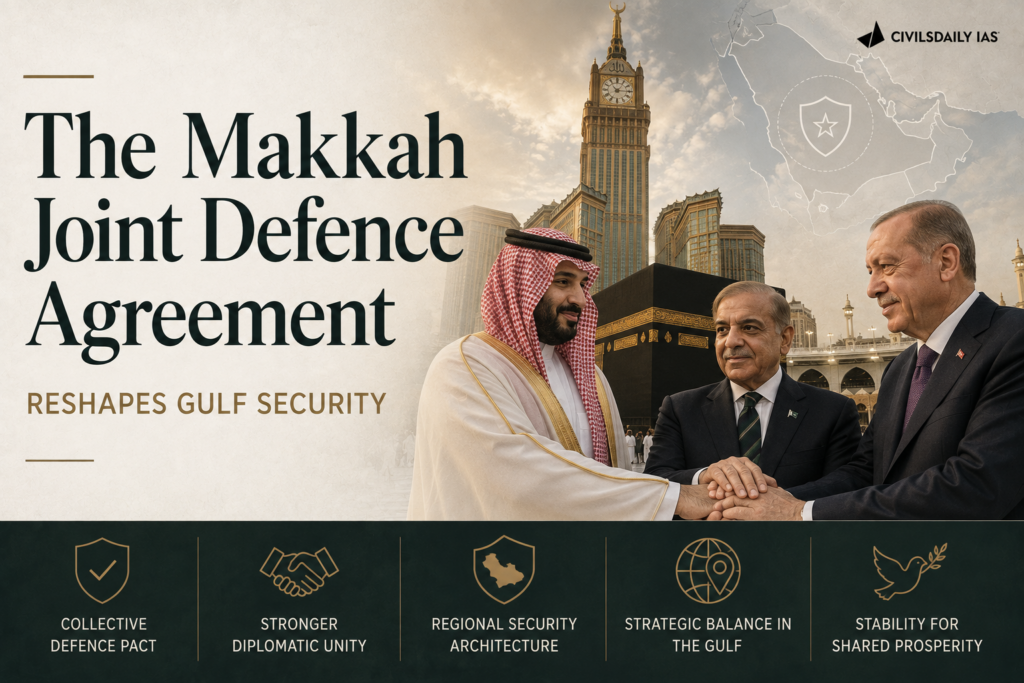
    The Makkah Joint Defence Agreement, a Saudi Arabia-Pakistan-Turkey mutual-defence pact signed on 7 August 2026, is framed as a NATO-style collective-security bloc. It carries stakes for the Strait of Hormuz and Indian energy security.

    What is a collective defence pact?

    1. Definition: A collective defence pact treats an armed attack on one member as an attack on all, obliging mutual assistance.
    2. Model: The template is NATO’s Article 5, which the new pact echoes for the Gulf and West Asia.

    Why does it matter for India?

    1. Nuclear linkage: It ties a nuclear-armed neighbour, Pakistan, to a Gulf power and a NATO member, altering the regional balance.
    2. Energy chokepoint: Instability around the Strait of Hormuz threatens India’s crude and LNG imports.
    3. Strategic autonomy: India must balance ties with Gulf states, Israel, and Iran without being drawn into bloc politics.

    Conclusion

    A new security triangle in West Asia complicates India’s balancing act in an energy-critical region. The next milestone is whether it acquires an operational command structure.

    “[2023, GS2, 15 marks] The expansion and strengthening of NATO and a stronger US-Europe strategic partnership works well in India. What is your opinion about this statement? Give reasons and examples to support your answer.”

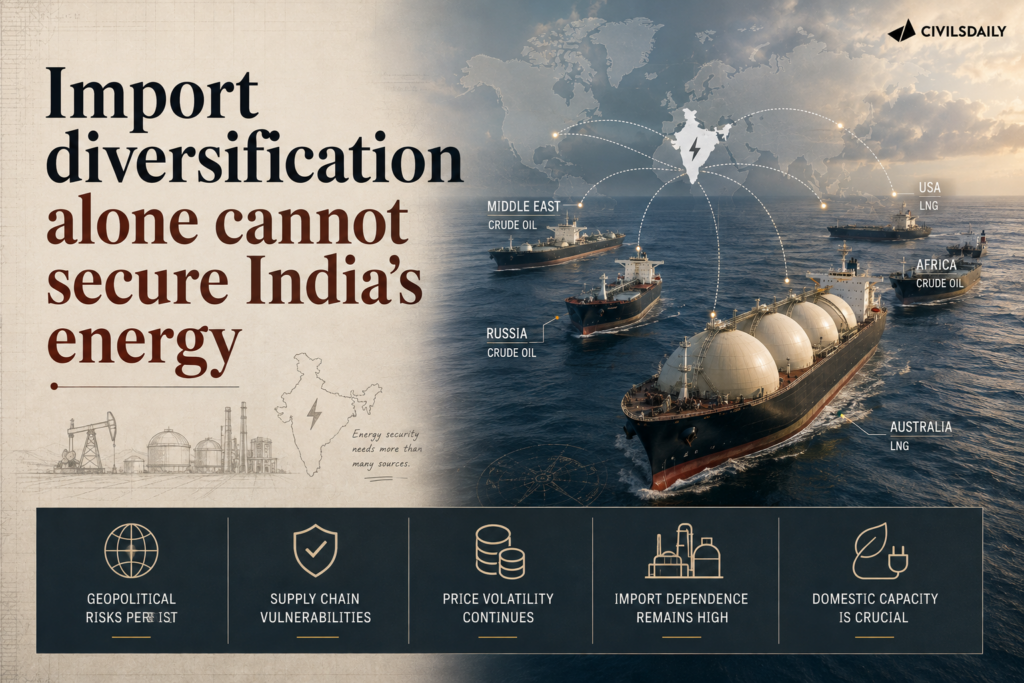
  • Import diversification alone cannot secure India’s energy

    Why in the News?

    Diversifying import sources cannot by itself secure India’s energy supply while crude and gas still transit a few chokepoints. The tension is between the visible fix of new suppliers and the hidden vulnerability of the routes those supplies travel.

    What is the energy security problem being described?

    1. Route dependence: India’s crude and Liquefied Petroleum Gas (LPG) flows still pass through a handful of maritime chokepoints.
    2. Supplier shift alone: Adding new source countries does not remove the risk if the shipping route stays the same.

    Which chokepoints concentrate the risk?

    1. Strait of Hormuz: The Gulf’s primary oil export chokepoint, exposed to conflict escalation.
    2. Bab el-Mandeb: The Red Sea gateway threatened by Houthi attacks on shipping.

    How does external policy compound the exposure?

    1. US tariff pressure: Trade measures constrain India’s room to optimise import decisions.
    2. Conflict spillover: West Asia instability raises both price and insurance costs.

    What structural response does the argument imply?

    1. Strategic reserves: Deeper petroleum reserves buffer supply shocks.
    2. Domestic transition: Faster renewable and storage build out reduces import dependence over time.

    Conclusion

    The central idea is that supplier diversification treats the symptom, not the structural route risk. Real energy security needs resilience against chokepoint disruption, not just a longer supplier list.

    PYQ Relevance

    [UPSC 2017] The question of India’s Energy Security constitutes the most important part of India’s economic progress. Analyze India’s energy policy cooperation with West Asian Countries.

    Linkage: The PYQ examines India’s energy security through its dependence on West Asian energy supplies and strategic partnerships. The article highlights how chokepoint dependence and regional instability can undermine India’s energy security despite diversification of suppliers.

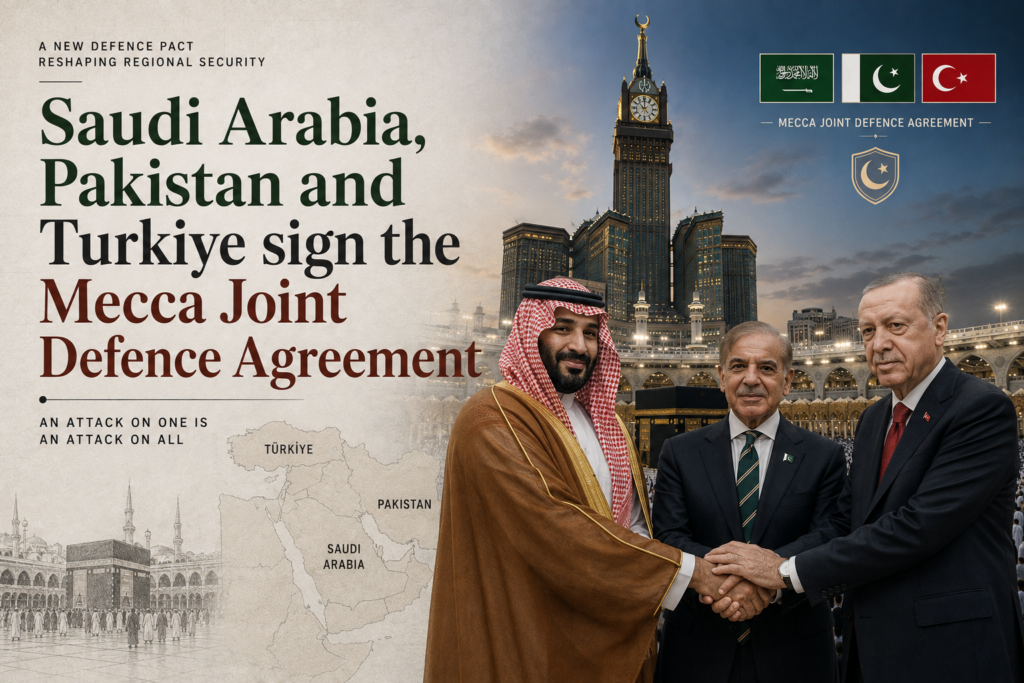
  • Saudi Arabia, Pakistan and Turkiye sign the Mecca Joint Defence Agreement

    Why in the News

    Saudi Arabia, Pakistan and Türkiye signed the Mecca Joint Defence Agreement on 7 August 2026, committing to collective defence. The pact is significant because it brings together Saudi Arabia’s Gulf influence, Türkiye’s NATO military capabilities and Pakistan’s nuclear capability.

    What is the Agreement?

    • Collective defence: An armed attack on one member is treated as an attack on all.
    • Nature: Presented as a defensive pact, amid escalating West Asian tensions.
    • It builds upon the earlier Saudi Pakistan Strategic Mutual Defence Agreement.

    Strategic Significance

    • Pakistan: Brings nuclear capability and significant military capacity.
    • Türkiye: A NATO member with one of the alliance’s largest militaries.
    • Saudi Arabia: Provides major energy, financial and geopolitical influence.
    • Regional security: Could increase coordination among three major Muslim powers.

    Why Does it Matter for India?

    • Pakistan factor: Could strengthen Pakistan’s strategic position beyond South Asia.
    • West Asia: India must balance relations with Saudi Arabia, Türkiye, Iran, Israel and Gulf partners.
    • Energy security: Instability in West Asia can affect India’s crude supplies and prices.
    • Indian diaspora: Regional conflict can affect the large Indian community in the Gulf.
    • Strategic balancing: India may need deeper engagement with Gulf partners and other regional powers.

    Key Uncertainties

    • The precise operational obligations of the collective-defence clause remain unclear.
    • It is uncertain whether the pact would automatically apply to a Saudi Pakistan conflict scenario involving India.
    • Differences among the three countries could constrain the pact’s practical implementation.

    Prelims Value Addition

    • NATO Article 5: Collective-defence principle where an armed attack against one member is considered an attack against all.
    • Important distinction: Mecca Agreement ≠ NATO
    • It is a trilateral defence pact, not a NATO-style integrated military alliance.
    • Strategic triangle:
      • Pakistan = Nuclear capability
      • Türkiye = NATO + military capability
      • Saudi Arabia = Energy + financial influence
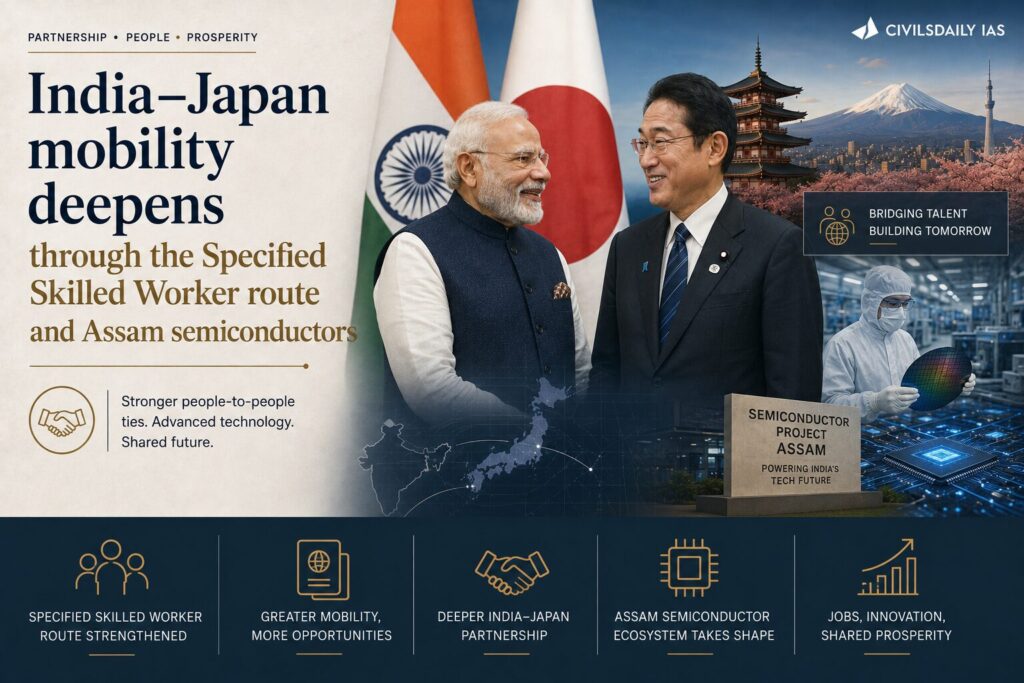
  • India Japan mobility deepens through the Specified Skilled Worker route and Assam semiconductors

    Why in the News?

    Youth from India’s Northeast are training as caregivers and agriculture workers for an ageing Japan under the Specified Skilled Worker (SSW) programme. This channels India’s demographic surplus into Japan’s labour shortage and links mobility to investment such as Japanese financed projects and the Assam semiconductor ecosystem.

    What is the Specified Skilled Worker (SSW) programme?

    1. Residence status from 2019: Japan introduced the SSW status of residence in 2019 to let blue collar foreign workers obtain a working visa for up to five years.
    2. Eligibility: Applicants must pass a Japanese language test and a specified skills exam in one of 16 fields, including nursing care, food and beverage manufacturing and industrial products.

    What is Official Development Assistance (ODA) through JICA?

    1. JICA loans: The Japan International Cooperation Agency (JICA) is Japan’s development agency that extends concessional ODA loans for infrastructure and social projects.
    2. Northeast footprint: JICA finances road corridors in Meghalaya, health facilities in Mizoram, Nagaland and Assam, and is joining Assam’s semiconductor ambitions.

    What is the A-SEMI project?

    1. Assam semiconductor ecosystem: The Assam Semiconductor Ecosystem on Manufacturing and Innovation (A-SEMI) is a state government project with JICA, alongside Tata Electronics’ assembly and testing facility expected to begin production this year.
    2. Research linkage: A Japanese firm signed a memorandum with IIT Guwahati for collaborative research in semiconductor manufacturing.

    Why is Japan turning to foreign workers?

    1. The 2040 problem: Japan’s working population is projected to fall from 66.34 million in 2025 to 55.42 million in 2040, threatening severe labour shortages.
    2. Ageing pressure: By 2040 there will be three seniors aged 65 and above for every teenager under 15.
    3. Scaled intake: Japan expects to accept 8.05 lakh Specified Skill Workers by the end of March 2029, with highest demand in industrial manufacturing, food and beverages and nursing care.

    How does this pathway serve India and the Northeast?

    1. Remittances: A caregiver in Japan can send home Rs 50,000 to Rs 60,000 a month, far above local nursing wages of around Rs 15,000.
    2. State backing: Assam subsidises SSW training fees, Manipur University opened a Japanese Language Centre, and Mizoram signed agreements with training centres.
    3. Cultural affinity: Widespread interest in Japanese media and easier physical assimilation draw young people from the region into the programme.

    Where does India stand among Japan’s foreign workforce?

    1. China leads: China was the largest foreign resident group in Japan at the end of 2025 with 9.3 lakh residents.
    2. Ahead of India: Vietnam, South Korea, the Philippines and Nepal all rank above India in resident numbers.
    3. India’s small slice: There were 53,974 Indian nationals in Japan as of December 2024, a fraction of the foreign worker pool.
    4. The joint target: India and Japan set an aspirational target of exchanging more than 5,00,000 personnel in both directions over five years, including 50,000 skilled personnel from India.

    What are the challenges to India Japan labour mobility?

    1. Language barrier: School level Japanese proves inadequate for daily workplace use, slowing settlement and placement.
    2. Migration safeguards: Ensuring legal, documented channels is essential to prevent exploitation of workers moving abroad.
    3. Skill drain: Trained nurses and caregivers leaving India can deepen shortages in the Northeast’s own health system.
    4. Small scale: Placement numbers remain nascent relative to Japan’s demand and India’s demographic potential.
    5. Isolation and costs: New arrivals face social loneliness and heavy documentation and relocation costs before earning.
    6. Certification bottlenecks: Delays such as the Certificate of Eligibility can stall departures despite cleared exams.

    Conclusion

    India Japan mobility is at an early but expanding stage, with the SSW route, JICA financed projects and the A-SEMI semiconductor plan tying labour flows to investment. The next milestone is the launch of the A-SEMI project and progress towards the joint target of 5,00,000 personnel over five years, alongside Japan’s planned intake of 8.05 lakh Specified Skill Workers by March 2029.

    Back2Basics:

    Japan International Cooperation Agency (JICA)

    1. Type: Japan’s governmental agency for delivering Official Development Assistance (ODA).
    2. Headquarters: Tokyo, Japan.
    3. Mandate: Provides concessional loans, grants and technical cooperation for infrastructure and social development in partner countries.
    4. India role: A major bilateral development partner financing metro rail, connectivity, health and industrial projects, including in the Northeast.

    PYQ Relevance

    [UPSC 2019] The time has come for India and Japan to build a strong contemporary relationship, one involving global and strategic partnership that will have a great significance for Asia and the world as a whole.” Comment.

    Linkage: The question examines the strategic and economic dimensions of the India-Japan Special Strategic and Global Partnership. The article shows how India-Japan ties are expanding beyond infrastructure to skilled mobility, human resource cooperation and semiconductor collaboration, deepening the strategic partnership.

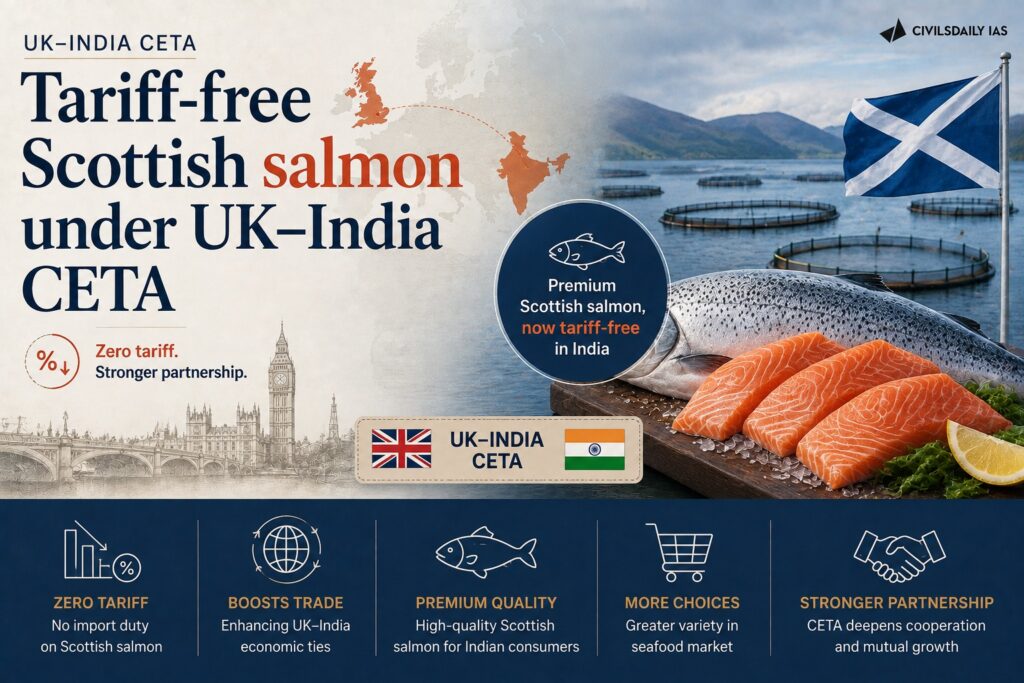
  • Tariff-free Scottish salmon under UK-India CETA

    Why in the News

    The first tariff free shipment of Scottish salmon reached Bengaluru on July 31 under the UK India Comprehensive Economic and Trade Agreement (CETA), eliminating India’s earlier 33 percent import tariff on the product. A single consignment marks the transition of a trade agreement from signed text into commercial reality, with industry estimating up to £130 million in additional export opportunity for Scotland’s salmon sector over the next decade.

    What is the UK India CETA?

    1. Comprehensive Economic and Trade Agreement (CETA): CETA is the bilateral free trade agreement between the United Kingdom and India that eliminates or reduces tariffs across a wide range of goods and services traded between the two countries, recently operationalised as part of the broader India-UK Comprehensive Strategic Partnership.

    Why does the tariff removal matter?

    1. Immediate price effect: Removing the 33 percent import tariff makes Scottish salmon significantly cheaper for Indian importers and retailers, directly affecting shelf pricing for consumers.
    2. Early proof of implementation: A commercial shipment moving within months of the agreement taking effect signals that CETA’s tariff schedules are being implemented on the ground, not just agreed on paper.
    3. Export opportunity for Scotland: Industry estimates suggest the tariff elimination could unlock up to £130 million in additional export opportunities for Scotland’s salmon sector over the next decade.

    What are the challenges to realising CETA’s full trade potential?

    1. Cold chain and logistics: Perishable goods such as fresh salmon require reliable cold chain logistics from the United Kingdom to Indian cities, infrastructure that must scale alongside tariff-driven demand growth.
    2. Domestic industry exposure: Cheaper imported salmon could pressure India’s own aquaculture and seafood sector as volumes scale beyond this early shipment.
    3. Uneven sector by sector implementation: Tariff elimination for individual products such as salmon does not guarantee equally smooth implementation across CETA’s other covered sectors, some of which involve more complex regulatory alignment.
    4. Consumer market development: Realising the full projected export opportunity depends on Indian consumer demand for premium imported seafood growing at the pace industry estimates assume.

    Conclusion

    The Scottish salmon shipment is an early, narrow proof point for CETA’s tariff provisions rather than evidence of the agreement’s full commercial impact. Subsequent months will show whether tariff elimination translates into sustained trade volumes across the agreement’s broader list of covered goods.

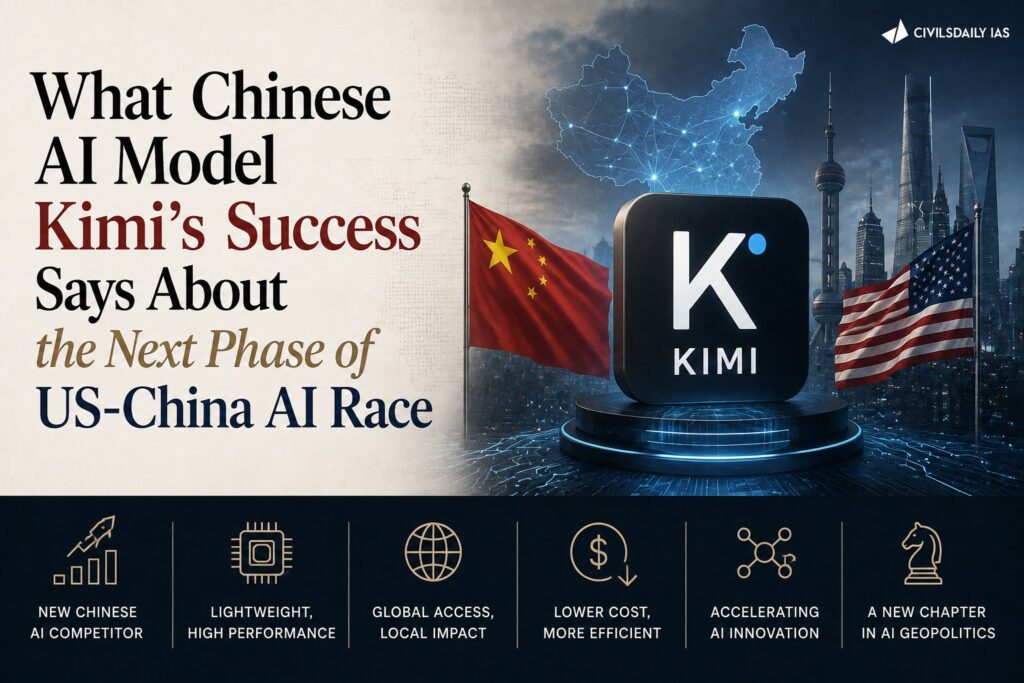
  • What Chinese AI model Kimi’s success says about the next phase of US-China AI race

    Why in the News

    Moonshot AI’s Kimi K3, released in July with 2.8 trillion parameters, is being billed as the world’s largest open-weight artificial intelligence (AI) system, prompting Anthropic to accuse the Chinese company of illicitly extracting the capabilities of its Claude model. The episode echoes the shock caused by DeepSeek R1 in January 2025, and exposes a widening split between China’s open-weight AI strategy and the closed, proprietary approach favoured by leading US labs.

    What is Kimi K3?

    1. Kimi K3: Kimi K3 is an advanced AI model released by the Chinese company Moonshot AI, said to rival models from OpenAI and Anthropic, built as an “open-weight” system that can be downloaded and modified by developers.

    What is an open-weight AI model?

    1. Open-weight: An open-weight model allows developers to download its parameters, the numerical values that determine how the system responds to prompts, and run or customise it locally, unlike a closed model whose parameters remain proprietary.

    Open-Weight vs. Closed Models

    1. Open-Weight: Anyone can download the core files, study how it works, and run it offline.
    2. Closed Models: The code and numbers stay hidden on a company’s private servers, and you can only use it through a web page or an API.

    How does the Kimi K3 episode parallel the DeepSeek moment of January 2025?

    1. Prior shock: DeepSeek R1’s January 2025 release triggered global market panic after being compared favourably to leading US models, with OpenAI accusing DeepSeek of copying its technology.
    2. Repeated pattern: Kimi K3’s release in July 2026 has prompted a similar sequence, with Anthropic accusing Moonshot AI of illicitly extracting Claude’s capabilities and a US official describing it as an assault on economies that reward private capital and fair competition.
    3. Chinese countercharge: China’s Commerce Ministry responded by accusing the US of “AI hegemonism.”

    Why is China favouring an open-weight strategy over proprietary models?

    1. Chip supply constraints: Chinese developers face chip supply constraints from Western export restrictions and domestic production bottlenecks, limiting their capacity to support commercial access to a closed model.
    2. Ecosystem building: Chinese labs use open weights to reach developers faster and build an ecosystem around their models, generating demand more quickly than a closed, enterprise-only distribution model would allow.
    3. Custom licensing approach: Kimi K3 uses a hybrid model, open-weight for most users but requiring large companies to strike a commercial agreement with Moonshot, an approach described as unusual among popular open-weight releases.
    4. Diplomatic dimension: China increasingly presents open models as part of international technological cooperation, illustrated by a new Chinese government AI governance body launched this month.

    What does the US industry debate reveal about the open versus closed model split?

    1. Industry open letter: Industry figures have called for the US to shift toward open-weight models, arguing that open-source software already underlies most of the internet and systems used by the US military and federal agencies.
    2. Divergent incentives: Companies behind AI infrastructure, such as chip makers, have generally favoured open-weight models to spread adoption and demand for their hardware, while companies with proprietary models, such as Anthropic, have expressed reservations about this shift.
    3. US investigation: The US government is reportedly investigating whether Moonshot AI illegally accessed advanced chips to train its models.

    Does China’s progress prove that US export controls have failed?

    1. Not proof of failure: Kimi K3’s capability does not prove that export controls have failed. It shows that progress in AI models depends on more than access to the most advanced chips.
    2. Gap still exists: Parity between US and Chinese AI companies remains distant, given the continuing US edge in compute capacity, capital, global distribution and chip access.
    3. Wider influence: The rise of Chinese AI companies could still give other countries more choice and lower-cost options for local deployment, extending China’s influence over global technical standards even without full parity.

    Conclusion

    Kimi K3 has intensified a two-player race for global AI dominance between the US and China, driven partly by a strategic divergence between China’s open-weight approach and the closed models favoured by leading American labs. Export controls have not stopped Chinese progress, but neither have they closed the underlying gap in compute, capital and distribution that still separates the two sides.

    PYQ Relevance

    [UPSC 2026] Which of the following statements with regard to Large Language Models (LLMs) used in machine learning is/are correct?

    1. LLMs assign probabilities to the next possible words and then pick the one with the highest probability.

    2. LLMs process data through mathematical optimisation to minimise prediction errors.

    3. LLMs produce unbiased outputs.

    (a) 1 only (b) 1 and 2 only (c) 2 and 3 only (d) 1, 2 and 3.

  • Amnesty International report: India’s arms exports to Israel

    Why in the News?

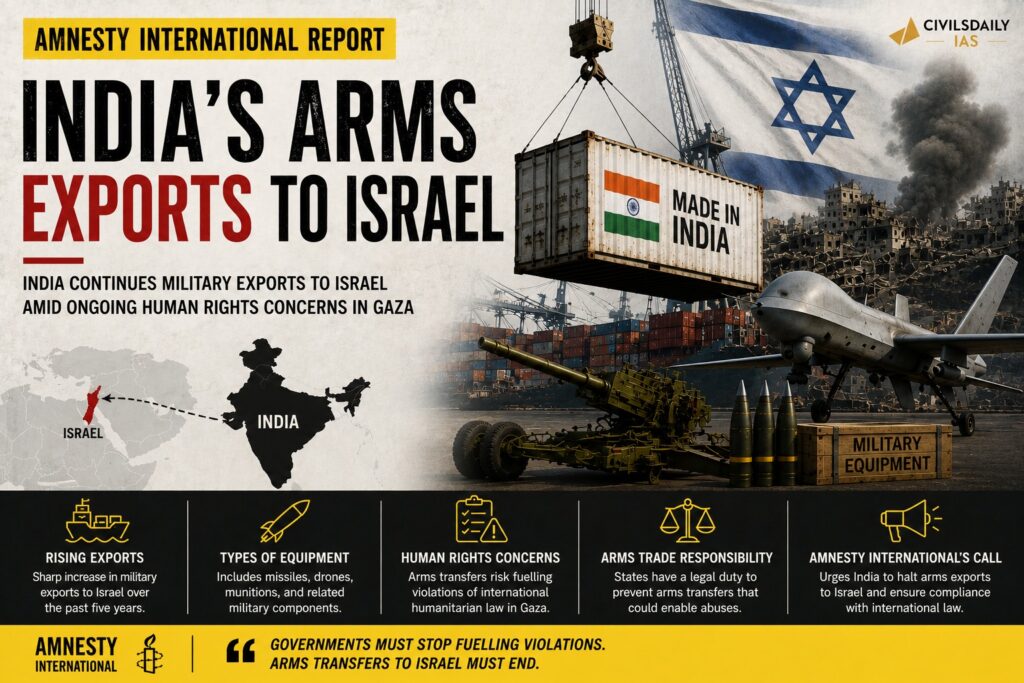
    An Amnesty International report titled “Made in India” alleged that India exported over 2,500 shipments of small arms, ammunition and components to Israel between October 2023 and November 2025, raising concerns over compliance with international humanitarian law.

    Key Findings

    • Over 2,500 shipments of arms and ammunition-related items were exported.
    • At least 788 shipments were identified as having military purposes.
    • Exports reportedly included machine gun components, artillery shells and explosive warheads.
    • The report relies on shipment-level trade data rather than aggregate trade statistics.

    Why is it Significant?

    • Raises concerns regarding India’s defence exports amid the Gaza conflict.
    • Brings attention to issues of international humanitarian law (IHL) and arms transfers.
    • Highlights the growing India-Israel defence partnership.

    Challenges

    • Balancing strategic defence cooperation with international legal obligations.
    • Ensuring transparency and oversight of defence exports.
    • Reputational risks arising from allegations of complicity in conflict-related violations.

    Amnesty International

    • Established in 1961.
    • Headquarters: London, United Kingdom.
    • Global human rights organisation that investigates and campaigns against human rights violations.
    • Publishes the annual State of the World’s Human Rights report.

    International Humanitarian Law (IHL)

    • Also known as the Law of Armed Conflict.
    • Regulates the conduct of armed conflicts.
    • Primarily based on the Geneva Conventions (1949) and their Additional Protocols.
    • Protects civilians, prisoners of war and the wounded during armed conflict.

    India-Israel Defence Cooperation

    • Israel is among India’s major defence suppliers.
    • Cooperation includes: Missiles (Barak-8), UAVs (Heron), Radar systems, Electronic warfare equipment, and Small arms and ammunition

    Geneva Conventions (1949)

    • Four international treaties governing humanitarian protection during war.
    • India is a State Party to all four Geneva Conventions.

    United Nations Commission of Inquiry (COI)

    • Independent fact-finding mechanism established by the UN Human Rights Council.
    • Investigates alleged violations of international human rights and humanitarian law.

    [2015] Amnesty International is

    (a) an agency of the United Nations to help refugees of civil wars

    (b) a global Human Rights Movement

    (c) a non-governmental voluntary organization to help very poor people

    (d) an inter-governmental agency to cater to medical emergencies in war-ravaged regions.

  • Italy suspends Schengen pact with Spain amid Ceuta migrant crisis

    Why in the News?

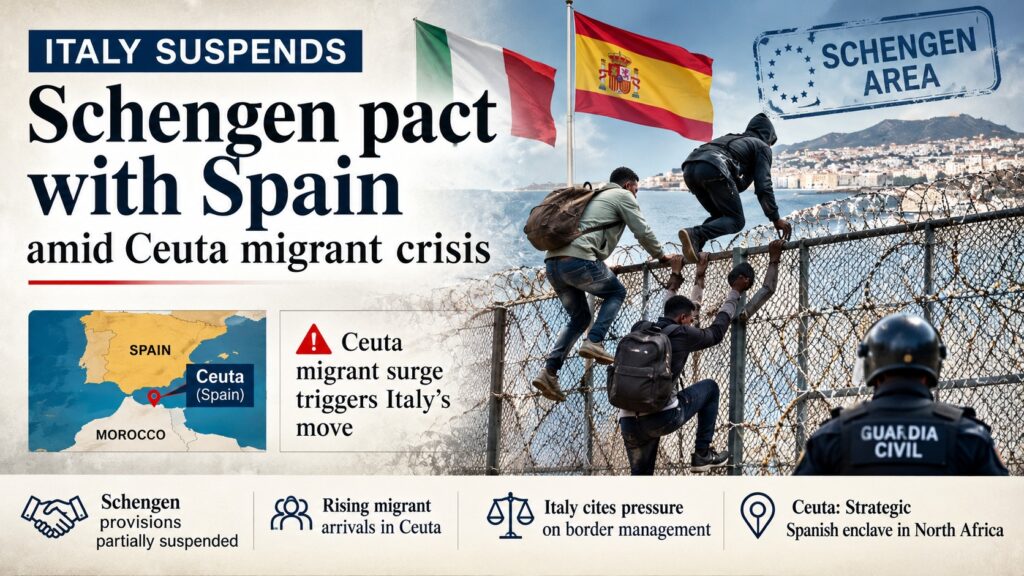
    Around 60,000 migrants crossed from Morocco into Spain’s Ceuta enclave within 24 hours, prompting Italy to temporarily suspend the Schengen Agreement with Spain for one month by reintroducing border checks.

    What is the Schengen Area?

    • A passport-free travel zone that abolishes internal border checks among participating European countries.
    • Members maintain common external border controls.
    • Internal border checks may be temporarily reintroduced on grounds of national security or public order.

    What Happened in Ceuta?

    • Around 60,000 migrants attempted to enter Ceuta from Morocco.
    • At least 57 migrants died during the crossing.
    • Spain deployed the armed forces and additional police to restore order.
    • Morocco used tear gas to disperse migrants near the border.

    Why is it Significant?

    • Highlights vulnerabilities at the EU’s external borders.
    • Tests the functioning of the Schengen free movement system.
    • Demonstrates that one member state can temporarily restore internal border controls during security emergencies.
    • Raises concerns over irregular migration, border management and humanitarian protection.

    Challenges

    • Rising irregular migration and human smuggling.
    • Balancing border security with humanitarian obligations.
    • Coordination among EU member states.
    • Political tensions between Spain, Morocco and other EU members.

    Ceuta

    • An autonomous Spanish city on the north coast of Africa, bordering Morocco.
    • Together with Melilla, forms the European Union’s only land border with Africa.
    • Frequently used as an entry point for migrants seeking access to Europe.

    Schengen Area

    • Established under the Schengen Agreement (1985).
    • Schengen Convention: 1990.
    • Implemented from 1995.
    • Comprises 29 countries (25 EU members and 4 non-EU countries).
    • Non-EU Schengen Members: Iceland, Norway, Switzerland, and Liechtenstein

    [2019] Which of the following adopted a law on data protection and privacy for its citizens known as ‘General Data Protection Regulation’ in April 2016 and started implementation of it from 25th May, 2018?

    (a) Australia

    (b) Canada

    (c) The European Union

    (d) The United States of America.