Mains Ready By December. Smash Mains & Smash PYQ Admissions Open

GS Paper: GS2-18.Bilateral, regional and global groupings and agreements involving India and/or affecting India’s interests.

  • Unmistakable shift (India signalled a change in foreign policy stance at SCO Summit)

    Introduction

    India’s foreign policy has historically oscillated between balancing great power politics and safeguarding its strategic autonomy. The 2025 SCO Summit in China witnessed a landmark moment: Prime Minister Narendra Modi’s first bilateral engagement with Chinese President Xi Jinping since the 2020 military standoff. The visit not only revived dormant dialogues but also underscored India’s shifting posture in a multipolar world marked by U.S. sanctions, instability in West Asia, and contestations within Eurasia.

    Significance of Indian Prime Minister’s Visit to China

    1. Seven-year gap: PM Modi had not travelled to China since 2017, making this a major diplomatic breakthrough.
    2. First bilateral since standoff: Meeting with Xi Jinping was the first since the 2020 military confrontation along the LAC.
    3. Three-year SCO absence: Modi’s return to SCO after three years shows India’s willingness to re-engage with a grouping seen as anti-Western.
    4. Optics of bonhomie: Images with Xi and Putin evoked memories of the inactive Russia-India-China trilateral, signalling recalibration.

    Revival of India-China Bilateral Engagement

    1. Troop disengagement: Both leaders endorsed the normalisation process initiated in October 2024.
    2. Boundary resolution: Agreed to fast-track talks between Special Representatives.
    3. Connectivity revival: Resumption of direct flights and visa facilitation announced.
    4. Economic ties: Leaders stressed on building trade relations to stabilise world commerce.
    5. Mutual trust rhetoric: Modi stressed ties based on “mutual trust, respect and sensitivity”, while Xi used the metaphor of “Dragon and Elephant” coming together.

    External Drivers of India’s Foreign Policy Recalibration

    1. U.S. tariffs and sanctions: American restrictions and mistrust of the Trump administration nudged India to diversify partnerships.
    2. Strategic compulsion: India managed to side-step concerns like China’s support to Pakistan during Operation Sindoor, UNSC/NSG opposition, and shielding of terrorists.
    3. Multipolar optics: India’s engagement at SCO signals balancing between West and Eurasia.

    Key Outcomes of the 2025 SCO Summit

    1. Tianjin declaration: Strong language against cross-border terrorism, including condemnation of the Pahalgam attack (India) and Balochistan attacks (Pakistan).
    2. West Asian crisis: SCO united on humanitarian crisis in Gaza and condemned U.S.-Israeli strikes on Iran.
    3. China’s push: Xi proposed an SCO Development Bank.
    4. India’s push: Modi proposed a Civilisational Dialogue among SCO members.
    5. India’s reservation: Continued opposition to China’s Belt and Road Initiative (BRI) paragraph.

    Missed Diplomatic Opportunities at the Summit

    1. Skipped SCO Plus: Indian Prime Minister did not attend the extended “SCO Plus” Summit, limiting engagement with neighbourhood and Global South leaders.
    2. Regional bonding gap: While optics were strong, substantive regional outreach was diluted.

    Conclusion

    The SCO Summit underscored India’s willingness to recalibrate its foreign policy in a changing world order. Modi’s visit after years of distance marked a thaw with China, greater Eurasian engagement, and assertion of India’s independent foreign policy despite U.S. pressures. However, missed opportunities in broader outreach and unresolved trust deficits with China remain cautionary notes.

    Value Addition

    Shanghai Cooperation Organisation (SCO)

    Historical Background

    1. Successor to: SCO is the successor to the Shanghai Five, formed in 1996 between China, Kazakhstan, Kyrgyzstan, Russia, and Tajikistan.
    2. Formation: Established in 2001 in Shanghai by China, Russia, Kazakhstan, Kyrgyzstan, Tajikistan, and Uzbekistan.
    3. Expansion: India and Pakistan joined as full members in 2017; Iran became a member in 2023.
    4. Observers & Dialogue Partners: Afghanistan, Belarus, Mongolia, and others engage as observers; several countries (e.g., Turkey, Sri Lanka) are dialogue partners.

    Strategic Importance of SCO for India

    1. Geopolitical Balancing: Provides a platform to engage with China and Russia while maintaining ties with the West (Quad, U.S.).
    2. Regional Security: Key forum for counter-terrorism cooperation, especially in light of cross-border terrorism and instability in Afghanistan.
    3. Eurasian Connectivity: Enhances India’s presence in Central Asia, a region rich in energy resources.
    4. Multipolar World Order: Strengthens India’s narrative of strategic autonomy and non-alignment in new form.

    Key SCO Mechanisms

    1. Regional Anti-Terrorist Structure (RATS): Headquartered in Tashkent, focuses on counter-terrorism intelligence sharing.
    2. Economic Cooperation: Proposals for SCO Development Bank, regional trade, and connectivity projects (though India resists BRI-linked initiatives).
    3. Cultural and Civilisational Dialogues: Shared platforms for people-to-people exchanges, education, and cultural diplomacy.

    India’s Challenges within SCO

    1. China Factor: Difficult to expand cooperation given border disputes and China’s Pakistan tilt.
    2. Pakistan Factor: Its membership often leads to diplomatic blockages on issues like terrorism.
    3. BRI Opposition: India consistently refuses to endorse the Belt and Road Initiative, creating friction.
    4. Russia-China Axis: Russia’s growing dependence on China may dilute India’s influence in the bloc.

    Contemporary Relevance

    1. Energy and Trade: Central Asia is crucial for energy diversification; SCO provides a gateway.
    2. Geopolitical Flux: With U.S.-China rivalry and West Asia instability, SCO’s role in Eurasian stability gains importance.
    3. Soft Power Opportunity: India uses SCO to promote civilisational dialogue, yoga, Ayurveda, and cultural diplomacy.

    PYQ Relevance

    [UPSC 2021] Critically examine the aims and objectives of SCO. What importance does it hold for India?

    Linkage: The article directly illustrates the objectives of SCO—counter-terrorism (Tianjin declaration), multipolarity, and Eurasian stability. It highlights India’s balancing act—reviving ties with China, opposing BRI, and pushing for civilisational dialogue. Thus, the SCO Summit outcomes reflect both the scope and constraints of SCO’s importance for India in strategic, economic, and security domains.
  • [26th August 2025] The Hindu Op-ed: India-Japan Ties, Old Partners, New Priorities

    PYQ Relevance

    [UPSC GS II] The time has come for India and Japan to build a strong contemporary relationship, one involving global and strategic partnership that will have a great significance for Asia and the world as a whole. Comment.

    Linkage: The question calls for examining India–Japan relations as a global and strategic partnership. The current visit, with Japan’s ¥10 trillion investment, defence cooperation, and Indo-Pacific focus, shows this vision materialising. It highlights how the partnership now goes beyond economics to shape Asian stability and world geopolitics.

    Mentor’s Comment

    PM Modi’s Japan visit signals India’s strategic clarity amid global flux. Japan’s unprecedented investment pledge, technology transfer, and defence cooperation position it as India’s most reliable Indo-Pacific partner when U.S. unpredictability and China’s mistrust loom large.

    Introduction

    India–Japan ties are deepening at a crucial juncture. With a ¥10 trillion ($68 billion) Japanese investment plan and renewed security cooperation, the partnership goes beyond economics. It reflects India’s balancing act between Tokyo, Beijing, and Washington, showcasing strategic autonomy in an uncertain world.

    Why is this visit significant?

    • Historic Japanese pledge: A ¥10 trillion ($68 billion) investment plan, among Tokyo’s most ambitious commitments to New Delhi.
    • Technology transfer: Includes next-generation E10 series Shinkansen for the Mumbai–Ahmedabad high-speed rail, reflecting economic plus technological collaboration.
    • Timing amid flux: Visit comes just before Modi’s participation in the SCO Summit in China, showcasing strategic balancing.
    • U.S. uncertainty: With Trump’s erratic second term, the visit highlights India’s recalibration of partnerships, reinforcing Japan as a dependable anchor.

    Japan’s Investment and Economic Partnership

    • Massive infrastructure push: ¥10 trillion investment spread across infrastructure, manufacturing, clean energy, and technology.
    • High-speed rail corridor: Japan’s E10 Shinkansen trains for Mumbai–Ahmedabad project symbolise trust and long-term collaboration.
    • Supply chain resilience: Economic Security Initiative expands cooperation on semiconductors, critical minerals, pharmaceuticals, and clean energy.
    • Digital partnership: Upgradation to cover artificial intelligence and startup ecosystems, placing India-Japan ties at the cutting edge of innovation.

    Strategic and Defence Cooperation

    • Security framework revision: 2008 Joint Declaration on Security Cooperation to be updated in line with today’s realities.
    • Indo-Pacific commitment: Reinforces shared vision of a free, open, and rules-based Indo-Pacific.
    • Maritime security and resilience: Japan remains central to India’s Indo-Pacific strategy amid an uncertain Quad trajectory.

    The China Factor and Strategic Balancing

    • Dual engagement: Modi’s Tokyo visit followed by Beijing trip reflects India’s ability to compartmentalise relations.
    • Confidence-building with China: Resumption of flights, visa relaxations, and trade measures post-Galwan.
    • Message of balance: India signals that deepening ties with Japan need not preclude dialogue with China.

    The U.S. Factor and Quad Challenges

    • Unpredictability under Trump 2.0: Threatens to erode years of steady New Delhi–Washington cooperation.
    • Quad dilution: U.S. disengagement risks weakening the grouping’s strategic coherence.
    • India-Japan partnership: Emerges as ballast to sustain Indo-Pacific momentum even when U.S. commitment wavers.

    Broader Political and Diplomatic Significance

    • Beyond economics: Japan’s engagement shows that consistent, long-term cooperation delivers real outcomes.
    • Diplomatic flexibility: India demonstrates ability to pursue multiple alignments without losing clarity.
    • Anchor role of Japan: Unlike Washington’s inconsistency or Beijing’s mistrust, Tokyo provides stability, resources, and shared values.

    Conclusion

    The Prime Minister’s Japan visit reflects one of the enduring features of Indian diplomacy, flexibility with clarity. By securing massive investment, strengthening defence ties, and reinforcing Indo-Pacific strategies, India positions Japan as its anchor partner in uncertain times. The visit sends a broader signal: India is capable of balancing great power politics while advancing its economic and strategic priorities. For UPSC, it is a live example of strategic autonomy in action.

  • Integrated Food Security Phase Classification (IPC) and Famine Declaration

    Why in the News?

    The United Nations has officially declared a famine in Gaza based on an Integrated Food Security Phase Classification (IPC) panel assessment.

    About Integrated Food Security Phase Classification (IPC):

    • What It Is: A global standard tool to assess and classify the severity of food insecurity.
    • Established: In 2004 during the Somalia food crisis by FEWS NET (Famine Early Warning Systems Network) and partners.
    • Coordination: Led by the UN Food and Agriculture Organization (FAO).
    • Purpose: Supports early warning, evidence-based decision-making, and coordinated response by governments, UN agencies, NGOs, and donors.
    • Partnership Model: Combines efforts of UN bodies, NGOs, academic institutions, and national governments.

    Key Features of the IPC:

    • Five-Phase Classification System:
      • Phase 1: Minimal
      • Phase 2: Stressed
      • Phase 3: Crisis
      • Phase 4: Emergency
      • Phase 5: Catastrophe/Famine
    • Methodology:
      • Uses convergence of evidence from food access, livelihoods, nutrition, and mortality.
      • Requires technical consensus among analysts for transparency and accuracy.
      • Allows real-time assessments and 6-month forecasts to support timely action.

    What is Famine and How is it Declared?

    • Definition: IPC Phase 5 – the most extreme level of food insecurity.
    • Criteria (All Must Be Met):
      • At least 20% of households face extreme food gaps.
      • At least 30% of children under five suffer acute malnutrition (wasting).
      • Death rate: 2 adults or 4 children per 10,000 people per day.
    • Declaration: Made by UN agencies, national governments, or authorized global bodies.
    • Purpose of Declaration:
      • Mobilize international aid and emergency operations.
      • Trigger food, health, and logistics support.
      • Raise global awareness and funding for urgent interventions.
    • Past Declarations:  Somalia (2011), South Sudan (2017, 2020), Darfur, Sudan (2024)
    [UPSC 2023] Which of the following countries has been suffering from decades of civil strife and food shortages and was in news in the recent past for its very severe famine?

    Options: (a) Angola (b) Costa Rica (c) Ecuador (d) Somalia*


  • Gaza War Impact on IMEC

    Why in the News?

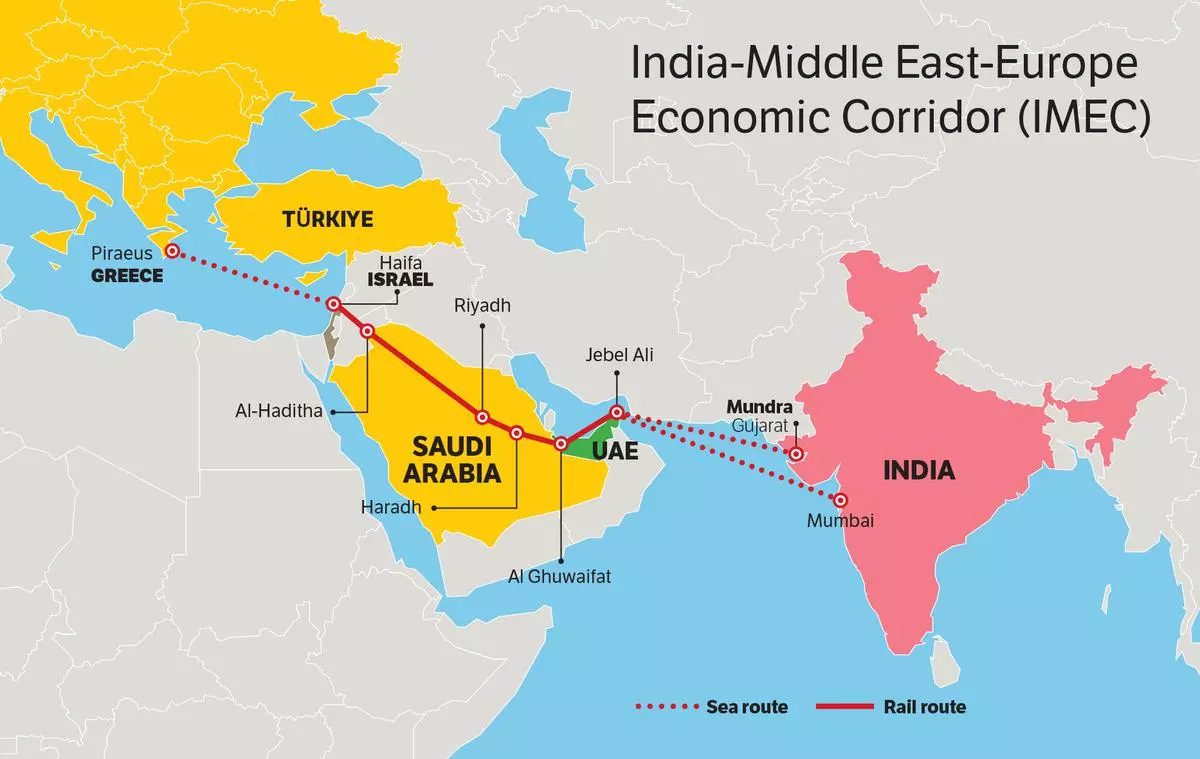
    India’s National Security Council Secretariat recently hosted envoys from the US, UAE, Saudi Arabia, France, Italy, Germany, Israel, Jordan, and the EU to review progress on the India–Middle East–Europe Economic Corridor (IMEC).

    Gaza War Impact on IMEC

    About IMEC Project:

    • Part of the Partnership for Global Infrastructure and Investment (PGII) for developing connectivity in emerging regions.
    • MoU signed on 10 September 2023 at the G20 New Delhi Summit.
    • Members: India, US, UAE, Saudi Arabia, France, Germany, Italy, European Union.
    • Aim: Integrate Asia, Middle East, and Europe to boost transport efficiency, reduce costs, create jobs, cut greenhouse gas emissions, and strengthen economic unity.
    • Structure:
      • East Corridor: India to Arabian Gulf.
      • Northern Corridor: Gulf region to Europe.
    • Key Ports:
      • India – Mundra, Kandla, Jawaharlal Nehru Port (Mumbai).
      • Middle East – Fujairah, Jebel Ali, Abu Dhabi, Dammam, Ras Al Khair.
      • Israel – Haifa.
      • Europe – Piraeus, Messina, Marseille.
    • Infrastructure includes: Railway links, ship-to-rail hubs, roads, electricity cables, hydrogen pipelines, and high-speed data cables.

    Impact of Gaza War:

    • Derailed work: Conflict from late 2023 halted stakeholder meetings and derailed western leg (Middle East–Europe) progress.
    • Jordan–Israel relations at historic low; Saudi–Israel normalisation stalled.
    • Regional rivalries (e.g., Saudi–UAE trade competition) hinder unified operational planning.

    Significance:

    • Economic: EU is India’s largest trading partner; corridor promises faster, cheaper trade with reduced emissions.
    • Strategic: Strengthens India’s role in West Asia and positions it as a connector between Europe and the Middle East.
    • Energy & Technology: Potential for clean hydrogen pipelines, electricity and data cable links.
    • Resilience: Provides alternative to Red Sea shipping routes vulnerable to disruptions.
    [UPSC 2025] India is one of the founding members of the International North-South Transport Corridor (INSTC), a multimodal transportation corridor, which will connect:

    Options: (a) India to Central Asia to Europe via Iran* (b) India to Central Asia via China (c) India to South-East Asia through Bangladesh and Myanmar (d) India to Europe through Azerbaijan


  • [8th August 2025] ​The Hindu Op-ed: Mending ties: On state visit of Philippines President to India

    Philippines’ President Ferdinand Marcos Jr.’s visit to India strengthened bilateral ties through a Strategic Partnership Agreement, focusing on defence cooperation, Indo-Pacific security, and future trade collaboration, while also serving broader strategic goals in ASEAN and Indo-Pacific diplomacy.

    Key Highlights of the Visit:

    1. Strategic Partnership Agreement: The Philippines becomes only the fifth country (after Japan, Vietnam, Australia, and South Korea) with which India has signed such an agreement.
    2. Maritime and Defence Cooperation: The Indian Navy held its first joint maritime exercise with the Philippine Navy in the South China Sea. India reaffirmed its support for the 2016 UNCLOS Arbitration Award favouring the Philippines in its dispute with China. Discussions were held to expand defence exports, especially BrahMos missiles and other Indian military hardware. New agreements include exchanges between all three services and Coast Guards.
    3. Connectivity and People-to-People Ties: Both countries agreed to begin direct flights and ease visa restrictions to facilitate travel and business.
    4. Economic and Trade Dimensions:
      • Bilateral trade remains modest at $3.3 billion (2024-25).
      • Investments are growing in technology and pharmaceuticals.
      • Talks to launch a Preferential Trade Agreement (PTA) have been initiated.
      • India’s decision to revise the ASEAN-India Trade in Goods Agreement (AITIGA) reflects renewed trade diplomacy.

    India’s Broader Indo-Pacific Strategy:

    1. Indo-Pacific strategy beyond the spectrum of Quad: India’s engagement with the Philippines shows its intention to look beyond the Quad (India, USA, Japan, Australia) in Indo-Pacific diplomacy. India is pushing for multipolar partnerships, focused on maritime security, trade resilience, and a rules-based international order.
    2. ASEAN & Indo-Pacific Messaging: The Philippines is the incoming chair for ASEAN in 2026 and the coordinator for the ASEAN-India comprehensive strategic partnership. This gives India a crucial partner to enhance its engagement with the bloc.

    Dimensions of India-Philippines Relations

    Historical and Cultural Links:

    • Diplomatic relations were formally established on November 26, 1949, soon after both nations gained independence.
    • Historical ties and shared civilizational links, though not fully documented, point to a long-standing connection.
    • A Treaty of Friendship was signed in 1952.
    • India’s “Look East Policy” (1992) and subsequent “Act East Policy” (2014) have been instrumental in revitalizing and intensifying the relationship.
    • 2019: BrahMos missile deal initiated, the Philippines becomes the first foreign buyer

    Common Issues and Contemporary Challenges:

    • South China Sea Dispute: Both countries face challenges from China’s expansive territorial claims and assertive actions. India supports international law and a rules-based order, which aligns with the Philippines’ interests.
    • Terrorism and Maritime Security: Both nations are susceptible to terrorism and face non-traditional security threats, making cooperation in these areas crucial.
    • Economic Liberalization and Trade: Navigating the complexities of global trade, especially in the face of protectionist policies from major powers like the U.S., is a common challenge that both countries are addressing through initiatives like the potential PTA.

    The recent meeting has elevated India-Philippines ties to a new level, rooted in mutual concerns over regional security, strategic autonomy, and economic cooperation. As ASEAN dynamics evolve and geopolitical tensions rise, such partnerships provide stability and avenues for cooperation in the Indo-Pacific. India’s outreach to the Philippines affirms its commitment to an inclusive regional order and diversified diplomacy.

    Mains Practice Question:

    1. The recent elevation of India-Philippines relations to a Strategic Partnership is part of India’s larger Indo-Pacific vision. Discuss the significance of this development in the context of ASEAN, regional security, and India’s Act East Policy.
  • India– U.S. Trade Friction Escalates Amid Russian Oil Dealings

    President Trump announces steep tariff hikes on Indian imports over continued Russian oil purchases; India calls it “unjustified and unreasonable”.

    Context and Relevance (GS2 – International Relations, GS3 – Economy, Trade Policy):

    In a move that has strained India–U.S. economic ties, U.S. President Donald Trump has announced plans to “substantially” increase tariffs on Indian goods. This decision comes days after a 25% tariff plus penalty was imposed, with Trump citing India’s oil imports from Russia as the trigger. India has hit back, defending its energy security needs and calling out the West’s own trade with Russia.

    This development adds to the geopolitical-economic complexity facing India’s foreign policy and trade decisions in the wake of the Russia–Ukraine conflict.

    What are Tariffs?

    1. A tariff is a tax imposed by a government on imported goods.
    2. Tariffs make foreign goods costlier, potentially protecting domestic industries but also risking retaliation and higher consumer prices.

    Sectors Likely to Be Affected

    1. Pharmaceuticals – India is a major exporter of generic drugs to the U.S.; tariffs could increase prices and affect competitiveness.
    2. Metals and Engineering Goods – Steel, aluminum, and other value-added metals are vulnerable.
    3. Textiles and Apparel – A major Indian export to the U.S. which operates on thin margins.
    4. IT Services (Indirect Impact) – Not under direct tariff but can be impacted by broader deterioration in trade ties.
    5. Petrochemicals and Refined Products – As India refines and re-exports Russian crude, this area could come under scrutiny.
    6. Defence Procurement and Technology Sharing – Strategic relations could take a hit, affecting high-tech transfers.
    7. Startups and Digital Trade – New tech collaborations may slow if the overall atmosphere deteriorates.

    Why is the U.S. Taking This Step:

    President Trump’s reasoning includes:

    1. India allegedly buying “massive amounts of Russian oil” and re-exporting it for profits.
    2. High Indian tariffs and non-tariff barriers that restrict U.S. goods.
    3. India’s continued energy and defence cooperation with Russia.
    4. Trump’s argument taps into U.S. domestic concerns around trade imbalances and perceived strategic neutrality by India on the Russia–Ukraine issue.

    India’s Stand: Energy Security First:

    India’s Ministry of External Affairs (MEA) issued a strong rebuttal:

    1. India started buying from Russia when traditional suppliers diverted oil to Europe.
    2. The U.S. itself had encouraged these imports to stabilise global markets.
    3. Western nations continue trading with Russia in: LNG, uranium, palladium, fertilisers, and chemicals.
    4. EU–Russia bilateral trade in 2024 exceeded €84.7 billion (goods + services).

    India argued that its trade was a “vital compulsion”, unlike the West’s “strategic choice”.


    Economic and Strategic Implications for India:

    Core Economic Concepts at Play

    1. Trade Diversion & Substitution: U.S. importers may turn to other countries, diverting trade away from India.
    2. Protectionism vs Globalisation: Rising protectionism threatens the rules-based global trade order.
    3. Non-Tariff Barriers Debate: Focus returns to India’s complex regulatory environment that discourages FDI and foreign trade.
    4. Elasticity of Demand for Indian Exports: Tariff hikes could reveal price sensitivity in sectors like pharma and textiles.

    Foreign Policy and Strategic Autonomy

    1. India’s multi-alignment strategy is being tested.
    2. Strategic autonomy in energy choices now faces economic costs.

    Impact on India’s Export Competitiveness

    • With countries like Vietnam, Mexico, and Indonesia unaffected by such tariffs, India faces a competitive disadvantage.

    Investor Confidence

    • Heightened U.S.–India tensions could create policy uncertainty for foreign investors.

    Way Forward for India:

    1. Bilateral Negotiations: Urgent dialogue needed through trade channels to de-escalate.
    2. Diversification: India must strengthen ties with other large markets (e.g., EU, ASEAN, Africa).
    3. Strengthen Domestic Industry: Boost manufacturing competitiveness through PLI schemes, FTAs, and ease of doing business.
    4. Energy Diplomacy: Deepen engagement with Gulf countries and renewables to reduce over-dependence on Russia.

    Conclusion:

    This episode is a litmus test for India’s balancing act between strategic autonomy and economic pragmatism. It also reflects the larger trend of global economic nationalism overshadowing multilateral cooperation. India will need to walk a tightrope between asserting its sovereign right to energy security and preserving its vital trade relationships.


    Sample UPSC Mains Question (GS2/GS3 – 15 Marks)

    In the wake of rising global protectionism and India’s continued energy trade with Russia, critically examine the impact of unilateral tariff impositions by developed nations on India’s strategic autonomy and export competitiveness. Suggest a multi-pronged approach to mitigate such risks.


  • Another slip up by India in the trade pact with the U.K.

    Why in the News?

    Concerns have emerged over India’s commitments in the India-UK Comprehensive Economic and Trade Agreement (CETA), particularly Article 13.6 on intellectual property. Critics argue it weakens India’s long-standing stance on compulsory licensing, favouring voluntary mechanisms instead.

    How does Article 13.6 affect medicine access in India?

    • Dilution of Compulsory Licensing Rights: The Article 13.6 of CETA favours voluntary licensing over compulsory licensing, reducing India’s legal room to ensure affordable drug access, especially during public health emergencies.
    • Reduced Policy Space in Patent Law: Provisions like weakening the “working requirement” restrict India’s ability to revoke non-working foreign patents, hampering local production of essential medicines.
    • Dependence on Foreign Patent Holders: Voluntary licensing shifts control to multinational corporations, allowing them to set restrictive terms, often limiting distribution, pricing, and manufacturing flexibility for Indian firms.
    • Loss of Global TRIPS Advocacy Role
      India’s past leadership in pushing for TRIPS flexibilities (Doha Declaration) is undermined, affecting its credibility in representing developing countries’ interests in global forums.
    • Risk to Access and Affordability of Medicines: The FTA could hinder production of low-cost generics, making life-saving drugs less accessible to Indian citizens and low-income countries relying on Indian pharma exports.

    What is Voluntary Licensing?

    Voluntary licensing is when the patent holder (usually a pharmaceutical company) gives permission to another company (often in another country) to produce and sell its patented product, usually generic versions under agreed terms and conditions.

    What is Compulsory Licensing?

    Compulsory licensing is when a government allows someone else to produce a patented product or process without the consent of the patent holder, usually under specific public interest grounds such as health emergencies.

    Which global rules backed India’s earlier patent stand?

    • TRIPS Agreement (WTO):  Allowed for compulsory licensing under public health grounds, helping India prioritize affordable access over strict patent monopolies.
    • Doha Declaration on TRIPS and Public Health (2001): Reaffirmed countries’ right to protect public health and promote access to medicines, supporting India’s flexible patent stance.
    • Paragraph 6 System (WTO, 2003): Enabled countries like India to export generic medicines to nations lacking manufacturing capacity, aligning with its role as the “pharmacy of the world.”
    • Indian Patent Act, 1970 (amended in 2005): Incorporated TRIPS flexibilities such as compulsory licensing and strict patentability criteria (e.g. Section 3(d)) to prevent evergreening.
    • UN High-Level Panel on Access to Medicines (2016): Emphasized that IP rights should not override public health, validating India’s position on balancing innovation and accessibility.

    What should be done? 

    • Reaffirm TRIPS Flexibilities in Trade Negotiations: India must ensure that all future FTAs explicitly protect its right to use compulsory licensing and patent law flexibilitiesunder the TRIPS Agreement.
    • Strengthen Domestic Patent Law: Amend and reinforce provisions like the “working requirement” to protect public health and allow challenges to non-working or unaffordable patents.
    • Enhance Public Health Safeguards in FTAs: Negotiate clear exceptions for essential medicines and green technology, ensuring that IP provisions do not override public interest obligations.
    • Build Strategic Alliances with Global South: Collaborate with developing countries to collectively oppose IP-heavy provisions in trade deals and promote affordable access to medicines globally.
    • Promote Indigenous Innovation and R&D: Invest in public sector research and incentivize Indian pharma and green tech innovation to reduce dependency on foreign patents and strengthen self-reliance.

    Mains PYQ:

    [UPSC 2024] Discuss the implications of Intellectual Property rights with respect to life materials? Although, India is second in the world to file patents, still only a few have been commercialized. Explain the reasons behind this less commercialization.

    Linkage: This question directly asks about “Intellectual Property rights with respect to life materials” and patents. The article talks about the implications of India’s CETA commitments on its patent regime concerning “patented medicines” and the “patent system”. The “slip up” in the trade pact is precisely about India compromising its traditional stance on IPR, particularly regarding access to medicines, which is a direct implication of intellectual property rights on life materials.

  • [2nd August 2025] The Hindu Op-ed: What has been missed is India’s digital sovereignty

    PYQ Relevance:

    [UPSC 2024] Right to privacy is intrinsic to life and personal liberty and is inherently protected under Article 21 of the Constitution. Explain. In this reference discuss the law relating to D.N.A. testing of a child in the womb to establish its paternity.

    Linkage: The article highlights that data is the “digital era’s most valuable resource” and that compromising its control, including individual data, poses “serious security risks” and affects national competitive advantage. Safeguarding personal data is a crucial component of asserting digital sovereignty.


    Mentor’s Comment:  The India–UK FTA, recently finalised, is hailed as a “gold standard” but raises concerns over digital sovereignty. India conceded access to source code and government data, weakening regulatory control and AI innovation leverage. The deal also marks a shift from India’s previous global stand on data localisation, contrasting positions taken even by countries like the US.

    Today’s editorial analyses the concerns over digital sovereignty in the India-UK FTA. This topic is important for GS Paper II (International Relations) in the UPSC mains exam.

    _

    Let’s learn!

    Why in the News?

    The India–United Kingdom Free Trade Agreement (FTA), officially called the Comprehensive Economic and Trade Agreement (CETA), is in the news because of a significant debate over its provisions for the digital sector and digital sovereignty.

    What digital issues arise from the India-UK FTA?

    • Unrestricted Use of Public Data: UK firms gain equal access to Indian public datasets, affecting domestic innovation potential. Eg: British companies can commercially exploit Indian transport or agricultural data.
    • Weakened Data Localization Autonomy: India must engage in consultations before enacting data rules, reducing flexibility.  
    • No Safeguards for Critical Infrastructure: The deal doesn’t exempt sensitive sectors from source code restrictions. Eg: India can’t review software running in strategic areas like nuclear power plants.
    • Lack of Coherent Digital Trade Policy: Commitments were made without a clear digital governance framework. Eg: Digital clauses went unchallenged, unlike the agricultural sector, which had strong negotiation backing.
    • Restricted Source Code Access: India is barred from demanding source code or algorithms, limiting oversight.

    What is Source Code?

    Source code is the original set of instructions written by a programmer in a human-readable programming language (like Python, Java, or C++) that defines how a software program works.

    How does source code access loss affect India’s digital control?

    • Weakens Cyber Sovereignty: Without access to source code, India cannot verify or modify software behavior, increasing reliance on foreign tech. Foreign telecom equipment may have backdoors compromising national security.
    •  Inhibits Regulatory Oversight: Lack of access hinders the ability of Indian regulators to audit algorithms or ensure compliance with local laws. Eg: India can’t fully inspect e-commerce platforms’ pricing algorithms for anti-competitive behavior.
    • Compromises Data Privacy & Security: Source code opacity prevents India from detecting data leaks or unauthorized data transfers.

    Why is a digital policy crucial for India’s trade interests?

    • Ensures Data Sovereignty: A strong policy helps India control how data is stored and used globally. Eg: Prevents sensitive health data from being transferred without oversight.
    • Protects Domestic Industry: Clear rules support Indian startups against unfair access by global players. Eg: Limits foreign firms from exploiting local e-commerce data.
    • Strengthens Negotiation Power: Defined digital laws give India leverage in FTA talks. Eg: Helps resist pressure to allow free cross-border data flow in trade deals.
    • Secures National Interests: Policy enables checks on cybersecurity threats and foreign surveillance. Eg: Restricts flow of defence-related digital information.
    • Boosts Digital Economy: Promotes data-driven innovation and economic growth through regulation. Eg: Encourages investment in Indian cloud services by assuring legal clarity.

    Way forward: 

    • Reassess Digital Commitments: Review FTA clauses that compromise digital sovereignty and seek renegotiation if needed.
    • Strengthen Data Protection Laws: Enforce robust data localisation and privacy regulations to safeguard national interest.
    • Ensure Source Code Access: Mandate conditional access to critical software for security audits and public interest.
    • Promote Indigenous Tech: Invest in local AI and digital infrastructure to reduce foreign dependency.
    • Align Trade with Policy: Harmonise trade agreements with India’s long-term digital and strategic goals.
  • How much India should trade with Russia must not be guided by Western diktat

    Why in the News?

    Recently, US President Donald Trump has threatened additional penalties on Indian imports, specifically targeting India’s purchase of discounted Russian oil.

    Why is India buying more oil from Russia?

    • Steep Price Discounts: Russian crude is sold at prices significantly below global benchmarks. In FY 2024-25, India imported $56.9 billion worth of mineral fuels from Russia, up from $2.1 billion in 2020-21.
    • Energy Security Priority: Ensuring affordable and reliable energy is vital for India’s economic stability and consumer welfare.
    • No UN Sanctions: India legally continues trade since Russian oil is not under United Nations sanctions, unlike US/EU bans. India cites international legality and moral justification for its purchases.
    • Strategic Pragmatism: India follows a non-aligned, interest-driven foreign policy, prioritizing national needs over bloc politics.

    What are the impacts of the US and NATO warnings on India?

    • Trade Penalty Threats: The US has imposed a 25% tariff on Indian goods and hinted at an additional penalty linked to India’s energy trade with Russia.
    • Secondary Sanctions Warning: NATO has warned that countries continuing business with Russia may face secondary sanctions. NATO Secretary General Mark Rutte issued a caution to India, China, and Brazil for sustaining Russia’s wartime economy.
    • Legislative Pressure in the US: A proposed US Congressional bill seeks a 500% duty on imports from nations trading in Russian-origin petroleum and uranium. If passed, this could impact Indian exports to the US due to its engagement in discounted Russian oil.
    • Strained Strategic Ties: Continued trade with Russia risks diplomatic friction with key Western allies, affecting defence cooperation and technology sharing. India’s balancing strategy between Russia and the West becomes harder as the Western bloc consolidates against Moscow.
    • Push for Energy Diversification: Western pressure is pushing India to rethink its energy security strategy and reduce dependence on Russian crude.

    How can India change its strategy to buy oil from other countries?

    • Diversify Import Sources: India can increase crude purchases from Gulf countries, the US, Latin America, and Africa to reduce dependence on Russia. Eg: India has ramped up imports from Iraq and Saudi Arabia, traditionally among its top suppliers.
    • Sign Long-term Contracts: Establish long-term supply agreements with stable oil-exporting nations to ensure steady and secure inflow. Eg: India signed a long-term deal with Abu Dhabi National Oil Company (ADNOC) for crude supply and storage.
    • Invest in Strategic Partnerships: Strengthen ties through energy diplomacy and joint ventures in oil exploration and production abroad. Eg: Indian PSUs like ONGC Videsh have stakes in oil fields in Vietnam, Venezuela, and Russia.
    • Leverage Spot Market and Strategic Reserves: Use the global spot market for short-term deals and enhance strategic petroleum reserves (SPRs). Eg: India has bought crude from the US and Nigeria on the spot market during price dips.
    • Boost Domestic Refining Flexibility: Upgrade refineries to process diverse crude grades, enabling imports from a wider range of countries. Eg: Reliance and Indian Oil refineries are capable of handling crude from the US, Middle East, and West Africa.

    How can India protect its interests and handle pressure? (Way forward)

    • Prioritize Strategic Autonomy: India should maintain an independent foreign policy, making decisions based on national interest rather than aligning with any geopolitical bloc.
    • Engage in Diplomatic Dialogue: Proactively communicate with Western partners to explain its energy needs and seek carve-outs or exemptions from potential sanctions.
    • Strengthen Domestic Resilience: Increase investments in renewable energy, expand strategic oil reserves, and boost refining capacity to reduce vulnerability to external shocks.
    • Balance Competing Relationships: Carefully navigate ties with both Russia and the West, ensuring that economic cooperation does not compromise strategic partnerships elsewhere.

    Mains PYQ:

    [UPSC 2019] What introduces friction into the ties between India and the United States is that Washington is still unable to find for India a position in its global strategy, which would satisfy India’s National self-esteem and ambitions” Explain with suitable examples.

    Linkage: This question highlights the tension arising when India seeks to act according to its “National self-esteem and ambitions” rather than conforming to a global strategy dictated by another power (the US). This strongly aligns with the idea of India making independent decisions guided by its own interests.

  • Soured relations: The higher U.S. tariffs place India at a relative disadvantage

    Why in the News?

    The 25% tariff plus penalty imposed by U.S. President Donald Trump on Indian imports has brought renewed attention to the strain in India-U.S. trade relations.

    Why did the U.S. impose a 25% tariff on Indian imports?

    • High Tariff and Non-Tariff Barriers by India: The U.S. accused India of maintaining high import duties and regulatory restrictions that limited American market access. Eg: Trump repeatedly criticized India’s high tariffs on U.S. goods like motorcycles and dairy products.
    • Geopolitical Frustration Over India-Russia Ties: India’s continued energy and defense cooperation with Russia, despite U.S. pressure, triggered punitive action. Eg: Trump expressed displeasure at India’s oil imports from Russia, linking them to trade penalties.
    • Failure to Reach a Mini-Trade Deal: Repeated delays and stalemates in talks over a limited trade agreement led to frustration in the U.S.

    What stalled the India-U.S. mini-trade deal?

    • India’s Reluctance to Lower Tariffs: India resisted U.S. demands to reduce import duties, especially in agriculture and dairy, to protect domestic interests. Eg: India declined to open its dairy sector to U.S. exporters, citing religious and cultural concerns over feed practices involving animal blood, which conflict with Indian dietary norms.
    • Unclear Negotiation Timelines: The deal lacked a defined timeline, and momentum stalled due to shifting priorities on both sides. Eg: U.S. Trade Representative Jamieson Greer stated the deal needed “some more negotiations,” while India stopped referencing the mini-deal, signaling disengagement.

    How do India’s farm and dairy policies hinder trade talks?

    • Protection of Domestic Farmers: India maintains high tariffs and import restrictions to shield small and marginal farmers from foreign competition. Eg: India imposes import duties of up to 100% on dairy products, making it difficult for U.S. exporters to access the Indian market.
    • Cultural and Religious Sensitivities: Indian regulations emphasise vegetarian feed practices, which clash with Western livestock farming methods. Eg: India rejected U.S. dairy imports because American cows are often fed blood meal, violating Hindu dietary norms.
    • Subsidy and MSP System: India’s Minimum Support Price (MSP) and subsidy policies create a non-level playing field, raising concerns about fairness among trade partners. Eg: The U.S. has objected to India’s public stockholding of food grains, which they claim distorts global agricultural trade.

    How do India-Russia ties affect India-U.S. trade relations?

    • Strategic Autonomy in Foreign Policy: India maintains a non-aligned stance, continuing strong ties with Russia, especially in defence and energy sectors, despite Western pressure. Eg: India’s purchase of the S-400 missile system from Russia triggered U.S. concerns under the CAATSA sanctions regime.
    • Energy Trade with Russia: India increased crude oil imports from Russia due to discounted prices amid the Ukraine conflict, which contradicts U.S.-led sanctions. Eg: In 2023, Russia became one of India’s top oil suppliers, raising questions in Washington about India’s commitment to Western-led efforts.

    How can India balance sovereignty with export interests? (Way forward)

    • Assert Strategic Autonomy while Building Economic Alliances: India must uphold its sovereign right to choose partners (e.g., Russia) while diversifying export markets and enhancing trade ties with nations like the U.S., EU, ASEAN, to reduce dependency and mitigate tariff risks.
    • Pursue Issue-Based Bilateral Negotiations: India can engage in sector-specific negotiations that safeguard sensitive areas (like agriculture) while offering market access in others (like pharmaceuticals or services), thereby balancing domestic priorities with global trade expectations.

    Mains PYQ:

    [UPSC 2018] How would the recent phenomena of protectionism and currency manipulations in world trade affect macroeconomic stability of India?

    Linkage: The article is directly related to impact of “protectionism” on India’s macroeconomic stability. The “25% tariff ‘plus penalty’ on imports of Indian goods” by the U.S. is a clear example of protectionist measures in world trade. The article explicitly states that these tariffs place India at a “relative disadvantage”, directly relating to the “soured relations” and potential impact on India’s economic stability.