Mains Ready By December. Smash Mains & Smash PYQ Admissions Open

GS Paper: GS2-18.Bilateral, regional and global groupings and agreements involving India and/or affecting India’s interests.

  • In news: Arab League

    Why in the News?

    The Arab League has strongly rejected US President Donald Trump’s proposal for Gaza relocation, calling it unacceptable.

    arab league

    About the Arab League

    • The Arab League was founded on March 22, 1945, in Cairo, Egypt.
    • Its founding members included Egypt, Iraq, Jordan, Lebanon, Saudi Arabia, and Syria.
    • The primary goals of the Arab League include:
      • Promoting economic, cultural, political, and military cooperation among Arab states.
      • Safeguarding the independence and sovereignty of its members.
      • Addressing regional conflicts through diplomatic engagement and coordination.
    • The League operates on consensus-based decision-making, meaning all member states must agree on major resolutions.
    • It holds regular summits and meetings where Arab leaders discuss and formulate policies.
    • Specialized councils and committees focus on key areas like economic affairs, defense, social welfare, and education.
    • Organisation Structure:
      • Today, it has 22 member states and several observer nations.
      • Members: Egypt, Iraq, Jordan, Lebanon, Saudi Arabia, Syria, Libya, Tunisia, Algeria, Bahrain, Comoros, Djibouti, Kuwait, Mauritania, Morocco, Oman, Palestine, Qatar, Somalia, Sudan, UAE, and Yemen.
      • Observer Nations: Several non-Arab nations, including Brazil, Eritrea, India, and Venezuela, hold observer status but do not have voting rights.

    Key Achievements of the Arab League:

    • Arab Peace Initiative (2002): Proposed a two-state solution to resolve the Israeli-Palestinian conflict.
    • Military Coordination: Facilitated joint military efforts in various regional conflicts.
    • Economic Integration: Established the Arab Free Trade Area to promote intra-regional trade.
    • Cultural and Educational Exchange Programs: Strengthened cooperation in education, research, and cultural preservation.


    PYQ:

    [2023] Consider the following statements :

    Statement-I: Israel has established diplomatic relations with some Arab States.
    Statement-II: The ‘Arab Peace Initiative’ mediated by Saudi Arabia was signed by Israel and Arab League.

    Which one of the following is correct in respect of the above statements?

    (a) Both Statement-I and Statement-II are correct and Statement-II is the correct explanation for Statement-I

    (b) Both Statement-I and Statement-II are correct and Statement-II is not the correct explanation for Statement-I

    (c) Statement-I is correct but Statement-II is incorrect

    (d) Statement-I is incorrect but Statement-II is correct


  • Nordic-Baltic Eight (NB-8) Countries

    Why in the News?

    Prime Minister Modi met Estonian President Alar Karis at the AI Action Summit in Paris to discuss trade, technology, cybersecurity, and stronger ties between India, Estonia, and the Nordic-Baltic Eight (NB-8).


    Key Highlights of the Recent Visit to Estonia:

    • First Bilateral Meeting: Held at the AI Action Summit in Paris, focusing on trade, digital ties, and cybersecurity.
    • Economic Cooperation: PM Modi invited Estonian businesses to invest in IT and cybersecurity in India.
    • Cybersecurity & Security Issues: Discussed digital governance, cybersecurity collaboration, and the Russia-Ukraine conflict.
    • Multilateral Ties: Emphasized India-Nordic-Baltic (NB-8) cooperation and India’s role in EU & UN diplomacy.
    • Cultural Exchange: PM Modi appreciated Estonia’s interest in yoga and strengthened people-to-people ties.

    Nordic-Baltic Eight (NB-8) Countries

    About Nordic-Baltic Eight (NB-8) Countries

    • The Nordic-Baltic Eight (NB-8) is a regional cooperation platform that includes:
      • Nordic Countries: Denmark, Finland, Iceland, Norway, Sweden
      • Baltic States: Estonia, Latvia, Lithuania
    • NB cooperation dates to the 1990s, following the Baltic states’ independence from Soviet rule.
    • The Nordic Council began engaging with Baltic leaders in 1989, leading to official cooperation in 1991.
    • The NB-8 framework was formally established in 2000 as a regional diplomatic and economic initiative.
    • Structural Mandate:
      • Trade and Economic Growth: Strengthening business and investment partnerships.
      • Technology and Innovation: Collaborating on digital governance, AI, and cybersecurity.
      • Security and Defense:  Enhancing NATO and EU-led security cooperation.
      • Climate and Energy Policy: Advancing sustainability and energy security initiatives.
    • NB-8 Leadership and Coordination:
      • Each year, one NB-8 country assumes the role of coordinator, hosting diplomatic meetings and leading regional initiatives.
      • Denmark will chair NB-8 in 2025, following Sweden in 2024 and Latvia in 2023.

    PYQ:

    [2014] Consider the following countries:

    1. Denmark
    2. Japan
    3. Russian Federation
    4. United Kingdom
    5. United States of America

    Which of the above are the members of the ‘Arctic Council ‘?

    (a) 1, 2 and 3

    (b) 2, 3 and 4

    (c) 1, 4 and 5

    (d) 1, 3 and 5


  • Phase 2 of ASPIRE Programme 

    Why in the News?

    The 4th India-UK Energy Dialogue, chaired by the Union Minister of Power and the UK’s Energy Security Secretary, was recently held in New Delhi. The dignitaries launched Phase-2 of the ASPIRE programme to improve power supply, energy efficiency, and renewable energy.

    About the ASPIRE Programme

    • The ASPIRE (Accelerating Smart Power and Renewable Energy in India) program was officially launched in November 2021 during the India-UK Energy for Growth Partnership.
    • It focuses on renewable energy expansion, power distribution reforms, and energy efficiency improvements.
    • The program is implemented in collaboration with India’s Ministry of Power (MoP), Ministry of New and Renewable Energy (MNRE), and the UK Foreign, Commonwealth & Development Office (FCDO).

    Key Features of ASPIRE Phase-2:

    • Round-the-Clock (RTC) Power Supply:  Ensuring uninterrupted electricity with smart grid integration.
    • Renewable Energy Expansion: Scaling up solar, wind, and offshore wind projects with investment support.
    • Industrial Energy Efficiency & Decarbonization:  Reducing carbon emissions in key industries like steel, aluminum, and cement.
    • Power Distribution & Market Reforms:  Enhancing smart metering, grid resilience, and regulatory cooperation between CERC (India) and OFGEM (UK).
    • Offshore Wind Development: Establishing a UK-India Offshore Wind Taskforce to boost supply chains & financing models.
    • Electric Mobility & Green Data Centers: Expanding EV charging infrastructure and sustainable energy solutions.
  • [11th February 2025] The Hindu Op-ed: Gaza and Trump’s ‘expanding the canvas’ strategy

    PYQ Relevance:

    Q) “India’s relations with Israel have, of late, acquired a depth and diversity, which cannot be rolled back.” Discuss. (UPSC CSE 2018)

    Q) Consider the following statements: (2023)

    Statement I: Israel has established diplomatic relations with some Arab States.

    Statement-II: The ‘Arab Peace Initiative’ mediated by Saudi Arabia was signed by Israel and Arab League.

    Which one of the following is correct in respect of the above statements?

    (a) Both Statement-I and Statement-II are correct and Statement II is the correct explanation for Statement I

    (b) Both Statement-I and Statement-II are correct and Statement-II is not the correct explanation for Statement-I

    (c) Statement I is correct but Statement II is incorrect

    (d) Statement I is incorrect but Statement II is correct


    Mentor’s Comment: UPSC mains have always focused on India’s relations with Israel (2018), and the Arab Peace Initiative for Israel and Palestine ( 2023).

    On February 4, 2025, Donald Trump proposed relocating Gaza’s 2.3 million residents to Egypt and Jordan, turning the area into a global resort under U.S. control. He hinted at a West Bank plan soon. Alongside Netanyahu, he praised Saudi Crown Prince Mb Salman, who reaffirmed that Saudi-Israel ties depend on a Palestinian state’s creation.


    Today’s editorial talks about issues in the Middle East which is always in the news because of the Israel and Palestine conflict. This topic is also the favourite of UPSC in GS Paper2 mains and prelims related to International relations above mentioned in the box (PYQ Relevance). This content would help in substantiation of answers in Mains GS Paper 2.

    _

    Let’s learn!

    Why in the News?

    Donald Trump recently proposed an audacious plan to relocate 2.3 million residents of the Gaza Strip to Egypt and Jordan, turning Gaza into a global resort, which has stirred geopolitical tension.

    • This suggestion, along with his praise for Saudi Crown Prince Mohammed bin Salman (MbS), hints at possible changes in the West Asia region, especially concerning the Israel-Palestine issue and Saudi Arabia’s potential involvement in the Abraham Accords.

    What is meant by Trump’s ‘expanding the canvas’ strategy?

    • Trump’s “expanding the canvas” strategy refers to his approach of broadening the scope of a negotiation or conflict resolution by introducing bold, often extreme proposals to provoke reaction and stimulate further discussions.
    • By presenting an audacious or exaggerated idea, he aims to shift the focus and push opposing parties to consider more realistic and agreeable counter-offers. The idea is that this “shock tactic” can help break a stalemate and create space for new solutions.
    • In the context of the Gaza proposal, Trump’s suggestion to depopulate Gaza and turn it into a global resort serves as an example of this strategy—pushing the boundaries of negotiation to force other stakeholders to come up with a more balanced, practical solution.

    What are the implications of the proposed strategy for the Gaza conflict, and how might it reshape the geopolitical landscape in West Asia?

    • Geopolitical Tensions and Pushback: This proposal would likely anger Palestinians and Arab nations, as it bypasses the core issue of Palestinian statehood and self-determination. It could worsen tensions between Israel, Palestinians, and neighboring Arab countries.
      • The suggestion might also be viewed as a land grab or colonial move, particularly because it disregards the established claim of Palestinians to their land, creating significant backlash in the region and beyond.
    • Impact on Palestinian Statehood: Trump’s plan shifts focus away from the two-state solution (Israel and Palestine coexisting as separate states), which many international actors, including the U.S. and the UN, support.
      • The proposal undermines the push for Palestinian independence and could derail efforts to achieve a lasting peace settlement.
    • Saudi Arabia and Other Arab Nations’ Involvement: Trump’s proposal could alter the balance in Arab-Israeli relations. Saudi Arabia, which is being courted for inclusion in the Abraham Accords, might find it difficult to reconcile such a plan with its own stance on Palestinian rights, especially since Saudi Crown Prince Mohammed bin Salman has linked normalization with Israel to the creation of a Palestinian state.
      • It could either push Saudi Arabia and other Arab states further toward Israel or create more division, depending on how the proposal is received by the region’s leaders.
    • Shifting Regional Alliances: If Saudi Arabia were to move toward accepting the proposal, it could signal a significant shift in Middle Eastern alliances, possibly leading to greater cooperation between Arab states and Israel, while sidelining Palestinian aspirations for statehood.
      • On the other hand, if the plan fails, it could deepen regional divisions, particularly between Israel and the Arab world, and intensify the existing geopolitical instability in the region.

    How are the ongoing conflicts and economic challenges in West Asia affecting the region’s future?

    Political Impact of Conflicts: The wars and conflicts in places like Gaza, Syria, Yemen, and Lebanon have created deep divisions and instability. The region has been repolarized, leading to less cooperation and more distrust between nations.

    • Issues such as the Israeli-Palestinian conflict, Iran’s nuclear ambitions, and Kurdish national aspirations remain unresolved, keeping tensions high and preventing lasting peace.

    Economic Challenges: The conflicts have caused massive destruction, with the rebuilding costs in places like Gaza, Lebanon, and Syria. However, economic recovery is impossible without resolving the political issues first.

    • The region’s economy is also heavily dependent on oil, which is a vulnerable resource. The global push to move away from fossil fuels and the volatility of oil prices make the region’s future uncertain.
    • Countries like Saudi Arabia are aware of this and are trying to diversify their economies, but this process is slow.

    What are the Abraham Accords?

    The Abraham Accords refer to a series of normalization agreements between Israel and several Arab countries, aimed at establishing diplomatic, economic, and cultural relations. These agreements were brokered by the USA, and they marked a significant shift in Middle Eastern geopolitics.

    Here are the four major features of the Abraham Accords:

    • Normalization of Relations: Israel established diplomatic ties with Arab countries like UAE, Bahrain, Sudan, and Morocco.
    • Economic Collaboration: The signatories are working together to enhance trade relations, investment opportunities, and economic partnerships. Israel’s advanced technology sector, including cybersecurity and innovation, is seen as a valuable area for collaboration with the Arab countries.
    • Security Cooperation: Enhances defense and intelligence sharing, especially to address regional threats like Iran. As part of the normalization, the Accords encourage cultural exchange programs, tourism, and people-to-people connections.
    • Exclusion of the Palestinian Issue: One of the most notable features—and points of controversy—of the Abraham Accords is that the agreements were made without resolving the Israeli-Palestinian conflict.
      • While Palestinian leaders and many in the Arab world have opposed the Accords, claiming they betray the Palestinian cause, the agreements were framed as separate tracks that do not require the resolution of Palestinian statehood for Arab-Israeli relations to normalize.

    Saudi Arabia’s Role in Shaping Stability:

    • Economic Influence: Saudi Arabia, as the largest economy in the region, plays a major role in the economic stability of West Asia. It has massive reserves of wealth, particularly from its oil exports, and is using this to invest in rebuilding and diversifying the region’s economy. The Saudi Public Investment Fund, for example, is helping to fuel new development projects.
    • Diplomatic Influence: Saudi Arabia’s political influence is also crucial. Under Crown Prince Mohammed bin Salman (MbS), the country has made efforts to mediate regional conflicts, like the war in Yemen and tensions with Iran. It has also sought to balance relationships with global powers, including the U.S., China, and Russia, while maintaining its leadership role in the Arab and Islamic world.
    • Potential to Guide Regional Stability: Despite the conflicts around it, Saudi Arabia has largely avoided direct involvement in the region’s major wars. It can use its wealth and diplomatic leverage to fund reconstruction efforts and push for more peaceful, negotiated solutions to ongoing conflicts. It also holds significant sway over organizations like OPEC, which can affect the global oil market and, by extension, the region’s economy.

    What are the challenges the US faces in advancing the Abraham Accords, and how does it  complicate vision for broader Arab-Israeli normalization?

    • Palestinian Statehood and the Core Issue of the Conflict: The Palestinian issue is a major barrier to Arab-Israeli normalization, with many Arab nations, including Saudi Arabia, insisting on a Palestinian state as a prerequisite.
      • Trump’s focus on individual peace deals with Arab states bypasses this issue, making it difficult for countries like Saudi Arabia to fully normalize relations with Israel.
    • Opposition from Palestinian Leaders and Supporters: The Palestinian leadership has consistently rejected the Abraham Accords, seeing them as a betrayal of their cause. They argue that normalizing relations with Israel without addressing Palestinian rights and the establishment of a Palestinian state undermines their struggle for sovereignty and independence.
      • This complicates the situation. As long as Palestinians feel excluded from peace processes or see no meaningful progress toward a state of their own, it will be difficult to secure broad Arab-Israeli normalization.
    • Resistance from Ultra-Religious Israeli Groups: Within Israel, the growing influence of ultra-religious Jewish groups also complicates Trump’s plans. These groups often oppose any peace deal and their influence makes it harder for the Israeli government to adopt policies that could lead to broader peace agreements, even with Arab states.
    • Competing Interests Among Arab States: While some Arab states like the UAE and Bahrain have embraced the Abraham Accords, others, particularly in the Gulf, have been more cautious.
      • Saudi Arabia, for example, has signaled interest in normalizing relations with Israel, but only on the condition that Palestinian statehood is part of the deal.
      • This puts Trump in a difficult position, as he must balance the desire to expand the Accords with the realities of Arab and Palestinian demands.

    Way Forward: 

    • Need for Revised Diplomacy: A lasting solution must address Palestinian statehood, with a two-state solution being central to gaining support from Arab nations and Palestinian leaders. Direct negotiations, backed by international mediators, are crucial.
      • Arab states, Israel, and global powers must work together through multilateral platforms, with Saudi Arabia playing a key role in fostering peace and stability in the region.
    • Humanitarian Focus: Immediate efforts are needed to address the humanitarian crisis in Gaza and surrounding areas, with international aid supporting reconstruction and stability.
    • Economic Diversification: The region must move beyond oil dependency by investing in other industries, with collaboration between the U.S. and Gulf states to promote long-term economic stability.
  • India as a bridge between the Global North and South

    Why in the News?

    At the 18th Pravasi Bharatiya Divas (2025) and the 3rd Voice of Global South Summit (2024), PM of India emphasised India’s leadership in advocating inclusive global governance and amplifying the Global South’s voice.

    How can India effectively bridge the divide between the Global North and South?

    • Alternate Paradigm of Development Cooperation: India needs to reinforce its call for an alternative development cooperation model that is not solely top-down and dictated by the Global North. It should focus on equal partnerships, but avoid an “India-first” approach, being open to learning from other Global South countries to address domestic challenges.
    • Human-Centric Approach: India has partnered with countries like UAE, Japan, and Saudi Arabia under agreements like the India-UAE Skill Harmonization Initiative, ensuring Indian workers are trained to meet global skill standards. This model can be expanded to Global South nations, helping them create skilled labour forces for industrial growth.
    • Advocating for Inclusive Global Governance: India can push for reforms in international institutions like the UN, WTO, IMF, and World Bank to better represent Global South interests. Example: India championed the inclusion of the African Union in the G20 during its presidency in 2023, making the grouping more representative.
    • Learning and Listening: India needs to listen to the Global South to be a good leader, using trilateral partnerships and increased engagement with new partners as a learning process to scale up India-led global initiatives.

    What are the key priorities and concerns of the Global South that India can champion?

    • Debt Relief and Fair Financial Structures: Many developing nations are burdened by unsustainable debt, often due to high-interest loans from global financial institutions and major lenders like China. Example: India has advocated for debt restructuring in international forums like the G20 and supports initiatives like the Common Framework for Debt Treatment to assist Global South nations.
    • Climate Justice and Sustainable Development: The Global South demands climate finance, technology transfer, and a fair transition to clean energy without compromising growth. Example: India spearheaded the International Solar Alliance (ISA) to help developing nations access affordable solar energy and pushed for climate finance commitments at COP summits.
    • Equitable Global Trade and Market Access: Many Global South nations struggle with restricted market access, unfair subsidies in developed countries, and dependence on primary commodity exports. Example: India has advocated for WTO reforms, sought duty-free access for developing countries’ exports, and promoted initiatives like ‘Make in Africa’ to reduce dependency on Western economies.
    • Food and Energy Security: Rising food and fuel prices disproportionately impact Global South nations, making self-sufficiency in agriculture and energy a key concern. Example: India’s export of wheat and rice during global food crises and partnerships in biofuel development, such as the Global Biofuels Alliance (GBA), help address these concerns.
    • Technology and Digital Inclusion: The digital divide limits economic opportunities in many developing nations, making access to digital infrastructure and AI-driven solutions crucial. Example: India’s Aadhaar-based digital public infrastructure and UPI payment system have been shared with countries like Sri Lanka and Mauritius, promoting financial inclusion and governance reforms.

    How can India balance its relationships with both to foster unified solutions? (Way forward)

    • Strategic Multi-Alignment: India follows a multi-aligned foreign policy, maintaining strong ties with the U.S. and Europe while deepening its engagement with Global South nations. Example: India’s participation in the Quad (with the U.S., Japan, and Australia) while simultaneously leading the Voice of Global South Summits showcases its balancing act.
    • Leveraging Common Agendas: India identifies shared global challenges like climate change, digital transformation, and healthcare to foster collaboration between developed and developing nations. Example: India played a key role in securing climate finance commitments for developing countries during its G20 presidency in 2023, aligning Global South needs with Global North priorities.
    • Soft Power and Cultural Diplomacy: India uses its democratic values, historical non-alignment stance, and rich cultural heritage to maintain trust across geopolitical divides. Example: India’s expansion of diplomatic missions in Africa, the International Solar Alliance (ISA), and Yoga Diplomacy have helped strengthen relationships across both blocs.
    • Promoting Fair Investment Practices: Unlike China’s debt-driven infrastructure projects, India focuses on sustainable and transparent investment models that ensure local benefits. Example: India’s development assistance to Africa through concessional credit lines and capacity-building programs, such as the Indian Technical and Economic Cooperation (ITEC), contrasts with China’s Belt and Road Initiative (BRI).
    • Institutionalizing Global Development Initiatives: India is working towards creating its own robust mechanisms for international development cooperation while collaborating with established institutions. Example: India’s push for the African Union’s inclusion in G20 and engagement in trilateral cooperation with France and the UAE for African development reflects its long-term vision of bridging the Global North-South divide.

    Mains PYQ:

    Q The China-Pakistan Economic Corridor (CPEC) is viewed as a cardinal subset of China’s larger ‘One Belt One Road’ initiative. Give a brief description of CPEC and enumerate the reasons why India has distanced itself from the same.  (UPSC IAS/2018)

    Q The long-sustained image of India as a leader of the oppressed and marginalised nations has disappeared on account of its new found role in the emerging global order.’ Elaborate. (2019)

  • Indian Immigrants Deported from US

    Why in the News?

    A U.S. Air Force C-17 plane landed at Amritsar’s Guru Ram Dass Jee International Airport on February 5, 2025, carrying around 100 Indian nationals. These individuals were suspected of trying to enter the U.S. illegally.

    What are the Hotspots states of Illegal Immigration in India?

    • Gujarat: North Gujarat, including the districts of Mehsana, Gandhinagar, Patan, and Banaskantha, is a major hotspot. Specific illegal immigration hotspots within these districts include Dingucha, Khalva, Nardipur, and Limdivas in Kalol taluka of Gandhinagar district; Vijapur, Andudar, Tundali, Bhadol, and Dhanali in Mehsana district; and Sola Science City Road and Bhadaj in Ahmedabad city.
    • Punjab: Punjab is also a significant hotspot for illegal immigration.
    • Haryana: Haryana is another state identified as a hotspot.

    Andhra Pradesh tops the list of agents engaged in illegal manpower migration overseas. As of Oct 30, 2023, a total of 2925 such agents have been identified.

    What are the most common methods used? 

    • Forged Documents: Agents create fake passports, visas, and other documents to facilitate illegal migration. This includes fake departure/arrival stamps, work permits, and educational or corporate papers.
    • “Donkey Routes”: Agents organize travel through multiple countries to exploit visa loopholes and enable illegal border crossings into the desired destination. This often involves routing individuals through countries with visa-on-arrival options for Indian nationals.
    • Exploiting Loopholes: Agents exploit student visas and family immigration categories, as well as sham marriages and adoptions, to facilitate illegal immigration.

    What are the Reasons for Illegal Migration?

    • Economic Factors: Poverty, lack of economic opportunities, and the desire for a better standard of living push individuals to seek opportunities in other countries. The promise of opportunities, like the “American Dream,” attracts migrants.
    • Political and Religious Persecution: Individuals flee their home countries due to political and religious persecution, seeking refuge in other nations.
    • Overpopulation and Natural Disasters: Overpopulation leading to a crisis of living space and natural disasters can force people to migrate for survival and better living conditions.
    • Existing Social Networks: Established social networks attract more migrants from similar communities, often resulting in migration through illegal routes when other options are unavailable.
    • Violence and Instability: Violence, exacerbated by gangs and the drug trade, and gender-based violence, such as honour crimes or forced marriage, drive individuals to seek safety elsewhere.

    What are the consequences of such Migration?

    • Clashes and Political Instability: Illegal migration can lead to clashes between locals and migrants due to competition over scarce resources, economic opportunities, and cultural dominance, resulting in political instability.
    • Economic Exploitation: Undocumented migrants are vulnerable to economic exploitation, often facing informal, temporary, or unprotected jobs and even forced labour due to a lack of legal safeguards. Illegal immigration can also increase the labour supply, impacting the wages and employment of some domestic workers.
    • Strain on Resources and Infrastructure: The influx of undocumented settlers can strain public services like healthcare, education, and transportation, while unregulated settlements may emerge with hazardous living conditions. A massive influx of immigrants can lead to increased consumption, creating crises as authorities struggle to maintain living conditions and provide housing and services.
    • Increased Crime and Security Concerns: Illegal migrants may engage in illegal and anti-national activities, such as fraudulently acquiring identity cards, participating in trans-border smuggling, and other crimes, undermining the rule of law. Organized criminal groups may also be involved in smuggling migrants across borders.
    • Violation of Human Rights: Illegal migrants are vulnerable to inhumane conditions and criminal offences like assault, rape, or extortion during their journeys or in destination regions2. They also face the risk of detention and deportation and may be mistreated during detention, such as having poor living conditions.
    • Social Tensions: Large-scale illegal migration can distort existing demographics and pose a threat to existing socio-cultural identity, potentially leading to xenophobic, ultranationalist, and racial manifestations.

    Way forward: 

    • Strengthening Border and Immigration Controls – Enhance surveillance, biometric tracking, and cooperation with international agencies to curb illegal entry and human smuggling networks.
    • Regulating Migration Pathways – Streamline legal migration channels, enforce stricter penalties on fraudulent agents, and promote awareness campaigns to educate potential migrants on legal and safe alternatives.

    Mains PYQ:

    Q How does illegal transborder migration pose a threat to India’s security? Discuss the strategies to curb this, bringing out the factors which give impetus to such migration. (UPSC IAS/2014)

  • India studying US memo on ‘modifying’ sanctions waiver for Chabahar Port

    Why in the News?

    A day after U.S. President Donald Trump signed an order that might lead to sanctions on India for investing in Iran’s Chabahar port, the Indian government did not comment on the order or its impact.

    How will the potential modification by the US impact India’s Chabahar Port project?

    • Increased Uncertainty: The potential withdrawal or modification of the U.S. waiver could put India’s long-term investment and operations at Chabahar at risk.
    • Disruptions in Operations: If U.S. sanctions extend to businesses involved in shipping, insurance, and logistics, Indian firms operating at Chabahar may face compliance challenges.
    • Delays in Expansion Plans: India’s plans to integrate Chabahar into the International North-South Transport Corridor (INSTC) and use it for trade with Russia and Central Asia may be significantly slowed.
    • Strategic Setback: Chabahar serves as a counterbalance to Pakistan’s Gwadar port (developed by China). Any disruption could weaken India’s strategic positioning in the region.

    What are the significance of the Chabahar Port project?

    • Strategic and Geopolitical Importance: Provides India a trade route to Afghanistan and Central Asia, bypassing Pakistan, and counters China’s influence at Gwadar Port under CPEC.
    • Economic and Trade Connectivity: Acts as a key link in the International North-South Transport Corridor (INSTC), enhancing India’s trade with Iran, Russia, and Central Asia.
    • Humanitarian and Security Role: Facilitates aid delivery to Afghanistan, strengthens India-Iran ties, and enhances India’s presence in the Indian Ocean region for maritime security.

    What will be the implications for India’s connectivity to Eurasia and Afghanistan?

    • Disruption in Trade Routes: Chabahar is India’s key route for accessing Afghanistan and Central Asia while bypassing Pakistan. U.S. sanctions could make trade difficult, impacting economic ties with these regions.
    • Humanitarian Concerns: The port has been critical in facilitating food and medical aid to Afghanistan. New restrictions could hamper India’s ability to provide humanitarian assistance.
    • Geopolitical Recalibration: If access to Chabahar becomes restricted, India may need to explore alternative routes, potentially shifting focus towards Russia and Central Asia via Iran’s Bandar Abbas port or strengthening ties with the Taliban for land-based transit through Afghanistan.

    How will India and the US address this issue in their bilateral conversations? (Way forward)

    • Diplomatic Negotiations: India is expected to lobby the U.S. for a continued waiver by emphasizing Chabahar’s role in humanitarian aid and regional stability.
    • Strategic Arguments: New Delhi could argue that Chabahar helps counterbalance China’s influence (via Gwadar and the Belt and Road Initiative) and aids the U.S. interest in regional connectivity.
    • Possible Compromise: India might propose limiting Chabahar’s use for trade with Afghanistan while finding alternative routes for trade with Russia and Central Asia to align with U.S. geopolitical concerns.
    • Bilateral Trade-Offs: India may leverage its growing defense and economic partnerships with the U.S. to seek exemptions, similar to the earlier waiver granted under the Trump administration.

    Mains PYQ:

    Q In what ways would the ongoing US-Iran Nuclear Pact Controversy affect the national interest of India? How should India respond to its situation?(UPSC IAS/2018)

  • [22nd January 2025] The Hindu Op-ed: Trump 2.0 as disruptor of the global legal order

    PYQ Relevance:

    Q) The broader aims and objectives of WTO are to manage and promote international trade in the era of globalization. But the Doha round of negotiations seem doomed due to differences between the developed and the developing countries.” Discuss in the Indian perspective. (UPSC CSE 2016)

    Mentor’s Comment: UPSC mains have always focused on various international fora in the context of geopolitics (2022), and Stability in the Indo-Pacific region (2020).

    While Trump’s bombastic style may be aimed at negotiating better deals, his administration’s approach could undermine established global alliances and institutions, raising concerns about the future of international cooperation. This approach may also embolden countries like China and Russia to pursue more aggressive territorial ambitions.

    Today’s editorial discusses the potential consequences of Donald Trump’s second term on international relations and global governance. This content can be used to present tussle between developed and developing countries in your mains answers based on the issues related to the global governance and multilateral stage.

    _

    Let’s learn!

    Why in the News?

    US President Donald Trump has warned that BRICS countries will face 100% tariffs if they attempt to reduce their reliance on the US dollar for trade. He stated that any such efforts would not be tolerated and emphasized that this is a firm position, not just a threat.

    What are the main points of Trump’s warning to BRICS nations?

    • 100% Tariffs: Trump threatened to impose 100% tariffs on BRICS countries (including India), if they attempt to reduce the use of the US dollar in international trade. He emphasized that even contemplating such actions would trigger these tariffs.
    • Economic Leverage: Trump asserted that the United States holds significant leverage over BRICS nations and dismissed claims that they have the upper hand. He stated, “We have them over a barrel,” indicating that the US would not tolerate any moves towards de-dollarization”.
    • Commitment Against New Currency: Trump has previously demanded a commitment from BRICS countries not to create or support a new currency that could replace the US dollar. He has warned that failure to comply would result in severe economic consequences, including exclusion from the US market.
      • The warning is a direct response to ongoing discussions among BRICS nations about reducing dollar dependence, particularly led by countries like Russia and China.

    What is de-dollarization and why is it significant?

    De-dollarization is the process of reducing reliance on the US dollar for international trade and finance. Countries aim to use other currencies instead of the dollar for transactions and reserves.

    Why is it Significant?

    • Economic Independence: Countries want to avoid risks from US economic policies and sanctions.
    • New Trade Opportunities: It allows nations to trade more freely with each other without using the dollar.
    • Response to Geopolitical Tensions: Many countries are looking for alternatives due to conflicts with the US.
    • Emerging Financial Systems: This shift could lead to new global financial systems that lessen the dollar’s dominance.
    USA Scenario under the Trump 1.0 Period:

    • Although the U.S. has influenced areas like climate change, human rights, and trade law, it faces criticism for violating the very norms it helped create. This duality has led to a decline in U.S. influence and credibility in international affairs. 
    • During his first term, Donald Trump adopted a “sovereigntist” approach to international law, prioritizing American sovereignty over multilateral agreements. This led to significant withdrawals from key treaties and organizations, such as the Paris Agreement on climate change and the Trans-Pacific Partnership, as well as blocking appointments to the WTO’s dispute resolution body.
    • The U.S. has also withdrawn from several international institutions such as UNESCO, and attempted to withdraw from the WHO.
    • Critics argue that this undermines both U.S. global standing and the effectiveness of international law itself, calling for greater engagement with these legal frameworks to restore U.S. leadership on the world stage.

    Present Onslaught:

    • Potential Withdrawal from Multilateral Institutions: Trump’s return to the White House may lead to renewed disengagement from multilateral organizations, similar to his first term, with immediate plans to withdraw from the WHO and the Paris Agreement.
    • Unilateral Trade Policies: Trump has proposed a 25% tariff on imports from Canada and Mexico, indicating a continuation of protectionist measures that could violate WTO rules and escalate trade wars.
    • Revival of Conquest Mentality: Donald Trump has expressed intentions to annex Greenland, reclaim the Panama Canal, and potentially include Canada as the 51st state, suggesting he may use coercive methods to achieve these goals.  These ambitions reflect a historical approach to territorial acquisition reminiscent of earlier eras of conquest, which could encourage other nations like China and Russia to pursue similar territorial claims.

    How will Trump’s 2.0 approach redefine U.S. foreign policy and its impact on BRICS?

    • Shift to Expansionism: Trump’s “America First” philosophy is evolving from isolationism to expansionism, which may lead to more aggressive U.S. actions on the global stage, including potential territorial ambitions and unilateral policies that challenge existing international norms.
    • Increased Trade Tensions: His administration plans to impose substantial tariffs on key trading partners which could escalate trade wars and disrupt global trade dynamics, affecting BRICS countries that engage with the U.S.
    • Diminished Multilateral Engagement: Trump is expected to withdraw from or disengage from various multilateral institutions and agreements, undermining the normative authority of these bodies and potentially leading to a less cooperative international environment.
    • Impact on Global Alliances: The shift in U.S. foreign policy may embolden countries like China and Russia within the BRICS framework, as they could exploit the perceived vacuum left by U.S. disengagement from traditional alliances.

    What are the implications of Trump’s domestic policies on civil liberties and social issues?

    • Increased Executive Power: Trump may limit First Amendment Rights (these rights are fundamental to American democracy and are designed to ensure individual liberties), using executive power to surveil citizens and suppress protests.
    • Targeting Immigrants: His administration could aggressively target immigrant communities, leading to racial profiling and violations of constitutional protections.
    • Justice Department Focus: Appointments may shift the Justice Department’s focus away from civil rights, potentially reversing progress in voting rights and police accountability.
    • Crackdown on Advocacy: There could be increased government scrutiny of advocacy groups and individuals opposing his policies, threatening free speech.

    What should India watch out for?

    • Strengthen Multilateral Cooperation: Countries like India should enhance collaboration through existing international institutions and treaties to collectively uphold the international legal order and counter unilateral actions.
    • Promote Norm Setting: India with other nations can work together to establish and promote norms that reinforce a rules-based international system, ensuring that their interests are represented and protected.
    • Engage in Strategic Partnerships: Forming alliances with like-minded states can amplify their influence in global governance and provide a united front against any erosion of international law.

    https://www.thehindu.com/opinion/op-ed/trump-20-as-disruptor-of-the-global-legal-order/article69124466.ece

  • India outlines 6-board principles to boost economic ties with EU

    Why in the News?

    Recently, Commerce and Industry Minister Piyush Goyal highlighted six key principles to strengthen the partnership between India and the European Union during a meeting with Maros Sefcovic, the EU Commissioner for Trade and Economic Security.

    What are the Six Broad Principles between the EU and India?

    • Common Values: Establish a partnership based on shared values of democracy, rule of law, and an independent judiciary.
    • Fair Trade Agenda: Develop a commercially meaningful trade agenda that addresses tariff and non-tariff barriers, ensuring benefits for small and medium enterprises, farmers, and fishermen.
    • High-Quality Production: Engage in the exchange of best practices and harmonization of standards to achieve “zero defect” and “zero effect” production capabilities.
    • Technological Collaboration: Work together to develop cutting-edge technologies and secure critical raw material supply chains, enhancing resilience against non-market economies.
    • Sustainable Development: Cooperate on trade and sustainable development while respecting differing levels of development among nations, adhering to the principle of common but differentiated responsibility.
    • Mutual Growth: Leverage India’s young talent pool to act as a bridge for mutual growth and development with the EU.

    What is the Significance of the EU for India?

    • Largest Trading Partner: The EU is India’s largest regional trading partner, accounting for approximately 12.2% of India’s total trade in goods as of 2023. This relationship facilitates substantial trade flows, with trade in goods reaching around €124 billion and trade in services amounting to €50.8 billion in 2023.
    • Major Source of Investment: The EU is a leading source of foreign direct investment (FDI) in India, with an investment stock of approximately €108.3 billion in 2022. This investment supports job creation and economic development across various sectors in India.
    • Technology Transfer and Innovation: The EU serves as a primary source of technology transfer to India, aiding in the development of critical sectors such as infrastructure, green technology, and digital solutions. This collaboration is vital for India’s aspirations to modernize its economy and enhance its global competitiveness.
    • Strategic Partnership: The EU-India relationship is built on shared values such as democracy and human rights. It has evolved into a strategic partnership that addresses global challenges, including climate change, security threats, and sustainable development. This partnership is crucial for both entities to enhance their roles in global governance.
    • Geopolitical Considerations: With the rise of assertive powers like China and shifting U.S. policies, the EU recognizes the importance of a robust partnership with India as a counterbalance in the region. Strengthening ties with India aligns with the EU’s goals of promoting multilateralism and addressing common security interests.

    Evolution of India-EU Relations:

    • Foundational Agreements and Strategic Partnership: India-EU relations date back to the early 1960s, with India being one of the first countries to establish diplomatic ties with the European Economic Community.
      • The relationship was formalized through the Joint Political Statement in 1993 and the Cooperation Agreement in 1994, which expanded cooperation beyond trade.
      • In 2004, at the 5th India-EU Summit, the relationship was upgraded to a Strategic Partnership, marking a significant milestone in bilateral ties.
    • Joint Action Plan and Enhanced Cooperation: Following the strategic partnership, a Joint Action Plan was adopted in 2005 and reviewed in 2008, focusing on strengthening dialogue and cooperation across various sectors including trade, investment, and cultural exchanges.
    • Recent Developments and Future Prospects: In 2022, India and the EU celebrated 60 years of bilateral relations by relaunching negotiations for a Broad-based Trade and Investment Agreement (BTIA), which had stalled since 2013.

    What are the challenges between India and the EU? 

    • Trade Barriers and Market Access: Indian companies face increasing non-tariff barriers when trying to access EU markets, including stringent technical regulations, phytosanitary measures, and compliance standards. These barriers hinder the export of Indian goods and services, complicating efforts to establish a comprehensive Free Trade Agreement (FTA) between India and the EU.
      • Also, India is cautious about reducing high tariffs on sensitive sectors like automobiles and agricultural products, which the EU seeks to liberalize.
    • Mobility of Professionals and Services Liberalization: The lack of a common working visa system in the EU restricts the free movement of Indian professionals across member states. India seeks greater access for its skilled workers in the EU, while the EU demands liberalization of India’s professional services sector, particularly in accountancy and legal services.

    Way forward: 

    • Balanced Trade Agreement: Prioritize resolving key differences in tariff reductions and non-tariff barriers, especially in sensitive sectors like automobiles, agriculture, and professional services, while ensuring fair market access for both sides to boost mutual economic growth.
    • Enhanced Mobility and Collaboration: Establish frameworks for the free movement of professionals and expand cooperation in technology transfer, sustainable development, and resilient supply chains, leveraging India’s skilled workforce and the EU’s technological advancements.

    Mains PYQ:

    Q ‘Indian diaspora has a decisive role to play in the politics and economy of America and European Countries’. Comment with examples. (UPSC IAS/2020)

  • [21st January 2025] The Hindu Op-ed: Prioritising IMEC is in America’s best interest

    PYQ Relevance:

    Q) The China Pakistan Economic Corridor (CPEC) is viewed as a cardinal subset of China’s larger ‘One Belt One Road’ initiative. Give a brief description of CPEC and enumerate the reasons why India has distanced itself from the same. (UPSC CSE 2018)

    Mentor’s Comment: UPSC mains have always focused on China Pakistan Economic Corridor (CPEC) (2018), and Central Asia, European Region – as a zone of interest for India (2018 & 2022).

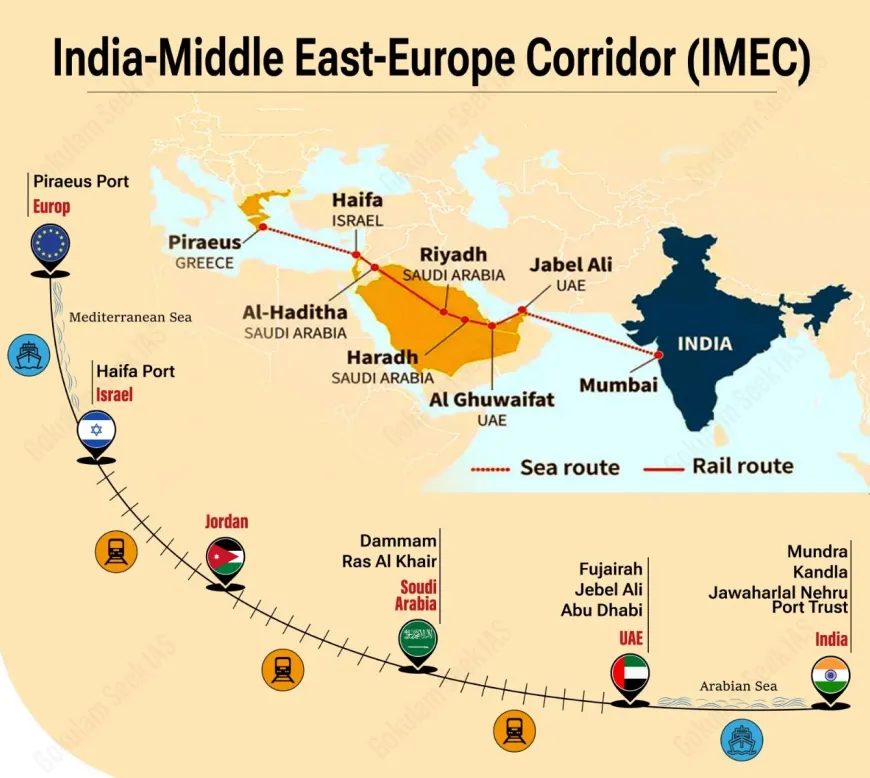
    Did you know that a 5% improvement in multimodal transport performance can lead to an increase in exports by nearly $500 billion annually across participating economies. India-Middle East-Europe Economic Corridor (IMEC), a multi-modal trade network focuses on not only physical infrastructure but also digital connectivity and energy security. 

    Today’s editorial emphasizes the strategic importance of the IMEC for the United States. This content can be used to address multifaceted approaches to enhance economic growth in Asian and European regions while promoting democratic values.

    _

    Let’s learn!

    Why in the News?

    The recent signing of a MoU on cybercrime investigations underscores this commitment, as both India and USA aim to bolster their security cooperation in response to common threats like terrorism and organized crime.

    • The IMEC agreement is viewed as a strategic opportunity for Prez. Donald Trump to deepen U.S.-India ties while also promoting multilateral collaboration among participating countries.
    • As Trump 2.0 begins, the present administration is anticipated to continue building on the defense and economic frameworks established during his first term.
    Key highlights of the Recent MoU:

    • Cyber Threat Intelligence Sharing: The agreement facilitates enhanced exchange of information regarding emerging cyber threats, allowing both nations to stay ahead of potential cybercriminal activities.It focuses on improving tools and processes for investigating cybercrimes, thereby strengthening the capabilities of law enforcement agencies in both countries.
    • Capacity Building: The MoU includes provisions for training programs aimed at enhancing investigative skills related to cybercriminal activities, ensuring that personnel are well-equipped to tackle these challenges. The Indian Cyber Crime Coordination Centre (I4C) under the Ministry of Home Affairs will be responsible for executing the MoU from India’s side, while the U.S. Department of Homeland Security (DHS), along with its sub-agencies like Immigration and Customs Enforcement (ICE) and the Homeland Security Investigations Cyber Crimes Center (C3), will lead implementation efforts from the U.S. side.
    • Addressing Common Security Challenges: The MoU recognizes the intricate linkages between cybercrime and broader security issues such as terrorism, violent extremism, drug trafficking, organized crime, human trafficking, illegal migration, and money laundering.
    • Strengthening Security Cooperation: This agreement is part of a broader effort to enhance India-U.S. security cooperation as part of their comprehensive strategic partnership, emphasizing the importance of international collaboration in addressing cyber threats.

    What is the strategic significance of IMEC with respect to India and USA’s common interests?

    • Economic Integration: The IMEC (network of ports, railways, and roads) aims to create a seamless flow of goods and services among the participating countries, which include India, the UAE, Saudi Arabia, Israel, and several European nations.
      • For instance, the corridor could significantly reduce transit times for shipping goods to Europe by up to 40% compared to traditional routes like the Suez Canal. Such improvements lead to increased trade volumes and economic growth. 
      • The potential for establishing Free Trade zones along the corridor further enhances this economic integration by reducing tariffs and regulatory barriers.
    • Geopolitical Influence: Supporting IMEC allows the U.S. to counterbalance China’s growing influence in the Middle East through its Belt and Road Initiative (BRI).
      • By investing in IMEC, the U.S. can strengthen its alliances with key partners in Asia and Europe while promoting democratic values and stability. The alignment of interests among the U.S., India, and European nations within this corridor serves as a counterweight to China.
      • For example, the collaboration between India and Gulf monarchies under the IMEC framework is seen as a strategic move to build economic interdependence that can mitigate geopolitical tensions. 
    • Holistic and Sustainable Connectivity: The initiative aims to establish secure High-speed data pipelines that would facilitate the export of India’s IT services to Europe and West Asia, which is crucial for modern economies that rely heavily on digital services.
      • Moreover, there are plans for Renewable Energy Grids that will enable countries along the corridor to share clean energy resources efficiently. 
      • For example, hydrogen pipelines are proposed to transport green hydrogen produced in the Gulf states to Europe, aligning with global energy transition goals. 

    What are the limitations in enhancing strategic ties over IMEC?

    • Logistical and Connectivity Issues: Implementing IMEC requires extensive coordination among multiple countries, involving various modes of transportation.
      • For Example, If one country has outdated ports or railways, it can slow down the movement of goods, making trade less efficient. For instance, delays at a port in India could hold up shipments to Europe.
    • Regulatory Harmonization: The diverse regulatory frameworks and systems and regulations of the participating nations pose significant challenges.
      • For Example, if India has strict import regulations while a Middle Eastern country has more relaxed rules, it could lead to conflicts about how goods are traded. 
      • Finding common ground on regulations is essential for smooth operations.
    • Security Concerns: The region traversed by IMEC is susceptible to security threats, including terrorism and political instability.
      • For Example, ongoing conflicts, such as those in Syria and Yemen, along with historical rivalries (e.g., Saudi-Iranian tensions), complicate efforts to ensure a secure environment necessary for attracting investments and fostering economic growth.
    • China Factor: If China offers better financing or faster infrastructure development for its routes, countries (esp European)  might prefer to partner with China rather than engage with IMEC.
      • As of 2023, BRI engagement has surpassed USD 1 trillion, with approximately USD 419 billion allocated to non-financial investments and USD 634 billion to construction contracts (which is much higher than IMEC).
    • Financial Commitments: The ambitious nature of IMEC demands substantial financial investments from participating nations.
      • But, if a country like Iraq struggles with its economy, it may not be able to contribute financially to the project, which could slow down progress for everyone involved.

    Way Forward: The IMEC represents a strategic opportunity for the USA to enhance its geopolitical influence while promoting economic growth and stability among participating nations. 

    • As the U.S. navigates complex international dynamics, prioritizing IMEC will be crucial in establishing a resilient and interconnected economic framework that benefits all stakeholders involved, ultimately contributing to a more stable and prosperous global order.

    https://www.thehindu.com/opinion/op-ed/prioritising-imec-is-in-americas-best-interest/article69120478.ece