Mains Ready By December. Smash Mains & Smash PYQ Admissions Open

GS Paper: GS2-18.Bilateral, regional and global groupings and agreements involving India and/or affecting India’s interests.

  • [4th September 2024] The Hindu Op-ed: A discourse on AI governance that India must shape

    PYQ Relevance:

    Q At the international level, the bilateral relations between most nations are governed by the policy of promoting one’s own national interest without any regard for the interest of other nations. This leads to conflicts and tensions between the nations. How can ethical consideration help resolve such tensions? Discuss with specific examples. (UPSC IAS/2015)

    Q “The emergence of the Fourth Industrial Revolution (Digital Revolution) has initiated e-Governance as an integral part of government”. Discuss. (UPSC IAS/2020)

    Q Describe the major outcomes of the 26th session of the Conference of the Parties (COP) to the United Nations Framework Convention on Climate Change (UNFCCC). What are the commitments made by India in this conference? (UPSC IAS/2021)

    Mentor comment: The United Nations is emerging as a central forum for establishing global AI standards, facilitating dialogue among diverse national interests, and promoting international cooperation. India has a long-standing strategic role at the UN and is involved in platforms like the G-20 and the Global Partnership on Artificial Intelligence (GPAI). India’s historical legacy of advocating the interests of the Global South, robust engagement at international fora, and lived experiences as a Global South country make it well-positioned to lead these conversations. In today’s Editorial we will have a look at India’s advocacy for a fair and inclusive AI governance framework is also crucial in the context of bipolar dynamics between the U.S. and China, where both countries are driving the AI governance discourse to advance their strategic interests.

    _

    Let’s learn!

    Why in the News?

    The Summit of the Future, taking place on September 22-23, 2024, will be a crucial event for global discussions on Artificial Intelligence (AI) governance. 

    • World leaders will gather under the United Nations during this summit to promote the Global Digital Compact (GDC).

    What are the main goals of the Global Digital Compact?

    It aims to establish a collaborative framework for addressing key digital challenges and promoting an inclusive digital future. Its main goals include:

    • Closing Digital Divides: Ensuring equitable access to digital technologies and accelerating progress towards the Sustainable Development Goals (SDGs).
    • Expanding Inclusion: Enhancing participation and benefits from the digital economy for all individuals.
    • Fostering a Safe Digital Space: Creating an open, secure environment that respects and promotes human rights.
    • Advancing Data Governance: Promoting responsible and equitable international governance of data.
    • Strengthening AI Governance: Enhancing international governance of emerging technologies, particularly artificial intelligence, to benefit humanity
    The present state of Geopolitical contestation

    The UN General Assembly has adopted two significant resolutions led by the U.S. and China regarding Artificial Intelligence (AI).

    U.S.-Led Resolution: Focuses on ‘Safe, Secure and Trustworthy AI for Sustainable Development’ which promotes a harmonized approach to AI governance, encouraging shared ethical principles and transparency standards. This aims to assert U.S. dominance in AI technology.

    China-Led Resolution: Emphasizes equitable benefits from AI, bridging the digital divide, and fostering an open business environment. This positions China as a key player in global trade and technology standards.

    What are the Challenges?

    • Wider gaps vs. Realm of AI: While developed countries have readily available resources, developing countries lack even the basic infrastructure, Internet access, and electricity which are absolute essentials for AI advancements.
      • This issue might be overlooked or simplified by developed economies.
    • Exacerbating Inequalities: Policies and Frameworks that fail to address the root issues faced by developing countries limit the effectiveness of global AI governance initiatives, and exacerbate existing inequalities.

    How can India leverage its historical legacy and advocacy for the Global South?

    • Engaging in Multilateral Platforms: Active participation in international forums, such as the United Nations and G-20, allows India to highlight the priorities of the Global South and shape the discourse around digital governance and AI to reflect these interests.
    • Building Coalitions: By forming alliances with other Global South nations, India can strengthen its voice in negotiations, ensuring that the concerns and perspectives of developing countries are represented in the GDC discussions.
    • Emphasizing Human-Centric Development: India can advocate for a GDC that prioritizes human rights and sustainable development, ensuring that digital policies promote social equity and economic justice for all.
    • Addressing Geopolitical Dynamics: With the current geopolitical contestation between major powers like the U.S. and China, India can position itself as a leader advocating for a balanced approach that considers the needs of the Global South, rather than allowing these powers to dominate the narrative.
    • Climate Justice Advocacy: India’s experience in international climate negotiations (during UNFCCC and CBDR) highlights its commitment to equity and justice, which can inform its approach to AI governance.

    Conclusion:

    India must underscore the importance of aligning AI development with democratic values and human rights, advocating for a collaborative approach that involves multiple stakeholders (South countries as well as North countries) to ensure that AI technologies benefit society as a whole while mitigating potential risks.

    https://www.thehindu.com/opinion/lead/a-discourse-on-ai-governance-that-india-must-shape/article68602063.ece

  • Dealings at a China-Africa forum that India must track

    Why in the News?

    The 9th edition of the Forum on China-Africa Cooperation (FOCAC) is scheduled to be held in Beijing from 4th to 6th September, 2024.

    About the China-Africa Cooperation (FOCAC)

    The Forum on China-Africa Cooperation (FOCAC) was established in 2000 to enhance the strategic partnership between China and African nations. It serves as a platform for collective dialogue and cooperation in various sectors, including trade, investment, and development.

    Challenges of China-Africa Debt:

    • Chinese loans to African countries amounted to approximately $170 billion from 2000 to 2022. However, Chinese lenders represent only about 12% of Africa’s total public and private debt, indicating that China is not the primary creditor.
    • A significant portion of Chinese loans is not disclosed in sovereign debt records, complicating the understanding of Africa’s overall debt levels. This lack of transparency raises concerns about the sustainability of these debts.
    • Despite concerns over “debt trap diplomacy,” China is unlikely to forgive or cancel debts but may consider writing off smaller, interest-free loans.

    African Priorities at FOCAC 2024

    • Economic Goals: African nations are focusing on enhancing trade relations with China, with a modest goal of $300 billion in imports from Africa between 2022-2024. As of mid-2024, trade has reached $167 billion, primarily dominated by raw materials.
    • Agricultural Development: There is a pressing need to develop a sustainable agricultural industry in Africa. This includes improving the processing of agricultural commodities and leveraging the expertise of countries like China and India to enhance crop resilience and productivity.
    • Green Energy and Industrialization: African countries are advocating for the establishment of refining and processing hubs to increase the value added from their raw materials.

    What are the learnings that India can have?

    • Continuity in Engagement: India should emphasize consistent engagement with Africa, particularly by organizing the India-Africa Forum Summit (IAFS-IV) to capitalize on recent momentum, especially after the African Union’s inclusion in the G-20.
    • Support for Industrialization: Indian companies are encouraged to invest in higher value-added sectors in Africa, such as agriculture and pharmaceuticals, to foster local employment and market development.
    • Private Sector Participation: Greater involvement of the Indian private sector is essential, along with innovative financing solutions like public-private partnerships to support projects in Africa.
    • Digital and Financial Connectivity: Utilizing India’s digital stack and establishing rupee-based financial transactions can enhance connectivity and reduce forex risks for African nations.

    Conclusion: India should deepen its strategic partnerships with African nations by expanding bilateral and multilateral engagements, focusing on key sectors like healthcare, digital infrastructure, and renewable energy. Leveraging India’s experience in these areas can help address African development needs while enhancing India’s influence on the continent.

    Mains PYQ:

    Q Increasing interest of India in Africa has its pros and cons. Critically Examine. (UPSC IAS/2015)

  • A crisis in WANA that no one talks about 

    Why in the News?

    The fight between the Sudan Armed Forces (SAF), led by General Abdel Fattah al-Burhan, and the Rapid Support Forces (RSF), led by General Mohamed Hamdan Dagalo, also known as Hemayti (“My Protector”), has caused severe destruction in Sudan.

    Historical Background of Sudan

    • Civil Strife and Governance: Sudan has a history of civil strife, marked by 15 military coups and two civil wars since its independence in 1956, resulting in 1.5 million deaths and the secession of South Sudan in 2011. The conflict in Darfur has been particularly notable, involving the Janjaweed militia and leading to over 200,000 deaths and millions displaced.
    • Current Crisis Genesis: The ongoing conflict is rooted in the 30 years of autocratic rule by Omar Hassan al-Bashir, who was overthrown in 2019. The subsequent attempts to establish a civilian government failed, culminating in a military coup in October 2021, which led to the current armed conflict between the Sudan Armed Forces (SAF) and the Rapid Support Forces (RSF) starting on April 15, 2023.

    Global Power Competition and Regional Powers Influence

    • Foreign Involvement: Sudan’s conflict has drawn significant foreign interest due to its strategic location and natural resources. Egypt supports the SAF, while Iran backs the SAF despite its rivalry with Egypt. The UAE has emerged as the primary supporter of the RSF, providing weapons and resources. Russia’s Wagner Group has also supported the RSF, while the Kremlin seeks a naval base in Port Sudan.
    • Geopolitical Dynamics: The conflict has created complex alliances, with countries like Chad and Libya also involved. Mercenaries from various regions, including South Sudan and Ukraine, have joined the fray, complicating the conflict further.

    Sudan and Syria Issue:

    • Humanitarian Crisis: Sudan’s crisis is particularly acute due to its strategic location and resource wealth, leading to a massive displacement crisis, with over 10 million people displaced since April 2023
    • Parallel Conflicts: Both Sudan and Syria have experienced severe internal conflicts driven by authoritarian regimes, regional power plays, and foreign interventions, leading to widespread human suffering and instability.

    India’s Strategic Considerations:

    • Economic Interests: India’s trade with Sudan reached $2,034 million in 2022-23, with a significant trade surplus. India has also invested heavily in Sudan’s oil sector, with cumulative investments worth $2.3 billion.
    • Historical Ties: India has maintained strong people-to-people ties with Sudan, including educational exchanges and medical tourism. President A.P.J. Abdul Kalam’s visit in 2003 reinforced these relations.
    • Humanitarian and Diplomatic Engagement: India evacuated its nationals early in the conflict, but the ongoing crisis may require continued diplomatic and humanitarian engagement to protect its broader interests in the region.

    Way forward: 

    • Strengthen Multilateral Diplomacy: India should collaborate with international bodies like the UN and the African Union to promote peace initiatives in Sudan, leveraging its neutral position to mediate and support conflict resolution efforts that safeguard regional stability and its strategic interests.
    • Expand Humanitarian and Development Aid: India can bolster its humanitarian assistance, focusing on essential services like healthcare and education, while also exploring opportunities for post-conflict reconstruction projects, ensuring long-term economic engagement and goodwill in Sudan.
  •  Pacific Islands Forum back joint police plan, maintain ties with Taiwan 

    Why in the News?

    Pacific leaders endorsed a significant joint policing initiative and rejected attempts by China’s allies to marginalize Taiwan in the Pacific Islands Forum (PIF), held in Tonga.

                  (Note: India and Taiwan are not a member countries.)

    Why are the countries sticking to Taiwan despite the pressure?

    • Reaffirmation of Taiwan’s Status: The Pacific Islands Forum (PIF) leaders reaffirmed Taiwan’s participation as a “development partner,” despite efforts from China and the Solomon Islands to sideline Taiwan. 
      • Countries emphasize the importance of maintaining existing agreements from 1992 that recognize Taiwan’s role in the forum.
    • Support from Allies: Countries like New Zealand and the United States expressed support for Taiwan’s inclusion in the PIF, highlighting that any decision regarding the exclusion of parties should be made through consensus.
    • Resistance to Chinese Influence: Many nations recognize the strategic importance of Taiwan and its contributions against China’s increasing influence, leading them to uphold its involvement.

    Significance of Taiwan for India: 

    • Strategic Balance in the Indo-Pacific: Taiwan is a crucial player in the Indo-Pacific region, and  India’s engagement with Taiwan serves as a counterbalance to China.
    • Economic and Technological Cooperation: Taiwan is a global leader in semiconductor manufacturing and advanced technology, areas where India seeks to enhance its capabilities.
    • People-to-People Ties and Education: Taiwan offers significant opportunities for Indian students and professionals in education and skill development.
      • For example, in 2018, the number of Indian students enrolled in Taiwanese universities reached 2,398, marking a 56% increase from the previous year.
    • Diversifying Supply Chains: In the wake of global disruptions due to COVID-19, India aims to diversify its supply chains. Taiwan’s expertise in manufacturing and electronics presents opportunities for India to reduce its dependence on other countries, particularly China, for critical components and technology.

    What did the forum say on the Climate cash and French press?

    • Climate Finance Initiatives: The forum committed to organizing a “global pledging event” to raise funds for climate initiatives, with a goal of $500 million.
      • This decision was supported by UN Secretary-General Antonio Guterres, who emphasized the urgent need for climate finance in the Pacific, which is disproportionately affected by rising sea levels.
      • Although not officially on the agenda, deep-sea mining generated significant discussion among forum members. A company backed by Nauru plans to scale up ocean mining operations, while other members, like Palau, called for a moratorium due to environmental concerns. 
    • Concerns Over French Governance: The French government faced criticism during the forum for its handling of unrest in New Caledonia. A Pacific delegation is expected to conduct a fact-finding mission there, indicating ongoing tensions regarding French governance in the region and the need for improved oversight.

    Conclusion: India should enhance diplomatic and economic ties with Taiwan by establishing formal mechanisms for regular dialogue and collaboration in areas such as technology, trade, education, and healthcare. This will reinforce strategic partnerships while respecting the “One China” policy framework. 

  • [29th August 2024] The Hindu Op-ed: ​A Silent democratic backlash in South Asia 

    [29th August 2024] The Hindu Op-ed: ​A Silent democratic backlash in South Asia 

    PYQ Relevance:

    Q The proposed withdrawal of the International Security Assistance Force (ISAF) from Afghanistan in 2014 is fraught with major security implications for the region’s countries. Examine in light of the fact that India is faced with a plethora of challenges and needs to safeguard its own strategic interests. (UPSC IAS/2013)

    Q ‘India is an age-old friend of Sri Lanka.’ Discuss India’s role in the recent political crisis in Sri Lanka in the light of the preceding statement. (UPSC IAS/2022)

    Mentor comment: The political landscape in countries like India, Pakistan, and Bangladesh, where governments have faced criticism for undermining democratic institutions and processes. Elections in Bangladesh (January 7, 2024) resulted in PM Sheikh Hasina securing a fourth consecutive term. However, the elections were widely condemned by boycotting, demanding a caretaker government to oversee the electoral process. Similarly in Pakistan, the elections (February 8, 2024), were marred by allegations of irregularities and military influence. International observers and analysts have raised alarms about the military’s increasing control over political processes, which has led to Pakistan being classified as an authoritarian regime by the Economist Intelligence Unit.

    This backlash may be attributed to various factors, including economic challenges, social unrest, and the manipulation of electoral systems, which have led to a deterioration of public trust in democratic norms and practices. Today’s editorial emphasizes the importance of recognizing these trends as they pose risks to the stability and future of democracy in South Asia, urging a reevaluation of the political dynamics at play in the region.

    Let’s learn!

    __

    Why in the News?

    South Asian region is experiencing a subtle yet significant backlash against democratic governance, characterized by increasing authoritarian tendencies and a decline in civil liberties.

    On Emerging Democratic Backlash in India and Pakistan:

    • Middle-Class Attitudes: Historically, the middle classes in both countries have shown ambivalence towards democracy, sometimes favoring military rule, though a younger generation in Pakistan is becoming critical of military involvement in politics.
      • Presently, in India, there has been a democratic pushback against the BJP’s authoritarianism. People also fought against the dictatorship during the Emergency in 1975.
      • In Pakistan, the PTI emerged as a major political force, resonating with public sentiment against military influence, despite state machinery working against it.
    • Digital Backlash: Both countries are witnessing a silent democratic backlash, with citizens utilizing digital platforms and electoral participation to reclaim democratic spaces.

    What are the main causes of the democratic backlash in South Asia?

    • Authoritarian Tendencies: The noticeable shift towards authoritarianism is often characterized by the erosion of civil liberties, media suppression, and the undermining of democratic institutions.
      • For example, in India, the Modi government has been accused of implementing divisive policies and attacking minority rights, leading to a downgrade in its democratic status.
    • Electoral Integrity Issues: In Bangladesh, the 2024 elections were described as a “sham” and  Pakistan’s elections faced accusations of military interference and manipulation, particularly against the Pakistan Tehreek-e-Insaf (PTI) party.
    • Polarization and Social Unrest: Politically, there are rising tensions between various social and ethnic groups. This leads to social unrest and can create an environment where authoritarian measures are justified as necessary for maintaining order.
    • Political Culture: In India, the middle class has at times expressed a preference for authoritarian rule when faced with perceived chaos, reflecting a complex relationship with democracy.
      • Similarly in Pakistan, the military’s historical role in politics has fostered a culture where military intervention is sometimes seen as a stabilizing force.
    • Economic Challenges: Issues such as poverty and unemployment exacerbate political discontent and can lead citizens to support more authoritarian governance as a means of achieving stability and order.
    Pakistan towards authoritarianism since its inception:

    • 1971 Events: Major protests led to significant political changes, including the first general election in 1970 and the eventual disintegration of East Pakistan in 1971, countering military intentions.
    • 2008 Events: Since 2008, Pakistan has experienced a relative transition to democracy with four general elections, but this has been met with military pushback.
    • Present Dynamics: Recent elections (2018 and 2024) reveal a troubling trend of political elites forming alliances with the military, undermining democratic processes and targeting political opponents.

    India’s Democratic Trajectory:
    • 1975 Events: India was seen as a model democracy with a history of free elections and separation of powers, barring the Emergency period in 1975.
    •Since 2014: Indian Politics marked a shift towards an authoritarian model of governance characterized by executive overreach and a campaign for an “Opposition-free democracy”.
    •Judicial Activism and Overreach: Judicial activism has played a role in protecting rights and promoting social justice in India, filling legislative vacuums and enhancing administrative efficiency.
    However, judicial overreach can undermine parliamentary democracy by interfering with the functioning of the legislative and executive branches, damaging the balance between organs of government.

    Implication for South Asia

    • Silent democratic backlash: Factors like authoritarian tendencies, electoral integrity issues, military influence, economic challenges, and social unrest have contributed to the erosion of democratic norms and public trust in the region.
      • The international community has expressed concerns about the deteriorating state of democracy in South Asia, particularly in Pakistan where the military’s influence has led to its classification as an authoritarian regime.

    Conclusion: As citizens in both countries increasingly advocate for democratic governance, it is crucial to observe how these movements evolve, particularly in Pakistan, where the political landscape is more volatile.

    https://www.thehindu.com/opinion/lead/a-silent-democratic-backlash-in-south-asia/article68577856.ece

  • How Canada’s policy of ‘reducing low-wage, temporary workers’ may impact Indians?       

    Why in the News?

    On Monday, August 26, Canadian PM Justin Trudeau announced that Canada would be “reducing the number of temporary foreign workers in low-wage jobs.”

    Who are these “Temporary Workers” in Canada?

    Temporary workers in Canada encompass various categories of individuals, including:

    • Temporary Work Visa Holders: These individuals come to Canada for a fixed duration, typically two years, to work in low-wage jobs that pay between CAD 13-19 per hour (approximately Rs 800-1,200 per hour).
    • International Students: After completing their studies, many international students remain in Canada on work visas for one to three years while applying for Permanent Residency (PR).
    • Spouse Open Work Permit Holders: Many international students bring their spouses to Canada, who can work in low-wage jobs under this permit.
    • Labour Market Impact Assessment (LMIA) Workers: These workers are hired under LMIA contracts, which allow employers to recruit foreign workers when they cannot find Canadians to fill job openings.
    • Humanitarian Arrivals and Youth Program Participants: This category includes individuals arriving through special humanitarian pathways, such as the Canada-Ukraine Authorization for Emergency Travel (CUAET), asylum seekers, and participants in reciprocal youth programs that allow Canadians to work abroad.

    How will Canada’s Policy of “Reducing” Such Workers Impact Indians?

    • Reduced Opportunities: The restrictions on temporary workers will limit job opportunities for many Indians, particularly students and their spouses, who make up a significant portion of the temporary workforce.
    • Impact on International Students: Indians constitute around 40% of Canada’s international student population, with a majority coming from Punjab. The new policy may restrict their ability to transition from temporary work to permanent residency.
    • Shift in Immigration Dynamics:  The introduction of restrictions emphasizes a policy shift that could deter potential migrants from considering Canada as a destination.

    Indians in Canada: 

    • The Indian community in Canada has grown significantly in recent years. Between 2000 and 2020, the registered Indian population increased from 670,000 to over 1 million.
    • As of 2021, there were approximately 1.8 million people of Indian origin in Canada, representing over 5% of the total population.
    • Indian students are the largest international student group in Canada, accounting for 20% of all international students in 2021. There were over 319,000 Indian students enrolled in Canadian institutions, contributing approximately US$ 4.9 billion to the Canadian economy in 2021
    • Many highly skilled Indian professionals contribute to various sectors, including technology, healthcare, and engineering. In 2022, over 15,000 Indian tech workers moved to Canada, enhancing the labor market with their expertise.

    Way forward: 

    • Strengthen Domestic Opportunities: India should focus on creating more job opportunities and enhancing skill development programs within the country to reduce dependency on foreign employment, ensuring that young professionals and students have viable career options at home.
    • Bilateral Engagement and Negotiation: Engage in diplomatic discussions with Canada to advocate for the interests of Indian workers and students, seeking to ensure continued access to work and study opportunities under fair and equitable conditions.
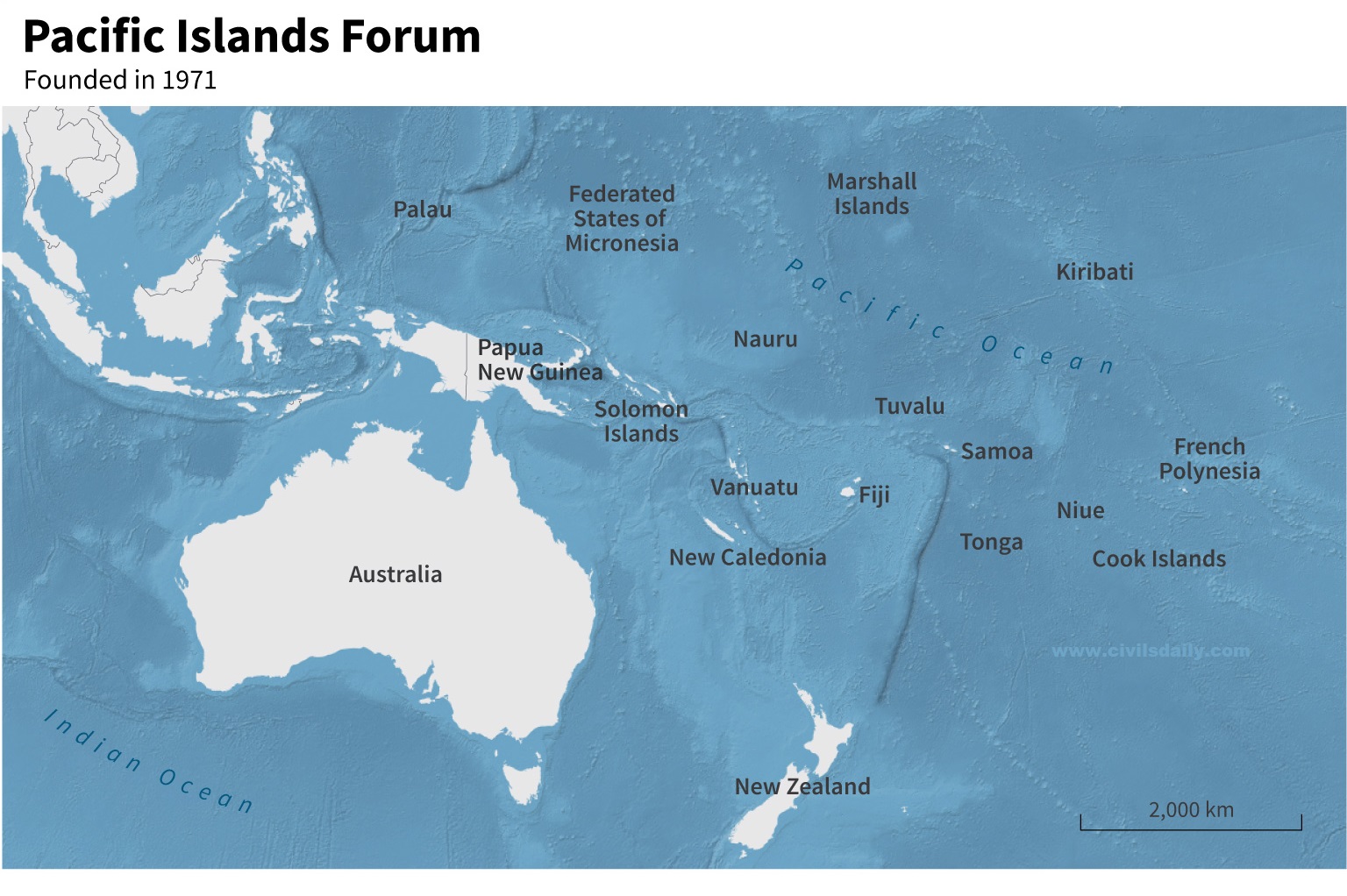
  • What is the Pacific Islands Forum (PIF)?

    Why in the News?

    The annual meeting of the Pacific Islands Forum (PIF) has begun in Nuku’alofa, the capital of Tonga.

    About Pacific Islands Forum (PIF):

    Details
    Establishment 1971
    Members 18 members: Australia, Cook Islands, Federated States of Micronesia, Fiji, French Polynesia, Kiribati, Nauru, New Caledonia, New Zealand, Niue, Palau, Papua New Guinea, Republic of Marshall Islands, Samoa, Solomon Islands, Tonga, Tuvalu, and Vanuatu.
    Vision Promote peace, harmony, security, social inclusion, and prosperity in the Pacific region.
    Framework Operates under the Framework for Pacific Regionalism which outlines strategic visions and objectives.
    Dialogue Partners 18, including major nations like the USA, China, India, and members of the EU.
    Key Focus Areas Environmental sustainability, economic growth, cultural development, and regional security.
    Leadership Directed by a Secretary-General, with annual meetings among leaders of member countries.

    Significance of PIF

    • The PIF advocates for global climate action and funds resilience efforts through the Pacific Resilience Facility (PRF) to support vulnerable Pacific nations.
    • It enhances cooperation among its 18 small island states, fostering joint decision-making on key regional issues.
    • The forum strengthens the Pacific’s ability to navigate geopolitical tensions between major powers like the US and China.
    • PIF promotes sustainable economic development through regional trade and investment initiatives.
    • It focuses on protecting the Pacific’s ecosystems by addressing challenges like ocean pollution and overfishing.

    PYQ:

    [2016] With reference to the ‘Trans-Pacific Partnership’, consider the following statements:

    1. It is an agreement among all the Pacific Rim countries except China and Russia.

    2. It is a strategic alliance for the purpose of maritime security only.

    Which of the statements given above is/are correct?

    (a) 1 only

    (b) 2 only

    (c) Both 1 and 2

    (d) Neither 1 nor 2

  • PM Modi presents BHISHM Cube to Ukraine

    Why in the News?

    Prime Minister Modi has presented the BHISHM Cube, a state-of-the-art mobile hospital designed for rapid deployment in disaster zones to Ukraine.

    What is the BHISHM Cube?

    • The BHISHM Cube is an advanced mobile hospital unit designed for rapid deployment in disaster zones and emergency situations.
    • It is developed under the “Project BHISHM” (Bharat Health Initiative for Sahyog, Hita, and Maitri), reflecting India’s commitment to providing swift medical assistance in crisis areas.
    • The unit is capable of treating up to 200 casualties.
    • Key Features:
      • It weighs 720 kg and is composed of 72 components that can be easily transported by hand, bicycle, or drone.
      • The unit can be fully operational within 12 minutes of deployment, a critical feature in emergencies where every second counts.
      • It includes an operating theatre, X-ray machines, ventilators, and facilities for treating a wide range of injuries.
      • It incorporates AI and data analytics for real-time monitoring and coordination of medical services.
      • It also uses RFID-tagged equipment for efficient tracking and management of medical supplies.
      • The unit is robust and waterproof, making it suitable for diverse environments and capable of withstanding various weather conditions.

    Significance of the move

    • By providing the BHISHM Cube to countries in need, such as Ukraine, India demonstrates its commitment to global humanitarian efforts.
    • The project aligns with India’s broader initiatives like ‘Aarogya Maitri’, aimed at supporting developing countries affected by natural disasters or crises.
    • The deployment of the BHISHM Cube enhances disaster preparedness by ensuring that essential medical services are available when and where they are needed most.
    • The gifting serves as a tool of soft diplomacy, strengthening India’s international relations by contributing to global health and safety.

    PYQ:

    [2022] With reference to the Ayushman Bharat Digital Mission, consider the following statements:

    1. Private and public hospitals must adopt it.
    2. As it aims to achieve universal, health coverage, every citizen of India should be part of it ultimately.
    3. It has seamless portability across the country.

    Which of the statements given above is/are correct?

    (a) 1 and 2 only

    (b) 3 only

    (c) 1 and 3 only

    (d) 1, 2 and 3

  • [23rd August 2024] The Hindu Op-ed: The Kursk gambit, Ukrainian tactics, and battle realities

    [23rd August 2024] The Hindu Op-ed: The Kursk gambit, Ukrainian tactics, and battle realities

    PYQ Relevance:
    Q (a): Russia and Ukraine war has been going on for the last seven months. Different countries have taken independent stands and actions keeping in view their own national interests. We are all aware that war has its own impact on the different aspects of society, including human tragedy. What are those ethical issues that are crucial to be considered while launching the war and its continuation so far? lllustrate with justification the ethical issues involved in the given state of affair. (b): Write short notes on the following in 30 words each: (i) Constitutional morality (ii) Conflict of interest (iii) Probity in public life (iv) Challanges of digitalization (v) Devotion to duty (UPSC IAS/2022)

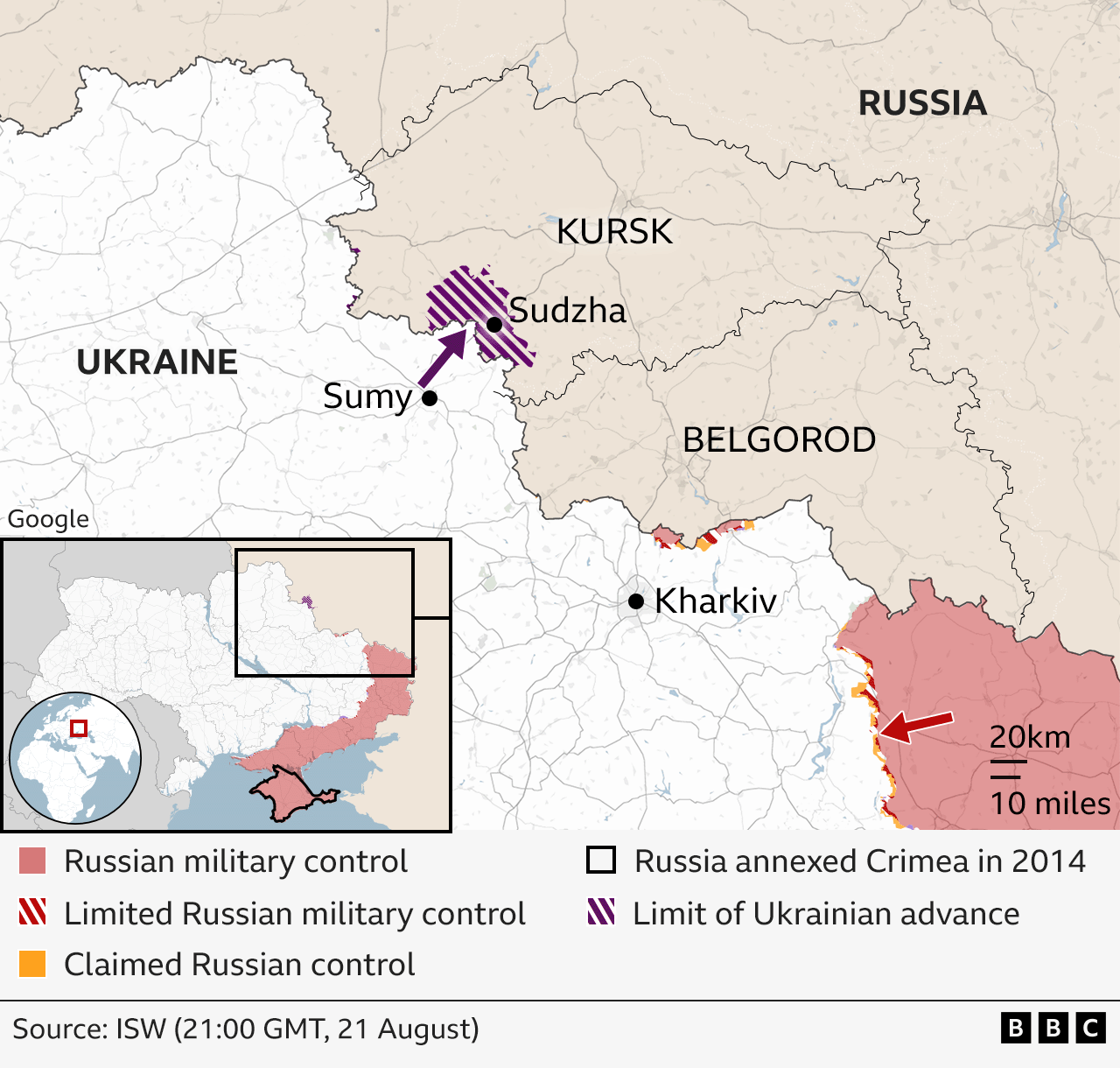
    Mentor comment: Ukraine had recently launched a surprising military offensive into the Kursk region of Russia, capturing several hundred Russian soldiers and gaining control over approximately 1,000 square kilometers of territory. This move is seen as a bold tactic to shift the war dynamics and boost morale among Ukrainian forces and civilians. While Ukraine made gains in Kursk, Russian forces are advancing towards the Ukrainian city of Pokrovsk, a crucial logistics hub. The capture of Pokrovsk could again escalate the political tensions reflecting Russia’s position in the ongoing conflict

    Let’s learn!

    __

    Why in the News? 

    Ukraine’s recent military incursion into the Kursk region of Russia outlines its tactical and political implications in the ongoing conflict.

    Ukrainian Incursion:

    • Surprise Attack: Ukraine launched an unexpected offensive into the Kursk region, capturing several hundred Russian soldiers and seizing approximately 1,150 square kilometers of territory.
    • Strategic Goals: The operation aims to divert Russian forces from their offensive in Ukraine, particularly around the critical city of Pokrovsk, which is under siege and vital for Ukrainian logistics.
    What are the long-term implications of Ukraine’s capture of Kursk for future negotiations?


    • Territorial Gains as Leverage: By occupying Kursk, Ukraine has secured valuable territory that can serve as a bargaining chip in future negotiations. This strategic advantage is crucial, especially if Ukraine faces reduced military support from the West, particularly in the event of a change in U.S. leadership.

    • Pressure on Russia:  The need for Russia to defend its territory in Kursk diverts resources from ongoing offensives in Eastern Ukraine, particularly in Donbas. This could weaken Russia’s overall military effectiveness and complicate its strategy, potentially leading to a more favorable environment for negotiations for Ukraine.

    Significance of Pokrovsk: It is formerly known as Krasnoarmiisk and Grishino, is a city and the administrative center of Pokrovsk Raion in Donetsk Oblast, Ukraine.

    • Key Logistics Hub: Pokrovsk’s capture by Russian forces would significantly enhance their operational capabilities in Eastern Ukraine, potentially leading to further territorial gains.
    • Ukrainian Withdrawal: Ukrainian troops are being ordered to withdraw from Pokrovsk, indicating the pressure they face from advancing Russian forces.

    Tactical and Political Analysis:

    • Operational Secrecy: Ukraine’s successful execution of the incursion was attributed to exceptional operational security, which prevented leaks and allowed for a covert buildup of forces.
    • Russian Response: Russia’s military has reacted slowly, focusing on containing the incursion rather than reversing it, revealing weaknesses in their intelligence and troop readiness.
    • Increase in Bargaining Power: The incursion enhances Ukraine’s negotiating position for potential future discussions, especially with looming uncertainties regarding Western military support.
    • Risks for Ukraine: While the offensive has been a tactical success, it poses risks of overstretching Ukrainian forces and facing significant losses in the overall region if Russia mounts a concentrated counterattack.
    Can India make Putin stop Russia’s War in Ukraine?

    India has been warming to the West in recent years, especially given rising border tensions with China, but, at the same time, India cannot disallow its relationship with Russia considering United States. India’s visit (in July 2024) comes as Ukraine pushes its initiative in Russia’s southwestern region of Kursk.

    • Humanitarian Concern: India during the recent talks with Putin in July, secured several concessions and seemingly chided the Russian leader over the war, calling the deaths of children killed in a Russian strike on a hospital “unbearable.”
    • Economic interests of India: Bilateral trade with Russia soared last year on the back of its energy purchases, with India in July topping China as the largest importer of Russian oil. PM Modi and Zelensky are expected to discuss issues of bilateral and multilateral cooperation” and sign multiple documents.

    Conclusion: The Kursk operation marks a significant shift in the conflict, with Ukraine demonstrating its capability to operate within Russian territory. Ukrainian offensive stands out and deserves and merits closer scrutiny because no country since Hitler’s Germany has ever invaded any part of Russia.

    However, the long-term viability of this strategy remains uncertain as both sides prepare for ongoing military engagements.

  •  How South China Sea tensions pose a threat to international trade? 

    Why in the News?

    Tensions between China and the Philippines have sharply escalated after a violent clash between their sailors in the South China Sea (SCS) last week. Currently, escalating tensions in the South China Sea are heightening global security concerns over this vital trade route.

    How Important is the South China Sea for World Trade?

    • About a third of global maritime trade passes through the 3.5 million square kilometre South China Sea annually, according to UNCTAD.
    • Around 40% of petroleum products traded globally are delivered via the South China Sea every year.
    • In 2016, an estimated $3.4 trillion to $3.6 trillion worth of goods and commodities travelled the seaway.
    • Tens of thousands of cargo vessels move through the South China Sea every year, carrying around 40% of China’s, one-third of India’s and 20% of Japan’s trade with the rest of the world.
    • The South China Sea is a vital crossroads for both intra-Asian trade as well as for commerce with the rest of the world, especially Europe, the Middle East and Africa.

    What makes the South China Sea such a Controversial Issue?

    • Beijing claims almost all of the South China Sea as its own, angering its neighbours who say China’s territorial ambitions cut into their exclusive economic zones.
    • China ignored a 2016 ruling by an international arbitration court that Beijing has no legal or historical basis for its expansive claims under international law.
    • The Chinese military has staged increasingly aggressive actions in the seaway recently, including clashes with Filipino ships, fueling fears of a full-scale conflict.
    • Vietnam and the Philippines have filed claims with the UN for extended continental shelves in the South China Sea.
    • Concerns that Beijing may use military force to bring Taiwan under its control have further raised tensions in the region.

    Why is the South China Sea Contested?

    • Availability of Natural gas and oil: The South China Sea is estimated to hold about 5.38 trillion cubic meters of proven and probable natural gas and 11 billion barrels of oil reserves.
    • Rare earth elements: The disputed waters also contain large deposits of rare-earth minerals crucial to China’s technological ambitions, including electric vehicle batteries and advanced electronics.
      • Some estimates suggest the Pacific Ocean contains a thousand times more rare-earth minerals than the currently known land reserves, more than half of which are controlled by China.

    Biggest Chokepoint in the South China Sea

    • The Malacca Strait, which lies between Malaysia, Indonesia and Singapore, is considered the biggest chokepoint in the South China Sea.
    • Last year, 23.7 million barrels of oil and petroleum products were moved through the strait per day, 13% higher than through the Strait of Hormuz.
    • The Malacca Strait is just 64 kilometers wide at its narrowest point and is already vulnerable to congestion and collisions.
    • Experts predict that if China invades Taiwan, the U.S. and its allies could blockade the Malacca Strait, limiting China’s access to oil and exports

    What should India do? (Way forward)

    • Enhance Strategic Partnerships: India should strengthen its maritime collaborations with key regional players like ASEAN nations, Japan, and Australia while deepening its involvement in forums such as the Quad to promote a rules-based order in the Indo-Pacific and ensure freedom of navigation in the South China Sea.
    • Bolster Naval Capabilities: India should continue to modernize and expand its naval presence in the Indo-Pacific, focusing on securing critical sea lanes and chokepoints like the Malacca Strait to safeguard its trade routes and energy supplies in the event of escalating tensions.

    Mains PYQ:

    Q South China Sea has assumed great geopolitical significance in the present context. Comment.(2016)