Mains Ready By December. Smash Mains & Smash PYQ Admissions Open

GS Paper: GS2-18.Bilateral, regional and global groupings and agreements involving India and/or affecting India’s interests.

  • Dealing with Death at Work    

    Why in the News?

    On August 21, 2024, a deadly explosion at the Escientia plant in Atchutapuram SEZ killed 17 workers and injured over 50, triggered by a solvent leak involving MTBE. The incident, part of a troubling safety trend, has prompted a government inquiry and calls for stricter safety regulations, particularly due to the exemption from regular inspections for SEZ units.

    • Previous Incidents: This accident is part of a troubling pattern, as it follows another major explosion in the same SEZ last year, and recalls a deadly styrene vapour leak incident in 2020 that killed 12 people.
    • Government Response: The Andhra Pradesh government has ordered a high-level inquiry into the incident. Chief Minister N. Chandrababu Naidu has expressed condolences and promised support for the victims’ families.

    Importance of Safety Audits

    • Preventing Future Accidents: Regular safety audits can help identify potential hazards and ensure compliance with safety regulations, reducing the risk of catastrophic incidents.
    • Accountability: Audits enforce accountability among management to adhere to safety standards, promoting a culture of safety within organizations.
    • Regulatory Compliance: Conducting safety audits helps organizations ensure compliance with local, state, and national safety regulations.
    • Public Trust: Enhancing safety measures and transparency can restore public confidence in industrial operations, particularly in regions prone to industrial accidents.

    Safety Law and Guidelines:

    • Factories Act, 1948: Governs worker safety in factories, mandating safety audits and safety officer appointments. Requires safety committees with management and employee reps to address hazards.
    • IS 14489:1998: Provides guidelines for occupational safety and health audits, focusing on compliance, deviations, and safety management effectiveness across sectors.
    • Occupational Safety, Health and Working Conditions Code, 2020: Consolidates labor laws, mandates regular safety audits for hazardous processes, and grants inspectors authority to enforce compliance.
    • CIMAH Rules: Require industries with hazardous processes to prepare safety reports and conduct regular audits to prevent major accidents, enforced by state safety authorities.
    • Integrated Guidance Framework for Chemicals Safety: Offers guidance for safety audits in handling hazardous chemicals, emphasizing compliance with MSIHC Rules and robust audit practices.

    Note:

    IS 14489:1998 is an Indian Standard titled “Code of Practice on Occupational Safety and Health Audit.” It provides comprehensive guidelines for conducting occupational safety and health audits in various workplaces.

    Way forward: 

    • Implement Regular Safety Audits: Enforce routine safety audits for all industrial units, including SEZs, to identify hazards and ensure compliance with safety standards, thus preventing future incidents and promoting a culture of safety.
    • Strengthen Regulatory Oversight: Close regulatory gaps by applying safety standards uniformly across all sectors, including exempted units, and enhance transparency and accountability in safety practices to restore public trust.
  • India-Malaysia Comprehensive Strategic Partnership

    Why in the News?

    India and Malaysia have elevated their relationship to a ‘Comprehensive Strategic Partnership’ following talks between Prime Ministers Modi and Ibrahim, aiming to overcome past tensions.

    What is a Comprehensive Strategic Partnership (CSP)?

    • The Comprehensive Strategic Partnership (CSP) represents a deepened level of engagement between two nations, encompassing a broad spectrum of areas such as political, economic, cultural, and security cooperation.
    • This partnership reflects a commitment to working closely across these domains to achieve mutual goals.

    Upgradation of ties between India and Malaysia:

    • The recent upgrade includes agreements and MoUs in workers’ mobility, digital technology, culture, tourism, sports, and education.
    • India has also agreed to support Malaysia’s bid to join the BRICS grouping, which the Malaysian Prime Minister has been advocating for.
    • The leaders discussed new areas of cooperation, including semiconductors, fintech, defence industry, artificial intelligence (AI), and quantum technologies.
    • A special allocation of 200,000 metric tonnes of white rice was granted by India to Malaysia in response to Malaysia’s request, reflecting India’s role in Malaysia’s food security.

    Bilateral Friction between India and Malaysia:

    • Citizenship Amendment Act (CAA): During the Kuala Lumpur Summit in December 2019, Malaysian PM Mahathir Mohamad criticized India’s CAA, which provides a pathway to citizenship for non-Muslim refugees from Afghanistan, Bangladesh, and Pakistan.
    • Reorganisation of Jammu and Kashmir: Mahathir Mohamad also voiced strong criticism regarding India’s reorganization of Jammu and Kashmir, particularly after the revocation of its special status in August 2019.
    • Extradition of Zakir Naik: India’s repeated requests for the extradition of Zakir Naik, wanted on charges of hate speech and money laundering, have been denied by Malaysia, citing insufficient evidence.
    • COVID-19 Pandemic: During the pandemic, hundreds of Malaysians were detained in India due to the lockdown, further adding to tensions.

    Way forward: 

    • Enhance Diplomatic Engagement: Continue regular high-level dialogues to resolve sensitive issues and foster mutual trust, focusing on joint working groups for contentious matters like extradition and human rights.
    • Expand Strategic and Economic Collaboration: Prioritize joint ventures and research in emerging sectors such as fintech, AI, and quantum technologies to strengthen economic ties and minimize political friction.
  • [pib] 2+2 Ministerial Dialogue

    Why in the News?

    Japanese foreign and defence ministers have arrived in India to participate in the India-Japan 2+2 ministerial meeting.

    About 2+2 Ministerial Dialogue

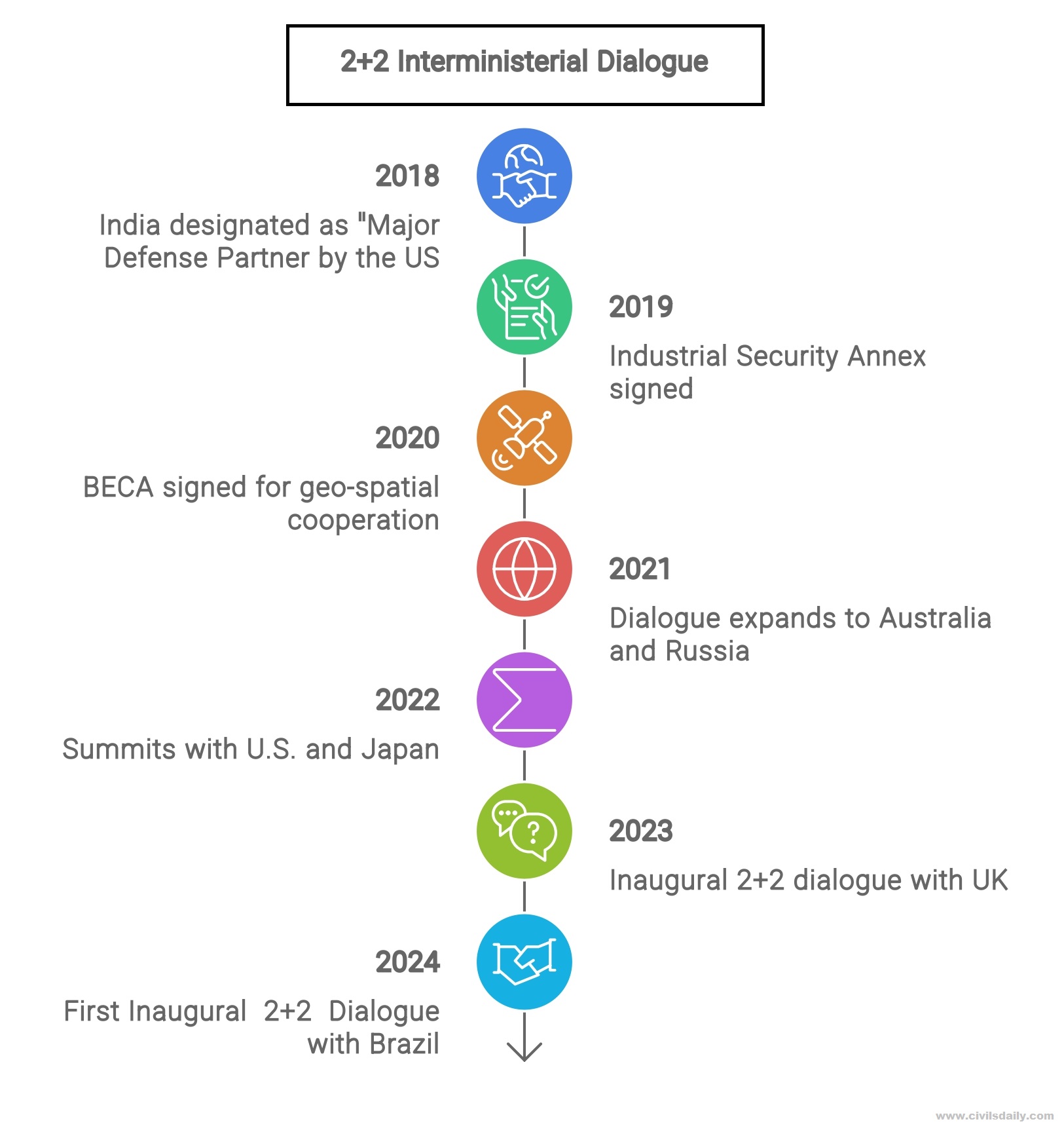
    • The 2+2 Ministerial Dialogue is a diplomatic summit held annually since 2018, initially between India and the US.
    • It later expanded to include Japan, Australia, Russia, and the United Kingdom.
    • This dialogue involves the Foreign and Defense Ministers of participating countries and focuses on strengthening bilateral relations and addressing common concerns.
    • The dialogue replaced the Strategic and Commercial Dialogue during a 2017 agreement between PM Narendra Modi and President Donald Trump.
    • First Summit was held on September 6, 2018, between India and the US in New Delhi, involving discussions on defense partnerships and strategic cooperation.

    Key Milestones:

    What are the key priorities of the Indo-Japan 2+2 Dialogue?

    • Update Security Cooperation: Revising the 2008 security agreement to reflect current strategic needs.
    • Promote a Free Indo-Pacific: Collaborating to ensure a free, open, and stable Indo-Pacific region.
    • Engage in Strategic Talks: Holding strategic discussions between foreign and defense ministers to boost bilateral ties.
    • Address Regional Security: Discussing key issues like Chinese assertiveness, the Russia-Ukraine war, and the Gaza crisis.
    • Coordinate Quad Efforts: Exploring cooperation within the Quad framework, including a potential summit.

    PYQ:

    [2020] Quadrilateral Security Dialogue (Quad) is transforming itself into a trade bloc from a military alliance, in present times Discuss.

  • India, UAE reviewing precious metals trade under CEPA

    Why in the News?

    India is seeking a review of certain provisions of the free trade agreement (FTA) with the UAE, which came into force on May 1, 2022.

    India-UAE Trade Relations: An Overview

    Concerns over Precious Metals Imports

    • There has been a significant increase in imports of precious metals from the UAE under the trade agreement.
    • Global Trade Research Initiative (GTRI) has raised concerns about the spurt in imports of gold, silver, platinum, and diamonds with zero tariffs in the coming years.
    • GTRI’s report highlights potential revenue losses and a shift in import business from banks to private traders, favouring Dubai-based firms.
    • It also claims that many imports do not meet the Rules of Origin conditions, making them ineligible for concessions.

    Review of IT Hardware Import Regime

    • When asked about the review of the new authorisation regime for monitoring imports of certain IT hardware products, Barthwal indicated that the government would make a decision at the appropriate time.
    • The government had previously adjusted import restrictions on laptops and computers, allowing importers to bring in shipments under an ‘authorisation’ system until September.
  • [14th August 2024] The Hindu Op-ed: The shock-effects of South Asian tumult

    PYQ Relevance:

    Mains:

    Q1 Do you think that BIMSTEC is a parallel organisation like the SAARC? What are the similarities and dissimilarities between the two? How are Indian foreign policy objectives realized by forming this new organisation?  (UPSC IAS/2022) 

    Q2 Critically examine the compulsions which prompted India to play a decisive role in the emergence of Bangladesh (UPSC IAS/2013) 

    Note4Students: 

    Mains: Reason behind the declining India’s influence in South Asia;

    Mentor comments:  Since the start of this decade, India has faced a series of shocks in its neighborhood. In 2021, the coup in Myanmar and the Taliban takeover in Afghanistan set the stage. In 2022, the ouster of Prime Minister Imran Khan in Pakistan and the riots that forced Gotabaya Rajapaksa out in Sri Lanka added to the turmoil. More recently, electoral changes in the Maldives and Nepal have replaced India-friendly governments with less cooperative ones. With Sheikh Hasina’s dramatic exit in Bangladesh, India is now urgently reassessing its approach to safeguard against future upheavals in South Asia.

    Let’s learn!

    __

    Why in the News? 

    Hasina’s removal from power in Bangladesh is no doubt a dramatic setback for India, as both countries have transformed ties on every front in the past decade and a half. 

    Key lesson for India: 

    • Engage with All Political Stakeholders: India must broaden its diplomatic engagement to include all political parties in Bangladesh, particularly the opposition, such as the Bangladesh Nationalist Party (BNP).  
    • Monitor and Respond to Local Sentiments: India should enhance its intelligence and diplomatic capabilities to monitor local sentiments and political developments in Bangladesh more effectively. This includes understanding the socio-political dynamics and public opinion, which can provide critical insights into potential unrest or shifts in governance.  
    • Reassess Strategic Partnerships: India needs to reassess its strategic partnerships and avoid over-reliance on any single government or political party.  
    • Promote Democratic Values and Human Rights: India should advocate for democratic values and human rights in its foreign policy, emphasizing the importance of free and fair elections and the protection of civil liberties.  

    Loss of Reputation:

    • Reputation as a Dependable Partner: India’s reputation as a reliable ally in the region suffered a setback after the fall of Kabul when it refused visas to hundreds of Afghans fleeing the Taliban. Many of these individuals were senior defense and security officials who had risked their lives for Indian diplomats.
    • Pragmatism in Supporting Allies: Despite the potential complications, India wisely allowed Sheikh Hasina to stay in the country after her removal from power, recognizing that turning its back on an old ally would have been a betrayal. This approach is necessary to maintain long-term relationships in the region, where political leaders often return to power.
    • Future Diplomatic Challenges: The continued presence of Sheikh Hasina in India could complicate ties with any new government in Bangladesh, especially if they request her extradition or perceive the Awami League as regrouping in India.

    Communal Lens:

    • Faulty Assumption of Religious Ties: The good diplomatic ties in South Asia are somehow linked to shared religious majorities. For example, Hindu-majority Nepal has been a challenging relationship for India, while Buddhist-majority Bhutan and Muslim-majority Maldives have often been among its closest allies.
    • Impact of the Citizenship (Amendment) Act (CAA): The Indian government’s introduction of the CAA, which fast-tracks citizenship for non-Muslims from Muslim-majority countries (Afghanistan, Pakistan, Bangladesh), has backfired across the region. It has strained relationships not only with the countries directly mentioned but also with others in the neighbourhood.

    Erosion of Pan-South Asian Mechanisms: 

    1. Boycott of SAARC by India: India has boycotted the SAARC (South Asian Association for Regional Cooperation) summit for a decade now due to bilateral issues with Pakistan. This has led to the stagnation of the regional grouping and its inability to address common challenges.
    2. Abandonment of BIMSTEC: There are concerns that India may abandon the Bay of Bengal Initiative for Multi-Sectoral Technical and Economic Cooperation (BIMSTEC) if ties with Bangladesh worsen, similar to its stance on SAARC. This would further erode regional cooperation mechanisms.

    Implications for India

    1. Loss of Influence in the Region: The erosion of pan-South Asian mechanisms has diminished India’s influence in the region. Countries like Bangladesh are now more open to engaging with other powers, reducing India’s ability to shape regional dynamics.
    2. Vulnerability to External Interference: The absence of effective regional cooperation platforms has made South Asian countries more vulnerable to external interference from global powers like the United States and China. Their rivalries can now play out in the region without sensitivity to India’s interests.
    3. Deprived Economic Opportunities: The lack of regional integration has deprived India and its neighbours of potential economic benefits through increased trade, investment, and connectivity. Reviving mechanisms like SAARC could unlock significant economic opportunities for the region.

    Way Forward for India

    1. Reviving Pan-South Asian Mechanisms: India must take the lead in reviving pan-South Asian mechanisms like SAARC and finding ways to engage with its neighbours without external interference. This would require addressing bilateral issues and prioritizing regional cooperation.
    2. Balancing Relations with Global Powers: India needs to strike a balance in its relations with global powers like the United States and China. It should avoid being drawn into its rivalries and instead focus on pursuing its own interests in the region.

    Source: https://www.thehindu.com/opinion/lead/the-shock-effects-of-south-asian-tumult/article68521412.ece 

  • Ukraine’s Kursk Operation in Russia

    Why in the News?

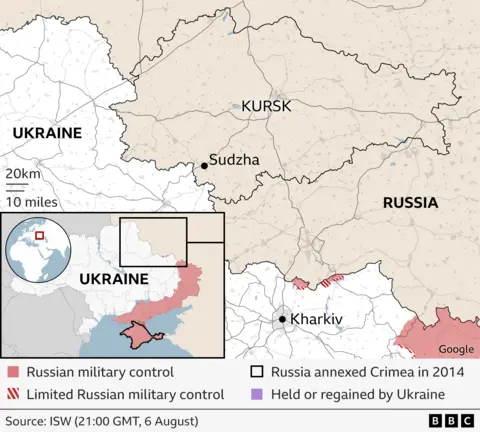
    Ukrainian troops have advanced up to 35 kilometers into Russian territory in the Kursk region. 

    What is the Kursk Operation?

    • The Kursk operation marks a significant escalation in the ongoing conflict between Ukraine and Russia.
    • The operation has been characterized by intense fighting, with reports of casualties.

    About Kursk Region:

    • It is located in the western part of Russia, bordering Ukraine to the southwest.
    • The region holds historical significance Battle of Kursk as the site of the, which took place from July to August 1943 and is recognized as the largest tank battle in history during World War II.
    • The Kursk region is rich in iron ore, which has led to substantial mining operations in the area.
    • The region experiences a continental climate, with cold winters and warm summers.


    Significance of the Kursk Operation for Ukraine

    • Strategic Leverage: Strengthens Ukraine’s position in future negotiations by capturing Russian territory for potential land exchanges.
    • Buffer Zone Creation: Enhances security for contested Ukrainian areas by establishing a protective buffer on Russian soil.
    • Military Diversion: Forces Russia to redeploy troops, weakening their main front lines and easing pressure on Ukrainian forces.

    PYQ:

    [2023] Consider the following pairs:

    Regions often mentioned in news Reason for being in news
    1. North Kivu and Ituri War between Armenia and Azerbaijan
    2. Nagorno-Karabakh Insurgency in Mozambique
    3. Kherson and Zaporizhzhia Dispute between Israel and Lebanon

    How many of the above pairs are correctly matched?

    (a) Only one

    (b) Only two

    (c) All three

    (d) None

  • [8th August 2024] The Hindu Op-ed:  The leader who lost touch with Bangladesh

    [8th August 2024] The Hindu Op-ed:  The leader who lost touch with Bangladesh

    PYQ Relevance:

    Q. The protests in Shahbag Square in Dhaka in Bangladesh reveal a fundamental split in society between the nationalists and Islamic forces. What is its significance for India? (UPSC IAS/2013)

    Q. Critically examine the compulsions which prompted India to play a decisive roles in the emergence of Bangladesh. (UPSC IAS/2013)

    Mentors’ comment: The political crisis in Bangladesh escalated dramatically following Prime Minister Sheikh Hasina’s resignation amid widespread protests against a controversial government job quota system. The unrest has led to significant violence, particularly against Hindu minorities, with reports of targeted attacks and rising casualties. The military has since established an interim government, raising concerns over regional stability and India’s strategic interests. The crisis threatens to disrupt bilateral trade, which reached $13 billion in FY 2023-24, and could impact ongoing infrastructure projects vital for connectivity between India and Bangladesh.

    Let’s learn!

    __

    Why in the news?

    Bangladesh is engulfed in chaos following Prime Minister Sheikh Hasina’s abrupt resignation amid escalating student protests over job quotas.

    Why Hasina’s fall was not a surprise?

    • Long-standing Discontent: Widespread protests against Sheikh Hasina’s government had been brewing over issues like a controversial quota system for government jobs, indicating significant public discontent.
    • Authoritarian Drift: Hasina’s government has been accused of suppressing opposition and civil society through measures like the Digital Security Act, which has been used to arrest critics and journalists.
    • Historical Context: Since gaining independence in 1971, Bangladesh has experienced several military coups, political assassinations, and periods of military rule, including the killing of Hasina’s father, Mujibur Rahman, in 1975.

    Impact on India-Bangladesh relations: 

    • Loss of a Trusted Ally
      • Hasina’s leadership enabled India to work closely with Bangladesh on security matters, countering terrorism and strengthening bilateral ties. Her resignation jeopardises India-Bangladesh’s relationship as political dynamics shift in Bangladesh.
    • Disruption of Trade and Economic Ties
      • India-Bangladesh bilateral trade reached $13 billion in FY 2023-24, making Bangladesh India’s largest trade partner in South Asia. Hasina’s exit could disrupt these gains, affecting the movement of goods and people.
      • Discussions for a potential India-Bangladesh Free Trade Agreement (FTA) initiated in October 2023 aimed to boost trade. However, the future of these talks remains uncertain with the interim government in place.
      • India had a $9.2 billion trade surplus with Bangladesh in FY24. The ongoing unrest has already caused issues like internet disruptions affecting banking and issuing letters of credit, concerning exporters.
    • Uncertainty over Infrastructure Projects
      • India has extended $8 billion in credit since 2016 for developing Bangladesh’s road, rail, shipping and port infrastructure. Projects like the Akhaura-Agartala rail link and Khulna-Mongla Port rail line, inaugurated in 2023, could face disruption.
      • A breakdown in ties could restrict India’s access to the Northeast, currently connected through narrow land corridors. 
      • Existing bus routes and port usage agreements also face potential risks.

    Way forward: 

    • Engagement with All Political Factions: India must proactively engage with a broader spectrum of Bangladeshi political parties, including the opposition parties like the Bangladesh National Party (BNP) and Jamaat-e-Islami (JI). 
    • Strengthening Economic Ties and Infrastructure Projects: India should prioritize the continuity of trade and infrastructure projects established under Hasina’s government. This includes reaffirming commitments to the $8 billion credit extended for infrastructure development and ensuring that transit arrangements remain intact.  
  • A shift in the US to autocratic trends   

    Why in the news?

    Since WWII, U.S. foreign policy framed democracies vs. dictatorships, but this binary blurs with recent domestic political trends and shifting allegiances.

    The binary between democracy and autocracy in the USA  

    Difference between Democracy and Autocracy

    • Democracy is defined as a system of government where the population, typically through elected representatives, exercises power. It emphasizes freedom, constitutional governance, and the protection of fundamental rights.
    • In contrast, autocracy is characterized by absolute power held by a single ruler, where the will of the ruler supersedes the rights and freedoms of individuals. Autocracies suppress dissent and limit political pluralism, often relying on force and coercion to maintain control.
    • Current Political Climate

        • The political landscape in the U.S. has shifted towards a more autocratic style of governance, particularly among factions within the Republican Party. This shift is marked by a growing acceptance of strongman leadership, which seeks to undermine traditional democratic norms and institutions.
        • Trump’s rhetoric and actions have often reflected a disdain for the checks and balances that are foundational to American democracy. His assertion of broad presidential powers and his attempts to consolidate authority signal a move away from democratic principles toward a more autocratic governance model.
    • Implications of the Shift

      • This trend raises concerns about the future of democracy in the U.S. Supporters of Trump and similar populist leaders often view the federal government as an adversary, promoting a narrative that pits “the people” against a corrupt establishment. 

    What are the different phases of transformation?  

    • Rise of the Administrative State: The first phase was the rise of the administrative state under Theodore Roosevelt, Woodrow Wilson, Franklin Roosevelt, Lyndon Johnson and Richard Nixon.
        • This broadened the scope of government intervention and generated a complex bureaucracy to address social problems and welfare.
    • Centralizing Executive Power: As the administrative state grew, presidents needed to bring it under their direct control. During the 1980 transition, Ronald Reagan’s team employed a large staff to centralize control over policy, budgeting, and appointments. This led to the centralized apparatus that now resides in the Executive Office of the President.
    • In 2024, embracing autocratic tendencies: The populist faction of the Republican Party, concentrated among less educated, blue-collar, white, rural, and religious populations disadvantaged by globalization, embraces a strongman vision of leadership that operates beyond democratic norms.  
      • Trump waged a campaign against norms and institutions of two-party politics, culminating in his efforts to overturn the 2020 election. The Supreme Court’s ruling granting Trump immunity from prosecution for official acts has significantly blurred the line between democracy and autocracy.

    The present new normal

    • Erosion of Democratic Norms and Institutions: Trump showed disdain for legal limitations on presidential power and waged a campaign against democratic norms and institutions. His attempts to overturn the 2020 election results despite losing to Biden exemplified this authoritarian tendency.
    • Conservatism and Nationalism: Trumpism embraced conservative values like opposition to abortion, support for gun rights, and backing law enforcement.
      • Trump reshaped U.S. foreign policy to prioritize American interests over global cooperation and multilateralism.

    Way forward: 

    • Strengthen Democratic Institutions: Need to reinforce checks and balances to prevent executive overreach, enhance judicial independence, and protect electoral integrity to ensure democratic principles are upheld.
    • Promote Civic Education and Engagement: Need to educate citizens on democratic values, the importance of pluralism, and the dangers of autocracy to foster informed and active participation in the democratic process.
  • How India needs to deal with the new Bangladesh?  

    Why in the News?

    India will require significant political and diplomatic acumen to navigate the fallout from Sheikh Hasina’s fall, which could destabilize and potentially reshape the geopolitics of the subcontinent.

    Why Hasina’s fall was not a surprise?

    • Long-standing Discontent: Widespread protests against Sheikh Hasina’s government had been brewing over issues like a controversial quota system for government jobs, indicating significant public discontent.
    • Authoritarian Drift: Hasina’s government has been accused of suppressing opposition and civil society through measures like the Digital Security Act, which has been used to arrest critics and journalists.
    • Historical Context: Since gaining independence in 1971, Bangladesh has experienced several military coups, political assassinations, and periods of military rule, including the killing of Hasina’s father, Mujibur Rahman, in 1975.

    Five Challenges Beyond 1971

    • Engagement with Opposition: Due to prevailing political uncertainity, India need to distance itself from Hasina and engage with her opponents to maintain credibility and influence in Bangladesh.
    • Managing Regional Rivalries: India needs to prepare for potential exploitation of the situation by Pakistan and China, which may seek to influence the new government against Indian interests.
    • Historical Narratives: India needs to navigate the complex historical narratives surrounding the 1971 liberation of Bangladesh, recognizing that many in Bangladesh do not share the same interpretation.
    • Economic Stability: Ensuring economic stabilization in Bangladesh will be crucial, requiring collaboration with regional partners to prevent extremism and maintain stability.
    • Recognition of Local Agency: India must acknowledge that Bangladesh has its own political dynamics and agency, which cannot be solely dictated by Indian interests or actions.

    What India must prepare for now? (Way forward)

    • Diplomatic Strategy: India needs to develop a proactive diplomatic strategy to engage with the new government in Bangladesh while avoiding perceptions of interference.
    • Security Concerns: India must be vigilant about border security and the potential resurgence of anti-India activities, especially if the new government leans towards Pakistan or China.
    • Economic Engagement: Strengthening economic ties and leveraging people-to-people connections will be essential for maintaining a positive relationship with Bangladesh, regardless of political changes.
    • Learning from Past Experiences: India should draw lessons from its past experiences with political transitions in the region, such as in Afghanistan, to navigate the current situation effectively.
    • Collaborative Approach: Working with international partners, including the US and Gulf nations, will be important to address the challenges posed by the political shift in Bangladesh and to ensure regional stability.

    Mains PYQ: 

    Q Critically examine the compulsions which prompted India to play a decisive role in the emergence of Bangladesh. (2013)

  • [3rd August 2024] The Hindu Op-ed: The five guidelines to a Dragon-Elephant tango

    [3rd August 2024] The Hindu Op-ed: The five guidelines to a Dragon-Elephant tango

    PYQ Relevance:

    Mains:

    Q1 The China-Pakistan Economic Corridor (CPEC) is viewed as a cardinal subset of China’s larger ‘One Belt One Road’ initiative. Give a brief description of CPEC and enumerate the reasons why India has distanced itself from the same. (UPSC IAS/2018) 

    Q2 China is using its economic relations and positive trade surplus as tools to develop potential military power status in Asia’, In the light of this statement, discuss its impact on India as her neighbour. (UPSC IAS/2017) 

    Prelims: 
    Q ‘Belt and Road Initiative’ is sometimes mentioned in the news in the context of the affairs of: 
    (a) African Union 
    (b) Brazil 
    (c) European Union 
    (d) China

    Note4Students: 

    Prelims: Internation groups in which India and China are both members;

    Mains: Issues between India and China;

    Mentor comments: India-China relations are characterized by a complex interplay of cooperation and conflict. Historically rooted in ancient civilizations, the two nations have faced significant challenges, particularly territorial disputes along their shared border. The 2020 clashes heightened tensions, leading to military standoffs and economic measures. Despite these issues, both countries recognize the importance of dialogue and mutual respect, as emphasized in recent diplomatic engagements. The “Five Mutuals” framework aims to foster cooperation, highlighting shared interests and the potential for collaboration in regional and global contexts.

    Let’s learn!

    __

    Why in the News? 

    The appointment of a new Chinese ambassador to India in May 2024 signals a potential intent to normalize relations. 

    Five guidelines of ‘Mutuals’

    • Mutual Respect: This principle emphasizes the importance of recognizing and valuing each other’s unique cultural identities, social systems, and developmental paths.  
    • Mutual Understanding: This guideline focuses on the need for empathy and support, particularly in acknowledging each other’s historical struggles for independence and development. It advocates for increased dialogue and communication at all levels to build political trust and a solid foundation for bilateral relations.
    • Mutual Trust: This principle highlights the necessity of overcoming suspicion and fostering a strategic perspective on bilateral relations. It encourages both countries to view each other as partners rather than competitors, promoting peaceful coexistence and the resolution of disputes through dialogue.
    • Mutual Accommodation: This guideline acknowledges that differences and frictions are natural between neighbouring countries. It stresses the importance of effectively managing these differences through dialogue and finding mutually acceptable solutions, ensuring that cooperation is not hindered by isolated incidents.
    • Mutual Accomplishment: This principle emphasizes the shared goals of national development and revitalization. It encourages China and India to support each other’s growth and collaborate on global issues, reinforcing the idea that their successes are interconnected and beneficial for both nations.

    Issues between India and China: 

    • Border Disputes: The most significant source of tension is the unresolved border disputes, particularly in regions like Aksai Chin and Arunachal Pradesh. The deadly clashes in Galwan Valley in 2020 marked a severe escalation, leading to a prolonged military standoff and ongoing military tensions along the Line of Actual Control (LAC).
    • Unequal Trade Relations: India faces a substantial trade deficit with China, leading to concerns about economic dependence. This imbalance has fueled economic nationalism and calls for reducing reliance on Chinese imports, further straining relations.
    • Strategic Alliances and Regional Influence: China’s strategic ties with Pakistan and its increasing influence in South Asia and the Indian Ocean have raised alarms in India.
      • India’s growing partnerships with the United States and other Quad members (Japan and Australia) are viewed by China as a challenge to its regional dominance, exacerbating the security dilemma between the two nations.
    • Political Pressure: China has used its influence to block India’s attempts to gain membership in international forums, such as the Nuclear Suppliers Group, and to prevent India from placing individuals wanted for terrorism on UN watchlists.  

    Need an ‘all-round relationship’ (Way forward)

    • Recognition of Differences: The relationship between China and India acknowledges the inevitability of differences and frictions due to their geographical proximity.
      • Understanding and correctly perceiving these differences is essential for developing a constructive relationship.
    • Dialogue and Mutual Accommodation: By emphasizing the importance of dialogue, both nations can effectively address core interests and concerns, allowing them to reach mutually acceptable solutions. This approach is rooted in the political wisdom of their ancient civilizations.
    • Comprehensive Cooperation: The relationship is all-encompassing, meaning it should not be defined solely by specific differences.
      • Cooperation should be resilient enough to withstand isolated incidents, ensuring that broader collaboration continues.
    • Shared Development Goals: Both countries are at critical stages of national development and revitalization, with common interests that provide ample opportunities for cooperation.
      • This shared vision fosters mutual accomplishments, promoting unity and collaboration in the Global South.