Mains Ready By December. Smash Mains & Smash PYQ Admissions Open

GS Paper: GS2-18.Bilateral, regional and global groupings and agreements involving India and/or affecting India’s interests.

  • [25 May 2024] The Hindu Op-ed: The missing links in IMEC, as shown by the Gaza war

    [25 May 2024] The Hindu Op-ed: The missing links in IMEC, as shown by the Gaza war

    PYQ Relevance:

    Mains: 

    Q) The China Pakistan Economic Corridor (CPEC) is viewed as a cardinal subset of China’s larger ‘One Belt One Road’ initiative. Give a brief description of CPEC and enumerate the reasons why India has distanced itself from the same. (150 Words, 10 Marks). (UPSC CSE 2018)

    Q) What introduces friction into the ties between India and the United States is that Washington is still unable to find for India a position in its global strategy, which would satisfy India’s National self-esteem. (UPSC CSE 2019)

    Prelims:

    ‘Belt and Road Initiative’ is sometimes mentioned in the news in the context of the affairs of (UPSC CSE 2016)
    (a) African Union
    (b) Brazil
    (c) European Union
    (d)China

    Note4Students: 

    Prelims: Global Issues; West Asia; East-Europe Economic Corridor (IMEC);

    Mains: Global Security Issues; West Asia; Trades;

    Mentor comment: In a world of shifting geopolitical landscapes, India embarked on a grand vision to reshape its economic and strategic ties with the world. At the heart of this vision lay the India-Middle East-Europe Economic Corridor (IMEC), a path-breaking initiative that promised to transform the way India engaged with its partners across the Eurasian landmass. The story began in September 2023, when India, along with the European Union, France, Germany, Italy, Saudi Arabia, the United Arab Emirates (UAE), and the United States, signed an agreement to bring IMEC to life. This ambitious project, designed under the Partnership for Global Infrastructure and Investment (PGII), aimed to stimulate economic development through enhanced connectivity and integration between Asia, the Arabian Gulf, and Europe. For India, IMEC represented a strategic opportunity to assert its presence on the global stage and counter the growing influence of its rival, China.

    Let’s learn.

    –

    Why in the News?

    After India signed a landmark 10-year bilateral contract with Iran (Chabahar Port), the U.S. State Department has warned of potential sanctions for any entity considering business deals with Iran.

    • In the past, American sanctions had delayed the project, which was conceived in 2003.
    • Practically, the signing of a long-term agreement marks a significant milestone in India’s infrastructure and trade partnership with Iran. 
    • However, considering US sanctions, India also needs to focus on the next upcoming IMEC Project which is stalled due to West Asian tensions. 
    mundra port
    How IMEC is countering the Belt and Road Initiative (BRI)?:

    IMEC has two corridors – the East corridor (India to Arabian Gulf) and the North corridor (Arabian Gulf to Europe).

    1. The East Corridor connects the Indian ports of Kandla, Mumbai, and Mundra to UAE’s ports like Fujairah, Jebel Ali, and Abu Dhabi by sea.
    2. The North Corridor link is the Railroad link through Saudi Arabia, and Jordan to European regions like Haifa, Marseille, Messina, and Piraeus.The Railway network for cross-border ship-to-rail transit is based on electricity, digital connectivity, and clean hydrogen export infrastructure.

    Significance of IMEC over BRI:
    It secures regional supply chains by overcoming Pakistan’s obstacle to overland access.

    It increases Trade Accessibility and Facilitation which will be effective in countering China’s Belt and Road Initiative (BRI) as it will reduce time by 40% and cost by 30% of transporting goods from India to Europe. Hence, the U.S. is also a major stakeholder.

    What is the impact of the recent Gaza War on IMEC? (Challenges faced)

    • War in Gaza led to project stall; in fact, Iran is threatening to close the Strait of Hormuz.
      • For example, Adani Group’s plans for Haifa port expansion halted.
    • The present Gulf region is facing trade and security issues due to ‘Houthis’ blocking Red Sea access for Israel and its allies.
    • Due to increased shipping time and insurance costs (due to unsafe routes), the trade barriers and eventually inflation have also being increased.

    The Role of Oman and Egypt in Strengthening IMEC: (Way Forward)

    • Oman as an Alternative: Oman’s ports in the Arabian Sea, away from Iranian influence which is the closest and most direct link to Indian ports. Secondly, Oman also has good relations with all its stakeholders
    • Extending to Egypt: Egypt can act as an alternate spur through Egypt to Mediterranean ports in Europe. This will provide a safe and direct sea route to Europe. Secondly, Egypt’s inclusion balances regional dynamics and has good relations with Israel, Europe, and the U.S.

    Conclusion: Today, as the world watches with bated breath, IMEC stands as a testament to India’s vision and determination. It is a story of how a nation, once constrained by geography and politics, found a way to break free and forge its path in the global arena. And as the story continues to unfold, one thing is certain: IMEC will forever change the way India engages with the world, and the world engages with India.
  • BIMSTEC acquires ‘legal personality’ after charter comes into force

    Why in the News?

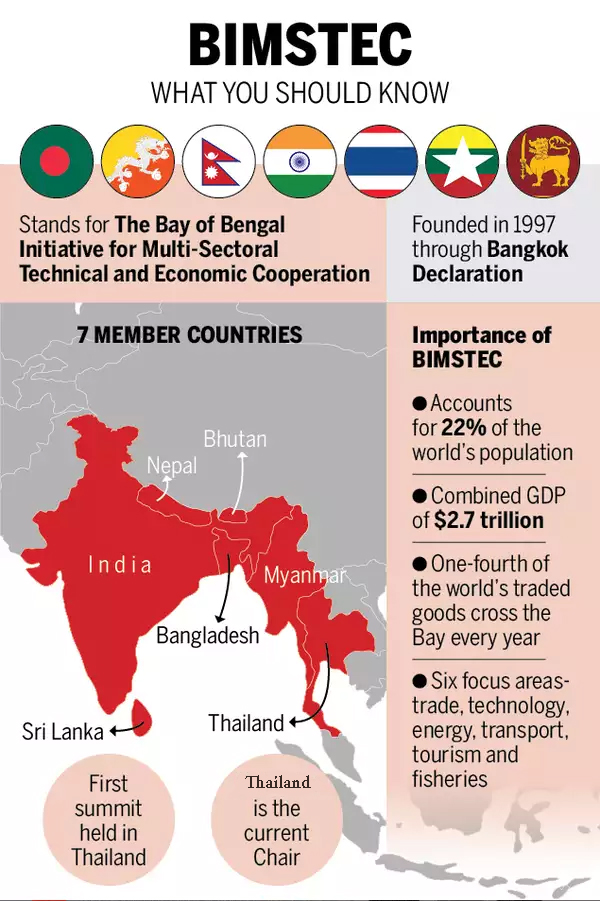
    The Ministry of External Affairs has announced that with the establishment of its inaugural charter on May 20th, the Bay of Bengal Initiative for Multi-Sectoral Technical and Economic Cooperation (BIMSTEC) will now accept new members and observers.

    About BIMSTEC: 

    • The Bay of Bengal Initiative for Multi-Sectoral Technical and Economic Cooperation (BIMSTEC) formed in 1997 is a multilateral regional organization comprising seven member states: Bangladesh, Bhutan, Sri Lanka, Nepal, Thailand, Myanmar, and India.
    • Aim: To promote technical and economic cooperation among its member countries, particularly in sectors such as security, connectivity, trade, agriculture, environment, science and technology, and people-to-people contact.

    Adoption of the Charter:

    • After years of deliberation, the BIMSTEC leaders adopted the organization’s first charter during their 5th summit.
    • This charter provides a legal framework for the group, granting it a “legal personality” and enabling the structured diplomatic dialogue with other countries and regional groupings.
    • In the context of international organizations like BIMSTEC, obtaining legal personality means that the organization is recognized as a legal entity in its own right, separate from its member states.

    Significance of BIMSTEC for all member countries:

    The charter’s implementation enhances cooperation and deeper integration within the Bay of Bengal region, benefiting all member states economically and strategically.

    • Enhanced Cooperation: With the charter in place, member countries can engage in more structured and organized cooperation across various sectors such as security, connectivity, trade, agriculture, environment, science and technology, and people-to-people contact.
    • Strengthened Regional Integration: The charter facilitates deeper integration within the Bay of Bengal region. By establishing common goals and mechanisms for cooperation, it promotes economic growth, social development, and cultural exchange among member countries.
    • Diplomatic Dialogue: The charter enables BIMSTEC to enter into structured diplomatic dialogue with other countries and regional groupings. This opens up avenues for broader engagement and partnership, enhancing the geopolitical significance of the BIMSTEC platform.

    Challenges in the present world context: 

    • Historical Discord: Long-standing historical discord between member states, such as Bangladesh and Myanmar, presents a challenge to cohesive cooperation within BIMSTEC. These tensions can hinder progress on joint initiatives and impede the organization’s effectiveness.
    • Geopolitical Complexities: Geopolitical complexities, exacerbated by events like the Rohingya refugee crisis and the coup in Myanmar, add layers of complexity to regional dynamics.
      • These complexities can strain relationships between member states and complicate efforts to foster collaboration and integration within BIMSTEC.
    • Stagnation of SAARC: While BIMSTEC offers an alternative platform for regional cooperation, the near stagnation of SAARC underscores the challenges faced by regional organizations in fostering meaningful collaboration.

    Way forward:

    • Need a Conflict Resolution Mechanisms: Implement effective conflict resolution mechanisms to address historical discord and tensions between member states.
    • High Diplomatic Engagement: Encourage regular diplomatic engagement and dialogue between member states to address geopolitical complexities and build trust.

    Mains PYQ

    Q Do you think that BIMSTEC is a parallel organization like the SAARC? What are the similarities and dissimilarities between the two? How are Indian foreign policy objectives realized by forming this new organization? (UPSC IAS/2022)

  • [23 May 2024] The Hindu Op-ed: A ‘No-Limit’ bromance that is not just a bilateral matter

    PYQ Relevance:
    Mains: 
    Q) What is the significance of Indo-US defense deals over Indo-Russian defense deals? Discuss with reference to stability in the Indo-Pacific region. (UPSC CSE 2020)

    Q) The new tri-nation partnership AUKUS is aimed at countering China’s ambitions in the Indo-Pacific region. Is it going to supersede the existing partnerships in the region? Discuss the strength and impact of AUKUS in the present scenario. (UPSC CSE 2021)

    Prelims:

    With reference to the ‘Trans-Pacific Partnership’, consider the following statements:  (UPSC CSE 2016)
    1. It is an agreement among all the Pacific Rim countries except China and Russia.
    2. It is a strategic alliance for the purpose of maritime security only.
    Which of the statements given above is/are correct?
    (a) 1 only
    (b) 2 only
    (c) Both 1 and 2
    (d) Neither 1 nor 2

    Note4Students: 

    Prelims: Global Issues;

    Mains: Global Issues; Multipolar World; Russia-China Relations;

    Mentor comment: The article discusses the present “no-limits” friendship declared between Russian President Vladimir Putin and Chinese President Xi Jinping, and how it is a defining feature of the emerging multipolar world order. During World War II, the world was divided into – Allied (UK, USSR, US, and China)  and Axis (Germany, Italy, and Japan). Eventually after WW II, there was again a division between the US and the USSR which came to be known as the ‘Cold War’ where India adopted its Non-aligned stand. Taking today’s article view i.e. the Russia-China Friendship, the relations between both countries date back to the 17th century, with historical conflicts and territorial disputes. However, the relationship improved significantly after the fall of the Soviet Union in 1991, leading to the establishment of diplomatic relations and the signing of the Treaty of Good-Neighborliness and Friendly Cooperation in 2001. In the present context, we need to study what impact it will have on World order and of course our India also.

    Let’s learn.

    –

    Why in the News?

    Chinese President Xi Jinping and Russian President Vladimir Putin declared their ‘no-limits’ friendship just days before the Ukraine war began.

    • Putin, who was sworn in for his new term recently, will spend two days in China.
    • The Putin-Xi bromance is not just a bilateral affair, but a harbinger of a new world order. 

    What are the common grounds for ‘no limits’ friendship?

    • A Shared Anti-West Sentiment: Both leaders believe the West is trying to hold them back and undermine their influence. This shared grievance has brought them closer together, with Putin and Xi presenting a united front against what they see as a hostile Western world.
    • Military Cooperation: The two leaders have celebrated military cooperation, particularly during times of heightened tensions such as the US-China trade war. It includes security cooperation, emphasizing their mutual opposition to the Washington-led global consensus.
    • Economy and Trades: The structure of their bilateral trade shows that Russia mainly supplies raw materials, such as oil, natural gas, and coal, while importing manufacturing and technological products from China.
      • Russia has also been receiving loans and export credits, with the yuan’s share in the Russian central bank’s foreign currency reserves increasing significantly.
    • Strategic Partnership: The friendship between Putin and Xi is strategic, aiming to counterbalance U.S. global influence.
      • The two leaders have been attempting to put economics at the center of their strategic partnership, with Xi’s Belt and Road Initiative (BRI) and Putin’s Eurasian Economic Union (EAEU) aiming to create a single market among Russia, Armenia, Belarus, Kazakhstan, and Kyrgyzstan. 

    Limitations on their ‘no limit’ friendship:

    • A Relationship of Unequals: Despite aiming for equal friendship, China’s growing economic and technological might dwarf Russia’s. This power imbalance could create tension in the relationship, especially as China’s dominance continues to grow in Central and West Asia.
      • Russia may struggle to maintain its status as an equal partner, potentially leading to friction in the alliance.
    • A Delicate Balance: Beijing may face pressure from its trading countries and internal critics to distance itself from Moscow, especially if Russia’s actions continue to attract international condemnation.

    What does it mean for the rest of the world?

    • New Multipolar System and Geoplotical Risks: Russia has recently shifted its Nuclers Policies making it questionable for European and other Western countries. This shift in power dynamics (Russia-China) could lead to a more fragmented and unstable world, with the West facing a united front from two of its most powerful adversaries. 
    • Potential Risks to Global Energy Security: Russia’s growing dependence on China as an energy export market could give China more leverage over Russia and influence global energy prices and supply.
      • Expanded Russia-China energy cooperation may undermine Western efforts to isolate Russia economically and limit its ability to wage war in Ukraine.
    • Implications for Global Gas Markets: If the power of the Siberia pipeline is completed, it could reshape global gas markets by providing a new major source of supply to China and reducing Russia’s dependence on European gas exports.
      • However, the fate of the pipeline remains uncertain, as China has refrained from committing to it so far, likely because it currently benefits from keeping the project in Limbo.

    What does it mean for India?

    • Strategic Concerns: Russia being a major supporter of the Indian defense system, India can face challenges in ensuring reliable defense supplies after the evolution of such “no limit” friendship and China-Russia cooperation.
    • Diplomatic Balancing: India aims to balance ties with Russia and West Asia to have a seamless connection with the European Union but faces challenges due to evolving Russia-China relations.
    • National Interests: India has always been a ‘big brother’ in the Asian region incorporating its Foreign Policies. Seeing the present context, India must navigate the changing geopolitical landscape, leveraging its diplomatic strengths and pursuing a clear long-term strategy.

    Conclusion: The economic interests and trade between Russia and China are critical components of their “no-limits” friendship. While their bilateral trade has grown significantly, the relationship is marked by an unequal dynamic, with China’s economic dominance over Russia growing. 

  • The risks of Russia’s nuclear posturing


    Why in the news?

    The Russia-Ukraine war persists with no end in sight. Russia’s nuclear drills and plans to station weapons in Belarus escalate Global tensions and are deeply concerning.

    What is the NPT and how does it address Russia’s actions?

    • The NPT (Nuclear Non-Proliferation Treaty) is a multilateral agreement aimed at limiting the spread of nuclear weapons through three pillars: non-proliferation, disarmament, and peaceful use of Nuclear energy.
    • It defines Nuclear Weapon States (NWS) as those that had manufactured and detonated a nuclear explosive device before 1967, with all other states considered non-nuclear weapon states (NNWS).

    The NPT has addressed Russia’s actions in several ways:

    • Russia, as a NWS, is obligated under Article VI to pursue negotiations in good faith on effective measures relating to nuclear disarmament. However, Russia’s invasion of Ukraine has increased the salience of nuclear weapons in ways that threaten to erode this bargain.
    • The NPT’s 2022 Review Conference specifically condemned overt nuclear threats, and the Treaty on the Prohibition of Nuclear Weapons (TPNW) called for nuclear deterrence to be delegitimized.
    • The NPT requires NNWS to accept International Atomic Energy Agency (IAEA) safeguards on all nuclear materials on their territories. However, the IAEA has found several states, including Russia, in non-compliance with their safeguards agreements.
    • The NPT’s review process, where state parties convene every five years to review the implementation of the Treaty, has been unable to reach a consensus on condemning Russia’s nuclear threats due to Russia’s objections.

    The Shift in Nuclear Policy of Russia:

    • Criticism by Western countries:  The international community has expressed concern over Russia’s nuclear rhetoric, calling for accountability. Western states and allies condemn Russia’s actions and seek to address them through initiatives like the United Nations and the NPT (Treaty on the Non-Proliferation of Nuclear Weapons) to uphold norms and deter irresponsible behaviour.
    • Changing Nuclear Threshold and Policy: Russia appears to be considering lowering the threshold for nuclear weapon use, which could set a dangerous precedent.
      • Traditionally, Nuclear Weapons were reserved for existential threats, but Russia is now signalling a potential first-use policy even for non-existent threats.
    • Erosion of Mutually Assured Destruction (MAD): For decades, the principle of Mutually Assured Destruction (MAD) deterred the use of nuclear weapons. Russia’s current stance threatens this principle, suggesting that nuclear weapons could be used in conflicts that do not directly jeopardize National survival.

    What are the consequences of Russia’s nuclear rhetoric for Global Security?

    • It has raised the risk of nuclear escalation and use, as Russia has purposefully increased the level of risk to discourage Western support for Ukraine and instill fear. Russia’s actions may encourage other nuclear-armed states, like Iran and North Korea, to adopt similar tactics.
      • This undermines the long-standing separation between Conventional and Nuclear warfare.
    • Undermined Strategic Stability and the Global Nuclear Order:  Russia’s actions have broken down nuclear guidelines and norms, advocating for nuclear use against Ukraine and NATO. This has contributed to the return of nuclear arms competition on the global stage.
    • It has caused alarm and fear among Russia’s neighbors, who worry that if Russia is not stopped in Ukraine, it may turn aggression against other territories. Small countries like Moldova, Georgia, and even Russia’s allies like Kazakhstan fear becoming Putin’s next target.
    • It has required the international community to respond with strong deterrence and accountability measures. The West has emphasized that Russian nuclear use would have devastating consequences.
      • Holding Russia accountable through multilateral initiatives is crucial to upholding norms and deterring further irresponsible behaviour.

    Way forward:

    • Strengthen International Diplomatic Engagement: Initiate high-level dialogues involving all nuclear-armed states to reinforce commitments to non-proliferation treaties and discourage the lowering of nuclear use thresholds.
    • Revise and Reinforce Security Assurances: Provide renewed and clear security assurances to non-nuclear states to discourage them from pursuing nuclear weapons. Revisit agreements like the Budapest Memorandum to ensure their effectiveness and credibility.

    Mains PYQ:

    Q (UPSC IAS/2022) 

    (a): Russia and Ukraine war has been going on for the last seven months. Different countries have taken independent stands and actions keeping in view their own national interests. We are all aware that war has its own impact on the different aspects of society, including human tragedy. What are those ethical issues that are crucial to be considered while launching the war and its continuation so far? lllustrate with justification the ethical issues involved in the given state of affair.

    (b): Write short notes on the following in 30 words each:

    (i) Constitutional morality

    (ii) Conflict of interest

    (iii) Probity in public life

    (iv) Challanges of digitalization

    (v) Devotion to duty

  • After Ebrahim Raisi’s death, why India will be watching Iran’s succession plan unfold

    Why in the News?

    The sudden demise of Iranian President Ebrahim Raisi in a helicopter crash has sent shockwaves through the Islamic Republic, grappling with the implications for the country’s future leadership.

    • India is closely monitoring the unfolding of Iran’s succession plan, given the significant geopolitical and economic stakes involved.
    • India and Iran have recently signed a 10-year agreement to develop and operate a terminal at the strategic Chabahar Port, enhancing trade connections with Afghanistan and Central Asian countries.  

    BACK2BASICS: India-Iran Bilateral Relations:

      • Pre-Cold War Era:  India and Iran span centuries of relationship which is marked by meaningful interactions. Both countries shared a border till 1947 with several common features in their language, culture, and traditions. They established their diplomatic ties in March 1950.
    • Cold War Era (1950-1990): India followed its Non-alignment policy, but paralleling strong links with the Soviet Union (USSR), while Iran was an open member of the Western Bloc and enjoyed close ties with the United States.
        • Therefore, the relations between India and Iran suffered due to their differing political interests.
    • Post Cold-War Era:
        • Iran’s continuously supported Pakistan in the India–Pakistan border conflicts. This was also a major reason that India had expressed strong opposition to Iran’s Nuclear program.
        • India’s close relations with Iraq during the Iran–Iraq War greatly strained bilateral ties.
        • Oil Trade: In 2019, due to the sanctions imposed by the US on Iran, India stopped importing crude oil from the country. Before 2019, India was the second biggest buyer of oil from Iran.
        • During recent times in 2021, both countries continued to collaborate in supporting the broad-based anti-Taliban government until the Taliban recaptured Afghanistan.
    • Other Trades:
        • India-Iran bilateral trade during the FY 2020-21 was USD 2.1 billion, a decrease of 56 % as compared to USD 4.8 billion during FY 2019-20.
        • Our Exports to Iran: rice, tea, sugar, fresh fruits, drugs/pharmaceuticals, man-made staple fibers, electrical machinery, artificial jewelry etc.
        • Our Imports from Iran: dry fruits, inorganic/organic chemicals, glass and glassware, natural or cultured pearls, precious or semiprecious stones, leather, gypsum, etc.

    About Raisi’s Rise and Hardline Agenda:

    • Ebrahim Raisi, had politically risen through the ranks of Iran’s theocracy and was widely seen as a leading candidate to succeed.
    • His presidency was part of a broader consolidation of power by hardliners dedicated to shoring up the pillars of the Islamic Republic against dissent and external threats.
    • Raisi’s death poses significant challenges for the conservative hardliners who had backed him as a unifying figure loyal to the Supreme Leader.
    • Raisi’s demise opens the door for the ambitions of the powerful Iranian Revolutionary Guards Corps (IRGC), which has exploited its constitutionally mandated roles to expand its political and economic influence.
    • Raisi’s death introduces great uncertainty into the succession process, with various factions and figures vying for influence.

    What are the potential implications of Iran’s succession plan for India?

    • Trade ties: The death of President Raisi could impact India-Iran trade relations, which reached $2.33 billion in 2023-24 under Raisi’s policies.
    • Regional stability: India has enjoyed good ties with Iran and has been involved in key projects like the development of the Chabahar port, which serves as India’s gateway to Central Asia.
      • The succession plan in Iran could affect regional stability and India’s relation to energy security and connectivity.
    • Foreign policy alignment: Changes in Iran’s stance towards regional conflicts and international agreements could influence India’s foreign policy decisions in the Middle East.
    • Security concerns: Instability or changes in Iran’s approach to regional conflicts or its relations with other countries could impact India’s security calculations.

    Way Forward

    India needs to prioritize economic projects like the Chabahar Port, which are crucial for regional trade and India’s strategic interests, ensuring long-term agreements and investments. Further, maintaining a delicate balance between US relations and Iran ties by leveraging diplomatic channels to navigate sanctions can help.


    Mains PYQ:

    Q In what ways would the ongoing US-Iran Nuclear Pact Controversy affect the national interest of India? How should India respond to its situation? (UPSC IAS/2018)

    Q The question of India’s Energy Security constitutes the most important part of India’s economic progress. Analyze India’s energy policy cooperation with West Asian Countries. (UPSC IAS/2017)

  • India-Middle East-Europe Economic Corridor (IMEC) Project

    Why in the News?

    An Indian inter-ministerial delegation visited the UAE to discuss the operational aspects of the India-Middle East-Europe Economic Corridor (IMEC), marking a significant step forward since the signing of the agreement.

    About IMEC Project

    • IMEC is part of the broader Partnership for Global Infrastructure and Investment (PGII), which focuses on infrastructure development in economically developing regions.
    • The MoU for IMEC was formally endorsed on September 10, 2023, during the 2023 G20 New Delhi summit.
    • Signatories to this agreement: India, United States, United Arab Emirates, Saudi Arabia, France, Germany, Italy, and the European Union.
    • Aim: To integrate Asia, Europe, and the Middle East, enhancing economic cooperation across these regions.
    • Objectives:
      • Improve transportation efficiency, lower costs, and promote economic cohesion among participating nations.
      • Generate employment opportunities and reduce Greenhouse Gas (GHG) emissions.
      • Facilitate trade and connectivity, thereby reshaping regional integration among Asia, Europe, and the Middle East.

    Corridor Configuration:

    IMEC comprises two primary corridors:

    1. East Corridor: Linking India to the Arabian Gulf.
    2. Northern Corridor: Connecting the Gulf region to Europe.

    Key ports integral to the project’s success include:

    • India: Mundra, Kandla, and Jawaharlal Nehru Port Trust (Mumbai).
    • Middle East: Fujairah (UAE), Jebel Ali (Dubai, UAE), Abu Dhabi (UAE), Dammam (Saudi Arabia), and Ras Al Khair (Saudi Arabia).
    • Israel: Haifa port.
    • Europe: Piraeus (Greece), Messina (Italy), and Marseille (France).

    Additionally, it encompasses various infrastructure components such as railway networks, ship-to-rail connections, road transport routes, electricity cables, hydrogen pipelines, and high-speed data cables.

    Significance:

    • IMEC, upon completion, will establish a dependable and cost-efficient cross-border ship-to-rail transit network, complementing existing maritime and road transport networks.
    • The IMEC Project holds significant promise in redefining regional trade dynamics and fostering sustainable economic growth and cooperation among the involved countries.

    PYQ:

    [2018] The China-Pakistan Economic Corridor (CPEC) is viewed as a cardinal subset of China’s larger ‘One Belt One Road’ initiative. Give a brief description of CPEC and enumerate the reasons why India has distanced itself from the same. (150 Words, 10 Marks)

    [2016] ‘Belt and Road Initiative’ is sometimes mentioned in the news in the context of the affairs of:

    (a) African Union

    (b) Brazil

    (c) European Union

    (d) China


    Back2Basics: Partnership for Global Infrastructure Investment (PGII)

    • The PGII was first announced in June 2021 during the G7 (or Group of Seven) summit in the UK.
    • The G7 countries include the United Kingdom, the United States, Canada, France, Germany, Italy, Japan, and the European Union (EU).
    • US President Joe Biden had called it the Build Back Better World (B3W) framework. However, it did not register much progress.
    • In 2022, during the G7 summit in Germany, the PGII was officially launched as a joint initiative to help fund infrastructure projects in developing countries through public and private investments.
      • Objective: To mobilise nearly $600 billion from the G7 by 2027 to invest in critical infrastructure.
      • It is essentially in response to the infrastructure projects being undertaken and funded by China under the Belt and Road Initiative (BRI) at a global level.


    Present Maritime Routes between India and Europe

    Trade Route Route Issues Advantages
    Suez Canal Route Indian Ocean -> Arabian Sea -> Red Sea -> Suez Canal -> Mediterranean Sea -> Europe
    • High traffic causing congestion.
    • Potential for piracy, especially near the Horn of Africa.
    • Most efficient and shortest maritime route.
    • Well-established with advanced port facilities.
    Cape of Good Hope Route Indian Ocean -> Arabian Sea -> Indian Ocean (southern tip of Africa) -> Atlantic Ocean -> Europe
    • Longer transit time compared to the Suez Canal.
    • Higher fuel costs and longer journey duration.
    • Avoids congestion and security risks of the Suez Canal.
    • Suitable for large vessels unable to transit the Suez Canal.


  • Renew the Generalized System of Preferences

    Why in the News? 

    It is widely believed that renewing the Generalised System of Preferences (GSP) program would pave the way for comprehensive U.S.-India trade negotiations, potentially elevating the bilateral trade relationship to new heights.

    What is the ‘Generalised System of Preferences (GSP)’ Program about?

      • The Generalised System of Preferences (GSP) is a trade initiative by developed countries to aid developing countries.
    • Nearly all developed countries have their versions of the GSP, tailored to their economic and policy goals.
        • It involves reducing tariffs on imports from these countries, aiming to stimulate their economic development. (It is not formally part of the World Trade Organization).
    • Origin and its Evolution:
      • During the 1960s: The idea of the GSP emerged during the 1960s as part of broader efforts within the United Nations Conference on Trade and Development (UNCTAD) to help developing countries gain better access to markets in developed countries.
      • During 1968: UNCTAD proposed the GSP as a mechanism to offer non-reciprocal, non-discriminatory tariff preferences to developing countries, aiming to promote their economic growth and industrialization.
      • During 1974: The US officially established its GSP program under the Trade Act of 1974. This act authorized the U.S. to provide duty-free treatment for selected products imported from designated beneficiary developing countries (BDCs)​.

    The Significance of Renewing the GSP:

    • US Factor:  The GSP program is unique because it requires periodic reauthorization by Congress. This program of the U.S. expired in 2020 and has not yet been renewed, despite bipartisan support.
    • For Stability in the Market: Renewal is challenging in a polarized political environment but is crucial for maintaining stable market access for developing countries.
    • For Diversification: The GSP supports small businesses and women-owned enterprises, encouraging economic empowerment and diversification away from Chinese imports.
    • To bring Reform: It will promote labor and environmental reforms and reduce tariff costs for American businesses, particularly small and medium-sized enterprises.

    Significance of US – India Trade Relationship:

    • Broader the Trade agreement: The U.S. and India have a significant trade relationship, with bilateral trade worth around $200 billion. Renewing the GSP could facilitate further negotiations and potentially lead to a broader trade agreement.
    • Need for GSP renewal: Before the GSP expired, the U.S. and India were close to a trade deal covering various sectors including medical devices, agriculture, ethanol, and IT products.
      • Despite ongoing trade dialogues, the U.S. is currently not negotiating new Free Trade Agreements (FTAs), making GSP renewal a key tool for enhancing trade relations.
      • A renewed GSP could cover multiple areas such as labour rights, environmental laws, and regulatory practices, fostering a more robust and ambitious trade partnership.
    • Strategic Importance:
    • In the Indo-Pacific region.
    • It can significantly boost trade and economic cooperation between the two countries.
    • It would signal a mutual commitment to deepening their trade relationship and addressing broader economic and regulatory issues.

    Way forward:

    • Utilize GSP as a Negotiation Tool: Leverage GSP renewal as a platform to initiate broader trade negotiations between the U.S. and India, potentially leading to a more comprehensive trade agreement.
    • Focus on Strategic Sectors: Identify and prioritize sectors such as technology, pharmaceuticals, and agriculture where both countries have mutual interests and complementary strengths.

    Mains PYQ: 

    Q “What introduces friction into the ties between India and the United States is that Washington is still unable to find for India a position in its global strategy, which would satisfy India’s National self-esteem (UPSC IAS/2019)

  • [18th May 2024] The Hindu Op-ed: After the Civil War, the stifling impasse in Sri Lanka

    PYQ Relevance:
    [2022] ‘India is an age-old friend of Sri Lanka.’ Discuss India’s role in the recent crisis in Sri Lanka in light of the preceding statement. 
    [2013] In respect of India — Sri Lanka relations, discuss how domestic factors influence foreign policy. 

    Note4Students: 

    Prelims: NA 

    Mains: Disruptions in Sri Lanka’s development trajectory post the Civil War

    Mentor Comment: A decade and a half after Sri Lanka’s civil war, deep wounds persist, with tens of thousands dead and widespread destruction. Truth, accountability, and justice remain unresolved, and political polarisation hinders progress. Economic reconstruction lags, further stunted by crises. The Tamil middle class aspires to emigrate, while the working class remains destitute. 

    Let’s learn

    ___

    Why in the News?

    The future of the Tamil people relies on creating a renewed vision for themselves and the whole nation, founded on the ideals of equality and freedom.

    Back2Basics: Sri Lankan Civil WarC:\Users\SSCIS\Desktop\Imgress\ltte.jpg
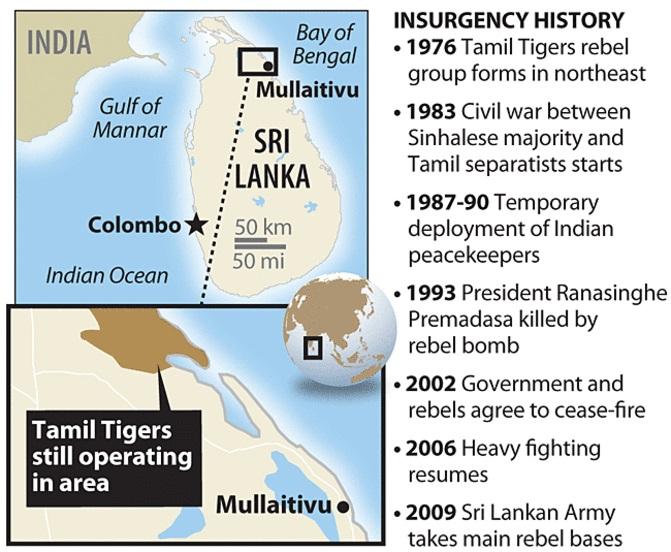
    It was a protracted armed conflict that lasted for nearly three decades, from 1983 to 2009, between the government of Sri Lanka and the Liberation Tigers of Tamil Eelam (LTTE).

    LTTE was a separatist militant organisation seeking an independent Tamil state in the northern and eastern regions of the island nation.
    The conflict was characterised by violence, human rights abuses, and widespread displacement of civilians.

    The LTTE, known for its guerrilla tactics and suicide bombings, controlled significant territory in the north and east of Sri Lanka and waged a violent insurgency against the government.

    Key Hindrances to Sri Lanka’s Progress

    • Limited Progress: While infrastructure like trains, banks, supermarkets, and hotels returned to the north, rural areas continue to struggle with unstable livelihoods.
    • Setback from Terror Attack: The Easter bombings in April 2019, followed by the COVID-19 pandemic and an ongoing economic crisis since 2022, have exacerbated economic hardships, marking the worst crisis since Independence.
    • Economic Crisis: Economic misery is pervasive, with outmigration and hunger becoming the norm, particularly impacting the deprived and landless in war-torn areas.

    Challenges in Reconstruction Efforts

    1. Economic Challenges
    • Failed Investments: Expectations of substantial investments from the Tamil diaspora have not materialised, failing to stimulate local economic revival.
    • International Donor Projects: Projects focused on infrastructure have not effectively revitalised the local economy, while NGO aid has sometimes led to dependency and microfinance debt traps.
    1. Political Polarisation and Neglect
    • Political Neglect: Tamil political leadership has often prioritised international accountability over addressing local livelihoods, perpetuating dependency on diaspora remittances.
    • Parallel Nationalisms: Tamil nationalist politics mirrors Sinhala nationalism, focusing on rights and international intervention, rather than fostering local reconciliation.
    • Reconciliation Challenges: Efforts towards political reconciliation and power-sharing have faltered due to political expediency, exacerbating tensions and marginalising minorities.
    • Communal polarization: Relations between Tamil and Muslim communities remain strained, with unresolved issues from historical displacements and marginalization.

    Future Prospects for Tamil People

    • V. Karalasingham’s Reflections (1963): Highlighted the paradox of Tamil leadership and the continued suffering and humiliation of Tamil-speaking people.
    • Aragalaya Movement (2022): Sri Lankans united to oust a President promoting Sinhala-Buddhist nationalism, showing potential for collective action.
    • Path to Change: Embracing inclusive politics, moving away from isolationist strategies, and advocating for economic and social justice can pave the way for a democratic future based on equality and freedom.
    India’s Economic Assistance to Sri Lanka:

    Bailout Package: During Sri Lanka’s economic crisis in 2022, India was quick to extend financial support, amounting to over USD 4 billion. This surpassed even the International Monetary Fund’s (IMF) bailout package over 48 months.

    Facilitating IMF Engagement: India’s role was instrumental in the early stages of Sri Lanka’s negotiations with the IMF. India’s Finance Minister, Mrs Sitharaman, played a significant part in these discussions, showcasing India’s commitment to its neighbour’s recovery.

    Private Investment: The expansion of the Colombo port’s west container terminal in 2023 by India’s Adani Group was a key development project.

    Cricket Diplomacy: Cricket surprisingly became a focal point, with international matches hosted in Sri Lanka, including a notable India-Pakistan game during the World Cup.

    Way Forward

    • Political Reconciliation: Advocate for genuine political reconciliation, including devolution of power and addressing historical grievances.
    • Community Integration: Foster solidarity and mutual understanding between ethnic and religious communities to promote social integration.
    • Local Empowerment: Support local initiatives and reduce dependency on external aid, empowering communities to drive their development.
    • Unified Movements: Promote movements that unite diverse groups towards common goals of justice, equality, and inclusive governance.

    https://www.thehindu.com/opinion/lead/after-the-civil-war-the-stifling-impasse-in-sri-lanka/article68187672.ece

  • Explained: History of India and Nepal’s border issue

    Why in the News? 

    Nepal’s Cabinet last week decided to put a map on its Rs 100 currency note showing certain areas administered by India in Uttarakhand as part of its territory.

    • India’s External Affairs Ministry said that such “unilateral measures” by Kathmandu would not change the reality on the ground.

    Genesis of the issue: 

    Territorial dispute: The territorial dispute is about a 372-sq-km area that includes Limpiadhura, Lipulekh, and Kalapani at the India-Nepal-China trijunction in Uttarakhand’s Pithoragarh district. Nepal has claimed for long that these areas belong to it both historically and evidently.
    • Treaty of Sugauli (1815-16): This treaty marked the end of the Anglo-Nepalese War and resulted in Nepal ceding significant territories to the British East India Company, including lands east of the Kali River. Article 5 of the treaty delineated the boundary along the river, thereby affecting Nepal’s jurisdiction over the area.
    • Historical division: Maps issued by the British Surveyor General of India in the 19th and early 20th centuries depicted the Kali River as originating from Limpiadhura. These maps served as crucial references for defining territorial boundaries between Nepal and British India.
    • Depiction of Kali River: Maps from different periods showed variations in the depiction of the Kali River, with some using the name “Kuti Yangti” and others referring to it as the Kali River. Additionally, discrepancies emerged regarding the river’s exact origin point, with some maps showing different sources.
    • Map issued by Britisher (1947): The last map issued by the British before they left India in 1947 reverted to showing the initial position of the Kali River originating in Limpiadhura, indicating a reaffirmation of the historical boundary according to British cartographic records.

    Argument given by Nepal to claim land:

    • According to Shrestha, villages in this area — Gunji, Nabhi, Kuti, and Kalapani, also known as Tulsi Nyurang and Nabhidang — were covered by the Nepal government census until 1962, and the people paid land revenue to the government in Kathmandu.
      • However, the situation changed after the war between India and China in 1962.
    • Nepal also says that then Indian PM Jawaharlal Nehru approached King Mahendra of Nepal asking for permission to use Kalapani, which was strategically located close to the trijunction, as a base for the Indian Army.
    • Prominent personalities representing Nepal in bilateral talks have claimed that India has made assurances regarding the resolution of border disputes if Nepal could provide evidence for its claims.
    • Despite assurances and agreements to expedite the resolution process, progress has been slow or stalled.

    Frictions in Bilateral Ties:

    • From 2005-2014: The period from 2005 to 2014 saw India mediating Nepal’s transition from a Hindu Kingdom to a secular federal republic.
      • However, tensions arose in 2015 when Nepal’s Maoist Party rejected India’s suggestion to delay the adoption of a new constitution until the concerns of the Terai parties were addressed.
      • The subsequent 134-day blockade by India in September 2015 exacerbated distrust and led Nepal to seek alternative trade routes, including agreements with China.
    • During 2020: Nepal’s inclusion of disputed territories, such as the 372 square kilometres in Uttarakhand, in its new map in 2020 escalated tensions with India. While Nepal aimed to assert sovereignty over these areas, India condemned the move as “cartographic aggression.”
      • Despite India’s stance that the issue should be resolved diplomatically based on evidence, no concrete steps have been taken to address the dispute.
    • During 2024: The decision by Nepal’s cabinet to include the new map on its currency notes in 2024 has reignited tensions between the two countries.

    India-Nepal Border Dispute

    Way Forward:

    • Need for Dialogue: While both India and Nepal agree on the need to resolve territorial disputes through dialogue and evidence-based discussions, there has been no concrete progress in scheduling meetings or setting a timeframe for resolution.
    • Need for Dispute settlement: Nepal has successfully resolved boundary issues with China in the past through bilateral meetings of the boundary commission. However, the unresolved disputes with India highlight the importance of timely and effective diplomatic engagement to prevent future complications and ensure peaceful coexistence between the two neighbours.
    • Joint Border Commission: Establishing a joint border commission comprising representatives from both countries can facilitate a systematic review of historical documents, maps, and evidence related to territorial claims.

    Mains PYQ: 

    Q Border management is a complex task due to difficult terrain and hostile relations with some countries. Elucidate the challenges and strategies for effective border management.

  • India backs Palestine’s bid for full UN membership

    Why in the news?

    India has voted in favour of a UN General Assembly resolution recommending Palestine’s admission as a full member of the United Nations.

    Arab push for Palestine’s Membership

    • The emergency special session was convened by the Arab Group, with the UAE presenting the resolution in support of Palestine’s full membership.
    • The resolution calls for the Security Council to “reconsider” Palestine’s membership favourably, based on its determination that Palestine is qualified for UN membership.
    • The resolution received overwhelming support, with 143 votes in favour, including India’s, nine against, and 25 abstentions.
    • As an observer state, Palestine currently lacks voting rights in the General Assembly and cannot nominate candidates to UN organs.

    India’s Stance on Palestine:

    • In 1988, India recognized the State of Palestine.
    • In 1996, India opened its Representative Office to the Palestine Authority in Gaza, later relocating it to Ramallah in 2003.

    About United Nations

    Details
    Background  Resulted from the devastation of World War I and II

    Highlighted the need for a more effective international body to maintain peace and prevent future conflicts.

    Predecessor The League of Nations, created in 1919 after World War I, aimed at peacekeeping but failed during World War II.
    The Atlantic Charter Issued in August 1941 by President Franklin D. Roosevelt (USA) and Prime Minister Winston Churchill (UK), this document outlined principles for a post-war world and set the stage for the UN’s creation.
    Naming The term “United Nations” was coined by President Roosevelt in 1941 to describe the allied nations opposed to the Axis powers.
    Declaration by United Nations On January 1, 1942, representatives from 26 Allied nations, including India under British colonial rule, signed this declaration in Washington DC, formalizing their alliance and war objectives.
    Official Formation UN was officially established on October 24, 1945, when its Charter was ratified by 51 member countries

    It included 5 permanent Security Council members: France, Republic of China, Soviet Union, UK, and US.

    First General Assembly The inaugural meeting of the UN General Assembly took place on January 10, 1946.
    Core Goals
    1. To maintain international peace and security.
    2. To foster friendly relations among nations.
    3. To cooperate in solving international problems and in promoting respect for human rights.
    4. To be a centre for harmonizing the actions of nations in attaining these common ends.
    India’s Role India was a founding member of the United Nations, having signed the initial Declaration alongside 25 other Allied nations during World War II.


    Rights and Privileges:

    • The rights and privileges of member states in the United Nations are designed to ensure that all members can effectively participate in the organization’s activities and benefit from its resources.

    PYQ:

    [2022] With reference to the “United Nations Credentials Committee”, consider the following statements:

    1. It is a committee set up by the UN Security Council and works under its supervision.
    2. It traditionally meets in March, June and September every year
    3. It assesses the credentials of all UN members before submitting a report to the General Assembly for approval.

    Which of the statements given above is/are correct?

    (a) 3 only
    (b) 1 and 3
    (c) 2 and 3
    (d) 1 and 2