Why in the News
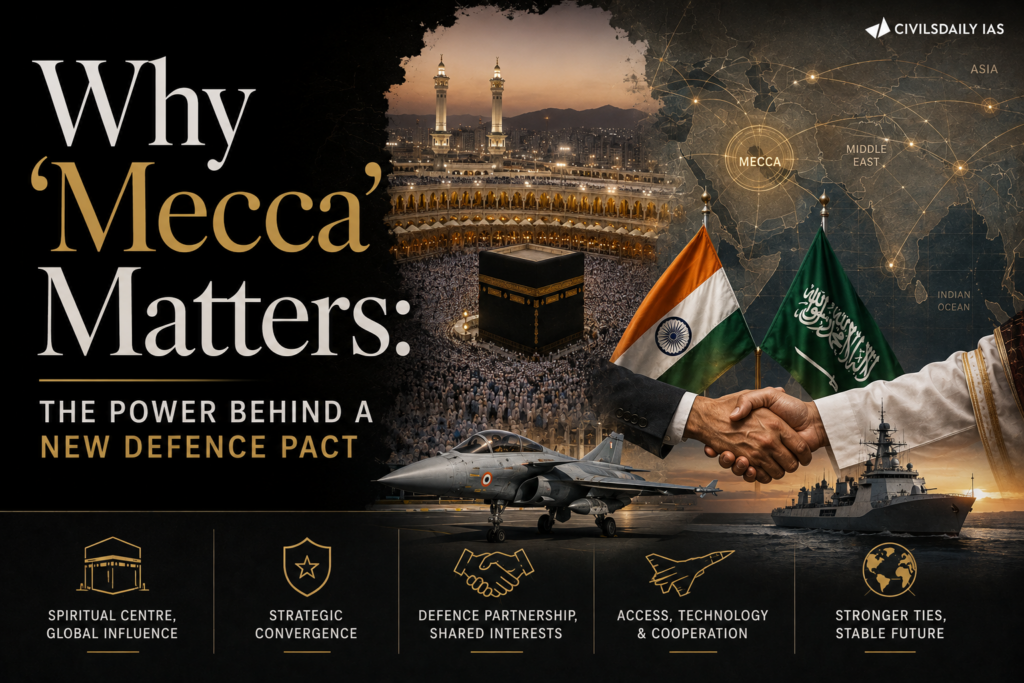
The Mecca Joint Defence Agreement, signed on 7 August 2026 by Saudi Arabia, Pakistan and Turkiye, takes its name from Islam’s holiest city. The naming choice is read as a deliberate framing device that lets each signatory claim a different benefit from the same text. The tension is between the civilisational legitimacy the name projects and the narrow, technical liabilities the agreement’s legal text actually creates.
What is the Mecca Joint Defence Agreement?
- About: The Mecca Joint Defence Agreement is a trilateral defence arrangement between Saudi Arabia, Pakistan and Turkiye, signed on 7 August 2026.
- Naming: The agreement is named for the city of Mecca, which carries religious authority across the Muslim world.
- Legal character: The operative text keeps mutual obligations technical and limited, rather than creating an automatic collective defence commitment.
- Point of interest: The gap between the symbolic name and the limited legal commitment is the substance of the analysis.
Why does the name carry strategic work?
- Saudi objective: The name lets Riyadh reassert leadership of the Muslim world by anchoring a security arrangement in custodianship of the holy cities.
- Pakistani objective: Islamabad can present the arrangement domestically as a holy alliance, converting a defence pact into religious legitimacy.
- Turkish objective: Ankara can frame defence exports as civilisational solidarity rather than as commerce.
- Shared function: One name allows three different domestic narratives without changing a word of the text.
What is the comparable precedent in agreement naming?
- Abraham Accords, 2020: The normalisation agreements between Israel and several Arab states were named for the shared patriarch of Judaism, Christianity and Islam.
- Stated rationale: The naming was explained at the time as invoking a common religious ancestry to frame a political settlement.
- Effect achieved: The name softened a security and recognition arrangement into a civilisational reconciliation.
- Parallel drawn: The Mecca naming performs the same function for a defence arrangement, transferring the technique from normalisation to security.
What does the arrangement mean for India?
- Pakistan’s external depth: A formal defence link with Saudi Arabia and Turkiye enlarges Pakistan’s strategic and financial backing.
- Gulf relationship: India’s ties with Saudi Arabia rest on energy supply, remittances from a large expatriate workforce and defence cooperation, which the arrangement does not displace.
- Turkiye divergence: Ankara’s position on Kashmir at multilateral forums remains the sharpest point of difference with India.
- Limits of the pact: The technical character of the obligations restricts how far Pakistan can invoke it in a bilateral contingency.
Where does the analysis turn against its own framing?
- Symbolism versus obligation: A powerful name does not create an automatic defence commitment, and the text deliberately avoids one.
- Divergent interests: Saudi Arabia’s normalisation track with Israel and Turkiye’s position on Gaza are not aligned, which limits joint action.
- Reading risk: Treating the name as evidence of a bloc overstates cohesion the signatories have not committed to.
- The real signal: The arrangement marks a shift toward regional security architectures built outside United States security guarantees.
Challenges to reading the pact as a bloc
- Absence of an automatic trigger: The text creates consultation obligations rather than an attack on one is an attack on all clause. e.g. the contrast with Article 5 of the North Atlantic Treaty.
- Divergent Israel policy: Signatories differ on normalisation with Israel. e.g. Saudi Arabia’s suspended normalisation track against Turkiye’s public position on Gaza.
- Financing dependence: Pakistan’s participation rests on financial support rather than reciprocal capability. e.g. repeated Saudi deposits with the State Bank of Pakistan during balance of payments stress.
- Competing regional groupings: Overlapping arrangements dilute exclusivity. e.g. the Gulf Cooperation Council and the Organisation of Islamic Cooperation covering the same members with different mandates.
- Defence supply asymmetry: Turkish defence exports create a supplier and buyer relationship, not an alliance of equals. e.g. Turkish drone sales across West Asia and North Africa.
- Iran factor: Any Sunni framed security architecture invites an Iranian counter alignment. e.g. the Iran Saudi normalisation of 2023 that the pact’s framing strains.
Conclusion
The naming of the agreement is the substantive act, since it manufactures a civilisational legitimacy that the legal text neither requires nor delivers. For India, the operative question is not the pact’s symbolism but whether Saudi Arabia’s energy and remittance relationship with India changes, which it has not. The next milestone is whether the signatories convert consultation obligations into a standing joint command or joint exercise schedule.
Back2Basics: India and Saudi Arabia
- Diplomatic relations were established in 1947, with the relationship upgraded through the Delhi Declaration of 2006 and the Riyadh Declaration of 2010.
- The Strategic Partnership Council was established in 2019, with two ministerial committees covering political and security cooperation, and economy and investments.
- Saudi Arabia is among India’s top crude oil suppliers and hosts one of the largest Indian expatriate populations.
- India and Saudi Arabia conduct the Al Mohed Al Hindi naval exercise.
- Saudi Arabia is a partner in the India Middle East Europe Economic Corridor announced at the G20 summit in New Delhi in 2023.
Way Forward
- Deepen the Gulf economic anchor: Convert the Strategic Partnership Council commitments into dated investment and energy supply agreements.
- Separate the Turkiye and Saudi tracks: Treat Ankara’s Kashmir position as a bilateral issue rather than allowing it to define the wider Gulf relationship.
- Institutionalise defence exchanges: Expand joint exercises and defence industrial cooperation with Gulf partners to keep the relationship independent of third party arrangements.
- Secure the energy corridor: Reduce single chokepoint exposure given that a large share of imports transit the Strait of Hormuz.
- Engage the Organisation of Islamic Cooperation constructively: Sustain outreach so multilateral resolutions do not consolidate against India by default.
“[2023, GS2, 15 marks] ‘The expansion and strengthening of NATO and a stronger US-Europe strategic partnership works well in India.’ What is your opinion about this statement? Give reasons and examples to support your answer.”
