💥Join UPSC 2027,2028 Mentorship (July Batch) + XFactor Notes & Microthemes PDF

GS Paper: GS2-19.Effect of policies and politics of developed and developing countries on India’s interests, Indian diaspora.

  • Understanding Russia’s Taliban gauntlet

    Why in the News?

    On July 3, 2025, Russia officially recognised the Islamic Emirate of Afghanistan (IEA), becoming one of the first major powers to do so since the Taliban’s return to power in 2021. This move follows the accreditation of the Taliban’s ambassador to Moscow, and marks a major shift in Russia’s Afghanistan policy, which had previously labelled the Taliban as a terrorist organisation.

    Why did Russia recognise the Taliban regime now?

    • Acknowledging Ground Reality: Russia views the Taliban as the de facto rulers of Afghanistan with control over territory and administration. Eg: Since 2021, the Taliban have exercised uninterrupted control over Kabul and provinces, making them the sole authority maintaining internal order.
    • Counterterrorism Cooperation: Russia sees the Taliban as a potential partner in counterterrorism, especially against Islamic State-Khorasan (IS-K), which threatens regional and Russian security. Eg: After the Moscow concert hall attack (March 2024) attributed to IS-K, Russia enhanced backchannel security coordination with the Taliban.
    • Maintaining Strategic Influence in the Region: By recognising the Taliban, Russia aims to safeguard its geopolitical influence in Central and South Asia, countering Western absence and Chinese rise. Eg: Russia’s engagement through the Moscow Format strengthens its regional leadership in Afghan dialogue.
    • Preceding Legal and Diplomatic Softening: In April 2025, Russia’s Supreme Court suspended the 2003 ban on Taliban activity, allowing legal recognition without full delisting. Eg: The suspension of the terrorist tag created a diplomatic opening for formal recognition.

    What are the regional implications of Russia’s move?

    • Shift in Regional Power Dynamics: Russia’s recognition challenges the Western-led isolation of the Taliban and may encourage other regional powers to formalise ties. Eg: Countries like Iran and China, already engaged economically with the Taliban, may now consider official recognition, altering the diplomatic status quo.
    • Boost to Taliban’s Legitimacy and Regional Acceptance: Recognition provides the Taliban diplomatic credibility, enabling greater participation in regional forums and access to aid or investment. Eg: The Taliban may now join regional security formats like the Shanghai Cooperation Organisation (SCO) observer sessions more freely.
    • Enhanced Security Cooperation Against Terrorism: Russia may now collaborate more openly with the Taliban to counter threats like IS-K, stabilising parts of Central Asia. Eg: Joint discussions on border security with Tajikistan and Uzbekistan may increase, helping curb militant infiltration.

    How has Russia’s Taliban policy evolved since 1996?

    • Rejection and Hostility (1996–2001): Russia declared the Taliban a terrorist organisation, opposing its rise in Afghanistan due to fears of Islamist extremism spreading to Chechnya and Central Asia.
    • Cautious Engagement (2001–2021): While still labelling the Taliban a terrorist group, Russia began unofficial contacts to safeguard regional interests and hosted intra-Afghan peace talks in Moscow.
    • Strategic Recognition (Post-2021): Following the U.S. withdrawal and Taliban takeover, Russia shifted to a realpolitik approach, officially recognising the Taliban in 2024 to secure influence, counter the West, and stabilise its southern flank.

    What does this recognition mean for India and China?

    • India – Strategic Marginalisation: Russia’s recognition may reduce India’s diplomatic influence in Afghanistan, where it has supported a democratic and inclusive political setup. Eg: India’s $3 billion investments in Afghan infrastructure (like the Afghan Parliament building) may lose strategic value amid a Taliban-dominated regime backed by regional powers.
    • China – Regional Leverage: It boosts China’s ability to engage the Taliban diplomatically and economically, securing interests in security (Xinjiang) and resource extraction. Eg: China has initiated talks on expanding the Belt and Road Initiative (BRI) into Afghanistan and invested in Mes Aynak copper mines, which may progress with Russian support.

    How should India engage with the Taliban post-recognition? (Way forward) 

    • Pragmatic Diplomatic Channels: India should maintain non-recognition-based engagement through back-channel talks and functional diplomacy to protect its strategic and security interests, especially in areas like counter-terrorism and regional connectivity.
    • Conditional Development Cooperation: India can offer developmental aid and economic projects in health, education, and infrastructure, conditioned on Taliban commitments to human rights and non-support for cross-border terrorism.

    Mains PYQ:

    [UPSC 2024] Critically analyse India’s evolving diplomatic, economic and strategic relations with the Central Asian Republics (CARs) highlighting their increasing significance in regional and global geopolitics.

    Linkage: The article explicitly states that Russia’s decision to officially recognize the Islamic Emirate of Afghanistan (IEA) government sets a “precedent” and that “some Central Asian states and even China may well follow suit”. This direct link indicates that Russia’s strategic shift regarding the Taliban significantly impacts the diplomatic, economic, and strategic relations of CARs, making understanding this “gauntlet” crucial for analyzing regional and global geopolitics.

  • The threat to India’s ‘great power’ status 

    Why in the News?

    The ongoing tensions in West Asia, particularly between Iran, Israel, and the U.S., have reignited concerns about a potential U.S.-Israel-Iran conflict, which could have serious geopolitical and economic consequences.

    How could a U.S.-Israel-Iran war impact India?

    • Energy Security Risk: A war could disrupt oil exports from Iran and the Strait of Hormuz, through which 60% of India’s crude imports pass. Eg: During the 2019 U.S.-Iran tensions, India faced uncertainty in oil supply and had to cut Iranian imports.
    • Geopolitical Imbalance: Collapse of Iran may increase U.S. dominance in West Asia, weakening India’s strategic depth and bargaining power. Eg: India’s balancing diplomacy between Gulf countries, Israel, and Iran would face strain, as seen when Chabahar Port talks slowed under U.S. pressure.
    • Diaspora and Economic Fallout: War could threaten the safety of 8 million Indians in the Gulf and affect remittances and trade. Eg: During the 1990 Gulf War, India had to evacuate over 1.7 lakh citizens and faced economic shocks.

    What is the difference between great power and super power?

    The terms “great power” and “superpower” both refer to influential countries, but they differ in scale, reach, and dominance.

    • Great Power: A great power is a country with significant regional or global influence, strong economy, capable military, and active diplomacy. Eg: India, France, Germany
    • Superpower: A superpower is a country with unmatched global dominance across military, economic, political, and cultural spheresEg: United States (Cold War era: USA and USSR were two superpowers).

    How does the Iran-Israel conflict impact India’s great power status?

    • Challenges to Strategic Autonomy: The conflict pressures India to balance relations with both Iran and Israel, testing its strategic autonomy — a key trait of great powers. India called for restraint without directly criticising either side.
    • Limited Global Influence in Conflict Resolution: India’s geopolitical clout is still evolving, and its absence in conflict mediation highlights the gap between global aspirations and actual influence. Eg: India was not part of backchannel diplomacy, unlike the U.S. or China.

    How does multipolarity guide India’s foreign policy?

    • Strategic Autonomy: India avoids aligning permanently with any one power bloc, maintaining independent decision-making. Eg: India is a member of both the QUAD and BRICS, balancing ties with the U.S. and China.
    • Diversified Partnerships: Multipolarity enables India to build issue-based coalitions with different countries for mutual benefit. Eg: India partners with France on defence, Russia on energy, and U.S. on technology.
    • Global Rule-Shaping Role: India promotes a rules-based order and voices the concerns of the Global South in global forums. Eg: India’s presidency of the G20 in 2023 emphasized inclusive development and reform of global institutions.

    Why is Iran vital to India’s energy and strategy?

    • Energy Security: Iran has vast reserves of crude oil and natural gas, essential for India’s growing energy needs. Eg: Before U.S. sanctions, Iran was among India’s top three crude oil suppliers.
    • Strategic Connectivity: Iran hosts the Chabahar Port, offering India access to Afghanistan, Central Asia, and bypassing Pakistan. Eg: The International North-South Transport Corridor (INSTC) runs through Iran, linking India to Europe.
    • Regional Balance: Ties with Iran help India maintain a geopolitical balance in West Asia amid U.S., Israel, and Gulf influences. Eg: India engages Iran to counter China’s influence in the region, including at Gwadar Port in Pakistan.

    How does India balance ties between major powers?

    • Strategic Autonomy: India maintains independent foreign policy decisions without aligning fully with any bloc, ensuring flexibility in global affairs.
    • Multi-alignment Approach: India engages simultaneously with the U.S., Russia, China, EU, and others, based on issue-specific interests.
    • Issue-based Partnerships: India chooses partners depending on the context — cooperating with the U.S. on defense, Russia on energy, and China on trade, while managing conflicts diplomatically.

    How can India promote peace in West Asia? (Way forward)

    • Diplomatic Balancing: India can maintain neutral engagement with rival states like Iran, Israel, and the Gulf countries, promoting dialogue over conflict. Eg: India has strong ties with both Iran and Saudi Arabia, enabling it to act as a bridge-builder.
    • Economic Cooperation: Promoting trade, energy ties, and infrastructure projects can foster interdependence and reduce regional tensions. Eg: India’s investment in Chabahar Port connects the region economically and supports stability in Afghanistan.
    • Cultural and Diaspora Links: Leveraging its diaspora presence and civilizational ties, India can promote people-to-people engagement and soft power diplomacy. Eg: The 8-million-strong Indian diaspora in the Gulf enhances goodwill and mutual trust in the region.

    Mains PYQ:

    [UPSC 2014] Though 100 percent FDI is already allowed in non news media like a trade publication and general entertainment channel, the Government is mulling over the proposal for in creased FDI in news media for quite some time. What difference would an increase in FDI make? Critically evaluate the pros and cons.

    Linkage:  Evaluating the “pros and cons” necessitates an understanding of the challenges and opportunities associated with foreign investment inflows, reflecting a part of India’s FDI challenge in attracting and managing capital effectively. This question directly related to the implications of increasing FDI in a specific sector.

  • A long list: on the U.S., designation of The Resistance Front group

    Why in the News?

    The U.S. has designated The Resistance Front (TRF), which claimed responsibility for the Pahalgam terror attack (April 2025), as a Foreign Terrorist Organization (FTO) and Specially Designated Global Terrorist.

    What is the impact of the U.S. designating TRF as an FTO on global counterterrorism?

    • Legitimizes India’s concerns: The U.S. acknowledgment of TRF’s role in the Pahalgam terror attackstrengthens the global consensus on cross-border terror threats.
    • Links to Lashkar-e-Taiba (LeT): The U.S. designation of TRF as a front/proxy of LeT exposes the continued existence of banned groups under new names.
    • Strengthens international action: The move could help India push for sanctions against TRF at the UN’s 1267 Sanctions Committee, boosting transnational legal cooperation.

    Why is Pakistan’s claim about LeT being defunct questionable?

    • TRF’s Linkage with LeT: The U.S. designation of The Resistance Front (TRF) as a “front and proxy” for Lashkar-e-Taiba (LeT) proves that LeT continues to operate under new aliases, despite Pakistan’s claims of dismantling the group. Eg: TRF claimed responsibility for the 2025 Pahalgam attack, showing LeT’s continued operational role.
    • Continued Terror Activities: Despite LeT’s inclusion in the U.S. Foreign Terrorist Organization (FTO) list since 2001, it has repeatedly executed attacks in India, reflecting its persistent capabilities. Eg: The 2008 Mumbai attacks and later cross-border infiltrations have been linked to LeT-trained cadres.
    • International Endorsement Missing: Pakistan’s claim lacks credible global validation. Instead, it has been seen shielding TRF at the UN Security Council (UNSC), undermining its own narrative. Eg: TRF’s name was excluded from the UNSC resolution on the Pahalgam attack, reportedly due to Pakistani lobbying.

    How does the U.S. response post-Pahalgam reveal contradictions in its policy?

    • Mixed messaging: While designating TRF is a positive step, claims by the Trump administration about mediating a ceasefire and nuclear de-escalation dilute India’s counter-terror narrative.
    • Diplomatic inconsistency: Praise for Pakistan’s military chief shortly after India clarified its stance reflects a lack of consistent pressure on Pakistan to curb terrorism.
    • Missed opportunity at UNSC: The U.S. initially allowed TRF to be left out of the UNSC resolution, showing conflicting priorities between diplomacy and counterterrorism.

    What blocks India’s effort to sanction the TRF at the UNSC?

    • Veto Power Politics: The UN Security Council’s 1267 Committee requires unanimous consent among P-5 members for sanctions. Some permanent members, especially China and the U.S., have previously withheld support or yielded to Pakistan’s pressure, blocking India’s proposals. Eg: TRF’s name was omitted from the UNSC resolution on the 2025 Pahalgam attack.
    • Pakistan’s Diplomatic Shielding: Pakistan continues to lobby against designations of terror outfits like TRF, masking them as defunct or rebranded groups, and frames them as indigenous resistance, making it harder for India to gain international consensus.

    How should India strengthen its anti-terror diplomacy? (Way forward)

    • Build Strategic Alliances and International Pressure: India should deepen counter-terrorism cooperation with key countries like the U.S., France, and the UK, while mobilizing regional blocs (e.g., QUAD, BRICS) to collectively push for sanctioning terror groups at global forums like the UNSC 1267 Committee.
    • Pursue Legal and Diplomatic Action Proactively: India must file strong dossiers with evidence linking terror fronts like TRF to banned outfits like LeT and pursue timely extraditions of wanted terrorists through bilateral treaties and Interpol. Eg: The extradition request for Tahawwur Hussain Rana reflects India’s resolve to hold perpetrators accountable.

    Mains PYQ:

    [UPSC 2024] Terrorism has become a significant threat to global peace and security’. Evaluate the effectiveness of the United Nations Security Council’s Counter-Terrorism Committee (CTC) and its associated bodies in addressing and mitigating this threat at the international level.

    Linkage: The article explicitly mentions India’s hope that the U.S. designation of TRF will facilitate its designation at the UNSC under the 1267 Committee for sanctions, directly aligning with the question’s focus on international counter-terrorism mechanisms. This question directly pertains to the global challenge of terrorism and the role of international bodies like the UN Security Council.

  • America is going back on all the things that made it great. India’s must seize the opportunity

    Why in the News?

    Recent U.S. domestic policies on universities, companies, and immigration are causing short-term economic pain for India. However, they also offer long-term strategic opportunities. These changes may indicate the end of Pax Americana.

    Why do U.S. policy shifts offer both risks and opportunities for India? 

    Opportunities for India: 

    • Manufacturing Opportunity: As U.S.–China tensions disrupt global supply chains, India can attract companies looking to diversify production. Eg: Apple shifting iPhone assembly to India reflects the country’s growing role as a China+1 manufacturing hub.
    • Chance to Implement Bold Domestic Reforms: With reduced global dependence, India can focus on strengthening its internal systems through deregulation, decentralisation, and investment in human capital. Eg: A proposed 180-day plan calls for cutting compliance burdens, empowering state governments, and granting autonomy to top institutions like IITs and IIMs.
    • Higher Education and Innovation Ecosystem: As American universities face political and financial pressure, India can position its institutions as global research and innovation leaders. Eg: Granting “poorna swaraj” (full autonomy) to institutions like IISc, Ashoka, and IITs can help them climb global university rankings and drive home-grown R&D.

    Risks for India: 

    • Decline in Remittances and Student Enrolment: Stricter U.S. immigration and visa policies can reduce the flow of Indian students and workers, affecting remittances and global exposure. Eg: H-1B visa tightening under Trump led to fewer Indian tech workers entering the U.S., impacting remittancesand brain circulation.
    • Disruption to Exports and Supply Chains: Protectionist trade measures and tariffs can disrupt India’s export-dependent sectors like software, pharmaceuticals, and electronics. 

    What impact has U.S. research and immigration had on India’s growth?

    • Skilled Immigration: Indian immigrants in the U.S. contribute significantly to tech and scientific advancement, creating reverse knowledge flow to India. Over 70% of H-1B visas (2022) were granted to Indians, many of whom later founded companies or returned with expertise. Eg: Infosys, Wipro, and TCS have benefited from U.S.-trained professionals in leadership and innovation roles.
    • High Remittances Fueling Economic Stability: Indian diaspora in the U.S. contributes a major share of remittance inflows, supporting India’s foreign exchange reservesand rural economy. According to the World Bank (2023), the U.S. contributed over $23 billion in remittances to India, nearly 25% of India’s total remittance receipts.
    • Advancing Indian R&D and Education: U.S. federal funding has indirectly boosted India’s scientific growth through collaborations and return migration. The National Institutes of Health (NIH) funded research contributed to 99% of new drugs approved between 2010–2019. Eg: Indian researchers trained in U.S. labs or funded via U.S.-India Science and Technology Forum (USISTEF)have driven innovation in biotech, vaccines, and AI in India.

    What does a weakening Pax Americana mean for India’s strategy?

    Pax Americana refers to the period of relative global peace and stability under the dominance of the United States, particularly after World War II.

    • Push for Strategic Autonomy and Multipolar Engagement: As U.S. dominance declines, India must strengthen ties with multiple global powers while maintaining independence in foreign policy. India’s active role in BRICS, QUAD, and IMEC reflects efforts to diversify strategic partnerships and avoid overdependence on any one nation.
    •  Accelerated Domestic Reforms for Economic Resilience: With global uncertainty, India needs internal strength through deregulation, decentralisation, and investment in infrastructure and skills. PLI schemes, Digital Public Infrastructure, Make in India, and self-reliance efforts show a move toward economic resilience.
    • Enhanced Role in Global Governance and Norm Setting: A weakening U.S. opens space for India to shape the global agenda in climate change, digital governance, and international trade. India’s G20 presidency and promotion of Digital Public Infrastructure as a global good underline its leadership in global norm-setting.

    What are the key reforms that can boost India’s global economic standing? (Way forward)

    • Simplification: Simplifying regulations for employers by reducing compliance burdens, redundant filings, and removing criminal penalties in business laws can foster a more business-friendly environment. A focused 180-day plan to cut red tape would significantly improve ease of doing business and attract global investors.
    • Decentralisation: Decentralising power to States and cities by transferring funds, functions, and personnel empowers local governments to drive regional economic development. This enhances capacity for targeted innovation and creates globally competitive manufacturing ecosystems.
    • Autonomy: Empowering higher education and research institutions like IITs, IISc, and IIMs through full autonomy allows them to innovate, form global collaborations, and improve their position in international rankings.

    Mains PYQ:

    [UPSC 2018] How would the recent phenomena of protectionism and currency manipulations in world trade affect the macroeconomic stability of India?

    Linkage: The rise of protectionism, which can be associated with policies like “Make America Great Again” mentioned in the article, signifies a shift in global trade dynamics. This question asks about the impact of such phenomena on India’s macroeconomic stability, underscoring the need for India to adapt and strengthen its economy in response to these global changes.

  • Conflict in Middle East: As world watches oil, why India must watch its fertiliser supply 

    Why in the News?

    The Iran-Israel conflict has drawn global attention for its impact on oil prices, but a less visible and equally serious issue is emerging in fertiliser supply, which poses a significant risk to farming and food security in India.

    What are the fertiliser security risks for India amid geopolitical conflicts?

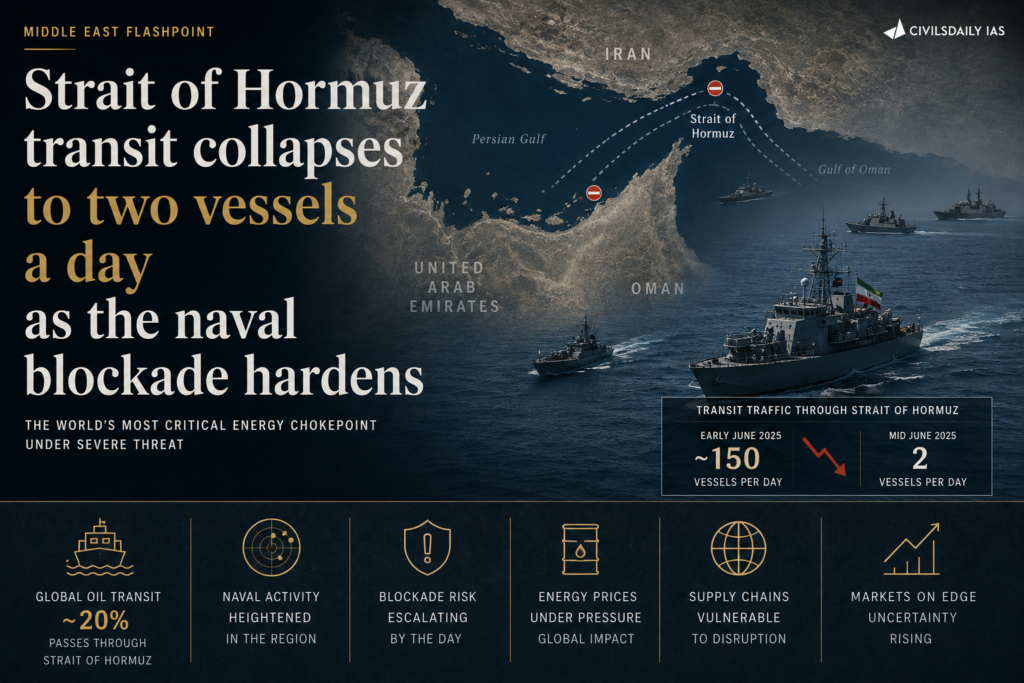
    • Disruption of Import Routes: India relies heavily on fertiliser imports from Gulf countries like Qatar, Saudi Arabia, and Oman. These imports pass through the Strait of Hormuz, a key shipping route vulnerable to blockades during conflicts like the Iran-Israel standoff. Eg: A naval blockade in the Strait could delay shipments of urea and DAP, affecting timely supply during sowing seasons.
    • Volatile Global Prices: Geopolitical tensions raise the prices of natural gas (used to produce urea) and finished fertilisers. Eg: A conflict-induced surge in natural gas prices increases the cost of domestic urea production, straining India’s fertiliser subsidy bill.
    • Dependence on Conflict Zones: India imports 100% of MOP (Muriate of Potash), including from Belarus and Israel, both affected by global instability. Eg: Escalation in the Iran-Israel conflict can disrupt MOP imports, impacting crops like sugarcane and cotton that need potash-based fertilisers.

    What lessons from the Russia-Ukraine crisis remain unaddressed?

    • Lack of Strategic Buffer Stocks: Despite 2022 supply disruptions, India still lacks a fertiliser buffer stock policy or minimum stocking norms for critical imports like DAP and MOP. Eg: During peak sowing seasons (like Kharif), 30–45 days of operational stock is inadequate to absorb external shocks.
    • Failure to Diversify Import Sources Meaningfully: While India talks of diversification, it continues to rely heavily on Gulf countries and politically unstable regions. Eg: After disruptions in nitrogen and potash from Russia and Belarus, the current dependence on Israel and Jordan for DAP remains high, risking repetition.
    • Reactive Rather than Proactive Policymaking: The policy response has focused more on short-term procurement than long-term resilience building through joint ventures, domestic innovation, or alternative fertilisers. Eg: No significant scaling of nano, bio or organic fertilisers occurred post-2022, leaving India stuck with high subsidy bills for synthetic inputs.

    Why should fertilisers be part of India’s national security planning?

    • Critical for Food Security: Fertilisers are essential for sustaining agricultural output in an input-intensive farming system. Eg: Disruptions in urea or DAP supply during sowing seasons can directly impact crop yields and food availability.
    • Vulnerability to Geopolitical Shocks: Heavy reliance on imports from unstable regions exposes India to external risks.  
    • Impact on Economic and Rural Stability: Fertiliser shortages or price hikes raise subsidy burdens and can lead to rural distress.  

    What are the steps taken by the Indian government?

    • Boosting Domestic Production: Reviving closed urea plants (e.g., Gorakhpur, Sindri, Talcher) to achieve 90% urea self-sufficiency by 2025. Focus on reducing import dependency for nitrogen-based fertilisers.
    • Diversifying Import Sources: Forming long-term agreements and joint ventures with countries like Morocco (for phosphates) and Canada (for potash) to ensure a stable supply. Exploring partnerships beyond the Middle East to reduce geopolitical risk.
    • Subsidy and Distribution Reforms: Implementing the Direct Benefit Transfer (DBT) system for fertiliser subsidies to ensure transparency. Promoting alternative fertilisers like Nano Urea and encouraging balanced nutrient usage.

    How can India build resilience in fertiliser supply chains? (Way forward)

    • Develop Strategic Fertiliser Reserves: Establish buffer stocks of key fertilisers like urea, DAP, and MOP, especially for critical sowing seasons (e.g., Kharif and Rabi) to cushion against global disruptions.
    • Expand and Diversify Import Partnerships: Forge long-term agreements and joint ventures with stable countries (e.g., Morocco, Canada, Jordan) and explore alternative shipping routes to reduce overdependence on the Middle East and de-risk supply chains.

    Mains PYQ:

    [UPSC 2017] The question of India’s Energy Security constitutes the most important part of India’s economic progress. Analyze India’s energy policy cooperation with West Asian Countries.

    Linkage: The article explicitly states that India relies heavily on Gulf countries for “natural gas — the key raw material used to produce” urea, a vital fertilizer. The ongoing conflict threatens “ammonia, urea, DAP, and liquified natural gas (LNG) — all vital for agriculture”. This PYQ precisely captures the energy dimension of India’s dependency on the Middle East, which is a critical underlying factor contributing to the fertilizer crisis.

  • Is U.S. imperialism a threat to the world?

    Why in the News?

    The U.S. recently carried out unprovoked attacks on three Iranian nuclear sites during a 12-day war with Iran. These actions, especially under a renewed Trump administration, have restarted discussions about U.S. imperialism and how it affects the global balance of power.

    Note: Imperialism is a policy or ideology by which a powerful country extends its control over weaker territories politically, economically, or militarily, often for strategic or resource-driven gains.

    Is U.S. imperialism a threat to the world?

    U.S. imperialism is often viewed as a threat to global stability for the following reasons:

    • Violation of International Law: The U.S. has engaged in unilateral military interventions without UN approval, undermining global legal norms. Eg: The 2003 invasion of Iraq was based on unverified claims of weapons of mass destruction and violated the UN Charter.
    • Destabilization of Regions: U.S. actions often leave countries in prolonged conflict, weakening state institutions and increasing terrorism or refugee crises. Eg: U.S. interventions in Afghanistan and Libya led to power vacuums and regional instability.
    • Erosion of Multilateralism: By acting outside global institutions, the U.S. encourages disregard for international cooperation, weakening collective decision-making. Eg: Withdrawal from the Paris Agreement (2017) under the Trump administration weakened global climate unity.

    Why does the U.S. view China’s rise as a threat?

    • Economic Rivalry: China’s rapid growth and its emergence as the world’s second-largest economy ($20 trillion GDP) challenge U.S. dominance in trade, infrastructure (e.g. Belt and Road Initiative), and manufacturing.
    • Technological Competition: China’s progress in semiconductors, AI, and green technologies (e.g. leading in renewables and EVs) threatens U.S. supremacy in global innovation and strategic industries.
    • Geopolitical Influence: China’s expanding presence in global institutions and alliances like BRICS and SCO counters U.S.-led systems. Its assertiveness in the South China Sea and strategic investments in Africa and Latin America reflect an alternative world order.

    What challenges does bipolarity pose for rising powers like India?

    • Reduced Strategic Autonomy: In a U.S.-China bipolar world, India may face pressure to align with one power bloc, limiting its independent foreign policy. Eg: India’s participation in Quad may strain ties with China-dominated SCO and BRICS.
    • Limited Global Influence: Bipolarity can marginalize middle powers in global decision-making, making consensus harder. Eg: India’s efforts in climate negotiations may be overshadowed by U.S.-China disagreements.
    • Geopolitical Vulnerability: Tensions between major powers can destabilize regional security, impacting India directly. Eg: Escalation in the Indo-Pacific due to U.S.-China rivalry increases India’s strategic risks.

    Why is the Global South crucial amid failing multilateralism?

    • Collective Voice Against Hegemony: As traditional multilateral institutions like the UN or WTO lose credibility, the Global South offers a platform for developing nations to assert their interests. Eg: BRICS expansion allows emerging economies to challenge Western dominance in global financial systems.
    • Alternative Frameworks for Cooperation: The Global South promotes minilateralism and regional alliances to address shared challenges like debt, climate change, and trade inequities. Eg: India’s role in the International Solar Alliance (ISA) reflects South-South cooperation in climate governance.
    • Safeguarding Sovereignty and Development Needs: It helps countries resist coercive trade or security alignments and focus on inclusive development models. Eg: G77 bloc resists WTO reforms that could harm public procurement protections vital to developing economies.

    How can India balance strategic ties and Global South leadership? (Way forward) 

    • Pursue Strategic Autonomy: India must maintain an independent foreign policy despite partnerships like Quad. Eg: It joined the BRICS Bank while deepening ties with the U.S., showcasing multi-alignment.
    • Take Principled Stands in Global Forums: India should speak out against violations of international law even by allies. Eg: India’s silence on U.S. strikes in Iran undermines its credibility as a Global South leader.
    • Champion Collective South-South Agendas: India can lead in climate justice, debt relief, and trade equity for developing countries. Eg: Through initiatives like the International Solar Alliance and Voice of Global South Summit.

    Mains PYQ:

    [UPSC 2023] The expansion and strengthening of NATO and a stronger US-Europe strategic partnership works well in India.’ What is your opinion about this statement? Give reasons and examples to support your answer.

    Linkage: The expansion of NATO and strengthening of the US-Europe strategic partnership represent key elements of U.S.-led alliances and its approach to global security. This directly relates to the U.S. acting as the “world’s sole superpower” engaged in “aggressive military behaviour” and violating the international order.

  • [2nd July 2025] The Hindu Op-ed: A triangular dynamic in South Asia’s power politics

    PYQ Relevance:

    [UPSC 2015] Terrorist activities and mutual distrust have clouded India-Pakistan relations. To what extent the use of soft power like sports and cultural exchanges could help generate goodwill between the two countries? Discuss with suitable examples.

    Linkage: This question directly linked with the central issue of “mutual distrust” and “terrorist activities” between India and Pakistan, which are explicit drivers of the complex “triangular relationship”. The article mentions India’s diplomatic campaign to isolate Pakistan globally and impose accountability on the state apparatus enabling terrorist groups.


    Mentor’s Comment:  The renewed ties between the Trump-led U.S. government and Pakistan’s military, seen in events like the high-profile lunch with Field Marshal Asim Munir and the return of military aid, show a clear shift in America’s approach to South Asia. This change, similar to the Cold War era, could weaken the strong U.S.-India partnership built on shared concerns over terrorism and China. At the same time, India has moved away from its earlier cautious approach, as shown by Operation Sindoor, raising the risk of conflict on two fronts against both Pakistan and China. As the U.S. balances between long-term strategy and short-term deals, the power dynamics in South Asia are being reshaped.

    Today’s editorial analyse the renewed ties between the Trump-led U.S. government and Pakistan’s military. This topic is important for GS Paper II (International Relations) in the UPSC mains exam.

    _

    Let’s learn!

    Why in the News?

    In the complicated power politics of South Asia, the relationship between the United States, India, and Pakistan tells an important story.

    What drives the recent shift in U.S.-Pakistan relations?

    • Transactional Diplomacy Over Strategic Values: The U.S., particularly under the Trump administration, has adopted a deal-based approach rather than value-based alliances. Eg: Authorisation of $397 million for Pakistan’s F-16 fleet for “counter-terrorism” signals a shift towards immediate tactical gains rather than long-term strategic alignment with India.
    • Pakistan’s Geostrategic Leverage: Pakistan’s location at the crossroads of Afghanistan, Iran, and China enhances its strategic utility for U.S. regional interests, especially amid tensions in West Asia. Eg: Trump’s praise of Pakistan’s role in understanding Iran and his meeting with “Field Marshal” Asim Munir show a willingness to engage Pakistan despite its terror-linked image.

    How is it affecting U.S.-India strategic relations?

    • Erosion of Strategic Trust: India-U.S. partnership, built over counterterrorism cooperation and convergence on China, is being undermined by the U.S.’s renewed engagement with Pakistan. Eg: Trump’s claim of mediating a ceasefire between India and Pakistan contradicted India’s “no third-party” policy, leading to diplomatic discomfort.
    • Increased Strategic Caution in India: India’s concern over U.S.-Pakistan proximity may lead it to recalibrate its own foreign policy posture, especially in South Asia and the Indo-Pacific. It may reduce India’s reliance on U.S. support in regional disputes, focusing instead on self-reliant deterrence and regional alliances.
    • Undermining of U.S.-India Indo-Pacific Vision: The Quad framework and Indo-Pacific cooperation, key pillars of U.S.-India ties, risk losing momentum due to America’s distracted diplomacy in South Asia.

    What is the significance of India’s “new normal” doctrine in South Asia?

    • Departure from Strategic Restraint: India’s “new normal” reflects a proactive military and diplomatic posture against cross-border terrorism, moving away from its earlier defensive doctrine. Eg: In response to the Pahalgam terror attack, India launched Operation Sindoor, signaling its intent to punish provocations decisively.
    • Global Isolation of State-Sponsored Terrorism: The doctrine aims to internationally isolate Pakistan by linking terror acts to state support, thereby shifting global opinion and increasing diplomatic pressure.
      Eg: India’s efforts in UN forums to designate Pakistan-based terror groups under sanctions align with this approach.
    • Regional Deterrence and Strategic Signaling: It serves as a deterrent by altering Pakistan’s cost-benefit calculation of supporting non-state actors, while also sending a message to China amid a two-front threat perception. Eg: Statements by PM of India calling the ceasefire a “pause, not peace” indicate sustained pressure on both Pakistan and its backer, China.

    Who gains or loses from the U.S.’s ambivalent role in India-Pakistan dynamics?

    • Pakistan Gains Strategic Leverage: The U.S.’s ambiguity allows Pakistan to portray itself as a valuable security partner, especially in the context of Afghanistan, Iran, and regional logistics.
    • India Faces Diplomatic Setbacks: U.S. engagement with Pakistan undermines India’s strategic trust in the U.S., weakening its position on issues like cross-border terrorism and Kashmir 
    • The U.S. Risks Losing Credibility: By oscillating between idealism and transactionalism, the U.S. dilutes its reliability as a consistent global partner, particularly in the Indo-Pacific strategy. Eg: India’s growing ties with Russia and Iran, and its push for strategic autonomy, partly stem from concerns over U.S. inconsistency.

    Way forward: 

    • Strengthen India-U.S. Strategic Dialogue: India should deepen institutional-level engagement with the U.S. to reaffirm mutual interests in the Indo-Pacific, counterterrorism, and technology partnerships, reducing the influence of personality-driven shifts.
    • Pursue Regional Strategic Autonomy: India must continue to build bilateral and multilateral ties with like-minded countries (e.g., France, Japan, UAE) to diversify strategic options and reduce overdependence on U.S. foreign policy swings.
  • In a perilous world, India must read the tea leaves well 

    Why in the News?

    Recently, the world’s growing preference for military force over peaceful talks have made India’s old policy of staying neutral and keeping strategic independence no longer enough.

    Why is India’s neutrality no longer viable in the current global conflicts?

    • Erosion of Strategic Leverage in Multilateral Crises: Neutrality has diminished India’s influence during major global conflicts where clear moral or strategic stands are expected. Eg: During the Israel-Iran conflict, India’s equidistant stance failed to garner goodwill from Iran, while Israel saw no added strategic value either.
    • Increased Global Polarisation and Military Alignments:  The world is now split into rival power groups, and staying neutral is often seen as being unsure or unwilling to take a stand. Eg: The U.S. bombing of Iran’s nuclear sites with bunker buster bombs, along with the growing China-Russia-Iran partnership, shows that being neutral in such a situation can actually be a liability and hurt a country’s interests.
    • Loss of Support from Traditional Partners: India’s neutral approach during its own security crises has failed to rally international support. Eg: During the recent India-Pakistan conflict, most West Asian countries and even the U.S. remained non-committal, despite India’s outreach in the Global South.
    • Reduced Credibility of Non-Alignment in a Hard Power World: Global forums are increasingly emphasising military strength over moral positioning. Neutrality is no longer seen as leadership. Eg: At the Shangri-La Dialogue, the U.S. stressed hard power and Indo-Pacific dominance, sidelining softer, non-aligned narratives like India’s.

    What are the threats posed by the China-Pakistan military alliance?

    • Two-Front War Scenario: India faces the real risk of a coordinated military confrontation on both eastern and western borders. Eg: During the India-Pakistan conflict in May, intelligence revealed Pakistan’s preparedness using Chinese-supplied J-10C and JF-17 fighter jets, suggesting synchronised planning with China.
    • Enhanced Pakistani Military Capabilities: China’s transfer of advanced weaponry has significantly boosted Pakistan’s defence systems, improving its precision strike and surveillance capacity. Eg: Chinese radar, missile systems, and drone technology are now integrated into Pakistan’s command and control network, enhancing its offensive potential against India.
    • Asymmetric Nuclear Threat: The alliance magnifies the nuclear imbalance in the region, putting India at a strategic disadvantage. Eg: China and Pakistan together possess nearly a 5:1 advantage in nuclear warheads over India, escalating the deterrence challenge and increasing the risk of nuclear brinkmanship.

    How has India’s Israel-Iran policy impacted its West Asia standing?

    • Loss of Credibility as a Neutral Mediator: India’s attempt to balance ties between Israel and Iran has diluted its influence in the region, as it failed to take a principled stand when it was needed most. Eg: During the Israel-Iran conflict, India’s mere call for “restraint on all sides” disappointed Iran, which expected vocal support against targeted attacks by Israel and the U.S.
    • Strained Relations with Key Regional Powers: India’s visible tilt towards Israel in recent years has alienated several West Asian countries, undermining its strategic and energy interests. Eg: India’s growing defence and technology cooperation with Israel has made its Iran policy less credible, especially after Iran was diplomatically isolated in the recent conflict.

    What are the reforms needed to prepare India for a two-front war? (Way forward)

    • Strengthen Long-Duration War Capabilities: India must boost its ammunition reserves, logistics systems, and supply chain resilience to sustain prolonged conflicts on both fronts. Eg: The UK’s defence audit revealed critical gaps in its own war readiness—India too must conduct similar assessments to plug vulnerabilities.
    • Develop Advanced Technologies and AI Warfare: Investing in Artificial Intelligence (AI), drone warfare, loitering munitions, and electromagnetic systems is crucial to match modern battlefield requirements. Eg: Lessons from the Russia-Ukraine war show the growing role of AI-guided drones and precision weapons in shaping war outcomes.

    Mains PYQ:

    [UPSC 2022] How will I2U2 (India, Israel, UAE and USA) grouping transform India’s position in global politics?

    Linkage: India’s role in emerging strategic alliances, emphasizing the need to understand how new groupings can re-shape India’s influence and standing in global politics. The article underscores that India’s foreign policy is currently facing an “existential crisis” due to events like the India-Pakistan conflict, the China-Pakistan nexus, and the Israel-Iran conflict, where “neutrality is no longer an option.

  • [27th June 2025] The Hindu Op-ed: Fathoming America’s plan to manage AI proliferation

    PYQ Relevance:

    [UPSC 2021] The USA is facing an existential threat in the form of a China, that is much more challenging than the erstwhile Soviet Union.” Explain.

    Linkage: The article explicitly state that the US views AI technology control as a means to “preserve its lead” against adversaries like China and Russia, seeing advanced AI capabilities as a determinant of national power, similar to nuclear weapons.


    Mentor’s Comment:  The United States’ decision to withdraw the AI Diffusion Framework marks a clear change in policy, but not in its overall strategy to control AI technology. The framework had treated AI like a nuclear threat, aiming to tightly control the export of AI chips, especially to China and Russia. Its removal is seen as positive news, especially for countries like India, which were not treated fairly. However, the U.S. is now trying to achieve the same goals through technology-based controls instead of direct trade rules. This shift from open policy to hidden enforcement could hurt global AI cooperation, cause strategic caution among allies, and lead to repeating the same problems in a new way.p

    Today’s editorial talks about the impact of the United States’ recent decision to cancel its AI Diffusion Framework. This topic is useful for GS Paper II (International Relations) in the UPSC mains exam.

    _

    Let’s learn!

    Why in the News?

    The United States recently cancelled its AI Diffusion Framework, a set of rules that controlled the export of AI technology. This decision is being seen as a positive move.

    What is the AI Diffusion Framework?

    The AI Diffusion Framework was a set of export control rules announced by the United States in early 2025. It aimed to regulate how advanced AI technology, such as AI chips and model weights, could be shared or sold to other countries.

    What were the key goals of the U.S. AI Diffusion Framework?

    • Restrict Access to Strategic Competitors: The framework aimed to block countries like China and Russia from obtaining advanced AI chips and model weightsto prevent them from enhancing their military and surveillance capabilities through powerful AI systems.
    • Preserve U.S. Technological Leadership: By limiting the global spread of high-performance computing resources, the U.S. sought to maintain its edge in AI development and ensure that cutting-edge innovations remained concentrated within the U.S. and trusted allies.
    • Create a Structured Export Control System: It introduced a clear set of rules combining export controls and licensing, aiming to simplify regulatory procedures and standardize how AI-related technology was shared or restricted across countries.

    Why was the U.S. AI Diffusion Framework seen as counterproductive?

    • Damaged trust among allies and partners: The broad restrictions impacted both rivals and friendly countries, causing diplomatic friction. Some nations that were not classified as preferred allies began investing in independent AI ecosystems to avoid overdependence on the U.S.
    • Accelerated innovation in restricted regions: By limiting access to advanced AI chips, the framework pushed affected countries to create more efficient algorithms that required less computing power. This led to the development of competitive AI models that challenged the dominance of those built with high-end hardware.

    Why is the framework’s withdrawal seen as beneficial for countries like India?

    • Improved Access to AI Hardware and Resources: With the framework withdrawn, countries like India now face fewer barriers in acquiring high-performance AI chips and related technologies. Eg: Indian startups and research institutions can more easily procure advanced GPUs necessary for developing large AI models.
    • Support for Strategic and Technological Autonomy: The removal of restrictions allows India to pursue its own AI development agenda without being constrained by another country’s policy. Eg: India can strengthen initiatives like the IndiaAI Mission and the Semiconductor Mission to build domestic capabilities.
    • Enhanced Global Collaboration Opportunities: The rollback encourages deeper cooperation between India and other nations, including the U.S., in AI research and innovation. Eg: Indian firms may now engage in joint ventures or technology partnerships with U.S. companies without facing restrictive export barriers.

    How do new U.S. AI chip controls reflect a continuation of earlier strategies?

    • Ongoing Restriction on Adversaries: The U.S. continues to block access to advanced AI chips for countries like China by expanding export controls and adding more firms to the Entity List, just as the earlier framework aimed to do.
    • Shift from Trade to Technological Enforcement: Instead of broad trade bans, the new approach focuses on hardware-level restrictions, such as embedding features in chips to monitor or limit usage, reflecting the same strategic intent in a new form.
    • Sustained Focus on Controlling AI Diffusion: The introduction of location tracking mandates and usage controls in AI chips shows the U.S. is still trying to control how and where AI technology spreads, continuing the goals of limiting proliferation and maintaining dominance.

    What are the global implications of U.S. AI export controls on innovation and technological sovereignty?

    • Push for Technological Self-Reliance: Countries affected by the controls are investing in domestic AI ecosystems and indigenous chip manufacturing to reduce dependence on U.S. technology, leading to the rise of multiple, parallel innovation hubs around the world.
    • Erosion of Trust and Collaboration: Export restrictions create privacy concerns, surveillance risks, and a sense of strategic vulnerability, prompting both allies and adversaries to hedge against U.S. influence, thereby weakening global scientific cooperation and technological integration.

    What are the steps taken by the Indian government in AI chips?

    • IndiaAI Mission (2024): A ₹10,000 crore initiative focused on developing compute infrastructure, datasets, and talent.
    • Semiconductor Mission (ISM): Includes financial incentives and infrastructure support for AI chip manufacturing and design.
    • Collaborations with the private sector: Partnerships with companies like Micron, AMD, and Tata Group to build chip fabs and R&D centres in India.
    • Supercomputing initiatives: Under PARAM and National Supercomputing Mission, India is developing indigenous high-performance compute for AI workloads.
    • IndiaAI compute platform: Aimed at giving startups and researchers access to high-end GPU clusters.

    Way forward: 

    • Promote Inclusive and Transparent AI Governance: The U.S. and other major powers should work through multilateral platforms to create balanced AI export norms that protect security interests without stifling global innovation or alienating partners.
    • Strengthen Global AI Collaboration Frameworks: Countries like India should advocate for open-access research, joint AI development programs, and capacity-building initiatives to ensure equitable access to AI technology and reduce dependency on a single ecosystem.
  • [26th June 2025] The Hindu Op-ed: The ‘Axis of Upheaval’ in the West Asia conflict 

    PYQ Relevance:

    [UPSC 2022] How will I2U2 (India, Israel, UAE and USA) grouping transform India’s position in global politics?

    Linkage: This question highlights a new grouping involving Israel and the USA, both central to the West Asia conflict described as the origin point for the “Axis of Upheaval”. The formation and impact of such new strategic groupings, particularly in the context of the Middle East, are directly relevant to the evolving power dynamics and strategic realignments that define the concept of the “Axis of Upheaval.”


    Mentor’s Comment:  The recent U.S.-Israel attack on Iran’s nuclear sites and the weak ceasefire that followed have shown that today’s global alliances, often compared to Cold War groups, are not very strong or united. Even though Iran has close economic and political ties with Russia and China, neither country gave any military support. This clearly shows the limits of strategic partnerships when there is a real military threat. The so-called ‘Axis of Upheaval’ made up of Iran, Russia, and China is really just a loose group, without any formal military treaties like those in Western alliances such as NATO. This crisis breaks the idea of a bipolar world and highlights the unequal power dynamics in today’s global politics.

    Today’s editorial discusses global power alliances in the context of the Israel-Iran war. This topic is helpful for GS Paper II (International Relations) in the UPSC mains exam.

    _

    Let’s learn!

    Why in the News?

    The recent U.S.-Israel attack on Iran’s nuclear sites, followed by a weak ceasefire, has shown that today’s global alliances, often compared to Cold War blocs, are not as strong or united as they appear.

    What are the new global power blocs?

    New global power blocs refer to emerging alliances among countries like China, Russia, and Iran that seek to challenge the dominance of the Western-led global order. These blocs focus on economic cooperation, strategic alignment, and institutional alternatives such as BRICS and SCO, but lack formal military treaties like NATO.

    Why has the Israel-Iran conflict weakened the idea of new global power blocs?

    • Lack of Military Support: Despite Iran’s close ties with Russia and China, neither provided military assistance during the conflict. Eg: Russia, engaged in the Ukraine war, offered only diplomatic mediation, while China limited itself to verbal condemnation.
    • Absence of Binding Alliances: The so-called ‘Axis of Upheaval’ lacks formal military treaties that require collective defense. Eg: Iran’s strategic partnerships with Russia (2025) and China (2021) are primarily economic, not military.
    • Diverging Strategic Interests: Russia and China used the conflict to advance their own interests, letting the U.S. get entangled in West Asia. Eg: The U.S. bombing of Iran may distract American focus from the Indo-Pacific and Europe, which suits Beijing and Moscow.

    What are the strategic limits of Iran’s ties with Russia and China?

    • No Binding Military Pact: Iran’s ties with Russia and China are largely economic and diplomatic, with no formal military alliance or commitment to joint defense.
    • Conflicting Strategic Priorities: Russia is deeply engaged in the Ukraine war, and China is focused on maintaining its economic growth and regional stability, limiting their readiness to back Iran militarily. Eg: Russia has turned to North Korea for troops, showing its own resource constraints.
    • Unequal Benefits: Iran is heavily dependent on these relationships, while Russia and China gain economic and geopolitical advantages without taking on direct strategic risks. For instance, China secures discounted Iranian oil under sanctions, while offering limited concrete support in return.

    How have Russia and China responded to Iran’s crisis post-ceasefire?

    • Diplomatic Support without Military Action: Russia offered to mediate the conflict through a call by President Putin, but this was ignored by the U.S., and no military support was extended.
      Putin’s involvement reflected symbolic backing, not a commitment to defend Iran.
    • Condemnation of Israeli Actions: China’s Foreign Minister Wang Yi criticised Israeli airstrikes as violations of international law, showing support through official statements while avoiding direct intervention. This response aimed to maintain China’s global diplomatic posture without escalating tensions.
    • Strategic Caution for Self-Interest: Both countries used the conflict to their advantage by letting the U.S. get entangled in West Asia, potentially weakening its focus on the Indo-Pacific and Ukraine. The crisis served to advance Beijing and Moscow’s strategic space without direct involvement.

    Where does Iran stand diplomatically and militarily after the recent conflict?

    • Diplomatic Isolation and Limited Support: Despite having strategic partnerships with Russia and China, Iran received only verbal and symbolic backing, with no concrete military or institutional support.
      Its regional alliances failed to activate, reflecting a gap between rhetoric and action.
    • Military Weakening and Proxy Setback: Iran suffered a decapitation of leadership and capacity, while its key proxies like Hezbollah, Hamas, and the Houthiswere unable to respond effectively.
      This has weakened Iran’s role as a regional power and exposed its dependence on non-state actors.

    Way forward: 

    • Formalize Strategic Partnerships: Iran, Russia, and China should work toward institutionalising their ties through defense cooperation frameworks, joint military exercises, and security dialogues to build trust and operational coordination.
    • Align Long-term Strategic Interests: The three nations need to develop a shared geopolitical vision that goes beyond transactional ties, ensuring mutual support mechanisms during crises while balancing individual regional priorities.